
Custom Cleaning Brush
Pond Filter Brush
Hanging polypropylene pond filter brush for mechanical and biological filtration in koi ponds and aquaculture. 300–800 mm lengths, 100–200 mm diameters.
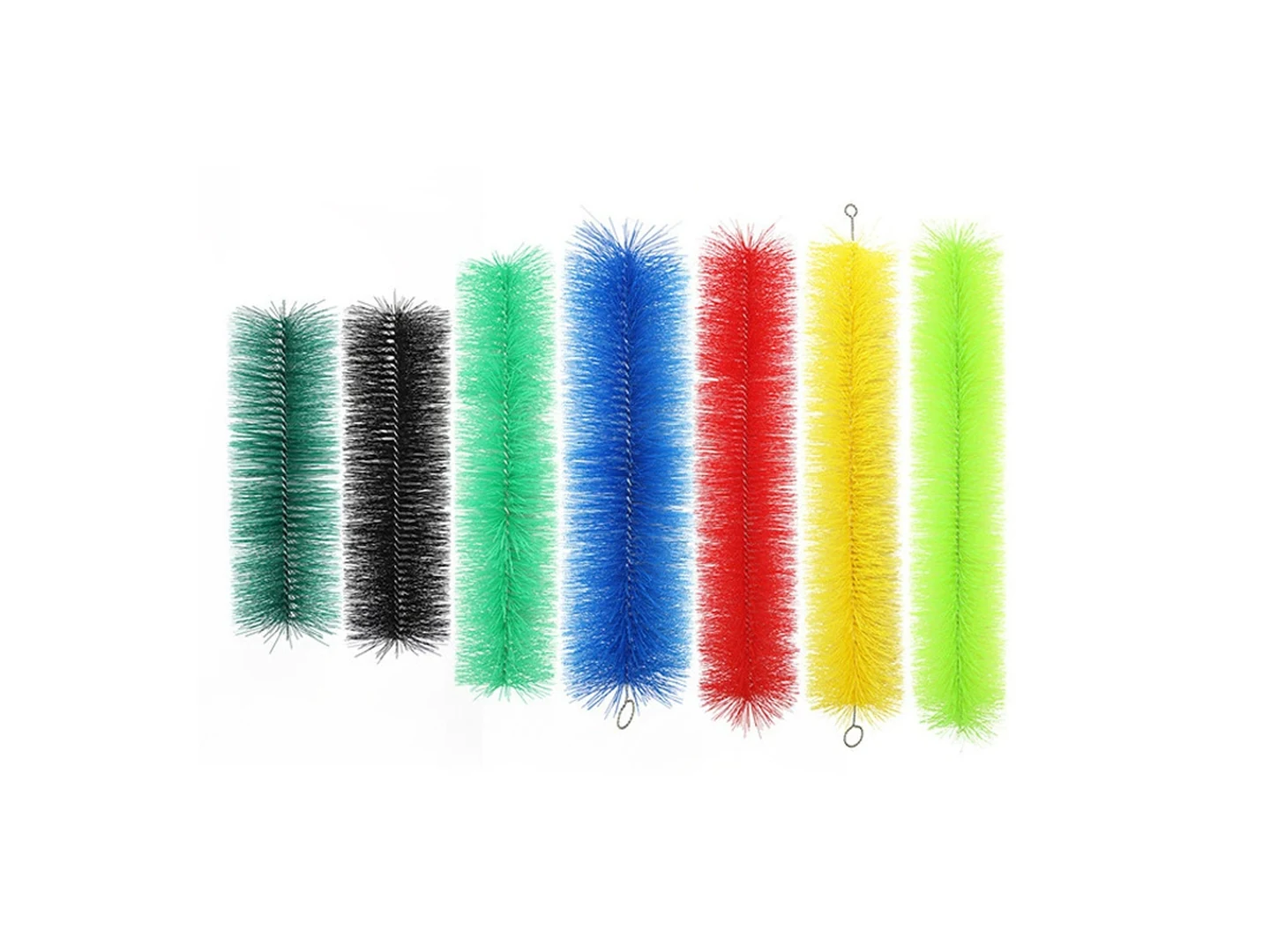
Medium brush
100 pcs
Minimum order
Worked with two hands or on a pole: chimney, gutter and pond-filter brushes, discs, cups and tank brushes.
Production lead time, once the specification is confirmed
- Up to 100 pcsWithin 7 days
- 101–5,000 pcsWithin 14 days
- 5,001–50,000 pcsWithin 21 days
- Over 50,000 pcsConfirmed with your quotation
Peak season can extend these times; the shipping date is confirmed in writing with your quotation. Sampling and shipping are quoted separately.
A cylindrical hanging filter brush built for mechanical and biological filtration in pond and aquaculture filter chambers. Its polypropylene filament matrix captures suspended solids and fish waste while providing a stable surface for nitrifying bacteria, with lengths and diameters configured to the flow path.
What can this brush do for you?
Traps solids before they reach fine filtration
Dense polypropylene filament loops catch suspended particles, fish waste, feed fines, and organic debris as water flows through the bristle field. Removing this load upstream keeps downstream mats, foams, and bead filters from blinding as quickly, so those stages need less frequent cleaning.
Works as biological media without extra hardware
Once the filter matures, nitrifying bacteria colonize the filament surface. The same brush that catches solids also hosts ammonia- and nitrite-oxidizing colonies, turning a mechanical stage into a working biofilter without adding a second media type.
Hangs into any chamber with minimal installation
One or two hanging eyes let operators drop the brush vertically into a bay, lay it horizontally across a channel, or hang it from a support rail. Bank-mounted rows follow the existing chamber shape, so no custom brackets or frames are required.
Withstands continuous immersion
Polypropylene resists rot, algae adhesion, and normal pond chemicals, while the galvanized steel or 304 stainless wire core holds shape under water. The brush operates from 5–40°C, covering seasonal outdoor service in temperate systems.
Cleans with a shake, not a teardown
When flow slows, lift the brush and shake it in a bucket of pond water or rinse with a low-pressure hose. Trapped solids drop away without unstacking filter layers or killing the biofilm.
What is a Pond Filter Brush?
A pond filter brush is a cylindrical bristle array wound around a wire core, designed to be suspended inside a pond filter chamber rather than held in the hand. The brush sits in the moving water so that pond water passes through the filament field. Suspended solids collide with the filament loops and stay trapped, while bacteria colonize every available filament length.
Installation is simple: the hanging eye drops over a support bar or hook, and the brush hangs vertically in the chamber bay. In shallower channels, brushes can also be laid horizontally in rows. The brush works as fixed filter media, not as a scrubbing tool. Mechanical capture starts on day one; biological ammonia and nitrite conversion develops over the following weeks as the bacterial film grows.
This distinction matters for maintenance. Cleaning should be gentle and partial. Rinsing away heavy solids restores flow, but scrubbing or disinfecting the entire array removes the bacterial colony and resets the biological stage.
Technical Specifications
The specifications below are the standard production range for this hanging filter brush. Length, diameter, and filament details are adjusted to your chamber and flow requirements.
| Parameter | Specification |
|---|---|
| Brush length (body) | 300–800 mm, cut to chamber depth |
| Brush diameter | 100–200 mm, selected to fill the chamber cross-section without overpacking |
| Core diameter | 2–8 mm twisted wire core; larger diameters add stiffness for long hang lengths |
| Filament diameter | 0.30–1.00 mm; finer filament catches smaller particles, coarser filament suits high solids loading |
| Hanging eye | 5–20 mm internal loop; single or double eye per brush |
| Filament material | Polypropylene (PP); PA nylon available where higher abrasion resistance is required |
| Core material | Galvanized steel or 304 stainless steel twisted wire |
| Water temperature | 5–40°C continuous immersion |
| Operating position | Vertical hang, horizontal bank, or frame-mounted row |
| Cleaning method | Shake in pond water or low-pressure rinse; avoid chlorinated water and strong cleaning chemicals |
| Brush type | Custom Filter Brushes |
| How it is driven | Fixed in place, no drive of its own |
| Cleaning target | mechanical stage of multi-bay koi pond filter, biological filter chamber, and aquaculture and hatchery raceway or sump cleaning |
| Surface or part | filters, chambers, rails, bars, sumps, tanks, channel, and frames |
| Residue or debris | suspended solids, fish waste, leaves, particles, and polish |
| Mounting / connection | Fixed |
Where does this brush work best?
- Mechanical stage of multi-bay koi pond filters – placed in the first or settlement chamber where the heaviest solids arrive before water moves to fine filtration.
- Biological filter chambers – submerged brush banks that convert ammonia and nitrite after the mechanical stage has removed most solid waste.
- Aquaculture and hatchery raceways or sumps – suspended arrays that capture solids and provide surface area for nitrifying bacteria under high fish loads.
- Commercial water features and retention systems – brush rows installed ahead of pumps to keep leaves and debris away from impellers.
- Quarantine and hospital tanks – temporary brush media for new or lightly stocked systems where biological surface area must be added quickly.
How do I choose the right one?
Start with the chamber dimensions and flow direction. Brush length should reach from the support bar to within about 50 mm of the chamber floor or tray, leaving room for settled solids. Brush diameter determines how many brushes fit across the flow path. Position brushes so the filament fields fill roughly 50–70% of the cross-section; tighter packing creates high head loss and forces water around the array, while loose packing lets water bypass unfiltered.
Match filament diameter to the waste type. Fine filament (0.30–0.50 mm) catches smaller particles and polishes the water, but blinds faster under heavy load. Coarse filament (0.60–1.00 mm) is the better choice for the first mechanical chamber, where large solids and high flow are common. A common setup is coarse brush media upstream and finer media downstream.
Select the core material for water chemistry. Galvanized steel is economical and lasts in neutral, freshwater ponds. Choose 304 stainless steel for brackish, salt, or chemically treated water and for systems where visible corrosion would be unacceptable. PP filament suits almost all pond water, but nylon filament is the stronger option where high flow or coarse debris continuously abrades the media.
Plan for access and cleaning. Each brush should lift out without snagging neighboring rows. A double-eye configuration lets a horizontal brush be lifted from either end, which helps when the support rail is hard to reach.
When another media or method fits better. Pond filter brushes remove suspended solids and host nitrifiers, but they do not remove dissolved organic compounds or polish water to crystal clarity. Add a fine mesh, bead filter, or drum filter after the brush stage for that job. If the system runs very hot water above 40°C, choose a different media because PP softens and loses stiffness. For very high flow above what the chamber can handle, moving-bed or open-cell media may create less pressure drop than a dense brush field.
Can I customize this brush?
Pond filter brushes are built around your chamber, not sold as one fixed size. To configure the brush for your filter, provide the chamber width, depth, water level, support rail spacing, flow rate, and the filtration stage where the brushes will sit. A sketch or photo of the chamber speeds up the configuration.
We can adjust:
- Brush diameter and length – standard range is 100–200 mm diameter and 300–800 mm length; other sizes can be produced for larger chambers or special bays.
- Filament diameter and density – filament thickness from 0.30 mm to 1.00 mm and twist pitch along the core to control capture rate and back pressure.
- Core construction – core diameter from 2 mm to 8 mm, galvanized or 304 stainless steel, with stiffness matched to hang length.
- Hanging eye configuration – single loop, double loop, snap hook, carabiner, or frame clip for your existing mounting hardware.
- Color and identification – custom filament color or a marked eye for stage identification in multi-bay filters.
- Packaging – bulk bundles, 10-pack or 24-pack cartons, pallets, or retail shelf-ready labels.
If your project requires material declarations, inspection reports, or third-party testing, we can assist with those requirements during the customization process.
Which filament survives the cleaning chemicals a pond filter brush meets?
How many pond filter brushes do I need?
Calculate from the filter chamber’s internal cross-section, not from water volume alone. Arrange brushes side by side so the filament fields fill roughly 50–70% of the flow path. For example, a 600 mm wide chamber using 150 mm diameter brushes usually takes three to four brushes per row, with rows spaced along the direction of flow. Avoid packing bristles so tightly that water is forced around the array instead of through it.
Should I clean the brushes when they look dirty?
Not completely. A brown biofilm coating is working biology, not a defect. When flow drops or the water level backs up, lift the dirty brush, shake it in a bucket of pond water to drop heavy solids, and return it to the chamber. Rinse only part of the array at a time so bacterial colonies stay active in the rest of the filter.
How long do the brushes take to mature biologically?
Mechanical capture starts the first day. Nitrification becomes measurable after two to six weeks at 15–25°C, and is slower below 15°C. Seeding new brushes in an established filter or using a bacterial starter shortens the cycle. Do not disinfect or aggressively clean the entire filter at once, because that removes the colonized surface.
Will the wire core rust in pond water?
Galvanized cores last well in most freshwater ponds with neutral pH, but hard water, low oxygen, or acidic conditions can accelerate corrosion. For marine, brackish, or chemically aggressive systems, choose the 304 stainless wire core. During annual maintenance, check for rust staining or flaking; if visible, replace the affected brushes or switch to stainless for future orders.
Can these brushes handle leaves and string algae?
They catch shredded leaves and loose algae, but whole leaves and long string algae can wrap around the core and block the bristle field. Install a coarse basket, skimmer, or settlement zone before the brush stage to remove large debris. If string algae is the main problem, add a UV clarifier or manual removal; the brush alone will not control algae growth.
How do I know if the brushes are causing too much pressure drop?
Watch the water level difference across the brush field after installation. A rise of 25–50 mm on the inlet side indicates the brushes are capturing solids and flowing normally. If the difference exceeds 100 mm, clean the brushes or reduce the packing density. If water simply bypasses the array around the sides, reposition the brushes so the filament field seals the full cross-section of the chamber.
Guides that go deeper on this
How to Choose Pond Filter Brush for Pond Pumps
Read this guideGuidePond Filter Brush: Material and Size for Leaf and Sludge
Read this guideGuideWhen to Use a Pond Filter Brush in Outdoor Wet Cleaning
Read this guideGuideAquarium Filter Brush: Material and Size for Outdoor Use
Read this guideGuidePool Filter Brush: Specs for Pond Pumps
Read this guideCustom Manufacturing RFQ
Describe Your Application
Send the key measurements, cleaning requirement, residue, material direction, mounting method, quantity, and drawing or photo.
Drawing or photo optional — it speeds things up, it does not gate the enquiry.
Custom Brush RFQ
Send Your Brush Project
Upload a drawing, product photo, or sample photo and provide the core dimensions and cleaning conditions.
“We need a brush to remove wet residue from a stainless steel conveyor, about 800mm wide. The current brush wears quickly. We can send photos.”
“We sell drinkware and need a cleaning brush to include with the product. Quantity around 5,000 pieces.”