
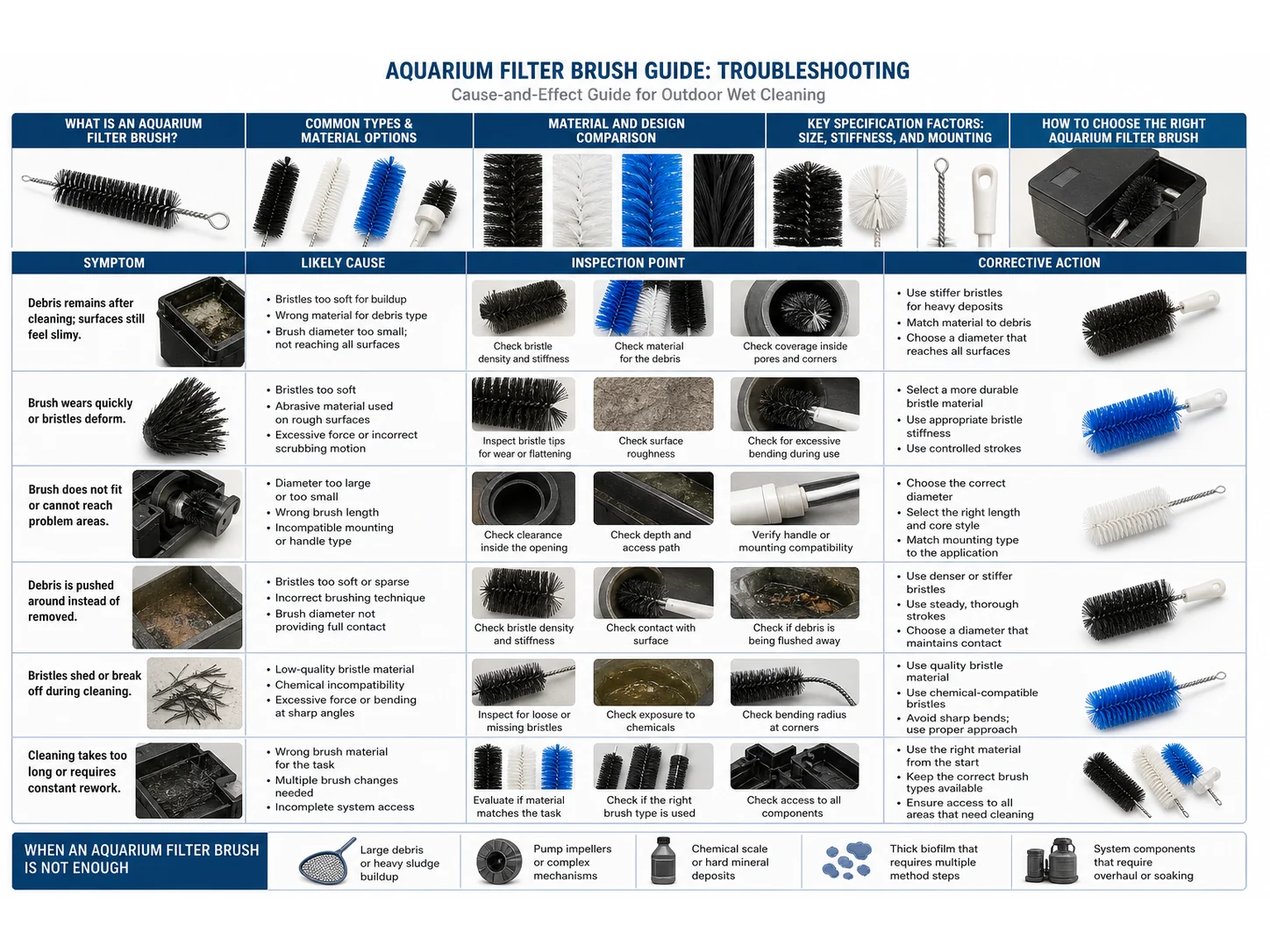
What Is an Aquarium Filter Brush?
An aquarium filter brush is a small-diameter cleaning brush, often with a twisted wire stem, flexible plastic core, or rigid handle, featuring bristles in a cylindrical, spiral, or flared shape. Its primary job is to reach inside filter tubes, spray bars, protein skimmer necks, pump housings, and crevices where biofilm, algae, fish waste, and mineral deposits accumulate. In outdoor or wet-service environments, the brush must withstand constant moisture, occasional chemical exposure (e.g., citric acid cleaners, bleach solutions), and repeated use without shedding bristles or corroding. Unlike general-purpose brushes, aquarium filter brushes are sized to match standard PVC pipe diameters and delicate enough to avoid scratching acrylic or vinyl tubing.
Common Types & Material Options
Filter brushes are differentiated by bristle material, stem flexibility, and mounting style. The main categories include:
- Nylon or polyester spiral brushes: Most common for general tube cleaning; flexible and durable in wet conditions.
- Stainless steel wire brushes: Used for hard deposit removal, but risk scratching plastic surfaces.
- Brass or bronze brushes: Provide antimicrobial properties and are suitable for copper-safe applications, but not for potable water.
- Natural fiber brushes (e.g., Tampico): Gentle enough for acrylic and soft rubber components, but absorb water and degrade faster.
- Double-spiral or looped-end brushes: Designed for pulling through pipes from both ends, often with a threaded connector for extension handles.
Material and Design Comparison
| Bristle Material | Stiffness | Recommended Use | Surface Compatibility | Typical Handle/Core | Chemical Resistance |
|---|---|---|---|---|---|
| Nylon | Medium | General cleaning of PVC pipes, filter housings | Safe for most plastics | Twisted wire, flexible spring | Good with mild acids and alkalis |
| Polypropylene | Medium-Hard | Heavy biofouling, protein skimmers | Safe for rigid plastics, may scratch acrylic | Rigid plastic core, threaded end | Excellent with most chemicals, including oxidizing agents |
| Stainless Steel Wire | Very Hard | Mineral scale, rust removal | Not for acrylic or soft metals | Twisted wire, long metal handle | Excellent, but can corrode in saltwater if low grade |
| Brass | Hard | Antimicrobial cleaning, light corrosion | Copper-safe surfaces; avoid drinking water systems | Twisted wire, short wooden handle | Good, avoid strong acids |
| Natural Fiber (Tampico) | Soft-Medium | Gentle scrubbing, acrylic tanks | Safe for all delicate surfaces | Wood or plastic dowel | Poor; absorbs water and chemicals |
| Polyester | Medium | High-frequency wet cleaning, durability | Safe for most plastics and metals | Twisted wire, quick-connect fitting | Very good, resists hydrolysis |
Key Specification Factors: Size, Stiffness, and Mounting
Choosing the correct aquarium filter brush requires more than just matching the tube diameter. Consider these factors:
- Diameter and length: The brush should be slightly larger than the pipe inner diameter for effective contact, but not so tight that it jams. Length must cover the entire filter passage plus some for grip.
- Stiffness: Measured by bristle material and wire gauge; stiffer brushes clean faster but increase scratch risk. For flexible PVC or rubber hoses, use a softer bristle.
- Handle or stem design: Flexible spring stems allow bending around elbows; rigid rods give more control. Look for corrosion-resistant stems (stainless steel or coated steel) if used outdoors.
- Mounting and connection: Threaded ends (e.g., 1/4″ NPT) allow attachment to extension poles or drill adapters for powered cleaning. Looped handles suit rope-pulling through long pipes.
- Brush shape: Cylindrical brushes clean straight tubes; flared or tapered brushes reach into corners and skimmer cups.
A sizing guideline: for a standard 2-inch PVC filter pipe, a brush diameter of 2-1/8 to 2-1/4 inches is typical. Always test fit on a sample section before full deployment.
How to Choose the Right Aquarium Filter Brush
Match the brush to the specific cleaning challenge:
- Residue type: Soft biofilm requires medium stiffness; hard mineral deposits need stainless steel or abrasive-embedded bristles.
- Surface sensitivity: Acrylic viewing windows or flexible tubing demand soft, non-scratching materials like Tampico or polyester.
- Equipment interface: Measure the smallest internal diameter the brush must pass through, including elbows and valves. Choose a brush that can navigate those geometries.
- Wet or chemical exposure: Outdoor systems may see rain, chlorine, or acid washes. Select materials with proven chemical resistance (e.g., polypropylene, 316 stainless steel).
- Hygiene expectations: For systems where water will contact food fish or sensitive specimens, avoid brass or materials that may leach. FDA-compliant nylon or polyester is preferred.
- Maintenance frequency: Daily cleaning in a commercial hatchery calls for durable, quick-drying brushes that resist mold. Consider quick-connect handles for rapid changeovers.
- Custom size requirements: If off-the-shelf brushes don’t fit non-standard pipe sizes or complex chamber shapes, request a custom diameter or double-opposed spiral design from a brush manufacturer. Provide a detailed drawing of the filter cross-section.
Common Mistakes in Brush Selection
Avoid these frequent errors:
- Choosing by diameter alone without checking stiffness: An oversize brush with very soft bristles may fold over and fail to clean; an undersize brush with hard bristles may scratch or skip debris.
- Ignoring chemical compatibility: Using a nylon brush with strong oxidizers or long-term acid washes can cause premature bristle breakdown and shedding.
- Using metal brushes on plastic components: Stainless steel wire brushes can gouge PVC and acrylic, creating crevices that harbor bacteria.
- Overlooking stem corrosion: A twisted wire stem that rusts outdoors will contaminate the system and weaken, potentially snapping inside the filter.
- Buying a brush too short: A brush that doesn’t reach the full length of a filter tube leaves a dead zone of debris, leading to clogging and poor water flow.
- Neglecting ergonomic and safety features: Slippery handles without grips or long handles that cause awkward body positioning increase injury risk during extended cleaning sessions.
When an Aquarium Filter Brush Is the Wrong Choice
An aquarium filter brush excels at mechanical removal of soft deposits and light scaling, but it has limits:
- Heavy calcification or cement-like buildup: May require chemical descaling agents or media blasting before brushing.
- Complex internal geometries: Baffled chambers or multi-port manifolds might need a custom-shaped brush or ultrasonic cleaning instead.
- High-purity water systems: Even trace bristle shed or metal ions can be unacceptable; verify with a test wash and particle count analysis.
- Sanitary or pharmaceutical-grade applications: Require documented material certifications and validated cleaning procedures, not just a visual scrub.
- When frequent brush replacement becomes costly: If abrasive conditions wear brushes quickly, consider alternative cleaning methods like high-pressure water jets or soak-and-rinse cycles.
In such cases, consult a brush engineering team with a sample of the residue and the filter drawing to determine if a specialized brush or a completely different cleaning approach is warranted.
Final Takeaway
Selecting an aquarium filter brush for outdoor wet cleaning is a matter of matching the bristle material, diameter, stiffness, and handle type to the specific cleaning requirements and system materials. By avoiding common mistakes and understanding when a brush might be insufficient, maintenance teams can keep filtration systems running smoothly and extend the life of their equipment.
What should be checked before using this brush?
Check access, residue type, surface sensitivity, bristle condition, and whether loosened debris can be removed safely after brushing.
Frequently Asked Questions
Should the brush be rinsed in tap water between uses?
Rinse it in tank water or in dechlorinated water, not straight tap water. Chlorine and chloramine kill the bacteria colony living in the filter media, and the brush carries whatever is on it back into the filter on the next pass. For the same reason a brush used on one tank should not be moved to another without being cleaned and dried.
What is the best material for an aquarium filter brush used outdoors?
Polyester and polypropylene are excellent for outdoor wet cleaning because they resist moisture, chemicals, and UV better than natural fibers. Stainless steel (316) is ideal for tough scale but may scratch plastic components.
How do I determine the correct brush size for my filter pipes?
Measure the inner diameter of the pipe or tube. Choose a brush slightly larger (about 1/8 to 1/4 inch) than the ID for effective scrubbing without jamming. Always test fit in a non-critical section first.
Can I use a metal brush to clean plastic filter parts?
Avoid metal brushes on plastic unless absolutely necessary. Stainless steel wire brushes can scratch PVC and acrylic, creating grooves that trap bacteria. Use softer nylon or polyester brushes instead.
How often should I replace my aquarium filter brush?
Replace the brush when bristles become flattened, shed excessively, or the core shows signs of corrosion or breakage. In commercial outdoor use, inspect monthly and replace every 3-6 months depending on frequency and chemical exposure.
Technical References
Which bristle material fits this job — AISI 304 Stainless Steel Wire, PVC or Nylon PA?
| Material | Continuous temperature (°C) | Peak temperature (°C) | Water absorption | Hardness |
|---|---|---|---|---|
| AISI 304 Stainless Steel Wire | 400 | 500 | 0% | Rockwell B 70–95 depending on temper and cold work |
| PVC | 50–70 | 75–90 | 0.04–0.40% | Shore A 70–95 or Shore D 70–85 |
| Nylon PA | 93 | 121 | 0.3–9% by PA grade and conditioning | Medium to firm; filament diameter and trim length control bending force. |
| Rubber | 100 | 130 | very low | Specified by compound and Shore hardness; published TPE families can span roughly 50–80 Shore A, but that is a product-family example rather than a universal rubber range. |
| PBT | 120–140 | 160–180 | 0.05–0.20% | Shore D 80–90 |
Figures as published by Alleima; Perlon; Brushtec / DuPont. Confirm the exact grade against the supplier datasheet before ordering.
What should replace Filter Brushes for aquarium filter brush?
- Filter Brushes — Filter brushes use an open radial structure in a flowing chamber; tube and bore brushes actively scrub a defined internal wall or passage. Closest alternative: Tube & Pipe Bore Brushes.
- AISI 304 Stainless Steel Wire — Use AISI 316 stainless steel wire for chloride, marine, dairy, beverage, chemical washdown, or higher pitting-resistance requirements. Use carbon steel for dry aggressive cutting and brass or abrasive nylon for lower marking risk.
- PVC — Compare PVC with PE board, PP, elastomer, aluminum holder. Change material when wet stiffness, temperature, chemical resistance, conductivity, particle shedding, or surface marking becomes the limiting factor.
- Nylon PA — Compare Nylon PA with PP, PBT, PET. Change material when wet stiffness, temperature, chemical resistance, conductivity, particle shedding, or surface marking becomes the limiting factor.