
Custom Cleaning Brush
Aquarium Filter Brush
Custom aquarium filter brushes in Nylon PA and PBT for mechanical solids capture and bio filtration. Lengths 300–800 mm, diameters 100–200 mm.
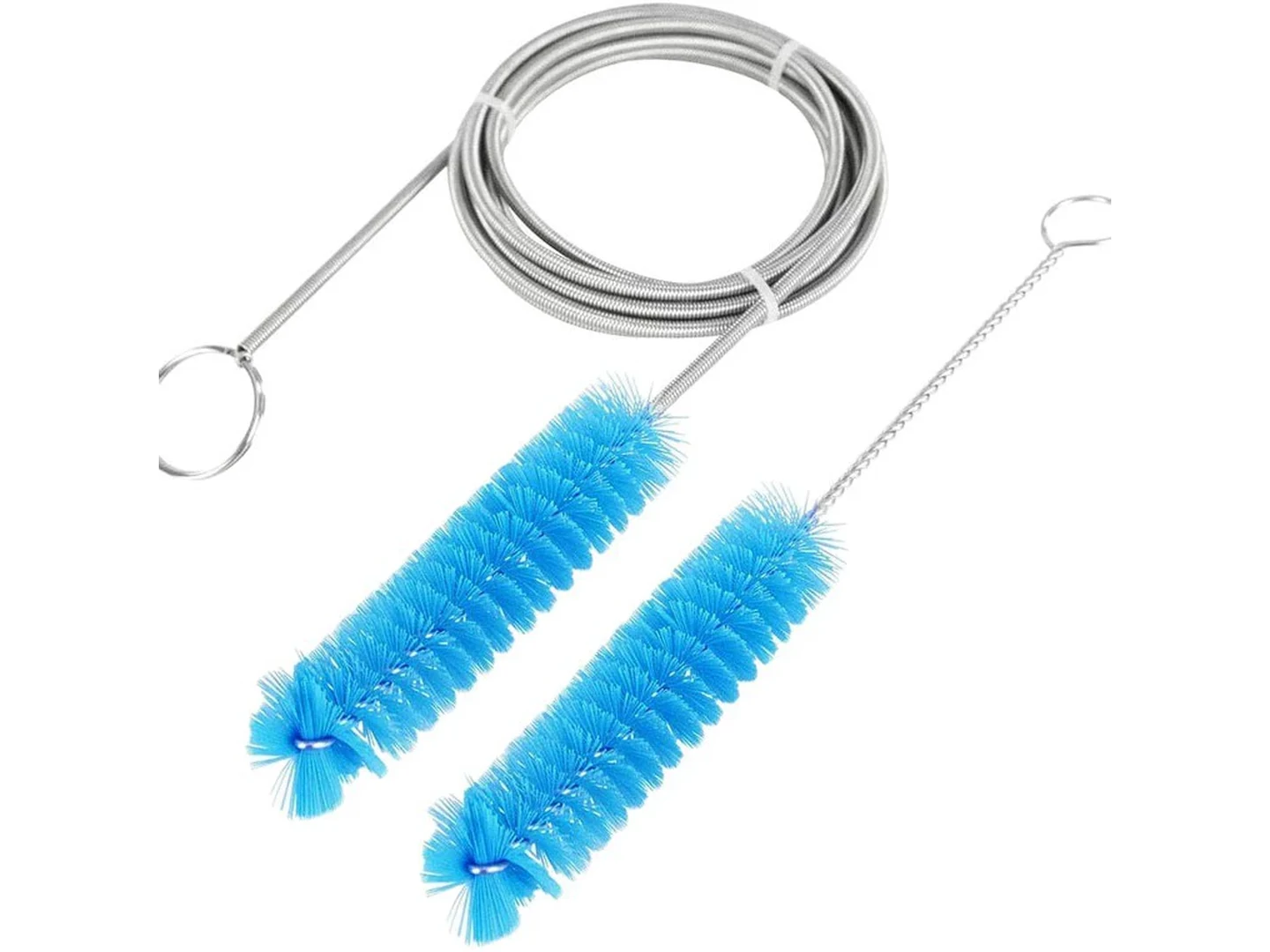
Medium brush
100 pcs
Minimum order
Worked with two hands or on a pole: chimney, gutter and pond-filter brushes, discs, cups and tank brushes.
Production lead time, once the specification is confirmed
- Up to 100 pcsWithin 7 days
- 101–5,000 pcsWithin 14 days
- 5,001–50,000 pcsWithin 21 days
- Over 50,000 pcsConfirmed with your quotation
Peak season can extend these times; the shipping date is confirmed in writing with your quotation. Sampling and shipping are quoted separately.
An aquarium filter brush is a submerged, hang-mounted filtration brush that traps suspended solids before they reach pumps and biological stages while adding a high-surface-area colony site for nitrifying bacteria. It is supplied in configurable lengths and diameters to fill sump compartments, pond filter chambers, and aquaculture filter bays.
What can this brush do for you?
Catches fish waste and feed particles before they break down
Dense radial filaments intercept suspended solids, uneaten feed, and organic fines as water passes through the brush field. This reduces the load on downstream fine media and keeps pump impellers, heaters, and UV sleeves cleaner between service intervals.
Adds colonizable surface without blocking flow
Each filament surface supports biofilm growth, so a brush array turns ordinary water-path volume into biological filter area. Because the filaments are separated along the core, water continues to move through the field instead of channeling around a solid block.
Springs back after rinsing and reuse
Nylon PA and PBT filaments flex during cleaning and recover their original diameter. The brush does not collapse or mat after a normal lift-and-spray cleaning cycle, so the same capture area returns between maintenance intervals.
Fits different chamber shapes through modular hanging
A hanging eye at the core end supports vertical or horizontal mounting. Multiple brushes can be spaced side by side or in series to fill rectangular, round, or irregular filter bays without changing the tank structure.
Survives continuous submerged service
Material options are selected for continuous water contact from 5 to 40°C. Filament and core combinations can be matched to freshwater or saltwater duty so the brush stays dimensionally stable through long immersion.
What is an Aquarium Filter Brush?
An aquarium filter brush is not a handled scrub brush. It is modular filter media: a corrosion-resistant core carries a cylindrical field of radial filaments, with a formed hanging loop at one end. The assembly is suspended in a filter chamber, sump, or settlement bay where water flows across the bristle field.
Larger particles are intercepted mechanically as the water moves through the filaments. Over time, the same surface becomes colonized by nitrifying bacteria, so each brush works as both a mechanical pre-filter and a biological media bed. Cleaning is done by lifting the brush from the chamber and spraying the captured solids off with tank or system water, usually on a rotating schedule so the bacterial colony is not removed all at once.
Because the brush remains submerged and under continuous flow, the configuration is driven by chamber width, water depth, flow rate, and solids load rather than by hand-cleaning ergonomics. It is a fixed or removable filtration insert, not a handheld cleaning tool.
Technical Specifications
| Parameter | Value / Options |
|---|---|
| Overall brush length | 300–800 mm, measured from filament tip to hanging-eye end |
| Swept brush diameter | 100–200 mm |
| Core diameter | 2–8 mm |
| Core material | 304 stainless steel, coated steel, or project-specified corrosion-resistant core |
| Filament material | Nylon PA or PBT |
| Filament diameter | 0.30–1.00 mm |
| Hanging eye opening | 5–20 mm inside diameter |
| Operating water temperature | 5–40°C continuous submerged |
| Mounting orientation | Vertical, horizontal, or bracket-mounted array |
| Filament fill density | Standard density, with low or high fill selected by solids load |
| Brush type | Custom Filter Brushes |
| How it is driven | Fixed in place, no drive of its own |
| Cleaning target | aquarium sump and filter compartment, first and second stages of gravity-fed pond, and aquaculture holding and quarantine system cleaning |
| Surface or part | filters, chambers, sumps, tanks, traps, ceramic, pads, and bars |
| Residue or debris | suspended solids, particles, and protein |
| Mounting / connection | Vertical, horizontal, or bracket-mounted array |
Length, diameter, and density are production parameters, not fixed stock sizes. A chamber drawing that shows the water path, mounting points, and available clear space allows the brush to be built to fit the actual filter bay.
Where does this brush work best?
- Aquarium sump and filter compartments where the brush row sits ahead of bio balls, ceramic media, or fine polishing pads.
- First and second stages of gravity-fed pond filter boxes as a mechanical intercept stage before biological media.
- Aquaculture holding and quarantine systems that produce continuous fecal and feed solids.
- Pre-filter chambers protecting UV clarifiers, protein skimmers, pumps, and fine cartridge stages.
- Overflow and filter bays where dead zones or bypass flow need to be broken up by a permeable brush field.
How do I choose the right one?
Measure the water path, not the tank size
Select the brush length so the free end clears the chamber floor and the hanging eye reaches its bar or hook without pulling the core into an angle. The diameter should fill the chamber width so adjacent brushes just overlap at their filament circumference; a visible open channel around the row becomes a bypass path.
Match filament diameter and density to the solids load
Fine filaments from 0.30 to 0.50 mm create more capture points and bio surface but load faster when the system carries heavy solids. Coarse 0.80 to 1.00 mm filament handles high-flow, high-solids stages and is easier to knock clean. High fill density increases capture but also increases head loss across the chamber.
Choose the filament material for the water chemistry
Nylon PA is flexible and tough, with good recovery after cleaning. PBT absorbs less water, keeps its stiffness during continuous immersion, and is often preferred for long submerged life or when the water carries persistent organic acids. In saltwater or chemically treated systems, specify the full water chemistry so the filament and core are selected together.
Select the core for mounting and exposure
Coated steel is economical for indoor freshwater service. 304 stainless handles continuous submerged fresh water. For saltwater, brackish water, or aggressive disinfectants, ask for a corrosion-resistant core option matched to the exposure rather than standard material.
When a different media is the better decision
The brush is a coarse-to-medium mechanical and bio stage. It will not produce polished water on its own; for fine particles below roughly 50–100 microns or crystal-clear display tanks, follow it with foam, filter mat, or cartridge media. If heavy solids such as gravel or leaves enter the filter, install a settlement or screen stage first. Sealed high-pressure filter housings are not the right environment for this hanging-brush form.
Can I customize this brush?
Aquarium filter brushes are built around the filter bay, not sold from a fixed stock table. The following can be changed for the project:
- Brush length and swept diameter to match chamber depth and width.
- Core diameter, core material, and hanging-eye size or end fitting.
- Filament material: Nylon PA or PBT.
- Filament diameter, cut length, fill density, and color for identification or brand requirements.
- Mounting format: single hanging eye, double-end loop, side bracket, or pre-spaced multi-brush bar.
- Brush array spacing and row configuration for large filter bays.
- Packaging: bulk carton, individual poly bag, retail card, or project-specific packing.
To define the correct configuration, provide the chamber inside width and length, water depth, flow rate, mounting points, water type and temperature, whether the brush will be cleaned in place or lifted out, and the solids load. A dimensioned sketch or photos of the filter bay speed up the fit. If your project requires material documentation, inspection, or third-party testing, we can support those requirements at the project stage.
What size should an aquarium filter brush be, and how long does it last?
How should I space multiple brushes in the same filter chamber?
Position rows so the filament sweeps of adjacent brushes just overlap by about 10–20 mm, and keep the bottom ends clear of the chamber floor. If gaps between brushes leave a straight open lane through the chamber, water will take that path and most of the brush field will be bypassed.
How do I clean the brushes without losing the biological colony?
Clean only a portion of the brush rows at each maintenance interval. Lift the selected brushes out and rinse them with tank, pond, or dechlorinated system water, working from the top of the core downward. Avoid chlorinated tap water directly on the biofilm when possible, and let the cleaned brushes drain briefly before returning them to the flow path.
Does this brush remove ammonia, nitrite, or dissolved discoloration?
No. The brush captures suspended solids. Ammonia and nitrite are converted by bacteria that colonize the filament surface after the filter matures. Dissolved organics and color also require carbon, resin, water changes, or other chemical media rather than mechanical or bio capture.
How can I tell when the brushes need replacement?
Inspect the core for corrosion or pitting, the hanging eye for wear, and the filament field for broken or shed bristles. If the filament diameter has thinned visibly, the sweep no longer fills the chamber, or the filaments stay flattened after cleaning, the brush is losing capture and bio surface and should be replaced.
Can I use the same brush in freshwater and saltwater systems?
Not automatically. Nylon PA absorbs water and loses some stiffness in long-term immersion, which may be acceptable in freshwater depending on the load. For saltwater or chemically treated water, PBT filament with a saltwater-suitable core is normally the safer combination. Specify salinity and treatment chemicals before ordering.
What should I do if my filter chamber has low overhead clearance?
Use a shorter brush length matched to the available vertical space, switch to horizontal or bracket mounting, or split the bay into two or three brush sections in series. If a hanging bar cannot fit, double-end loops or a fixed end anchor can be specified instead of a single top hanging eye.
Guides that go deeper on this
Aquarium Filter Brush: Material and Size for Outdoor Use
Read this guideGuideAquarium Filter Brush: What Fits Filter Media Channels?
Read this guideGuideAquarium Filter Brush: What Fits Fish Tank Tubing?
Read this guideGuideBiofilter Brush vs Filter Tube Brush: Where Each One Works Best
Read this guideGuideHow to Choose Pond Filter Brush for Pond Pumps
Read this guideCustom Manufacturing RFQ
Describe Your Application
For an accurate quotation, please provide the main dimensions, material preference, working surface, residue, quantity, and a drawing or photo.
Drawing or photo optional — it speeds things up, it does not gate the enquiry.
Custom Brush RFQ
Send Your Brush Project
Upload a drawing, product photo, or sample photo and provide the core dimensions and cleaning conditions.
“We need a brush to remove wet residue from a stainless steel conveyor, about 800mm wide. The current brush wears quickly. We can send photos.”
“We sell drinkware and need a cleaning brush to include with the product. Quantity around 5,000 pieces.”