
Custom Cleaning Brush
500mm PBT Pond Filter Brush
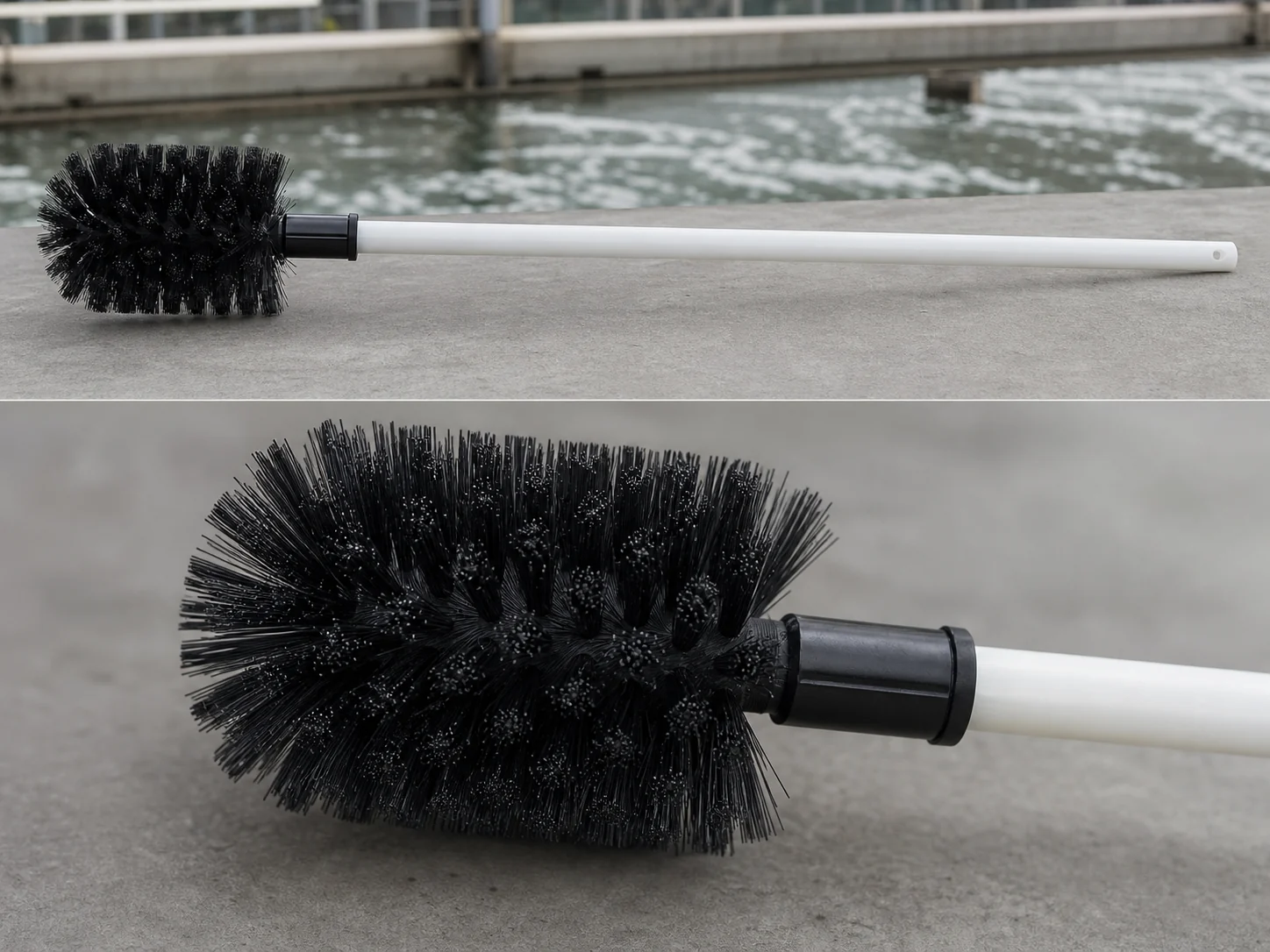
500mm PBT pond filter brush with a 120 mm round head and fixed PP core for mechanical and biological filtration in pond filters. Bulk and OEM options.
Medium brush
100 pcs
Minimum order
Worked with two hands or on a pole: chimney, gutter and pond-filter brushes, discs, cups and tank brushes.
Production lead time, once the specification is confirmed
- Up to 100 pcsWithin 7 days
- 101–5,000 pcsWithin 14 days
- 5,001–50,000 pcsWithin 21 days
- Over 50,000 pcsConfirmed with your quotation
Peak season can extend these times; the shipping date is confirmed in writing with your quotation. Sampling and shipping are quoted separately.
The 500mm PBT Pond Filter Brush is a 500 mm-long static filtration insert built for mechanical and biological filtration inside pond filter chambers. Its round 120 mm brush body uses a fixed polypropylene core and dense PBT bristles to trap suspended solids, fish waste, and organic fines while creating colonizable surface area for nitrifying bacteria.
What can this brush do for you?
Traps suspended solids before they foul downstream media
The 120 mm round bristle pack fills the filter chamber cross-section, so water must pass through the filament field rather than around it. Fish waste, feed fines, algae particles, and organic debris collect on the outer bristles, leaving the next chamber or bio-media stage cleaner and reducing clogging in fine polishing mats.
Adds biological surface area inside the same water path
Every PBT filament is a potential attachment site for nitrifying bacteria. Over the 500 mm length, the brush creates a large biofilm surface without requiring a separate media bed. Once colonized, the brushes help convert ammonia and nitrite while continuing to screen solids.
Holds its shape in continuous submersion
PBT is a dimensionally stable polyester that does not soften or swell in pond water. Unlike natural fibers, it will not rot, and it resists common pond treatment chemicals and UV exposure. The polypropylene core adds no metal, so there is no rust or corrosion to release into the pond.
Designed for fixed installation, not hand use
The brush has no handle or grip, which keeps every millimeter of the 500 mm length available for filtration. Plain ends and a fixed round form drop into rack slots, hanging frames, or mounting rails, so installers can build repeatable brush arrays across multi-bay filter systems.
Survives cleaning cycles and returns to work
PBT bristles spring back after hosing or pressure rinsing. Brushes can be pulled from the chamber, washed free of accumulated sludge, and reinstalled without replacing the set. If one unit is damaged, it can be swapped individually.
What is a 500mm PBT Pond Filter Brush?
It is a non-powered, submerged filter medium shaped as a long cylindrical brush. A central polypropylene core runs the full 500 mm length, and PBT polyester filaments radiate outward to form a round 120 mm diameter head. The brush sits in a filter chamber in rows; pond water flows through the bristle field at low velocity or by gravity. The filaments capture particles larger than the gaps between bristles, while the bristle surfaces gradually support a biofilm that provides biological filtration.
This product is not a handheld cleaning brush and has no handle or grip. It is an installed component, normally fixed into holder frames, rails, or racks inside a multi-bay pond filter, vortex filter, skimmer box, or settlement chamber. It works by retention and microbial colonization, not by chemical absorption.
Operating considerations: The brushes need periodic removal for cleaning, and their performance depends on water flow staying distributed through the bristle pack. Channels along chamber walls or around loosely spaced brushes reduce contact, so the mounting frame and spacing matter as much as the brush itself. High concentrations of large leaves and string algae may wrap around the bristles; these are better removed by a pre-filter or skimmer before the brush stage.
Technical Specifications
The standard configuration is 500 mm long with a 120 mm round brush head. Dimensions, bristle density, filament grade, and end details can be adjusted for project requirements.
| Parameter | Standard value / option |
|---|---|
| Overall brush length | 500 mm |
| Brush diameter | 120 mm |
| Head shape | Round |
| Bristle material | PBT (polybutylene terephthalate) |
| Core / backbone material | Polypropylene (PP) |
| Handle length | None (0 mm, fixed installation) |
| Grip diameter | None (0 mm, rack or frame mounting) |
| Connection | Fixed |
| Application environment | Continuous or intermittent submersion in freshwater pond filter chambers |
| Typical water temperature range | 4–40°C (39–104°F) |
| Typical pH range | 6–9 |
| Filament arrangement | Radial; density and trim length configurable by project |
| End detail / mounting | Plain fixed ends standard; hanging loop or frame pin optional |
| Brush type | Custom Filter Brushes |
| How it is driven | Fixed in place, no drive of its own |
| Cleaning target | multi-chamber koi pond filter, vortex and settlement pre-filter, and pond skimmer box and intake bay cleaning |
| Surface or part | filters, chambers, racks, frames, traps, channel, gaps, and tanks |
| Residue or debris | fish waste, biofilm, suspended solids, algae, particles, leaves, and fines |
| Mounting / connection | Fixed; Plain fixed ends standard; hanging loop or frame pin optional |
For saltwater, chlorinated, or chemically aggressive systems, confirm the filament and core grades against the actual water chemistry before specifying. We can match materials to the project when the operating environment is supplied.
Where does this brush work best?
- Multi-chamber koi pond filters: brushes in the first or second mechanical chamber collect suspended fish waste and feed particles before water reaches fine media, matting, or biological beds.
- Vortex and settlement pre-filters: the round 120 mm brush pack scrubs the circular water path and catches material that does not fully settle.
- Pond skimmer boxes and intake bays: fixed brush rows filter leaves, algae clumps, and floating debris before the pump intake.
- Recirculating aquaculture and holding tanks: brushes add mechanical screening and biofilm surface area in low-pressure RAS pre-filtration trains.
- Ornamental ponds and water gardens: low-maintenance mechanical stage for suspended organics where clear water is desired without aggressive chemical treatment.
How do I choose the right one?
Start with the filter chamber, not the pond volume. Three fit questions decide whether this 500 mm, 120 mm brush works: Can the chamber accept the diameter? Does the row height match the length? Will the brush array leave a bypass path?
- Diameter fit: confirm 120 mm passes into the chamber with enough clearance for the frame. If adjacent brushes are used, set spacing so bristle tips lightly overlap, typically 100–110 mm center-to-center for a 120 mm round brush. A gap larger than the bristle tips creates an open water channel where solids pass through.
- Length fit: 500 mm must suit the usable row or rack height. If the chamber is deeper, brushes can be stacked vertically; if shallower, a shorter cut length or different configuration may be required. The brush should not fold or compress against the chamber lid.
- Mechanical vs. biological priority: for a mechanical-first stage, choose denser bristle packing to capture finer suspended solids, and expect more frequent cleaning. For a biological stage, use slightly more open packing to improve water distribution and biofilm growth across the full length.
- Flow pattern: brushes work best in linear or circular low-pressure flow, not in high-pressure enclosed canisters. If the water bypasses the brush pack, the filter looks clean but does not filter. Choose frames that force water through the bristle field while allowing solids to drop in the chamber.
- Water chemistry: PBT and PP are suitable for typical freshwater ponds and mild treatment chemicals. For saltwater systems, verify material grade and cleaning protocol; for aggressive oxidizers or hot-water washdown, request material compatibility confirmation.
When a brush stage is not the right choice: use bar screens or leaf baskets for large coarse debris, fine foam or bead media for polishing after the brushes, and a dedicated bio-media bed if the system requires separate, high-specific-surface-area nitrification. The 500mm PBT Pond Filter Brush is a retained-solids and biofilm medium, not a pressure filter or a chemical clarifier.
Can I customize this brush?
The 500 mm length and 120 mm diameter are standard, but most dimensions and material details can be built to the pond filter system. To quote a custom configuration, provide chamber internal width, row height, brush-to-brush spacing, flow rate, targeted solids, water type, cleaning method, and mounting style. Drawings or photos of the existing rack simplify the definition.
- Dimensions: overall length from 200 mm to 1200 mm or more, brush diameter from 80 mm to 150 mm or custom, round or slightly oval head geometry.
- Bristle pack: PBT filament diameter, stiffness, trim length, density, and color; denser packs for fine solids, more open packs for biological use.
- Core: PP standard; UV-stabilized, reinforced, or alternative core material for saltwater or high-load arrays.
- Mounting ends: plain fixed ends, hanging loops, notches, pins, or threaded ends depending on the filter rack.
- Packaging: bulk pallet for OEM filter builders, individual poly bags, retail-ready labels, or project-specific batching.
For distributor, OEM, and large project requirements, we can support material declarations, inspection, third-party testing, and project-specific documentation as part of the customization process.
Which filament survives the cleaning and still lasts on a 500mm PBT pond filter brush?
How many 500mm PBT Pond Filter Brushes do I need for a chamber?
Measure the chamber width and usable row height. For a single horizontal row, divide the chamber width by the brush spacing; with the 120 mm diameter, place brush centers approximately 100–110 mm apart so the bristle tips overlap. A 600 mm-wide chamber would take about six brushes across. Multiply by the number of rows or stack layers for the total count.
How do I clean the brushes without killing the biofilm?
Do not clean all brushes in the same chamber at once. Pull each brush, hose or swish it in a bucket of pond water to dislodge solids, and return it to the frame. Chlorinated tap water and disinfectants can knock back the nitrifying bacteria, so use pond water or dechlorinated water for the biological stage. Mechanical-stage brushes can tolerate harsher rinsing if that stage is upstream of the biofilter.
How long does a new brush set take to become biologically active?
Colonization depends on water temperature and existing biofilter load, but expect two to six weeks before the brushes contribute meaningful ammonia and nitrite conversion. During that period they are still working as mechanical filters. If all filter media are new at once, add fish gradually and monitor ammonia and nitrite as the system matures.
What does a pond brush filter not remove?
Brushes remove suspended particles and provide biofilm surface, but they do not remove dissolved ammonia or nitrite by themselves before colonization, dissolved organic color, pathogens, or fine particles below the bristle gap size. UV clarifiers, foam polishing, activated carbon, or water changes may still be required for those functions.
How can I tell when a brush needs replacement?
Replace a brush if the PP core is cracked or bent, if bristles have permanently clumped, matted, or lost stiffness and will not return after cleaning, or if the outer diameter no longer overlaps adjacent brushes. Routine replacement is individual; a hardened or flattening brush reduces both mechanical capture and biological surface area.
Can the brush be installed vertically in a deep chamber?
Yes. Vertical installation works in chambers where the 500 mm length occupies the water column. Maintain side-to-side contact or overlap with neighboring brushes, and make sure flow does not channel along the smooth core or chamber walls. A top mounting point or bottom socket keeps the brush centered instead of leaning.
Guides that go deeper on this
Custom Manufacturing RFQ
Describe Your Application
Please share the brush dimensions, working area, residue type, material direction, quantity, and a drawing or photo for quotation.
Drawing or photo optional — it speeds things up, it does not gate the enquiry.
Custom Brush RFQ
Send Your Brush Project
Upload a drawing, product photo, or sample photo and provide the core dimensions and cleaning conditions.
“We need a brush to remove wet residue from a stainless steel conveyor, about 800mm wide. The current brush wears quickly. We can send photos.”
“We sell drinkware and need a cleaning brush to include with the product. Quantity around 5,000 pieces.”