
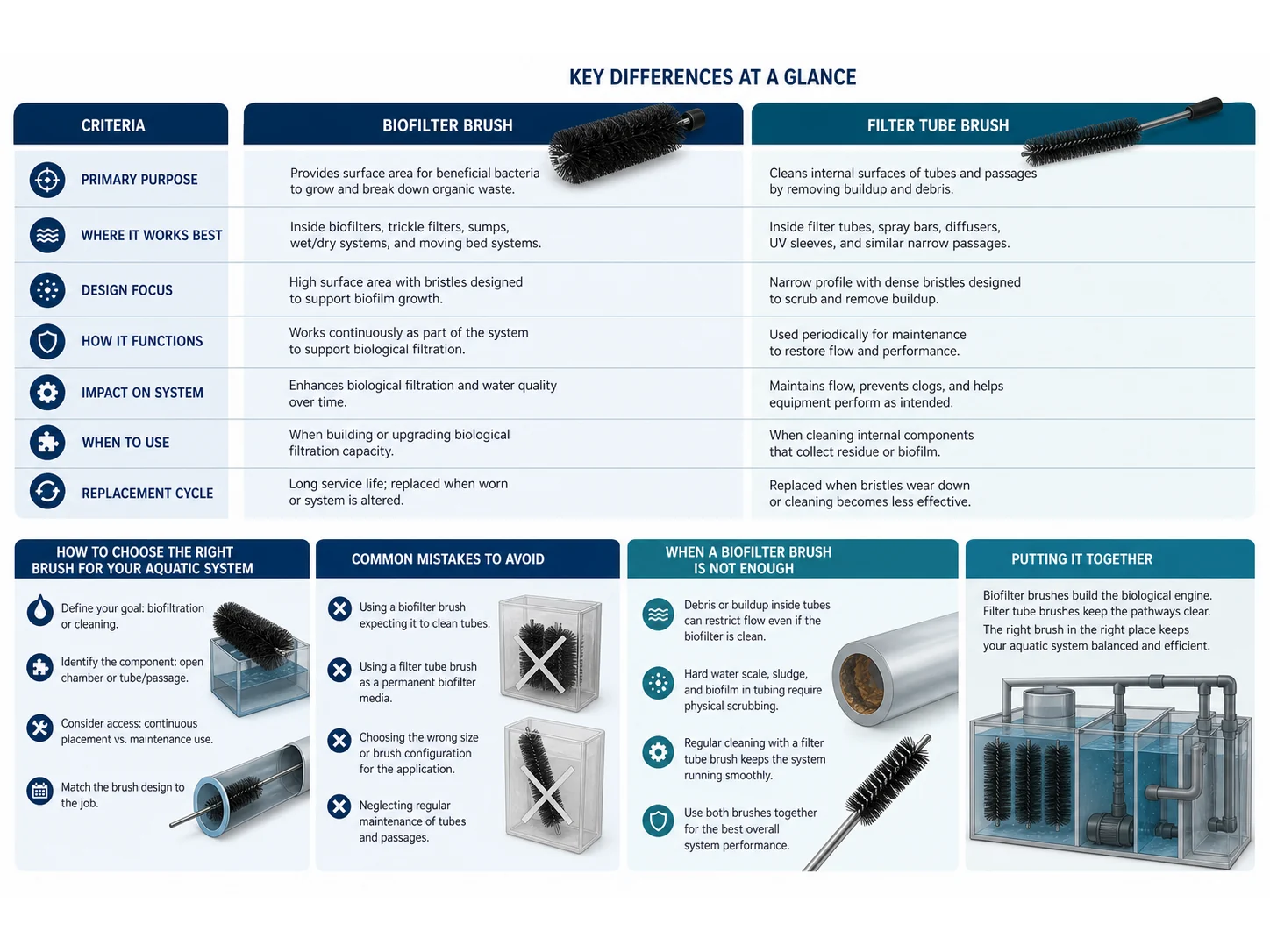
What Is a Biofilter Brush?
A biofilter brush is a brush-like media insert designed to provide a large surface area for nitrifying bacteria to colonize inside biological filters. Unlike a cleaning brush, it stays inside the filter chamber and rarely needs scrubbing. The bristles are typically made of durable, fish-safe plastic materials like polypropylene or nylon, arranged on a stainless steel or plastic core. The main goal is to maximize surface area per volume while allowing water to flow through with moderate resistance.
What Is a Filter Tube Brush?
A filter tube brush, sometimes called a tube cleaning brush or pipe brush, is a tool used to scrub the inside of pipes, hoses, filter components, and other hard-to-reach channels. It is designed for manual or drill-powered cleaning, with bristles that dislodge debris, biofilm, or sludge. These brushes come in many diameters, bristle materials (nylon, stainless steel, horsehair), and handle types. Their job is mechanical cleaning, not biological support.
Key Differences at a Glance
| Comparison Point | Biofilter Brush | Filter Tube Brush |
|---|---|---|
| Primary Purpose | Biological filtration / surface for bacteria | Physical cleaning of tubes, pipes, and filter parts |
| Typical Design | Large, open-bristle structure on a core; stays in filter | Compact brush head with bristles, attached to a handle or shaft; used temporarily |
| Bristle Material | Usually polypropylene (PP) or nylon, designed to be inert and long-lasting | Nylon, stainless steel, brass, horsehair, or abrasive materials depending on the cleaning task |
| Core / Handle | Stainless steel, PVC, or plastic core; sometimes mounted via a base plate or hung in the filter | Twisted wire handle (flexible) or rigid plastic/metal rod; may have a loop or socket for power tools |
| Mounting | Stationary inside a filter chamber; can be hung, stacked, or clipped into media baskets | Not mounted; handheld or attached to a drill for cleaning action |
| Water Flow Consideration | Must allow water to flow through with low to moderate restriction to avoid dead zones | Not relevant; used dry or with flowing rinse water to remove loosened debris |
| Ideal Use Cases | Pond filters, moving bed filters, large aquarium sumps, koi filtration systems | Cleaning filter intake/output pipes, hose lines, UV sleeves, protein skimmer necks, pre-filter tubes |
| Cleaning Frequency | Rarely cleaned to preserve beneficial bacteria; rinsed gently in old aquarium water if needed | Used as needed when buildup occurs; cleaning after each use to maintain brush condition |
| Lifespan | Several years; replace if bristles degrade or break | Varies by material; wire brushes may rust, nylon wears down over time |
How to Choose the Right Brush for Your Aquatic System
Your primary goal determines which brush you need. If you want to increase biological filtration capacity, a biofilter brush is the answer. If you have a dirty pipe or clogged filter tube, reach for a filter tube brush. For biofilter brushes, consider the filter chamber volume and recommended media volume; choose a size and shape that fits without blocking flow. For tube brushes, measure the inner diameter of the pipe or hose and select a brush with a bristle diameter about 10–15% larger to ensure a thorough cleaning. Check bristle density: biofilter brushes need open spacing for water flow and oxygenation, while cleaning brushes can have dense, stiff bristles for aggressive scrubbing. Always verify material compatibility—nylon or plastic tube brushes are safe for acrylic and delicate surfaces, while stainless steel is best for metal pipes but can rust in saltwater if not high-grade.
Common Mistakes to Avoid
- Confusing the two types: Buying a cleaning brush when you need biological media, or vice versa. A cleaning brush will not support bacteria, and a biofilter brush will not effectively scrub a pipe.
- Using the wrong diameter: A tube brush that is too small will leave residue behind; one too large can jam and damage the hose. A biofilter brush that is oversized can restrict flow and trap debris.
- Over-cleaning biofilter brushes: Aggressive scrubbing or tap water rinsing kills beneficial bacteria, potentially causing an ammonia spike. Only rinse gently in old tank water when necessary.
- Neglecting to anchor biofilter brushes: Unsecured brushes can float or shift, creating dead spots. Use appropriate mounting brackets or weighting.
- Choosing abrasive tube brushes for soft plastics: Stainless steel or brass bristles can scratch acrylic tanks and plastic fittings. Stick to nylon for these applications.
- Ignoring material corrosion: Stainless steel tube brushes can rust in saltwater or harsh chemicals if not made from 316-grade steel. When in doubt, opt for nylon or replace regularly.
When a Biofilter Brush Is the Wrong Choice
A biofilter brush provides excellent biological surface area, but it has limits. In systems with extremely high ammonia loads (e.g., heavily stocked koi ponds), supplementing with additional media like moving bed biofilm reactors (MBBR), ceramic rings, or fluidized sand filters may be necessary. If incoming water carries excessive suspended solids, mechanical filtration should be upgraded before it reaches the biofilter to prevent clogging. In some compact biofilter designs, inadequate water distribution can cause channeling around the brush, reducing contact time. If you observe spikes in ammonia or nitrite despite adequate brushing, consider a media layout review or seek advice from an experienced pond or aquarium supplier. For cleaning tasks beyond routine tube scrubbing—such as removing heavy scale or hardened deposits—a specialized brush with chemical treatment or professional equipment may be required.
Final Takeaway
Biofilter brushes and filter tube brushes solve completely different problems. One houses the beneficial bacteria that keep your water safe; the other physically removes debris from your equipment. Before buying, clearly identify whether you need a permanent biological media addition or a temporary cleaning tool. Match the brush size, material, and stiffness to your system’s requirements, and you’ll avoid common pitfalls while keeping your aquatic environment healthy and efficient.
Frequently Asked Questions
Can I use a filter tube brush to clean my biofilter brush?
It is not recommended because scrubbing can remove the beneficial bacteria biofilm. Instead, gently rinse a biofilter brush in old tank water if it becomes clogged with debris.
What diameter tube brush do I need for cleaning a standard aquarium hose?
Select a tube brush with a bristle diameter about 10–15% larger than the inner diameter of the hose. For example, a 1-inch ID hose might need a brush with a 1.25-inch overall bristle diameter.
Are stainless steel tube brushes safe for saltwater aquariums?
Only if made from high-grade stainless steel (316 or 316L) that resists saltwater corrosion. Even then, it is safer to use nylon or plastic brushes for most saltwater applications to avoid metal contamination.
How many biofilter brushes do I need for my pond filter?
The number depends on the fish load and filter volume. A common rule of thumb is to provide at least 100 square feet of effective surface area per pound of fish. Calculate the surface area per brush and divide accordingly.
Can I cut a biofilter brush to fit my filter chamber?
Yes, many biofilter brushes with plastic cores can be cut to length with a hacksaw. Be sure to smooth any sharp edges to prevent injury or damage to the filter.
Why do some filter tube brushes have a twisted wire handle?
A twisted wire handle provides flexibility to navigate bends in pipes and hoses. It also allows the brush head to expand slightly for a snug fit. However, it can scratch softer materials like acrylic, so use with caution.
Do biofilter brushes need to be replaced periodically?
Biofilter brushes can last for years if made from quality materials. Replace them if the bristles become brittle, break off, or if the core shows signs of rust or degradation.
Technical References
Which bristle material fits this job — AISI 304 Stainless Steel Wire, Nylon PA or Horsehair?
| Material | Continuous temperature (°C) | Peak temperature (°C) | Water absorption | Hardness |
|---|---|---|---|---|
| AISI 304 Stainless Steel Wire | 400 | 500 | 0% | Rockwell B 70–95 depending on temper and cold work |
| Nylon PA | 93 | 121 | 0.3–9% by PA grade and conditioning | Medium to firm; filament diameter and trim length control bending force. |
| Horsehair | 60–80 | 100–120 | 8–15% | — |
| Polypropylene PP | 80–100 | 120–140 | ≤0.03% | Shore D 65–75 |
| AISI 316 Stainless Steel Wire | 400 | 500 | 0% | Rockwell B 70–95 depending on temper and cold work |
Figures as published by Alleima; Brushtec / DuPont; Perlon. Confirm the exact grade against the supplier datasheet before ordering.
What should replace Filter Brushes for biofilter brush?
- Filter Brushes — Filter brushes use an open radial structure in a flowing chamber; tube and bore brushes actively scrub a defined internal wall or passage. Closest alternative: Tube & Pipe Bore Brushes.
- Tube & Pipe Bore Brushes — Tube and bore brushes work by radial contact inside a confined diameter; wire wheels and cups work mainly on external edges, profiles, welds, and broad surfaces.
- AISI 304 Stainless Steel Wire — Use AISI 316 stainless steel wire for chloride, marine, dairy, beverage, chemical washdown, or higher pitting-resistance requirements. Use carbon steel for dry aggressive cutting and brass or abrasive nylon for lower marking risk.
- Nylon PA — Compare Nylon PA with PP, PBT, PET. Change material when wet stiffness, temperature, chemical resistance, conductivity, particle shedding, or surface marking becomes the limiting factor.