
Custom Cleaning Brush
Biofilter Brush
Custom biofilter brush media for pond and aquarium filter chambers. Nylon filaments, corrosion-resistant cores, high surface area for nitrifying biofilm.
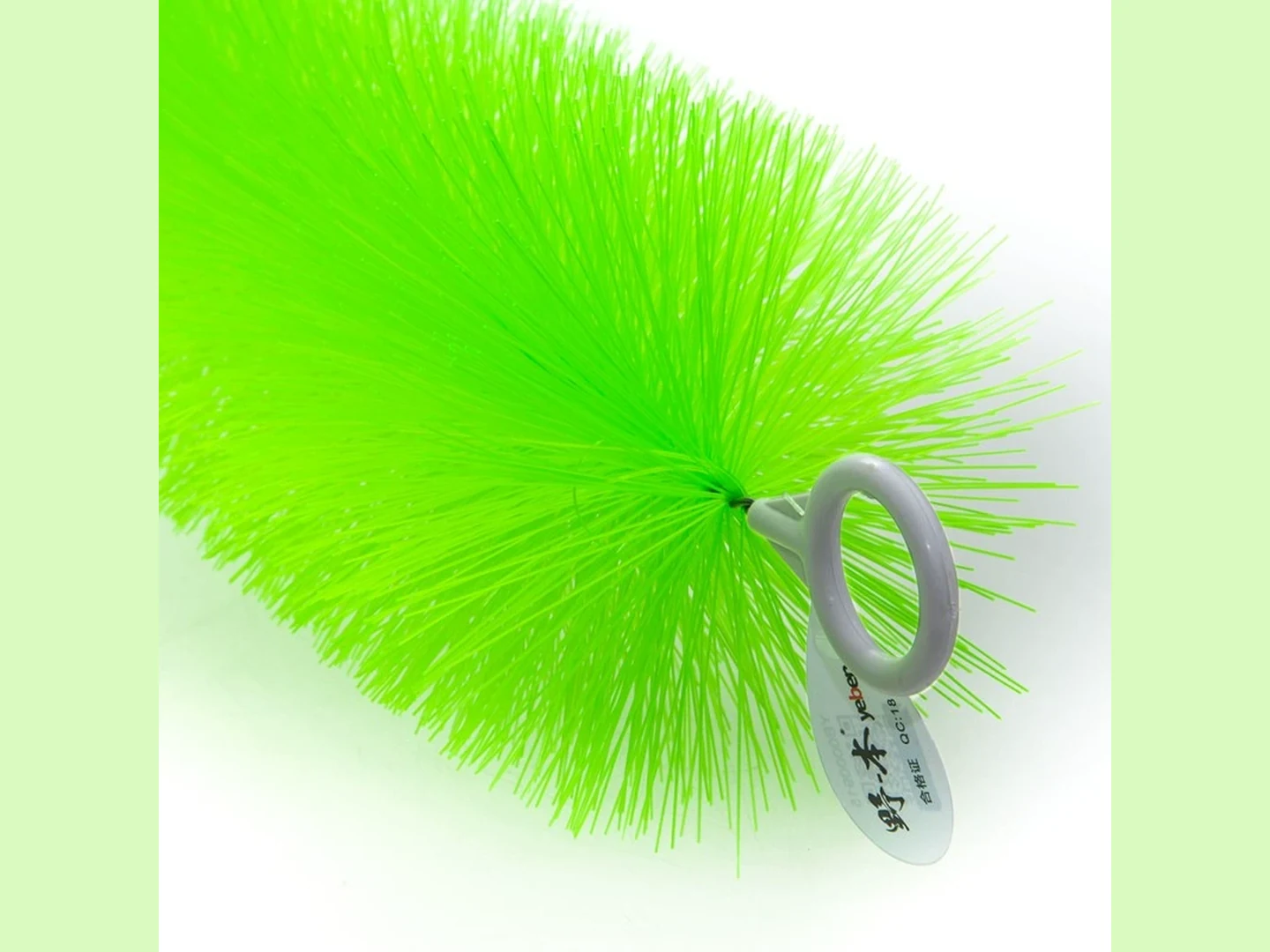
Medium brush
100 pcs
Minimum order
Worked with two hands or on a pole: chimney, gutter and pond-filter brushes, discs, cups and tank brushes.
Production lead time, once the specification is confirmed
- Up to 100 pcsWithin 7 days
- 101–5,000 pcsWithin 14 days
- 5,001–50,000 pcsWithin 21 days
- Over 50,000 pcsConfirmed with your quotation
Peak season can extend these times; the shipping date is confirmed in writing with your quotation. Sampling and shipping are quoted separately.
A high-surface-area nylon filament brush designed to serve as biological filter media in pond and aquarium filter chambers, capturing suspended solids while providing attachment sites for nitrifying biofilm.
What can this brush do for you?
Extensive biofilm colonization area
The dense radial array of nylon filaments multiplies the available surface area far beyond the brush’s nominal envelope. Every filament provides attachment points for nitrifying bacteria, so a packed chamber of brushes can convert ammonia and nitrite at the rates needed to sustain high fish loads.
Mechanical capture of suspended solids
As water passes through the brush, suspended organic solids, fish waste, and feed fines contact and stick to the filament network. This coarse mechanical capture reduces the load on downstream fine or polishing filtration stages and helps keep the water clearer between backwashing cycles.
Open structure preserves water flow
Because the filaments are arranged around an open central core with paths between the rows, water can move through the media without immediately plugging. The brush holds solids but does not form a solid block, so flow distribution stays acceptable longer between cleaning events.
Submersible construction for long service life
Nylon filaments resist water absorption, rot, and microbial breakdown in normal pond and aquarium temperature ranges, while the twisted core can be specified in galvanized steel, stainless steel, or coated versions to avoid corrosion in submerged service. This lets the brush remain installed for multiple seasons with only routine rinsing.
Simple hanging installation and reuse
Each brush includes a formed hanging eye at the top that accepts hooks, pipes, or support rails. Media beds can be lifted out as individual units for inspection or cleaning and then returned without replacing the entire filter load.
What is a Biofilter Brush?
A biofilter brush is a strand-type filter media, not a scrubbing brush. It is built from a twisted wire core that locks radially projecting nylon filaments into a cylindrical form. Installed statically inside a submerged filter chamber, it serves two functions at once: the filament mass catches and holds suspended particles, and those same surfaces become colonized by biofilm, which converts ammonia to nitrite and then to nitrate. It is commonly used in koi pond upflow chambers, vortex settling systems, aquaculture tanks, and aquarium sumps.
During operation, water flows between the filaments while the brush remains fixed in place. Unlike moving-bed media, it requires no air agitation, and unlike foam blocks it does not blind as quickly. Solids accumulate on the filament surfaces and can be removed by lifting the brush and rinsing it in pond water. Biological conversion, however, takes time to develop: mechanical capture is immediate, but full nitrification capacity builds over several weeks as the biofilm matures.
The brush should remain submerged at all times. It is not intended for use as a hand-cleaning tool or for dry applications. Protect it from freezing and avoid exposure to chlorinated municipal water during maintenance, as this can damage the biofilm.
Technical Specifications
The following table lists the standard production range for biofilter brushes. All dimensions and materials can be adjusted to match your filter chamber and water chemistry.
| Parameter | Standard Range / Options |
|---|---|
| Brush diameter | 100–200 mm, selected to fit chamber cross-section with flow clearance |
| Brush length | 300–800 mm, matched to submerged depth of filter chamber |
| Core diameter | 2–8 mm, depending on brush diameter and hanging load |
| Filament diameter | 0.30–1.00 mm; finer filaments for higher surface area, coarser for higher solids loading |
| Hanging eye | 5–20 mm inside diameter, formed or welded ring for support hardware |
| Filament material | Nylon PA (PA6 or PA66), UV-stabilized grade available for outdoor ponds |
| Core material | Galvanized steel, 304 stainless steel, 316 stainless steel, or plastic-coated wire |
| Operating water temperature | 5–40°C continuous, with brief excursions outside this range for cleaning |
| Service environment | Freshwater or saltwater; specify water chemistry for core selection |
| Brush type | Custom Filter Brushes |
| How it is driven | Fixed in place, no drive of its own |
| Cleaning target | koi pond and ornamental pond filter chamber, aquaculture and hatchery system, and aquarium sump and refugium section cleaning |
| Surface or part | filters, chambers, sumps, tanks, foam blocks, and columns |
| Residue or debris | biofilm, suspended solids, particles, suspended particles, salt, and fish waste |
| Mounting / connection | Fixed |
Where does this brush work best?
- Koi pond and ornamental pond filter chambers: static upflow, vortex, and settlement chambers where large-diameter media provides both solids capture and nitrification.
- Aquaculture and hatchery systems: raceways, rearing tanks, and degassing columns where additional surface area improves ammonia conversion under continuous feeding.
- Aquarium sumps and refugium sections: compact brush bundles provide biological media without the need for air pumps or rotating components.
- Outdoor water features and garden ponds with seasonal temperature swings within 5–40°C, where nylon remains stable and the open structure tolerates leaf and organic debris.
- Systems that want media that can be lifted and rinsed rather than replaced, reducing long-term media replacement cost.
How do I choose the right one?
Start by measuring the filter chamber. Choose a brush diameter that leaves at least 20–30 mm of open space around the perimeter or between adjacent brushes so water can move through the media bed rather than channeling around the outside. Length should allow the brush to hang from the support without touching the bottom of the chamber, preventing sludge from accumulating at the base.
Next, match filament diameter to the solids load. If the system has heavy feeding, fish waste, or visible suspended particles, a coarser filament (0.70–1.00 mm) creates a more open structure that holds more solids without clogging. For lightly stocked ponds or polishing stages, a finer filament (0.30–0.50 mm) provides greater surface area per brush and better biological conversion.
Core material follows water chemistry. Freshwater ponds can use galvanized steel or stainless; if the system uses salt, ozone, or aggressive water treatment, specify 304 or 316 stainless or a plastic-coated core. The core diameter should increase with brush diameter and length to prevent sagging when fully loaded with biofilm.
Think about packing density. Brushes can be mounted side by side, but overpacking reduces flow and creates dead zones. A practical starting point is to arrange brushes with the filaments of adjacent brushes just touching, not compressed. You can adjust after monitoring ammonia and nitrite.
Finally, decide whether a biofilter brush is the right media at all. If your filtration goal is very fine mechanical polishing, a foam block or filter sock will remove smaller particles. If the main goal is maximum biological surface in a very small volume, moving-bed media such as K1 may pack more efficiently. Biofilter brushes are best when you need combined mechanical and biological action in a simple, lift-out, maintenance-friendly format.
Can I customize this brush?
Biofilter brush dimensions, materials, and construction can be adapted to your filter system. When you request a quote, provide the filter chamber inside dimensions, water depth, fish load or feeding rate, water type (fresh/salt), and how the brushes will be hung. A photo or sketch of the installation helps.
- Brush diameter and length: any size within production limits; we can build outside the table range for large chambers.
- Filament diameter and density: tune surface area vs. clogging resistance.
- Core material and coating: galvanized, 304/316 stainless, or PVC/PP-coated wire for aggressive water.
- Hanging eye: size, shape (ring, loop, or two-hole), and orientation (top or side mount).
- Filament color: natural, black, green, blue, or custom for product differentiation.
- Packaging and marking: bulk cartons, individual poly bags with label, or retail-ready packaging; custom hang tags or barcode labels.
If your project requires material certificates, inspection reports, or third-party testing for export or regulatory approval, we can assist with those documentation requirements as part of the customization process.
How do you confirm a biofilter brush has actually cleaned the surface?
How many biofilter brushes do I need for my pond?
As a rough estimate, one standard brush of 200 mm diameter × 500 mm length can support relatively low stocking densities in 1,000–2,000 liters of pond volume. Heavily fed koi ponds may need double or triple that number. Monitor ammonia and nitrite after 4–6 weeks; if they do not drop to zero, add brushes or increase water changes.
How do I clean a biofilter brush without losing the biofilm?
During major filter maintenance, lift the brush out and gently swish it in a bucket of pond water or dechlorinated water. Do not use tap water with chlorine, do not scrub, and do not let the brush dry out completely. Keep a few brushes uncleaned as seed media to re-inoculate the cleaned ones.
How can I tell when the biofilm is mature?
Look for a brown or tan slimy coating on the filaments, and test the water. In a mature system, ammonia and nitrite should read at or near zero after feeding events. Biofilm maturity typically takes 4–8 weeks at water temperatures above 15°C; lower temperatures slow the process.
Can I use these brushes in saltwater or brackish systems?
Yes, but specify the water chemistry when ordering. Nylon itself is inert, but the core must be corrosion-resistant. For saltwater, choose a 316 stainless or plastic-coated core to avoid rust, and use a hanging eye made of the same material.
What should I check before installing a new set of brushes?
Inspect each brush for loose or bent filaments, core straightness, and the hanging eye for sharp edges or weld cracks. Verify that the brush diameter fits through any access hatches and that the hanging system can support the weight of waterlogged brushes. Space the brushes so filaments of adjacent units just touch; do not force them together.
Will a biofilter brush remove fine particles or dissolved organics?
No. The brush captures coarse suspended solids and provides surface for biological conversion. For very fine mechanical polishing, add a fine foam or bead filter downstream. For dissolved organics, tannins, or odor, use activated carbon, ozone, or a protein skimmer. The brush is one component of a complete filtration train.
Guides that go deeper on this
Custom Manufacturing RFQ
Describe Your Application
Send the key measurements, cleaning requirement, residue, material direction, mounting method, quantity, and drawing or photo.
Drawing or photo optional — it speeds things up, it does not gate the enquiry.
Custom Brush RFQ
Send Your Brush Project
Upload a drawing, product photo, or sample photo and provide the core dimensions and cleaning conditions.
“We need a brush to remove wet residue from a stainless steel conveyor, about 800mm wide. The current brush wears quickly. We can send photos.”
“We sell drinkware and need a cleaning brush to include with the product. Quantity around 5,000 pieces.”