
Custom Cleaning Brush
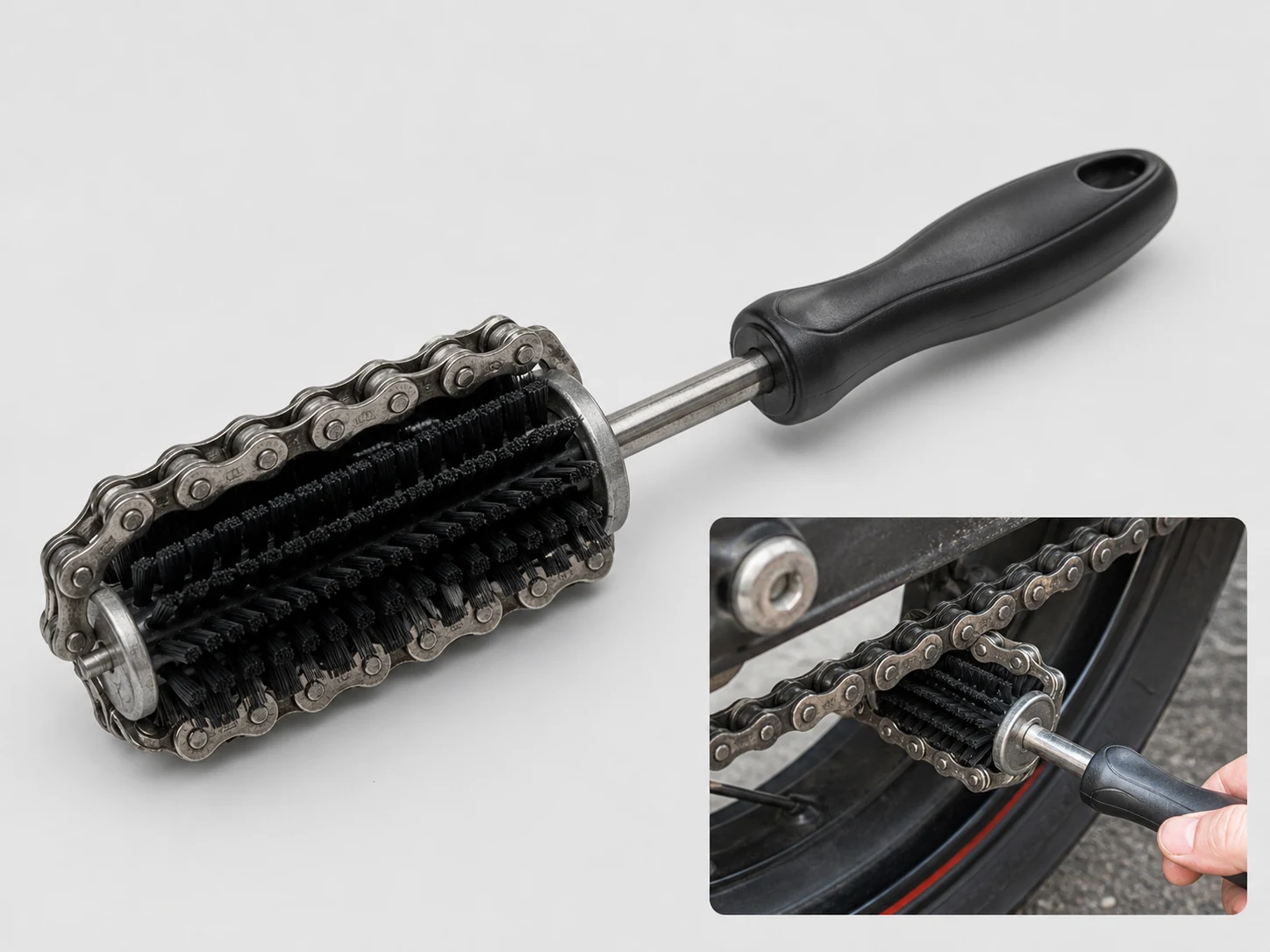
Rotary Chain Brush
A driven cylinder rotating against a moving chain, clearing grease and packed debris from link plates, rollers and joints while the line keeps running.
Small brush
500 pcs
Minimum order
Held in one hand: tube, bottle, detail and swab brushes — including long-handled ones with a small head.
Production lead time, once the specification is confirmed
- Up to 500 pcsWithin 7 days
- 501–50,000 pcsWithin 14 days
- Over 50,000 pcsWithin 21 days
Peak season can extend these times; the shipping date is confirmed in writing with your quotation. Sampling and shipping are quoted separately.
A power-driven cylindrical brush built for in-line chain cleaning and lubrication. It rotates against moving or stationary chain to remove grease, oil, dirt, rust, and packed debris from link plates, rollers, and joints, or to spread fresh lubricant evenly across the chain contact surfaces.
What can this brush do for you?
Cleans chain while the line keeps running
The brush is driven by its own shaft or threaded stud, so it rotates continuously while the chain passes. Every link receives repeated contact on each pass, which removes buildup evenly across the chain face without stopping the line for manual scraping. For overhead conveyors, packaging lines, and continuous chain drives, that means less unplanned downtime and fewer operator hours spent on hand cleaning.
Nylon PA filaments reach into link gaps and sprocket pockets
Nylon PA filaments flex and spring back after deflection, so the tips enter between side plates, around pins and bushings, and into sprocket recesses where packed grease and fine debris collect. The filament removes material from the chain joints themselves, not only from the exposed side plates. Stainless steel wire filament is available when the deposit is hardened rust or carbonized residue that nylon cannot break.
Old residue comes off before fresh lubricant goes on
If old lubricant and abrasive dust stay on the chain, new oil or grease mixes with them into a grinding paste. Running this brush ahead of the lubrication point strips that old film and the particles it holds, so the fresh lubricant can reach the pin and bushing contact surfaces instead of sitting on a contaminated layer.
Works as a controlled lubrication applicator
The same rotating contact can transfer lubricant when the brush is fed by a drip, wick, or metered oil supply. The filaments spread the fluid across the full chain width and carry it into the joint areas, which reduces over-lubrication, dripping, and the uneven film left by a poorly aimed oil line.
Wear is predictable and adjustment is quick
Filament wear shows up as a gradual reduction in outside diameter. The brush can be re-positioned toward the chain to restore contact until the trim length is exhausted, then the worn unit is replaced or re-filamented. Maintenance teams can plan replacement by measured OD instead of waiting for a cleaning failure.
What is a Rotary Chain Brush?
A rotary chain brush is a cylindrical brush with filaments radiating from a central core. The core is mounted on a threaded stud or a drive shaft and positioned above, below, or alongside the chain so the outer filament tips overlap the chain profile by a controlled amount. As the chain advances and the brush rotates, the filaments scrub the side plates, rollers, and exposed joint areas in a continuous wiping action.
This is a machine-mounted component, not a handheld tool. It needs a defined mounting point, a drive source or driven shaft, correct rotation direction, and enough clearance to avoid sprockets and guards. The working face is set to the chain width, while the outside diameter and trim length are set to the available space and the depth of contact required.
In cleaning duty, the brush may run dry, with solvent, or in a washdown zone. In lubrication duty, it is paired with a controlled oil supply and chosen for even film transfer rather than heavy scrubbing. Most units use straight, crimped, or spiral-set nylon PA filaments; stainless steel wire is an option for hardened deposits and higher-temperature or chemically harsh areas.
Technical Specifications
The table below lists the parameters a buyer or engineer should check before ordering. All values can be adjusted to the chain profile and line layout.
| Parameter | Value / Options |
|---|---|
| Brush outside diameter | 50–150 mm (2.0–5.9 in), matched to chain width and available clearance |
| Core diameter / bore | Custom to shaft, threaded stud, or keyed hub; common bores 10–40 mm |
| Face width / working length | Matched to chain width and contact zone; available from 20 mm up to 300 mm per segment |
| Filament material | Nylon PA6, PA66, or PA612, straight or crimped; stainless steel 304 or 316 wire for heavy residue |
| Filament diameter | Nylon: 0.4–1.5 mm; stainless steel wire: 0.15–0.5 mm |
| Trim length (radial filament length) | 10–60 mm, selected for reach, conformability, and contact pressure |
| Fill density / pattern | Straight, spiral, or chevron tuft pattern; density set to stiffness and debris release |
| Mounting interface | Threaded stud (M8–M20) or shaft mount with keyway, set screws, flange, or customer-specified bore |
| Core material | Aluminum, steel, stainless steel, or nylon/PP; selected for environment and drive load |
| Typical operating speed | 50–600 RPM depending on diameter and balance; final rating confirmed per project |
| Operating environment | Dry, oil-wetted, solvent-assisted, or washdown; filament and core grade matched to chemicals and temperature |
| Brush type | Custom Handheld Detail Brushes |
| How it is driven | Hand-guided |
| Cleaning target | overhead and power chain conveyor, packaging line, and chain lubrication station cleaning |
| Surface or part | chains, plates, joints, roller, conveyors, side plates, chain links, and pins |
| Residue or debris | oil, grease, lubricant, dust, rust, grain dust, product drips, and product residue |
| Mounting / connection | Threaded stud (M8–M20) or shaft mount with keyway, set screws, flange, or customer-specified bore |
For most projects we also need the chain pitch, overall chain width, clear opening around the chain, shaft or mounting drawing, line speed, residue sample or description, and cleaning fluid or lubricant type.
Where does this brush work best?
- Overhead and power chain conveyors — removes grease, overspray, and dust from chain links on paint lines, ovens, and material handling systems where stopped-line cleaning is costly.
- Bottling, filling, and packaging lines — cleans drive and guide chains while the line runs and supports controlled lubrication to prevent product drip and label contamination.
- Chain lubrication stations — spreads metered oil or grease across the full chain face and into pin and bushing areas, reducing over-lubrication and uneven film.
- Food processing and washdown conveyors — uses stainless steel core or compatible filament construction to scrub product residue and sticky deposits from chain links in wet cleaning areas; project-specific material support is available.
- Agricultural and bulk handling equipment — clears grain dust, soil, and sticky debris from chain and sprocket contact zones that accelerate chain wear.
- Maintenance and rebuild cells — driven fixtures clean chains before inspection, repair, or re-lubrication so worn links and cracked plates are not hidden under deposits.
How do I choose the right one?
Work through the chain fit, filament fit, and operating conditions in that order. A brush that fits the mounting but carries the wrong filament will create as many problems as one that fits poorly.
Start with the mounting envelope and chain profile
Measure the chain pitch, overall chain width, and the clear space around the chain where the brush will run. The outside diameter must reach the entire exposed contact zone without striking sprockets, guards, product carriers, or adjacent chain strands. Face width should cover the full chain width; for very wide chains, two or more brush segments can be mounted on a common shaft. If the clearance above the chain is small, choose a smaller brush OD with longer trim rather than forcing a large brush into a tight space.
Match the filament to the residue and chain surface
| Condition | Recommended filament |
|---|---|
| Grease, oil, soft dirt, light debris | Straight or crimped nylon PA |
| Wet washdown or constant moisture | Nylon PA with stainless steel core/shaft, or all-stainless construction |
| Hardened rust, carbonized oil, baked deposits | Stainless steel wire, with trial on a sample chain because surface marking is possible |
| Dry dust and loose particles | Crimped nylon at lower fill density for easier debris throw-off |
Nylon PA is the standard starting point for chain cleaning because it is flexible, non-marking on metal chain components, and resists most oils and mild cleaning fluids. Step up to stainless steel wire only when nylon cannot remove the deposit within an acceptable cycle time, or when temperature and chemical exposure exceed nylon’s limits.
Set trim length and fill density for the contact you need
Longer trim conforms around chain contours and reaches deeper into link gaps but applies lower contact pressure. Shorter, denser trim scrubs harder and wears faster. For lubrication distribution, use a shorter, denser trim that picks up less fluid and transfers a thin, even film. For cleaning packed joints, use a medium-length trim that lets the tips deflect into the spaces between side plates.
Choose rotation direction and speed for the process
Counter-rotation relative to chain travel increases the relative surface speed between filament tips and chain, which raises cleaning aggressiveness. Co-rotation is gentler and usually better for lubrication or sensitive surfaces. Both choices affect where debris is thrown, so orient the brush to direct removed material downward or away from product, not toward the clean side of the line.
Define the wet, dry, and temperature conditions
Dry cleaning needs a debris collection or containment plan. Solvent-assisted cleaning requires confirmation that the nylon grade and core material tolerate the solvent. If the application is a washdown area or exceeds the continuous temperature limit of nylon, select stainless steel wire and a stainless core. Provide the actual chemical and temperature range during quoting so the brush is built for the environment, not for a generic chain.
When this brush is not the right choice
Use a handheld chain cleaning brush for occasional manual cleaning of accessible motorcycle or industrial chains. Use a felt wiper or drip system if the job is only oil application and no debris removal is needed. Use a knotted wire wheel or blasting for heavy scale that has fused to the chain surface. If your process requires a very narrow contact zone or a brush under about 50 mm outside diameter, a smaller specialty brush or a different mounting configuration may be more practical.
Can I customize this brush?
Rotary chain brushes are built around the chain, the drive, and the line layout. To define a custom unit, send the chain type and pitch, overall chain width, clear opening, mounting or shaft drawing, line speed, rotation direction, residue description or sample, cleaning fluid or lubricant, operating temperature, and any service-life target. A sample link or worn chain section helps us confirm the joint geometry.
We can adjust:
- Brush geometry — outside diameter, core diameter, face width, trim length, and segment arrangement for wide chains
- Filament material — nylon PA6, PA66, PA612, straight or crimped, stainless steel 304/316, or mixed filament construction
- Filament and fill — filament diameter, tuft pattern (straight, spiral, chevron), and fill density for the required contact pressure
- Mounting interface — threaded stud size and pitch, keyed bore, set-screw hub, flange mounting, or machining to the customer’s shaft
- Core material — aluminum, steel, stainless steel, nylon, or PP for weight, corrosion, and drive-load requirements
- Rotation and balance — direction preference, dynamic balancing for higher speed, or marking of intended rotation
- Color and identification — filament color, core marking, or project-specific labeling
- Packaging — bulk, individual wrap, segmented sets, or project-specific packing
If the project requires material documentation, dimensional inspection, or third-party testing for a specific customer specification, we can arrange that support during the customization process.
How long does a rotary chain brush last, and how is it cleaned between runs?
How should I set the brush-to-chain contact?
Start with light contact: set the filament tips to overlap the chain surface by about 2–5 mm. Run the line briefly and inspect the chain. If residue remains, increase overlap in small steps. If the brush runs hot, the filament tips bend permanently, or dust generation is excessive, reduce the overlap. The right setting removes residue with visible filament recovery after each pass.
How can I tell when the brush needs replacement?
Measure the outside diameter at both ends and the middle of the face. If the OD has worn below the minimum set for your chain profile, or if re-positioning no longer restores even contact across the chain width, replace the brush. Also check for missing tufts, cracked core, shaft runout, or filament that stays bent instead of springing back.
Can one brush clean the chain and apply lubricant at the same time?
It can, but the result is better when the two functions are separated. A single brush wetted with oil removes some debris while applying lubricant, but the removed material mixes into the oil film. The preferred layout is a cleaning brush first, followed by a rinse or wipe, then a separate lubrication brush or oiling station. If space is limited, use two zones on the same shaft with different trim and fill.
Which rotation direction should I use?
Counter-rotation to chain travel creates a higher relative surface speed and stronger scrubbing action, which is preferred for heavy grease and packed debris. Co-rotation is gentler and works better for lubrication or delicate chain surfaces. Also consider throw direction: counter-rotation typically throws debris toward the incoming chain side, so install shielding or collection to keep the surrounding area clean.
What if the chain is wider than a single brush face?
Wider chains can be covered with two or more brush segments mounted end-to-end on a common shaft. We set the segment widths and any small gaps between them to avoid a missed strip in the center of the chain. The total face width, not the individual segment, should match the chain width plus the required overlap.
Does the brush replace solvent washing or chain disassembly?
No. The brush removes material that is mechanically accessible on the outside of the chain and in open joint areas. Hardened deposits inside sealed or tightly assembled joints may still require solvent soak, steam cleaning, or disassembly. After brushing, inspect the pin and bushing areas and wipe a sample link with a clean cloth to confirm the deposit is gone before re-lubrication.
Guides that go deeper on this
We have not written a guide specific to this one yet. The material that covers selection, filament, dimensions, maintenance and sourcing is collected in the technical resources library.
Custom Manufacturing RFQ
Describe Your Application
To prepare the correct quotation, provide the dimensions, cleaning task, residue, material, mounting details, quantity, and a drawing or photo.
Drawing or photo optional — it speeds things up, it does not gate the enquiry.
Custom Brush RFQ
Send Your Brush Project
Upload a drawing, product photo, or sample photo and provide the core dimensions and cleaning conditions.
“We need a brush to remove wet residue from a stainless steel conveyor, about 800mm wide. The current brush wears quickly. We can send photos.”
“We sell drinkware and need a cleaning brush to include with the product. Quantity around 5,000 pieces.”