
Custom Cleaning Brush
Anti-Static Printing Brush
Grounded conductive filament brush that dissipates static and removes paper and film dust on printing webs and sheets. Custom widths, mounts and filaments.
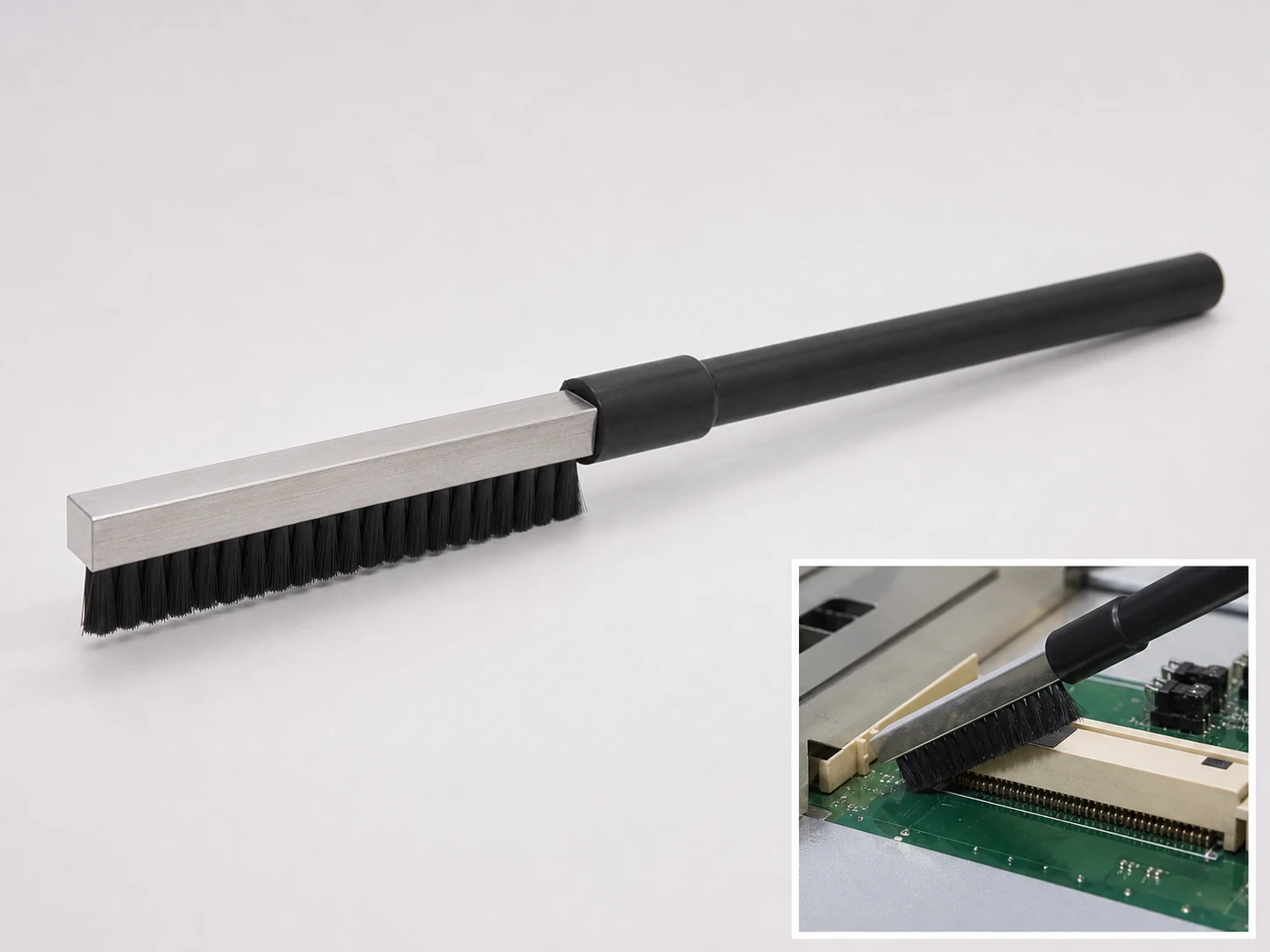
Small brush
500 pcs
Minimum order
Held in one hand: tube, bottle, detail and swab brushes — including long-handled ones with a small head.
Production lead time, once the specification is confirmed
- Up to 500 pcsWithin 7 days
- 501–50,000 pcsWithin 14 days
- Over 50,000 pcsWithin 21 days
Peak season can extend these times; the shipping date is confirmed in writing with your quotation. Sampling and shipping are quoted separately.
An anti-static printing brush uses grounded conductive filaments to drain static charge from moving paper, film, and board while lightly sweeping away loose dust and lint. It mounts directly in the press or converting line feed path to stop static-related feeding and printing problems before they reach the print unit.
What can this brush do for you?
Drains static charge at the contact point
Conductive filaments set in a grounded channel give the charged surface a controlled path to machine earth. On a moving web or sheet, this lowers surface voltage before the material enters the next process step, so sheets stop sticking and double feeding, film stops wrapping rollers, and ink mist is reduced.
Lifts paper dust and lint without abrading the substrate
Soft conductive nylon tips flex as they contact coated stock, films, and label facestocks. Loose particles are swept away or dropped from the surface. The brush is designed for light dry particle removal, not for scrubbing dried ink or adhesive residue.
Fits the existing machine layout
The brush can be built as a straight strip, angled bar, or two-sided array in an aluminum or conductive plastic profile. End brackets, slotted holes, T-slot mounts, or magnetic holders let you position it at the infeed, after a slitter, before a coating station, or wherever static and dust are causing problems.
Provides a confirmed ground path through the assembly
The conductive backing and ground wire are part of the product. When mounted to a grounded press frame, the brush is ready to dissipate charge without a separate clip or adapter, as long as the frame itself is properly earthed.
What is an Anti-Static Printing Brush?
An anti-static printing brush is a passive static control device built as one or more rows of conductive filaments held in a grounded profile. It is positioned so the web or sheet passes lightly against the filament tips before entering the print unit, coating station, cutter, or stacker. The brush does two jobs at once: it gives static charge a controlled path to ground, and it sweeps away surface dust and lint that static would otherwise hold on the material.
The working principle is contact-based. Charge transfers through the filament tips into the conductive backing and then through the ground wire to machine earth. The brush does not emit ions and is not an active eliminator. That means it must touch the surface and the holder must be grounded to work.
Typical construction uses conductive nylon, carbon-filled nylon, carbon fiber, or Thunderon filaments stapled or set into a conductive channel. The profile can be aluminum with a conductive finish, stainless steel, or conductive plastic. Mounting brackets hold the brush at the required height and angle. This type of brush is used in sheet-fed offset, web offset, flexographic, digital, laminating, and converting lines where static charge and loose dust interfere with feeding, registration, or coating quality.
Technical Specifications
| Parameter | Value / Options |
|---|---|
| Filament material | Conductive nylon (carbon-filled), carbon fiber, Thunderon, or custom blend |
| Filament surface resistivity | 10⁶–10⁹ Ω/sq for anti-static grade; below 10⁶ Ω/sq for conductive grade, selected by process speed and charge level |
| Filament diameter | 0.05–0.30 mm; finer options for films and coated papers, heavier for board |
| Filament length (trim) | 15–60 mm; adjusted to contact geometry and web wrap requirement |
| Overall length / working width | 100–3,000 mm standard; longer widths by joining sections; matched to web or sheet width plus required overhang |
| Backing / profile | Aluminum with conductive finish, stainless steel, or conductive PVC/PE |
| Mounting | End brackets, slotted holes, T-slot, magnetic, or custom bolt pattern |
| Ground connection | Conductive core or backing with ground wire, ring terminal, or stud; wire length and termination per machine |
| Filament density | 2–6 filament bundles per 10 mm; higher density for heavy dust, lower for delicate film |
| Operating speed | Up to 300–500 m/min depending on contact depth, filament stiffness, and charge level |
| Temperature range | -20°C to +80°C standard; carbon fiber and conductive metal profiles can extend the range |
| Brush type | Custom Strip Seal Brushes |
| How it is driven | Fixed in place, no drive of its own |
| Cleaning target | sheet-fed offset and digital press, web offset and web flexo line, and laminating, coating and wide-format printer cleaning |
| Surface or part | webs, boards, sheets, drain, profiles, aluminum, plastic, substrates, and roller |
| Residue or debris | dust, lint, loose dust, ink mist, carbon, fiber, adhesive, particles, and static-attracted particles |
| Mounting / connection | End brackets, slotted holes, T-slot, magnetic, or custom bolt pattern; Conductive core or backing with ground wire, ring terminal, or stud; wire length and termination per machine |
All dimensions, materials, mounting, and ground interfaces can be adjusted to the machine. Provide a layout drawing or photo of the installation position so the brush is sized to the actual web path and holder.
Where does this brush work best?
- Sheet-fed offset presses: installed on feed tables, register boards, and delivery paths to prevent static-induced double feeds and reduce paper dust transfer.
- Web offset and flexographic presses: mounted before print units on paper, board, or film webs to lower static build-up that causes misregister, ink mist, and sparking.
- Digital and wide-format printers: placed in the media path ahead of the print head so static does not pull dust onto the media or cause head strikes.
- Laminating and coating lines: brushing the web before coating or laminating stations keeps dust and lint from being trapped under the film or coating.
- Sheeters, slitter rewinders, and folders: positioned after cutting or folding to prevent static cling, sheet sticking, and uneven stacking.
How do I choose the right one?
Start by identifying where the brush will contact the material and what problem is most critical.
1. Measure the contact zone. For a continuous web, determine whether one side or both sides carry charge. For sheet-fed machines, the brush height must let the tips just contact the stock without excessive pressure. A two-sided array or a wrap-angle configuration may be needed if both surfaces are charged.
2. Match filament resistivity to the process. Conductive grades (below 10⁶ Ω/sq) drain charge faster and suit high-speed webs or severe static. Anti-static grades (10⁶–10⁹ Ω/sq) provide controlled dissipation and reduce the risk of rapid discharge marking sensitive substrates. Carbon fiber is stiffer and removes heavier dust; conductive nylon is softer on film and coated paper; Thunderon offers flexible conductive tips for delicate surfaces.
3. Choose filament length and density for the substrate. Film and thin label stock need longer, finer, lower-density filaments that feather over the surface. Board and heavier paper can use shorter, stiffer, denser filaments to dislodge lint without collapsing.
4. Verify the ground path. The brush only works if the backing is connected to a true machine ground. Use a multimeter to confirm continuity from the filaments to the earth point before production. If the press frame is not grounded, add a dedicated ground wire.
5. Plan for cleaning and replacement. A loaded brush can transfer dust back to the web. Choose a design that allows removal for compressed-air cleaning, or order spare inserts so the line has a quick changeover set.
| Condition | Recommended configuration |
|---|---|
| High-speed web, severe static | Conductive carbon or conductive nylon below 10⁶ Ω/sq, two-sided or wrap contact |
| Coated paper, film, label stock | Anti-static conductive nylon or Thunderon, fine trim, lower density |
| Heavy paper, board, converting | Stiffer carbon fiber or dense conductive nylon, shorter trim |
| Sheet-fed feed table | Anti-static conductive nylon, adjustable bracket, single row |
When another solution makes more sense: If the surface voltage is extremely high or the line speed exceeds what contact time the brush can provide, use an active ionizing bar in addition to or instead of the brush. If the surface carries oil, adhesive, or dried ink, the brush will not remove it; choose a solvent wiper or cleaning roller. If there is no ground path, the brush cannot dissipate static.
Can I customize this brush?
Anti-static printing brushes are built to the machine. Provide the substrate type and width, line speed, measured static voltage if available, dust type, available mounting area, bracket or hole pattern, and whether one or both sides need contact. A drawing or photo of the installation location shortens the process.
We can adjust:
- Working width and profile: 100 mm to several meters, single bar or segmented, straight or curved to follow a roller radius.
- Filament system: material, resistivity grade, diameter, trim length, density, number of rows, and double-sided arrays.
- Backing and mounting: aluminum with conductive coating, stainless steel, or conductive plastic; holes, slots, T-slot, magnetic, or spring-loaded adjustable brackets.
- Ground interface: ground wire length, ring terminal, banana plug, or stud, and the connection position along the length.
- Marking: custom color, logo, part number, or identification stripe.
- Packaging and replacement: bulk, individually wrapped, spare filament inserts, or replacement strips.
If your project requires material declarations, ESD test data, inspection, or third-party testing, we can arrange that support during the customization process.
Which filament survives the cleaning chemicals an anti-static printing brush meets?
How can I tell if the brush is grounded properly?
Use a multimeter in continuity mode between the filament tips and the machine ground point. Resistance should be low: typically under 1 megohm for an anti-static grade and well under 100 kilohms for a conductive grade. If there is no continuity, fix the ground connection before running production. A surface field meter before and after the brush should also show a clear voltage drop.
What static levels can this brush handle?
A contact brush works on static charge that can be drained by touching the surface. If the web carries tens of kilovolts or the line speed is so high that contact time is only milliseconds, the brush may only partially reduce charge. Measure residual voltage after the brush; if it remains above your process limit, add an active ionizer ahead of or after the brush.
How do I clean the brush without damaging the conductive filaments?
Remove the brush from the machine, then use clean, dry compressed air to blow dust out of the filament row. A vacuum with a soft nozzle also works. Avoid washing conductive nylon or Thunderon with water or solvents unless the filament is rated for it, because residue can raise surface resistivity. Replace the brush if filaments become matted, broken, or no longer show continuity to ground.
Will this brush scratch coated paper or film?
In normal setup, fine conductive nylon or Thunderon filaments are soft enough for coated stock and most films. The risk appears when the brush is pressed too hard, the trim is too short and stiff, or abrasive dust has become trapped in the filament row. Test height and pressure on scrap material before full production, and keep the brush clean.
Anti-static and conductive filaments—what is the difference for my line?
Anti-static grades have higher surface resistivity, usually 10⁶–10⁹ ohms, so charge bleeds away more gradually. Conductive grades are below 10⁶ ohms and drain charge faster, which suits high-speed webs and high static levels. On delicate or static-sensitive materials, anti-static grade reduces the chance of a rapid discharge marking the surface.
Can I use the same brush on an offset press blanket or in a wash-up unit?
No. This brush is intended for paper, film, board, and sheet/webs in the feed path. It is not a solvent cleaning brush for rollers, blankets, or plates. Solvent exposure can degrade conductive nylon and attack the backing and ground connection. Use a dedicated roller washing brush for those areas.
Guides that go deeper on this
Anti-Static Carbon Fiber Printing Brush: When Does It Make Sense?
Read this guideGuideCustom Anti-Static Printing Brush: What to Specify
Read this guideGuideAnti-Static Strip Brushes: What Sets the Resistance?
Read this guideGuideConveyor Belt Cleaning Brush Design
Read this guideGuideCustom Brush Sampling and Validation Plan
Read this guideGuideWhich Anti-Static Strip Brushes Suit Food Processing Lines?
Read this guideCustom Manufacturing RFQ
Describe Your Application
Please share the brush dimensions, working area, residue type, material direction, quantity, and a drawing or photo for quotation.
Drawing or photo optional — it speeds things up, it does not gate the enquiry.
Custom Brush RFQ
Send Your Brush Project
Upload a drawing, product photo, or sample photo and provide the core dimensions and cleaning conditions.
“We need a brush to remove wet residue from a stainless steel conveyor, about 800mm wide. The current brush wears quickly. We can send photos.”
“We sell drinkware and need a cleaning brush to include with the product. Quantity around 5,000 pieces.”