
Custom Cleaning Brush
Anti-Static Strip Brush
Industrial anti-static strip brush in conductive or anti-static nylon, 100–3000 mm lengths, 10³–10⁹ Ω resistance, standard channel mounting for webs.
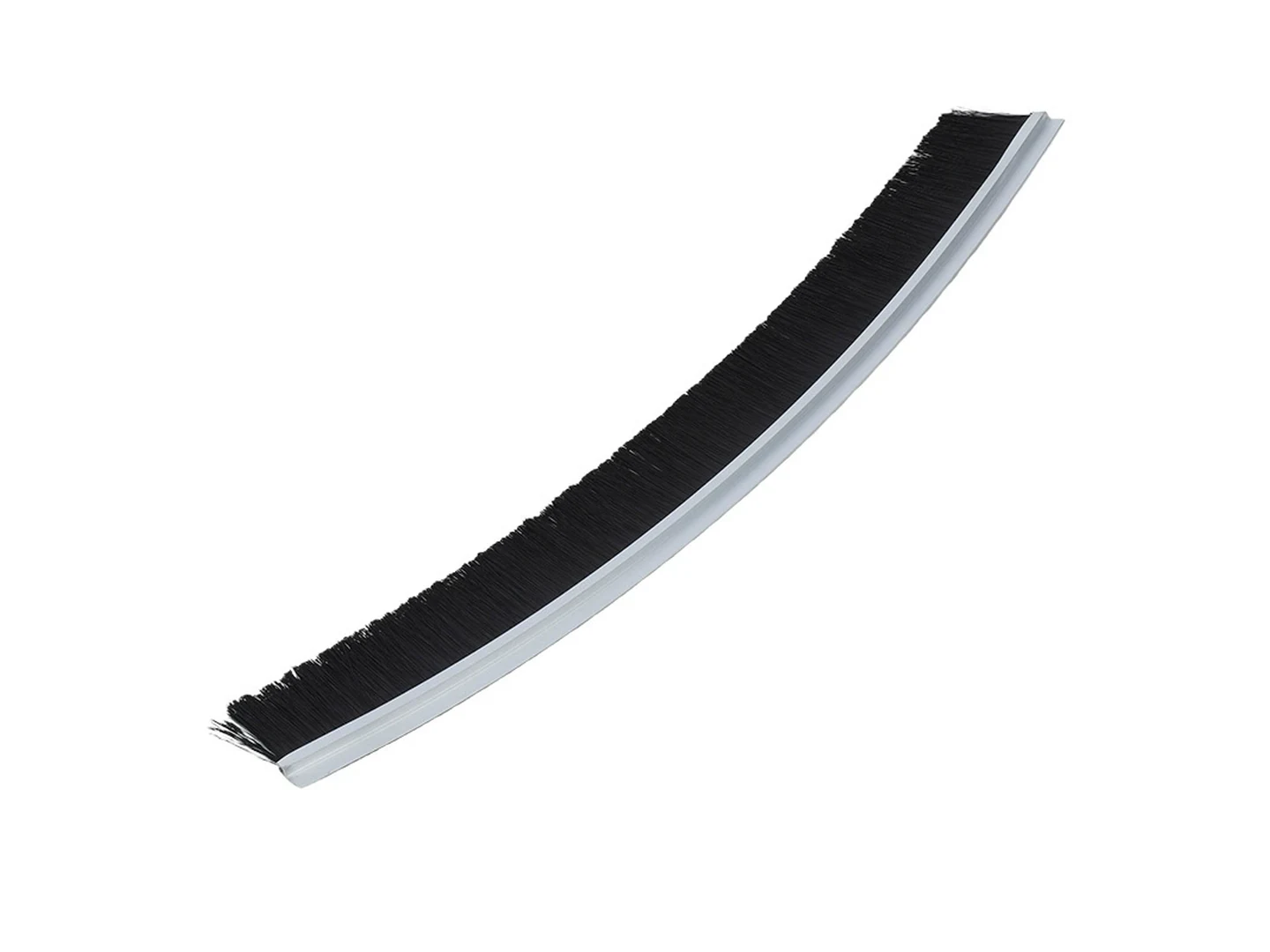
Large-format brush
100 pcs
Minimum order
Built one at a time on a core or channel: full-width rollers, sweeper brooms and long strip.
Production lead time, once the specification is confirmed
- Up to 100 pcsWithin 20 days
- 101–1,000 pcsWithin 30 days
- Over 1,000 pcsConfirmed with your quotation
Peak season can extend these times; the shipping date is confirmed in writing with your quotation. Sampling and shipping are quoted separately.
An industrial anti-static strip brush that creates a grounded filament contact line across moving webs, sheets, and conveyor surfaces. It dissipates static charge at the point of contact and lifts loose, static-attracted dust and fine particles before they reach coating, printing, or packaging stages.
What can this brush do for you?
Grounded Filament Contact Across the Full Web Width
The continuous channel fill places conductive nylon or anti-static filaments edge to edge along the entire strip. When the holder is grounded, each individual filament becomes a discharge path, so charge bleeds off the product at many contact points instead of one or two. The result is uniform static dissipation with no untreated bands across the moving surface.
Loose, Static-Attracted Dust Releases at the Contact Line
Dust that is held to a film or sheet primarily by electrostatic attraction often stays attached even when a clean wiper passes over it. The brush removes the charge first; once the static grip is gone, the filament tips can sweep the loose particles free. Position an extraction hood or vacuum nozzle just after the brush and the released dust is carried away instead of falling back onto the line.
Resistance Matched to the Discharge Speed You Need
Filament systems are available across a 10³–10⁹ ohm resistance range. Lower-resistance conductive nylon drains charge quickly for high-speed or heavily charged webs, while higher-resistance anti-static filament produces a slower, more controlled decay for sensitive materials or discharge currents that must be limited. The strip is built to a resistance target, not sold as a single-value answer for every line.
Compression-Controlled Contact That Protects the Substrate
The free trim height is set so the filament tips flex between 5% and 25% of their length in service. That light interference is usually enough to establish consistent electrical contact and disturb loose particles without the digging or marking that can happen when a stiff brush is forced into a delicate film, foil, coated paper, or printed surface.
A Compact Profile for Tight Machine Openings
With trim heights from 12.7 mm to 152.4 mm and channel backs from 3.2 mm to 14.3 mm, the strip can be mounted inside narrow web paths, near roller nips, at sheet exits, or along conveyor transition points where a larger static bar or cleaning assembly would not fit. When the holder style matches the machine, the worn strip can also be replaced without changing the mounting hardware.
What is an Anti-Static Strip Brush?
An anti-static strip brush is a linear strip of conductive or static-dissipative filaments crimped into a metal or plastic channel backing. It mounts into a straight channel, aluminum carrier, or angle holder fixed to the machine frame, and that holder is connected to machine ground. In operation, the filament tips contact a moving web, sheet, or conveyor surface and provide a path for the static charge to leave the product and pass to ground.
This is a passive, contact-based static control device. It works only where the filament tips actually touch the product, so the mounting position and compression setting are part of the installation. The brush is normally placed where the charge or dust problem matters: before a print or coating unit, after slitting or rewinding, at a sheet exit, or along a conveyor transition where parts need to be discharged.
The same contact that bleeds charge also mechanically clears loose, dry particles from the surface. The brush is not intended for removing oil, adhesive, tacky residues, or scale, and it does not clean by itself — released dust still needs an extraction system or downstream cleaning step.
Standard strip lengths run from 100 mm to 3,000 mm. Wider lines can be covered with joined sections, but long unsupported lengths usually need intermediate support to keep the contact line straight.
Technical Specifications
The following values can be adjusted to the machine and substrate. The dimensions below make sense when the strip is mounted: the nominal free trim height is not the installed height, because 5–25% of the trim is compressed in service.
| Parameter | Value / Options |
|---|---|
| Strip length | 100–3,000 mm per section; multiple sections can be joined for wider lines |
| Trim height (free filament length) | 12.7–152.4 mm (0.5–6.0 in) |
| Channel / backing width | 3.2–14.3 mm (0.126–0.563 in), matched to the existing holder groove |
| Filament diameter | 0.10–1.27 mm (0.004–0.050 in) |
| Fill material | Conductive nylon, anti-static filament, or a combination fill for the required resistance and stiffness |
| Electrical resistance | 10³–10⁹ Ω, selected for conductive or static-dissipative duty |
| Recommended working compression | 5–15% of trim height for wiping and dust control; 10–25% for sealing or firmer contact |
| Backing material | Galvanized steel, stainless steel, or aluminum, selected for holder fit and operating environment |
| Holder / mounting | Straight channel, aluminum carrier, angle holder, or custom profile with pre-punched mounting holes |
| Ground connection | Grounding terminal or conductive holder-to-machine-ground connection |
| Brush type | Custom Strip Seal Brushes |
| How it is driven | Fixed in place, no drive of its own |
| Cleaning target | web converting and coating line, printing and packaging equipment, and sheet cleaning |
| Surface or part | webs, sheets, conveyors, channel, plastic, panels, roller, and substrates |
| Residue or debris | dust, particles, static-attracted dust, fine particles, loose particles, adhesive, oil, and scale |
| Mounting / connection | Straight channel, aluminum carrier, angle holder, or custom profile with pre-punched mounting holes; Grounding terminal or conductive holder-to-machine-ground connection |
Where does this brush work best?
- Web converting and coating lines: film, paper, foil, label stock, and nonwoven webs before print, coating, laminating, or slitting stations.
- Printing and packaging equipment: sheet-fed presses, carton lines, shrink film, and package form-fill-seal paths where static causes misfeeds, sticking, or dust pickup.
- Sheet handling and panel lines: plastic sheets, glass panels, PCB panels, and thin boards where static holds dust and causes transport or stacking problems.
- Conveyor transitions and machine openings: grounded contact lines along rollers, belts, product transfer points, and openings where passing parts need to be discharged.
- Pre-inspection and cleanroom entry points: dry contamination release on parts entering inspection, painting, coating, or packaging areas.
In each case the brush should be positioned so the filaments contact the surface before sensitive processes or after charge-generating operations. The mounting and grounding are as important as the filament choice.
How do I choose the right one?
Start with the charge behavior and the installation, then work down to filament detail.
- Set the resistance target. Determine how fast the charge must decay and whether the product can tolerate a rapid discharge. If the web carries a strong charge and the product is not sensitive, lower-resistance conductive nylon (10³–10⁵ Ω class) usually gives the fastest decay. If the product or nearby electronics require a controlled discharge, choose a static-dissipative fill in the 10⁶–10⁹ Ω range.
- Measure the mounting gap and clearance. Find the distance from the holder to the product at the contact point, including any variation in web position, sheet thickness, or conveyor sag. The free trim height should be long enough to compress 5–15% in the normal wiping position without bottoming or buckling.
- Match filament diameter to the substrate. Fine filaments of roughly 0.10–0.25 mm suit thin films, foils, and coated surfaces; mid-range 0.25–0.50 mm handles paper, carton, and lightweight sheets; coarser 0.50–1.27 mm filament provides more stiffness and wear life for thicker webs, nonwovens, or higher-load contact.
- Confirm the channel and holder interface. Measure the existing groove width and check what backing material the holder accepts. The strip back should slide or bolt in without play, and the grounding terminal must make clean metal-to-metal contact.
- Set compression and verify. At 5–10% compression the brush is a light wiping contact; at 10–15% it is a working dust-removal contact; at 15–25% it becomes a firmer sealing or high-contact setting. Over-compression folds the filaments, widens the contact patch, and shortens filament life.
Consider a different tool when the contamination is wet, oily, tacky, or bonded to the surface — an anti-static strip brush removes dry loose particles and released dust, not deposits that require solvent or mechanical force. If the charge is generated after the brush contact point or the surface cannot be touched, use an ionizing bar or combine the two. For very abrasive or heavy debris, a conventional PBT, nylon, or wire strip brush may be a better wear choice. For widths above 3,000 mm, split the run into supported sections to keep the tips in line.
| Your condition | Preferred configuration |
|---|---|
| High charge, fast line, no sensitive electronics | Conductive nylon, 10³–10⁵ Ω, firmer contact |
| Sensitive products, controlled discharge | Anti-static/dissipative filament, 10⁶–10⁹ Ω, lighter compression |
| Thin film, foil, coated stock | Fine filaments, 5–10% compression |
| Thick web or sealing contact | Coarser filaments, 15–25% compression |
Can I customize this brush?
Yes. The strip is usually built to the line, not picked from a shelf. Provide the web or part width, substrate material and thickness, line speed, mounting clearance, holder groove dimensions, grounding point, and the required resistance or charge level. A photo or CAD sketch of the mounting area helps avoid interfacing errors.
We can adjust:
- Length and sections: 100–3,000 mm per section, butt joints for wider runs, notched or tapered ends.
- Trim height and filament diameter: matched to the gap, substrate stiffness, and contact requirement.
- Fill and resistance: conductive nylon, anti-static filament, or combined fill; resistance class selected between 10³ Ω and 10⁹ Ω.
- Backing channel: galvanized steel, stainless steel, or aluminum; width and profile matched to your holder; pre-punched mounting holes or custom notches.
- Carrier / holder: straight channel, angle holder, aluminum extrusion, or custom bracket with a specified ground stud or cable position.
- Color, marking, and packaging: standard black or custom color for line identification, batch labels, coil or cut-length packing, and project-specific packaging.
When the project calls for material declarations, inspection records, or third-party testing, we can support those requirements through the customization process instead of offering them as off-the-shelf properties.
How do you tell when an anti-static strip brush is worn out?
How do I verify that the brush is actually grounded after installation?
Measure the resistance from several filament tips to the holder ground terminal, and from that terminal to machine ground. The reading should sit inside the selected resistance range and stay stable along the full width. If the value is open or unstable, check the conductive back-to-holder contact, the ground terminal, paint or corrosion on mating surfaces, and filament contamination.
What does over-compression look like in service?
The filament tips bend into a hook or splay sideways instead of flexing uniformly, the contact changes from a thin line to a wide patch, and dust may be pushed around rather than released. When the web stops, the filaments should straighten again; if they stay folded or kinked, the gap is too tight or the trim height is too short.
Can this brush be used without a vacuum or extraction system?
It releases static-attracted dust from the product, but the loosened particles still need somewhere to go. Without extraction, some dust falls back onto the line or builds up in the filament row. For clean results, place a vacuum nozzle or extraction hood immediately after the contact line.
Does the anti-static strip brush replace an ionizer or static bar?
Only for surfaces the filaments actually touch. If the charge is regenerated after the brush, or if the product has deep internal areas or non-contact surfaces that remain charged, an ionizing bar may still be required. Many lines use both: brush contact for the accessible surface and ionization for airborne or downstream charge.
What should I check during routine filament inspection?
Look for permanent bending, broken or missing tips, build-up of dust or coating, and resistance drift outside the selected range. Confirm the holder bolts and ground terminal are tight. A brush that no longer makes a consistent line contact should be replaced before it stops discharging or begins marking the product.
When is a conventional strip brush the better choice?
If the contamination is abrasive, heavy, wet, sticky, or the brush has to scrub rather than lightly contact, a conventional PBT, nylon, or wire strip brush may last longer and do the job better. The anti-static strip brush is chosen for charge dissipation and dry particle release, not for removing bonded or liquid soils.
Guides that go deeper on this
Anti-Static Strip Brushes: What Sets the Resistance?
Read this guideGuideWhich Anti-Static Strip Brushes Suit Food Processing Lines?
Read this guideGuideBattery Separator Brushes: Cleaning and Static Elimination
Read this guideGuideCeramic Strip Brushes: Why Glass Lines Use Them
Read this guideGuideConveyor Belt Cleaning Brush Design
Read this guideGuideCustom Brush Sampling and Validation Plan
Read this guideCustom Manufacturing RFQ
Describe Your Application
An accurate custom quote starts with the dimensions, working surface, residue, material choice, connection, quantity, and reference files.
Drawing or photo optional — it speeds things up, it does not gate the enquiry.
Custom Brush RFQ
Send Your Brush Project
Upload a drawing, product photo, or sample photo and provide the core dimensions and cleaning conditions.
“We need a brush to remove wet residue from a stainless steel conveyor, about 800mm wide. The current brush wears quickly. We can send photos.”
“We sell drinkware and need a cleaning brush to include with the product. Quantity around 5,000 pieces.”