
Custom Cleaning Brush
Anti-Static Packaging Brush
Custom anti-static packaging brush with grounded conductive carbon fiber, nylon or acrylic filaments to eliminate static and dust on film and paper.
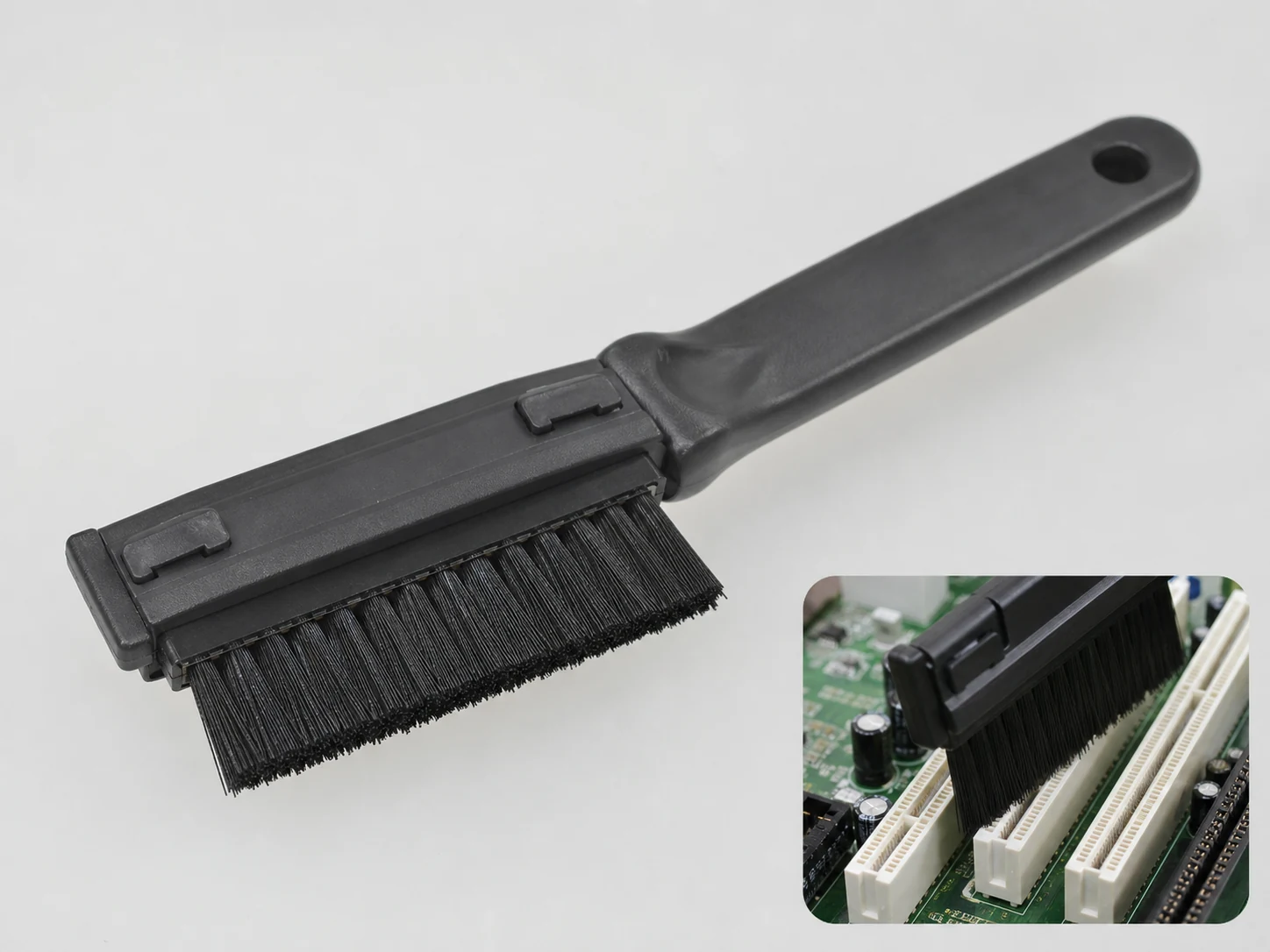
Large-format brush
100 pcs
Minimum order
Built one at a time on a core or channel: full-width rollers, sweeper brooms and long strip.
Production lead time, once the specification is confirmed
- Up to 100 pcsWithin 20 days
- 101–1,000 pcsWithin 30 days
- Over 1,000 pcsConfirmed with your quotation
Peak season can extend these times; the shipping date is confirmed in writing with your quotation. Sampling and shipping are quoted separately.
A grounded conductive-filament brush that neutralizes static charge and lifts static-attracted dust from moving film, paper, and product surfaces on packaging lines — installed inline before printing, sealing, or stacking operations.
What can this brush do for you?
Drains static charge before it causes misfeeds and jams
Conductive carbon fiber or nylon filaments contact the moving web and provide a path for static charge to flow to ground. This prevents film clinging, sheet sticking, double feeds, and the small sparks that can cause operator shocks or ignite solvent vapors.
Removes dust and particles that static holds on the surface
Static charge makes film and paper attract airborne dust, slitting debris, and fine fibers. The filament tips dislodge these particles while the charge is dissipated, so the debris does not re-attach downstream.
Soft contact that preserves film clarity and print quality
Carbon fiber and conductive nylon filaments are flexible and non-abrasive; they clean without clouding clear windows, scratching coated films, or marking printable surfaces.
Continuous cleaning without operator handling
The brush mounts directly to the packaging machine and works on the moving web at line speed. It replaces manual wiping and reduces contamination risk from operator contact.
Covers the full web width with uniform contact
The active face is sized to the film or product path, with filament density and trim length matched to the surface. Every lane receives the same static control and dust removal.
What is an Anti-Static Packaging Brush?
An Anti-Static Packaging Brush is a grounded brush with electrically conductive or static-dissipative filaments. It is installed across a packaging line so the filament tips lightly contact the moving film, paper, or product surface. The conductive filaments carry the electrostatic charge through the brush body to earth ground, neutralizing the surface. At the same time, the soft tips mechanically dislodge dust, paper fibers, and other particles that static attraction has bonded to the surface.
The brush is a passive static control device. It does not generate ions like an ionizing bar; it works by direct contact and conduction. For it to function, the brush back or holder must be connected to a reliable machine ground. The position, contact pressure, and filament condition all affect performance — a brush installed too far from the surface or with broken ground wiring will not dissipate charge.
This is not a scrub brush and is not designed for removing oil, grease, adhesives, or heavy debris. It is a precision contact tool for static elimination and light particle control on packaging materials.
Technical Specifications
| Parameter | Value / Options |
|---|---|
| Overall length | 100–2000 mm, cut to web width plus mounting clearance |
| Active working width | 50–1800 mm, matched to film, paper, or product path |
| Filament material | Carbon fiber, conductive nylon, or conductive acrylic (blend options) |
| Surface resistivity target | 10^6–10^9 Ω, conductive to static-dissipative range |
| Filament diameter | 0.05–0.30 mm; finer for delicate films, thicker for longer wear |
| Trim length | 10–40 mm, set for desired contact pressure and mounting clearance |
| Filament density | 40–400 filaments/cm², selected for surface coverage and particle pickup |
| Back / body | Aluminum, stainless steel, or conductive plastic with grounding terminal |
| Mounting interface | End brackets, back-mount slots, or machine-specific holders |
| Grounding method | Ground lug, pigtail with ring terminal, or conductive mounting hardware |
| Operating temperature | -20°C to +80°C typical; higher ratings available with material change |
| Chemical exposure | Compatible with common dry packaging environments; specify solvents for wet cleaning |
| Brush type | Custom Strip Seal Brushes |
| How it is driven | Fixed in place, no drive of its own |
| Cleaning target | form-fill-seal and vertical bagging machine, slitter rewinder and converting line, and flexographic and digital printing cleaning |
| Surface or part | webs, bars, carriers, trays, frames, product paths, and cable |
| Residue or debris | dust, fiber, paper fibers, particles, static-attracted dust, carbon, adhesive, and oil |
| Mounting / connection | End brackets, back-mount slots, or machine-specific holders |
We adjust each parameter to the actual web width, machine position, static generation level, and surface sensitivity. These are not fixed catalog dims; they are the design range we build from.
Where does this brush work best?
- Form-fill-seal and vertical bagging machines: treats film web before forming, filling, and sealing to prevent static cling and seal contamination.
- Slitter rewinders and converting lines: removes slitting dust and film/paper fibers while dissipating unwind and rewind static.
- Flexographic and digital printing on film: cleans the web before print stations so dust and static charges do not cause print defects.
- Labeling and shrink sleeve applicators: reduces label stock misfeeds and static attraction of dust before application.
- Pharmaceutical and medical packaging: controls static on lidding film and blister webs to keep sealing areas particle-free.
- Electronics packaging: removes static from carrier tapes, trays, and reels before component placement or sealing.
How do I choose the right one?
Measure the web and mounting space first
The active working width must span the full film or product path, or at least every lane that needs treatment. Measure the available mounting position, clearance to the web, and any machine members that could interfere with the brush body.
Match the filament material to static level and surface sensitivity
Carbon fiber offers the lowest resistance and fastest charge dissipation, with minimal particle shedding — ideal for high static, cleanroom, or optical-clear films. Conductive nylon is more durable and abrasion-resistant, suitable for longer service intervals and rougher paper webs. Conductive acrylic is softer and less aggressive, often chosen for delicate coated films or very thin materials.
Set trim length and density for contact pressure
Longer trim provides conformability over uneven surfaces, but reduces scrubbing force. Shorter trim gives firmer contact for more dust removal. Higher filament density gives more conductive contact points and better coverage; lower density is used when a lighter touch is needed.
Verify the ground path before installation
The brush body must connect to machine ground through a low-resistance path. Painted frames, oxidized brackets, or loose hardware can break the circuit and leave the brush ineffective. Use a ground lug or conductive hardware, and verify continuity after mounting.
Know when a different static control method is better
If the static charge is extremely high, the process requires non-contact neutralization, or the surface cannot tolerate any mechanical contact, an ionizing bar or blower is the better choice. If the web carries wet inks, adhesives, or heavy oil residues, this brush is not a scrubbing tool — use a cleaning brush designed for solvent or wet removal. For light static and dust control on packaging film and paper, this grounded filament brush is the direct-fit solution.
Can I customize this brush?
Anti-static packaging brushes are built to the machine, not picked from a fixed catalog. To define your configuration, provide the web width, mounting location and available space, surface material, measured static voltage (if available), line speed, and the grounding connection type.
We can adjust:
- Working width and overall length: any width up to 2 m, with multi-section construction for very wide webs.
- Filament material and blend: carbon fiber, conductive nylon, conductive acrylic, or custom blends for specific resistance targets.
- Filament geometry: diameter from 0.05 to 0.30 mm, trim length 10–40 mm, density from 40 to 400 filaments/cm².
- Back and mounting: aluminum, stainless steel, or static-dissipative plastic; end brackets, back-mount slots, or custom holders to fit existing machine frames.
- Grounding connection: ground lug, pigtail cable with ring terminal, or conductive mounting hardware; cable length and termination to your spec.
- Multiple rows or two-sided treatment: double filament rows for higher contamination loads, or paired brushes for cleaning both sides of a web.
- Color, marking, and identification: custom colored filaments or back, laser marking, pad print, or product coding.
- Packaging: bulk cartons, individual static-shielding bags, or project-specific packing for cleanroom delivery.
If your project requires material declarations, surface resistivity test reports, or third-party ESD verification for your specific configuration, we can support those requirements during the customization process.
Which filament survives the cleaning and still lasts on an anti-static packaging brush?
How do I know the brush is properly grounded and working?
After mounting, use an ohmmeter to measure resistance from the brush back to the machine’s earth ground. It should typically read less than 1 Ω. Then run the line and use a static field meter before and after the brush; the surface voltage should drop significantly. If it does not, check for paint or oxidation at the mounting points and tighten all hardware.
How often should the brush be cleaned or replaced?
Clean the brush with dry, low-pressure ionized air or a soft vacuum when you see visible dust accumulation on the filaments. Do not use liquid solvents unless the filament material is rated for them. Replace the brush when filaments become permanently bent, matted, or lose conductivity — usually indicated by a return of static cling or dust attraction after cleaning.
Does this brush replace an ionizing bar?
No. The brush is a passive contact device that drains charge and removes light particles. An ionizing bar actively generates ions and can neutralize surfaces without contact. For very high static levels or non-contact requirements, an ionizer may still be needed. Many packaging lines use both: the brush for contact dust removal and draining, and an ionizing bar for residual charge control.
Can the brush be used in a wet or washdown environment?
Standard carbon fiber and conductive nylon filaments are intended for dry packaging environments. Continuous wet exposure can affect filament performance and the conductive path through the back. If your line requires washdown, we can select sealed conductive materials and corrosion-resistant back/hardware — specify the cleaning chemicals and moisture level during customization.
Will the brush scratch clear film or coated surfaces used for product windows?
With the correct filament material and contact pressure, no. Carbon fiber and conductive acrylic are soft and flexible, and we select filament diameter and trim length to prevent marring. If you observe haze or scratching, reduce contact pressure, switch to a finer filament, or choose a lower-density configuration. Always test on a sample web before full installation.
What happens if the filaments become bent or matted over time?
Bent or matted filaments do not recover on their own. Matting usually indicates excessive contact pressure or incorrect mounting distance. Adjust the mount to restore a light, even contact across the web. If the filaments remain matted or the conductive tips are worn smooth, replace the brush — a matted brush loses both static dissipation and dust removal performance.
Guides that go deeper on this
How to Choose Anti-Static Packaging Brush
Read this guideGuideAnti-Static Strip Brushes: What Sets the Resistance?
Read this guideGuideConveyor Belt Cleaning Brush Design
Read this guideGuideCustom Brush Sampling and Validation Plan
Read this guideGuideWhich Anti-Static Strip Brushes Suit Food Processing Lines?
Read this guideCustom Manufacturing RFQ
Describe Your Application
For a custom quote, we need the key dimensions, surface or part, residue, material preference, quantity, and reference image or drawing.
Drawing or photo optional — it speeds things up, it does not gate the enquiry.
Custom Brush RFQ
Send Your Brush Project
Upload a drawing, product photo, or sample photo and provide the core dimensions and cleaning conditions.
“We need a brush to remove wet residue from a stainless steel conveyor, about 800mm wide. The current brush wears quickly. We can send photos.”
“We sell drinkware and need a cleaning brush to include with the product. Quantity around 5,000 pieces.”