
Custom Cleaning Brush
Anti-Static Strip Brush Food Processing
Conductive-nylon anti-static strip brush for food processing and packaging lines. Dissipates static and wipes dust from belts, webs, guides and chutes.
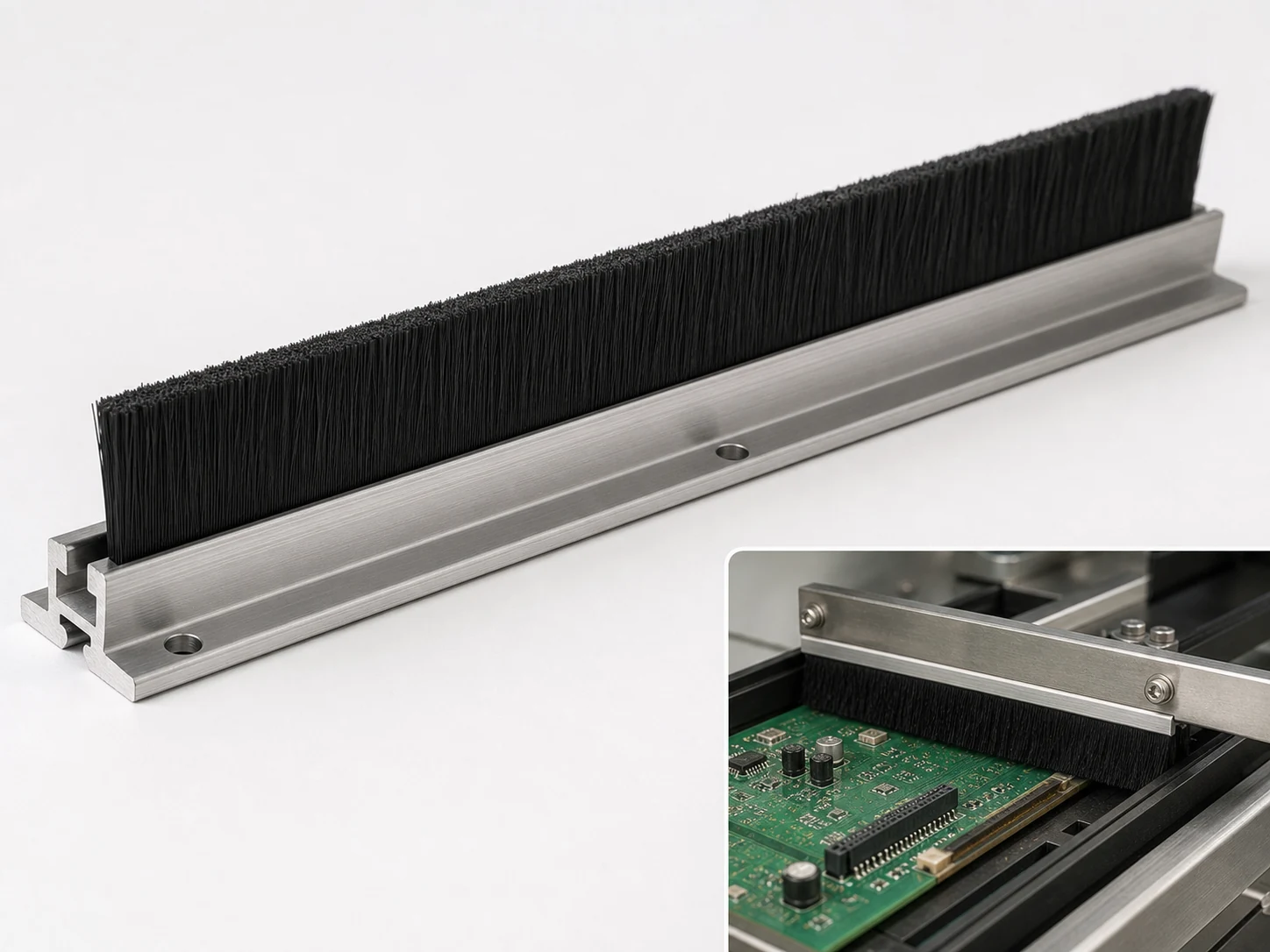
Large-format brush
100 pcs
Minimum order
Built one at a time on a core or channel: full-width rollers, sweeper brooms and long strip.
Production lead time, once the specification is confirmed
- Up to 100 pcsWithin 20 days
- 101–1,000 pcsWithin 30 days
- Over 1,000 pcsConfirmed with your quotation
Peak season can extend these times; the shipping date is confirmed in writing with your quotation. Sampling and shipping are quoted separately.
Anti-static strip brushes for food processing and packaging lines combine conductive nylon filaments with a grounded channel to dissipate static charge while wiping light dust, flour, film fragments, and product fines from belts, webs, guides, and chutes. Custom lengths, trim heights, and resistance values put static control exactly where the line needs it.
What can this brush do for you?
Dissipates static before it causes defects
Conductive nylon filaments with a resistance range of 10³–10⁹ ohms provide a controlled path for static charge to flow from the moving surface through the filament and grounded channel to plant ground. This reduces static cling that makes dust stick to packaging film, causes film flutter, or holds product fines on belts and guides.
Wipes light particles without scratching or marking
Filament diameters from 0.10 mm to 1.27 mm and a working compression of 5–15% of trim height create gentle, even contact across the full strip length. The brush sweeps loose flour, sugar fines, film fragments, and dust from the surface while protecting delicate packaging materials and coated belts from scratches or transfer marks.
Built for washdown and food-plant cleaning
Open channel construction drains quickly and resists particle buildup. Conductive nylon, anti-static PBT, and anti-static PP options withstand hot water and detergent cleaning from 20°C to 85°C. Aluminum, stainless steel, or food-compatible plastic holders provide corrosion resistance in wet and washdown areas.
Continuous coverage with no unwiped zones
Strip lengths are built from 500 mm to 3000 mm per piece and can be joined end-to-end for wider belts, film paths, or chutes. The continuous fill means there are no gaps in static dissipation or dust removal across the entire working width.
Adapts to real mounting positions
Trim heights from 12.7 mm to 152.4 mm and channel widths from 3.2 mm to 14.3 mm let the brush reach across curved hoods, fit tight machine clearances, or contact the center of a wide conveyor. Straight channels, aluminum carriers, angle holders, and custom profiles match the mounting points already on your equipment.
What is an Anti-Static Strip Brush Food Processing?
An anti-static strip brush for food processing is a linear brush assembly made of conductive or static-dissipative filaments held in an extruded channel or metal carrier. It mounts along conveyor belts, packaging film paths, product guides, transfer chutes, and other line positions where static charge accumulates on moving surfaces.
In operation, the filament tips make light, continuous contact with the belt, web, or product surface. Static charge travels from the surface through the filament base into the conductive channel or holder, which is bonded to equipment ground. At the same time, the flexible filament rows wipe away the light dust, flour, fines, and film fragments that static would otherwise hold in place or re-deposit downstream.
This is a static-control and light-debris tool — not a heavy scrubbing brush. It is selected when the main problems are static attraction, film flutter, product clinging, and surface dust on food-processing equipment. Sticky residues, baked-on deposits, or heavy debris loads require a different cleaning method.
Technical Specifications
The specifications below are typical ranges and can be adjusted for the application. Key values to confirm for each project are filament resistance, trim height, compression, and holder style.
| Parameter | Options / Values |
|---|---|
| Fill material | Conductive nylon (standard); anti-static PBT or anti-static PP for chemical or stiffness requirements |
| Electrical resistance | 10³–10⁹ ohms, selected for conductive (lower) or static-dissipative (higher) duty |
| Filament diameter | 0.10–1.27 mm (0.004–0.050 in) |
| Trim height | 12.7–152.4 mm (0.5–6.0 in) |
| Working compression | 5–15% of trim height for wiping and dust control; 10–25% for sealing applications |
| Channel width | 3.2–14.3 mm (0.126–0.563 in) |
| Holder / channel | Straight channel, aluminum carrier (anodized or coated), stainless steel back, angle holder, or custom profile |
| Strip length | 500–3000 mm per piece; longer assemblies by joining sections |
| Washdown conditions | 20–85°C water or detergent cleaning; open, drainable construction |
| Grounding connection | Metal channel or grounding lug bonded to equipment ground |
| Brush type | Custom Strip Seal Brushes |
| How it is driven | Fixed in place, no drive of its own |
| Cleaning target | flour-mill conveyor, packaging film and web path, and filling and bagging line cleaning |
| Surface or part | belts, chutes, channel, webs, guides, conveyors, carriers, and gaps |
| Residue or debris | dust, fines, flour, film fragments, particles, sugar, flour dust, and static-attracted particles |
| Mounting / connection | Metal channel or grounding lug bonded to equipment ground |
Filament resistance is the primary static-control spec: lower values drain charge quickly for high-speed film and belt lines; higher values provide slower, spark-safe dissipation where sensitive electronics are nearby. The final selection depends on line speed, material sensitivity, and the plant grounding scheme.
Where does this brush work best?
- Bakery, snack, and flour-mill conveyors: removes flour dust, crumbs, and sugar fines that static holds on belts, especially after cutting, slicing, or seasoning.
- Packaging film and web paths: wipes film before printing, sealing, or filling to reduce static-attracted particles that cause print defects and seal contamination.
- Filling and bagging lines: mounted at spouts, scale pans, and bag opening areas to keep powders and fines from clinging and creating dust.
- Product guides, side rails, and transfer points: prevents static buildup on contact surfaces so lightweight products move without sticking or skewing.
- Chutes and drop zones: discharges static so product flows freely instead of bridging or hanging up on the chute walls.
How do I choose the right one?
Start with the static control requirement. Determine whether you need conductive filament (10³–10⁶ ohms) for fast charge bleed-off on high-speed lines, or static-dissipative filament (10⁶–10⁹ ohms) for controlled dissipation near sensors and electronics. The plant grounding scheme and any cleanroom or hazardous-area rules influence this choice.
Measure the mounting position and contact gap. The brush must reach the surface with enough compression to maintain contact as the belt or web moves. For wiping and dust control, set compression to 5–15% of trim height. Too little compression leaves gaps; too much bends filaments flat and reduces wiping action. If the surface is curved or the mounting point is offset, an angle holder or custom profile may be needed.
Choose the filament material for the environment. Conductive nylon is the standard for washdown compatibility, flexibility, and good dust release. Anti-static PBT offers higher stiffness and better resistance to some chemicals and abrasion. Anti-static PP is a lower-cost option for light dust where chemical exposure is mild. Consider detergent type, cleaning temperature, and any oils or release agents on the belt.
Select the holder and grounding method. Aluminum carriers with a grounding screw are common for dry areas; stainless steel or food-compatible plastic channel is preferable for frequent washdown. The holder must be bonded to a reliable equipment ground with a low-resistance connection. If the existing frame is anodized or painted, the grounding point must be bare metal.
When a different tool is better: If static control is not needed, a conventional non-conductive strip brush is usually less expensive. If the line generates heavy dust loads rather than a light static-attracted layer, add vacuum extraction or an air knife instead of relying on brush contact alone. If deposits are sticky, greasy, or baked on, use a scrubbing brush or cleaning system — anti-static filaments are not designed for heavy residue removal.
Can I customize this brush?
Anti-static strip brushes are built to the line. Provide the mounting position, surface to contact, gap distance, line speed, washdown chemicals and temperature, and the required resistance range. A drawing or photo of the mounting area speeds up the design.
Configurable variables include:
- Filament: conductive nylon, anti-static PBT, or anti-static PP; resistance value; filament diameter; trim height; density or gap fill if needed.
- Channel / holder: straight, aluminum, stainless steel, angle, or custom profile; channel width; anodizing or coating.
- Length and mounting: strip length from 500 to 3000 mm, end joining, brackets, clamps, grounding lugs, end caps, and pre-drilled mounting holes.
- Contact geometry: single row, multiple rows, angled fill, or varying trim height along the strip for curved or irregular surfaces.
- Marking and packaging: color coding, identification labels, bulk or kit packaging, and project-specific part numbers.
For food-processing projects that require material declarations, inspection reports, or third-party testing, we can assist with the documentation and verification steps during the customization process.
Which filament survives the cleaning and still lasts on an anti-static strip brush food processing?
How do I verify the brush is properly grounded after installation?
Use a multimeter to measure resistance from a filament tip to equipment ground at several points along the strip. The reading should fall within the specified resistance range for the filament and remain stable. If the reading is open or much higher than expected, check the grounding lug, remove any paint or oxide from the bonding point, and confirm the connection to plant ground.
Can this brush touch food directly?
The standard design is intended for contact with belts, packaging film, product guides, and other equipment surfaces, not direct contact with food. If your process requires direct product contact, tell us during the design stage so we can review the filament and holder options for that specific contact situation and provide material documentation for your own evaluation.
Will washdown chemicals reduce the anti-static performance over time?
Routine washdown with water or mild detergent between 20°C and 85°C is acceptable for conductive nylon. Strong solvents, concentrated acids or alkalis, and abrasive cleaning can damage the filament surface and raise resistance. After washdown cycles, dry the strip and check resistance periodically. If the value drifts outside the specified range, replace the affected section.
How can I tell when the brush needs replacement?
Inspect the strip for flattened, permanently bent, melted, or broken filaments. If the brush no longer makes consistent contact across the full working width, or if static problems such as dust adhesion or film flutter return, the filament has reached the end of its useful life. Conductive nylon wears gradually and should be replaced before contact loss becomes complete.
Can the brush be formed around a curve or roller?
Yes. A flexible channel or custom curved holder can follow a radius, and trim height can be varied along the length to keep consistent compression on the curved surface. Provide the radius, the arc length, and the mounting points so the brush can be profiled correctly.
What is the practical difference between conductive and static-dissipative filament?
Conductive filament (10³–10⁶ ohms) bleeds charge away quickly and is usually the right choice for high-speed film lines or belts that generate charge continuously. Static-dissipative filament (10⁶–10⁹ ohms) drains charge more gradually and is preferred where sensitive electronic controls are close by or where a slower discharge is desirable. The choice depends on line speed and the surrounding equipment.
Guides that go deeper on this
Anti-Static Strip Brushes: What Sets the Resistance?
Read this guideGuideConveyor Belt Cleaning Brush Design
Read this guideGuideCustom Brush Sampling and Validation Plan
Read this guideGuideIndustrial Brush Wear Patterns and Corrective Actions
Read this guideGuideWhich Anti-Static Strip Brushes Suit Food Processing Lines?
Read this guideCustom Manufacturing RFQ
Describe Your Application
To prepare the correct quotation, provide the dimensions, cleaning task, residue, material, mounting details, quantity, and a drawing or photo.
Drawing or photo optional — it speeds things up, it does not gate the enquiry.
Custom Brush RFQ
Send Your Brush Project
Upload a drawing, product photo, or sample photo and provide the core dimensions and cleaning conditions.
“We need a brush to remove wet residue from a stainless steel conveyor, about 800mm wide. The current brush wears quickly. We can send photos.”
“We sell drinkware and need a cleaning brush to include with the product. Quantity around 5,000 pieces.”