
Custom Cleaning Brush
Strip Brush Food Processing
Custom strip brush for food processing equipment. Wipes and seals conveyors, hoppers, sifters, trays, and guides.
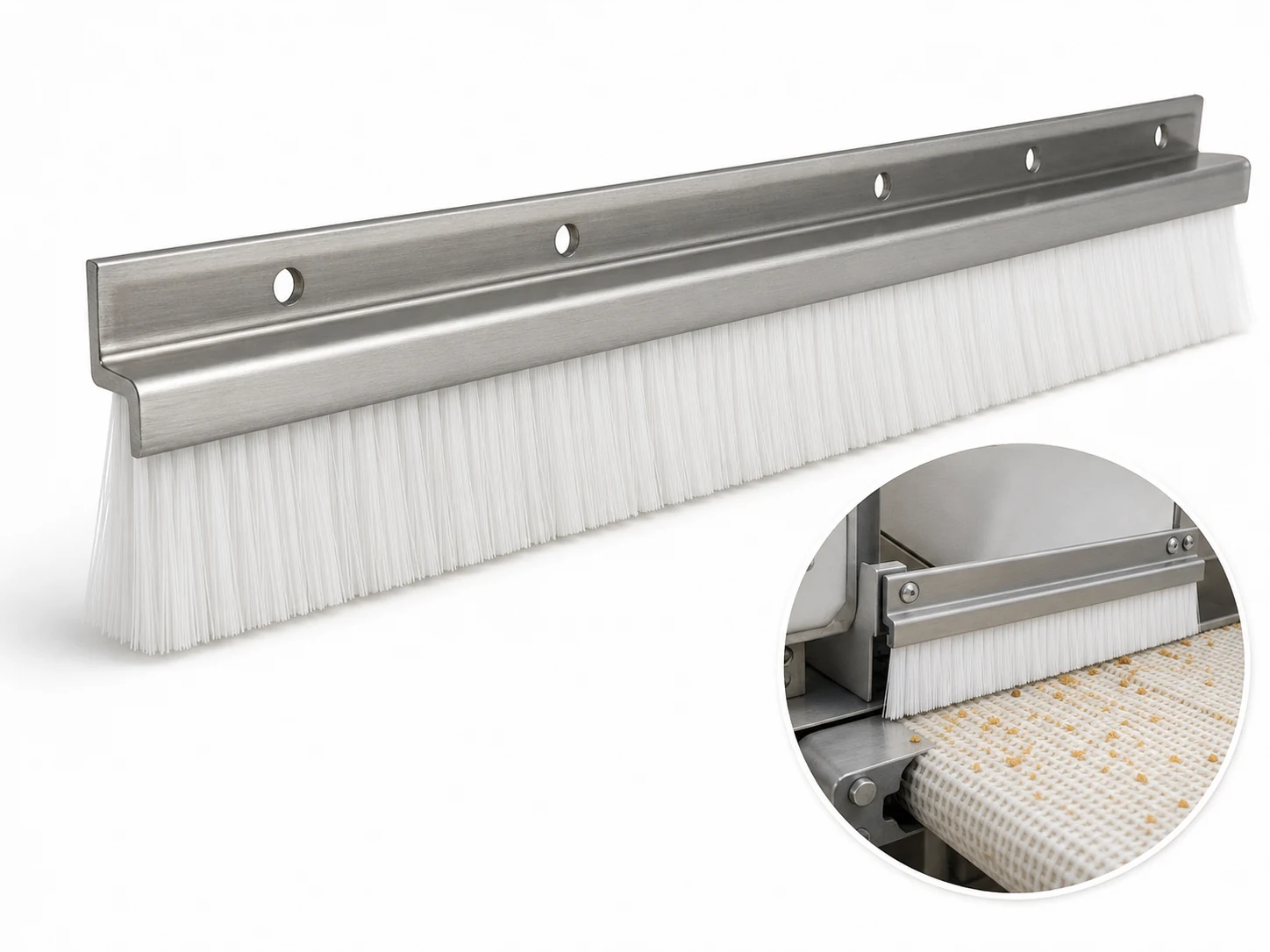
Large-format brush
100 pcs
Minimum order
Built one at a time on a core or channel: full-width rollers, sweeper brooms and long strip.
Production lead time, once the specification is confirmed
- Up to 100 pcsWithin 20 days
- 101–1,000 pcsWithin 30 days
- Over 1,000 pcsConfirmed with your quotation
Peak season can extend these times; the shipping date is confirmed in writing with your quotation. Sampling and shipping are quoted separately.
A washdown-ready, modular brush strip built for wiping, sealing, and residue removal on food processing lines. The strip supports cut-to-length fills in PBT, PP, or nylon and stainless or polymer holders, so it can be fitted to conveyors, trays, molds, bands, guides, hoppers, and sifters without rebuilding the whole line.
What can this brush do for you?
Sweeps flour, crumbs, sugar, and seasoning off moving belts
Fine-diameter filaments in PBT or PP form a dense wiping edge that lifts carryback residue from belt and roller surfaces as they pass. Because the fill diameter and trim height are selected for the contact zone, the strip removes material continuously without stopping the line.
Seals hopper and sifter gaps without crushing the fill
When mounted as an edge seal, the brush compresses 10–25% to block fine powder and air leaks while still flexing enough to let product move. The channel-backed construction keeps each filament row aligned, so sealing stays even across long runs.
Wipes chocolate, oil, and dough films off guides and frames
Nylon PA filaments deliver the toughness and flex needed to scrape sticky deposits, while PBT resists softening in warm washdown water. Dry-powder zones and sticky-residue zones can use different fills on the same style of strip, so one design doesn’t have to compromise for the whole line.
Survives washdown cycles without rusting or deforming
Stainless steel holders in 304 or 316 and moisture-resistant filament materials tolerate hot water, detergent, and sanitizer cycles inside the listed temperature range. Rigid polymer backings provide a metal-free alternative where stainless steel is not desired.
Drops into standard or custom holder rails for fast replacement
The brush is a replaceable component, not a permanently bonded part. Maintenance crews can pull a worn strip and insert a new cut-to-length section without unbolting the mount, reducing downtime from a full brush rebuild to a quick strip swap.
What is a Strip Brush Food Processing?
A Strip Brush Food Processing is a flexible, channel-backed brush that mounts as a fixed or movable strip along food production and cleaning environments to wipe, seal, or remove residue from equipment surfaces. The working edge is a continuous fill of synthetic filaments — PBT, polypropylene, or nylon — mechanically retained in a metal or polymer channel. The loaded strip slides into a holder rail, angle bracket, or custom extrusion on the machine frame, so the bristles face the surface that needs maintenance.
During operation, the brush contacts the moving belt, roller, tray, mold, band, guide, or hopper edge with a controlled compression. The free filament tips do the work: they knock loose flour, crumbs, dough, sugar, chocolate, oil, seasoning, or baked food residue while the channel holds the fill under load. The contact force is set by trim height, filament diameter, and installed position, not by operator pressure, so the result is repeatable across shifts.
This is not a handheld brush and not an aggressive abrasive tool. It is an engineered line component intended for continuous or scheduled contact with food-processing surfaces. The strip is replaceable, and the holder can stay in place for years while the brush fill is swapped as it wears.
Technical Specifications
All dimensions are selectable to the installation. The values below show the standard project range for this product.
| Parameter | Value / Options |
|---|---|
| Strip length | 100–3000 mm per section; longer runs joined in the holder |
| Trim height (free bristle length) | 12.7–152.4 mm, matched to contact distance |
| Channel / back width | 3.2–14.3 mm, selected for holder profile |
| Filament diameter | 0.10–1.27 mm; finer for powder and sugar, heavier for dough and baked residue |
| Fill material | PBT, Polypropylene (PP), or Nylon (PA); project-specific grade selected for residue and washdown chemistry |
| Backing / holder | 304 or 316 stainless channel, rigid polymer backing, aluminum carrier for dry non-corrosive zones, angle holder, or custom extrusion |
| Working compression | 5–15% for wiping and dust control; 10–25% for sealing without crushing the fill |
| Washdown temperature | 20–93°C, material-dependent; stainless hardware for hot or caustic cycles |
| Bristle profile | Straight trim standard; flagged or crimped tips available for fine wiping or firmer contact |
| Mounting interface | Straight channel, angle holder, pre-punched holes, clamp system, or custom profile |
| Brush type | Custom Strip Seal Brushes |
| How it is driven | Fixed in place, no drive of its own |
| Cleaning target | conveyor belt carryback removal, bake band, and hopper and sifter edge sealing cleaning |
| Surface or part | bands, hoppers, molds, trays, frames, sifters, rails, and conveyors |
| Residue or debris | mold, flour, seasoning, sugar, chocolate, crumbs, oil, and dust |
| Mounting / connection | Straight channel, angle holder, pre-punched holes, clamp system, or custom profile |
Trim height and filament diameter together set contact force. We normally confirm the installed gap and required compression before locking these values.
Where does this brush work best?
- Conveyor belt carryback removal: mounted under or against the return run to strip flour, crumbs, sugar, and seasoning before they build up on rollers and frames. Fine or medium PP or PBT fill works well here.
- Tray, mold, and bake band cleaning: stiffer PBT or nylon trim removes baked-on residue from heated surfaces after discharge; a stainless holder handles warm, humid cleaning areas.
- Hopper and sifter edge sealing: dense brush strip closes gaps around covers and transfer points to contain flour and sugar dust without jamming product flow.
- Guide, side rail, and equipment frame wiping: removes oil, chocolate, and seasoning films from machine surfaces during or between production runs.
- Nozzle and dispensing head wiping: a short, angled strip mounted near fill heads keeps sticky product off sealing faces and reduces clean-up between shifts.
How do I choose the right one?
Start with the job the strip has to do
Determine whether the strip is wiping fine powder, removing sticky residue, sealing a powder gap, or guiding product. Wiping and dust control use 5–15% working compression; sealing uses 10–25% and usually a denser fill. The function affects filament diameter and density more than the surface type alone.
Measure the installed gap and contact path
Take the distance from the holder back or mounting face to the surface that needs contact. Add the required compression to the free trim height: if the gap is 30 mm and you need 15% wiping compression, start around 35 mm free trim. If the gap varies along the line, split the strip into sections or use a flexible holder so the contact band stays even.
Choose the filament by residue and washdown, not just price
| Condition on the line | Preferred fill | Reason |
|---|---|---|
| Fine flour, sugar, or seasoning dust | PP or PBT, fine diameter | Soft wipe, low abrasion, good dust release |
| Chocolate, oil, or sticky glaze | Nylon PA or PBT, medium stiffness | Scrapes sticky film without scratching; resists set |
| Baked-on crumbs or dough residue | Nylon PA, stiffer and larger diameter | Higher cut and wear resistance |
| Hot or wet washdown, chemical exposure | PBT or PP with 304/316 stainless holder | Low moisture pickup; corrosion-resistant channel |
Pick the holder for the environment
Use 304 or 316 stainless steel for washdown, hot water, or caustic cleaning. Use a rigid polymer backing when a metal-free zone is required or when the line runs dry and light. Aluminum carriers are acceptable only in dry, non-corrosive areas. The holder can be straight, angled, or a custom extrusion to match the frame.
When a strip brush is not the right fit
A synthetic strip brush is not a replacement for wire or abrasive brushes on hard scale, carbonized buildup, or metal fines. Deep crevices, internal bores, and threads need tube or detail brushes. For continuous temperatures above the listed washdown range or direct steam exposure, specify a high-temperature material alternative. If the strip will touch food directly, confirm the required food-compatible grade and testing early rather than treating standard PBT, PP, or nylon as automatically compliant.
Can I customize this brush?
Yes. This is a made-to-specification strip brush, so dimensions, fill, backing, and mounting are defined by the line, not by an off-the-shelf catalog. The following variables can be adjusted:
- Fill: PBT, PP, or Nylon PA; filament diameter 0.10–1.27 mm; stiffness, color, density, straight, flagged, or crimped tip profile; working compression target.
- Backing / holder: 304 or 316 stainless channel, rigid polymer backing, aluminum carrier for dry areas, angle bracket, custom extrusion, pre-punched holes, welded tabs, or quick-release clamps.
- Dimensions: strip length 100–3000 mm per section, trim height 12.7–152.4 mm, channel width 3.2–14.3 mm, tapered or profiled ends.
- Mounting: straight rail, angle mount, curved or segmented installation for non-linear runs, brackets, and fasteners.
- End treatment: sealed/crimped ends, notches for clearance, end caps, and identification marking such as pad print or laser marking.
- Packaging: bulk, cut-to-length polybags, individual labeling, or project-specific packing.
If your project requires food-contact material declarations, third-party washdown or migration testing, inspection reports, or a documentation package, we can assist with those requirements during the customization process.
Which filament survives the cleaning and still lasts on a strip brush food processing?
How can I check whether the installed strip is making the right contact?
Stop the line and look at the contact pattern on the surface. The bristle tips should deflect visibly and form a consistent wiping band, not just touch. For wiping, deflection should equal 5–15% of the free trim length; for sealing, 10–25%. If one side contacts before the other, shim or re-level the holder or split the strip into sections.
Can the strip be cut to length on site without loosening the fill?
Yes, but only at pre-marked or crimped joints. Cutting through a random filament section can leave loose bristles at the end. For ends that must stay clean and secure, order factory-cut, sealed, or notched ends and retain the strip end with the holder clamp.
Does the brush remove all residue, or is a washdown still needed?
The brush removes loose and lightly attached residue during line operation. Heavy oil, chocolate, or built-up films still require scheduled washdown with proper cleaning chemicals. Use the strip to prevent recontamination and keep surfaces clear between wash cycles, not as a replacement for sanitation.
When should I switch from PBT to nylon for the fill?
Choose nylon PA when the residue is sticky, dough-like, or abrasive and the brush must flex repeatedly without breaking. Switch to PBT when the area is wet, warm, or washed frequently, because PBT absorbs less moisture and keeps its stiffness in humid conditions. PP remains the economical choice for light dust wiping on coated or sensitive belts where you want the softest contact.
What are the signs that a strip needs replacement?
Inspect at each maintenance interval for permanently bent bristles, tips worn short or polished, missing fill sections, or corrosion on the channel and holder. If compression drops, residue return increases, or the strip no longer rebounds after deflection, replace the strip. Check the holder alignment at the same time.
Can this strip be used on curved conveyor sections?
Short sections of flexible-backed strip can follow a gentle curve in the holder, but tight radii require custom-curved or segmented construction. Provide the radius and arc length so the strip is built with the correct bend and end relief.
Guides that go deeper on this
Conveyor Belt Cleaning Brush Design
Read this guideGuideCustom Brush Sampling and Validation Plan
Read this guideGuideIndustrial Brush Wear Patterns and Corrective Actions
Read this guideGuideWhich Anti-Static Strip Brushes Suit Food Processing Lines?
Read this guideGuideWhich Strip Brushes Hold Their Line on Plastic Processing Lines?
Read this guideCustom Manufacturing RFQ
Describe Your Application
An accurate custom quote starts with the dimensions, working surface, residue, material choice, connection, quantity, and reference files.
Drawing or photo optional — it speeds things up, it does not gate the enquiry.
Custom Brush RFQ
Send Your Brush Project
Upload a drawing, product photo, or sample photo and provide the core dimensions and cleaning conditions.
“We need a brush to remove wet residue from a stainless steel conveyor, about 800mm wide. The current brush wears quickly. We can send photos.”
“We sell drinkware and need a cleaning brush to include with the product. Quantity around 5,000 pieces.”