
Custom Cleaning Brush
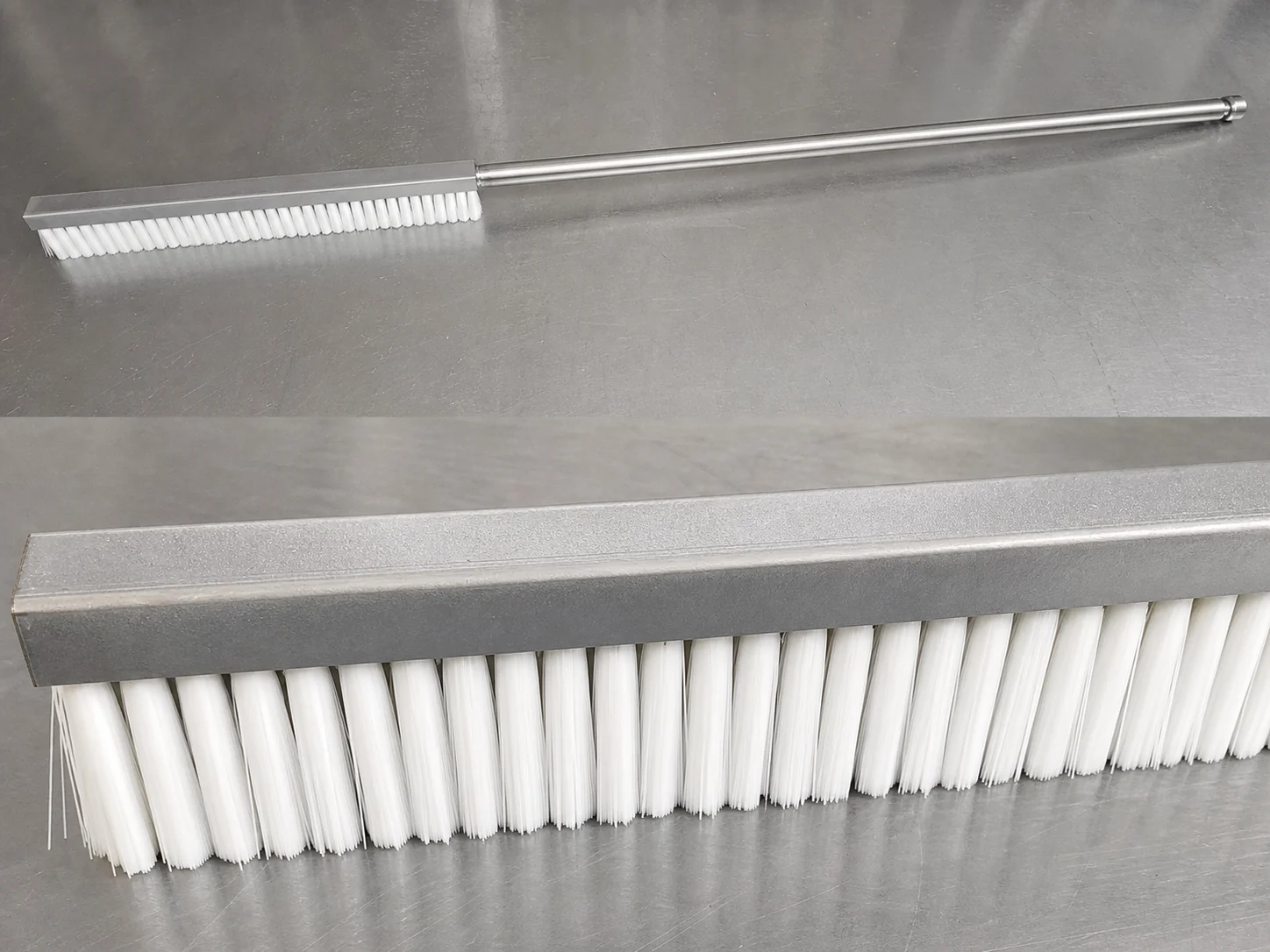
1000x30mm PBT Food Conveyor Strip Brush
Fixed-mount 1000 mm x 30 mm PBT strip brush for food conveyor belts. 304 stainless steel backing, grease and residue removal, custom filament and mounting.
Large-format brush
100 pcs
Minimum order
Built one at a time on a core or channel: full-width rollers, sweeper brooms and long strip.
Production lead time, once the specification is confirmed
- Up to 100 pcsWithin 20 days
- 101–1,000 pcsWithin 30 days
- Over 1,000 pcsConfirmed with your quotation
Peak season can extend these times; the shipping date is confirmed in writing with your quotation. Sampling and shipping are quoted separately.
A fixed-mount 1000 mm strip brush with 30 mm PBT filament and a 304 stainless steel channel. It mounts across or along food conveyor belts to continuously sweep grease, crumbs, syrup, labels, and adhered product film from belt surfaces, edges, and transfer points.
What can this brush do for you?
Constant contact across the full meter
The formed stainless steel channel holds the filament row in a straight line, and fixed brackets keep the brush at a set standoff. Instead of an operator making repeated hand passes, the moving belt feeds itself past the brush on every cycle. Residue removal is consistent along the entire 1000 mm face, cycle after cycle.
30 mm trim length that holds its position in wet conditions
The exposed 30 mm PBT filament gives a controlled working range for setting the gap to the belt. PBT absorbs very little moisture, so the filaments do not go limp during washdown, steam exposure, or standing water. The brush keeps the same contact geometry wet or dry.
Grease and food soils release from the filament
PBT has a naturally slick, low-friction surface. Grease, protein film, syrup, and oil-based residues tend to release at the tips instead of packing into the brush face. Rinsing or washdown clears the filament row faster than most natural or nylon fills.
304 stainless steel backing that does not stain the line
The channel and mounting interface are AISI 304 stainless steel. There is no carbon steel or zinc-plated hardware to corrode, drip rust, or leave marks on food-contact surfaces. The backing is built around the same logic as the rest of the washdown equipment on the line.
No bearings, motors, or rotating parts to maintain
This is a static surface-contact brush. There are no drive components to lubricate, seal, or replace. Installation is a fixed bracket, and maintenance is primarily inspection, washdown, and replacement of the strip when the filament wears.
What is a 1000x30mm PBT Food Conveyor Strip Brush?
This product is a straight strip brush built for fixed mounting on food conveyor frames. PBT monofilament is crimped into a formed 304 stainless steel channel over a 1000 mm working length, leaving 30 mm of filament exposed from the channel face. The supplied connection is fixed: stainless brackets or slotted mounts hold the brush at the conveyor frame, and the belt moves against the stationary filament tips.
The 30 mm dimension is the bristle trim length, not the brush height or the backing width. The total installed height depends on the channel profile and bracket. The backing is rectangular, so the brush sits flat against a mounting plate, rail, or bracket and can be oriented perpendicular to the belt or at a slight working angle.
In a typical mount, the brush is placed above the return side of the belt, at a head or tail pulley, or along a belt edge where product film accumulates. The filament tips sweep the belt surface as it passes. Contact pressure comes from the installed gap: the closer the channel face is to the belt, the more the 30 mm filament deflects. There is no operator pressure and no driven rotation.
The brush is a mechanical residue remover. It is not a sanitizer and it is not a heavy scraper. It works best for continuous removal of soft greases, oils, syrups, crumbs, label fragments, and wet films before they build into harder deposits or pass into rollers and guides.
Technical Specifications
All values below are the standard configuration for this product. Bracket geometry, channel profile, and fill density can be adjusted to the conveyor frame.
| Parameter | Value / Options |
|---|---|
| Overall strip length | 1000 mm |
| Bristle trim length | 30 mm |
| Bristle material | PBT (polybutylene terephthalate) monofilament |
| Backing material | AISI 304 stainless steel formed channel |
| Backing profile | Rectangular; height and width matched to the conveyor bracket or mounting slot |
| Fill configuration | Continuous straight filament; single or double row; density selected by soil load |
| Filament diameter | 0.20–0.60 mm, selected for residue type and belt speed |
| Mounting | Fixed mounting through stainless steel brackets, holes, or slotted channel; positions set to the conveyor frame |
| Installed contact | Set by bracket standoff; typical working deflection 2–6 mm against the belt surface |
| Operating temperature | Up to approximately 100°C (212°F) continuous wet washdown; short dry spikes may be higher; confirm chemical and time conditions |
| Chemical exposure | Good resistance to food oils, greases, mild acids, alkaline cleaners, and common detergent solutions |
| Color | Natural PBT, white, black, or custom masterbatch |
| Brush type | Custom Strip Seal Brushes |
| How it is driven | Fixed in place, no drive of its own |
| Cleaning target | confectionery belt, meat and poultry line, and ready-meal conveyor cleaning |
| Surface or part | belts, conveyors, channel, edges, roller, guides, gaps, and transfer points |
| Residue or debris | syrup, crumbs, product film, grease, labels, oil, protein film, and adhered product film |
| Mounting / connection | Fixed mounting through stainless steel brackets, holes, or slotted channel; positions set to the conveyor frame |
The critical fit dimensions are the overall length, the channel profile, and the bracket standoff. If the conveyor frame is already built, provide a drawing or photo of the mounting point so the backing and bracket positions can be matched before production.
Where does this brush work best?
- Snack, bakery, and confectionery belts where crumbs, sugar dust, oils, and release agents collect on the return side or at transfer ends.
- Meat and poultry lines where fat, protein film, and small meat particles smear onto the belt face, rollers, or side guides.
- Dairy, beverage, and ready-meal conveyors where syrup, sauces, fillings, or condensation create sticky films on belt surfaces.
- Packing and slicing lines where labels, backing paper, film fragments, or seasoning migrate onto belts and rollers.
- Conveyor edges and fixed side guides where product film collects out of reach of manual cleaning.
- Washdown food environments where a stainless steel backing and low-moisture filament are needed to survive wet cleaning cycles.
How do I choose the right one?
Check the installed gap before ordering
Measure the distance from the mounting channel face to the belt surface at the intended position. Include belt sag, splice bumps, and roller run-out in that measurement. For a 30 mm trim length, position the channel face about 24–28 mm from the belt so the tips deflect roughly 2–6 mm. If the available gap is larger than 30 mm, the filament will not reach; if it is much smaller, the brush will fold or wear prematurely.
Confirm the 1000 mm length and mounting support
The strip length should cover the contamination zone or equal the belt width when mounted across the line. For wider belts, multiple strips can be butted end-to-end. Support brackets should sit at intervals that keep the channel straight under washdown and contact load; long unsupported spans can bow and create uneven contact.
Match filament diameter and fill to the soil
Fine filaments in the 0.20–0.30 mm range work for light films, powders, and small crumbs. Medium diameters around 0.40 mm handle general grease, syrup, and protein films. Heavier 0.50–0.60 mm filament or higher fill density is appropriate when residue is thicker, belt speed is higher, or the brush is mounted against a splice area. Dense fill wipes films more completely; more open fill lets larger crumbs release instead of packing.
Confirm PBT fits the chemistry and temperature
PBT is a strong fit for wet food lines because it keeps stiffness in moisture and resists ordinary oils, greases, and cleaning agents. If the belt runs continuously above about 100°C, passes through ovens or fryers, or is exposed to strong oxidizers or aggressive solvents, check the actual continuous temperature and chemical list before committing. In those cases a different filament material or a different brush construction may be required.
Choose the contact angle carefully
Mounting the brush perpendicular to belt travel gives even contact and works in both belt directions. A slight angle can improve wiping action on thin films but creates a preferred travel direction and may load one side of the filament row. Tell us the belt travel direction and whether the line ever runs in reverse.
When a different brush makes more sense
If the residue is hardened, carbonized, or baked on, a static PBT strip brush may polish it rather than remove it. Use a motorized conveyor belt cleaner with a rotating roller brush, or add chemical pre-treatment. If you need to scrape metal scale or heavy abrasive deposits, a wire brush or scraper blade is a better fit. If the mounting area cannot provide a fixed channel, consider a flexible strip brush with a softer backing that can follow curvature instead of a rigid 304 stainless channel.
Can I customize this brush?
This brush is supplied as a configured part rather than a fixed off-the-shelf item. To quote the right build, provide the belt width, mounting point details, available gap, line speed, residue type, washdown chemicals, and water temperature. A drawing or photo of the mounting frame shortens the process.
Standard adjustments include:
- Overall length and number of segments for wider belts or split frames
- Bristle trim length in addition to the 30 mm standard, for larger or smaller standoff gaps
- Backing profile dimensions, wall thickness, and material grade, including 316 stainless for high-chloride washdown
- Bristle diameter, fill density, single or double row construction, and end treatments
- Bracket shape, mounting hole or slot pattern, standoff height, and fixed or adjustable positioning
- Filament color, masterbatch tint, and strip marking or identification
- Packaging and delivery format for plant installation or distribution
If your food plant requires material declarations, documentation, inspection records, or third-party testing for installed components, specify those requirements with the RFQ. We can support project-level documentation and testing needs through the customization process.
Which filament survives the cleaning and still lasts on a 1000x30mm PBT food conveyor strip brush?
What does the 30 mm dimension refer to?
The 30 mm is the bristle trim length, measured from the face of the stainless steel channel to the filament tips. It is not the overall brush height and not the backing width. The total installed height is the trim length plus the channel profile and bracket standoff.
How much filament deflection should I run against the belt?
Position the channel face so the filament tips deflect about 2–6 mm against the belt. Less deflection can produce intermittent contact when the belt sags or passes over splices. More deflection folds the filament, raises wear, and increases drag on the belt drive. If you cannot achieve that range with a 30 mm trim, ask for a longer or shorter trim length.
Will this strip brush remove baked-on or hardened deposits?
No. The brush removes fresh or soft greases, oils, syrups, crumbs, and films before they set. If deposits have already dried, carbonized, or hardened, the static PBT filament cannot cut through them. Add pre-soaking or use a driven rotary cleaner with a more aggressive fill for those situations.
Can the belt run in reverse after this brush is installed?
With a perpendicular, symmetrical filament orientation, reverse travel is generally acceptable. If the brush is mounted at a working angle, reversing the belt can fold the filament row against its layout direction and reduce contact. Confirm the mounting angle with the line direction before finalizing the bracket design.
How do I know when to replace the strip?
Check the remaining trim length and the filament recovery. When the trim length has shortened by roughly 8 mm or more, or when the filaments stay bent after passing a splice and no longer spring back to contact the belt, replace the strip. Also inspect the channel and crimp zone for corrosion, loose filament, or food accumulation that washdown is not clearing.
Does this brush replace belt washing or sanitation?
No. It removes attached soils mechanically, which can reduce the load on the washdown system and help keep rollers and return paths cleaner, but it does not rinse or sanitize. The conveyor still needs its normal wash, rinse, and sanitation steps.
Guides that go deeper on this
Conveyor Belt Cleaning Brush Design
Read this guideGuideCustom Brush Sampling and Validation Plan
Read this guideGuideIndustrial Brush Wear Patterns and Corrective Actions
Read this guideGuideWhich Anti-Static Strip Brushes Suit Food Processing Lines?
Read this guideGuideWhich Strip Brushes Wipe a Conveyor Belt Clean?
Read this guideCustom Manufacturing RFQ
Describe Your Application
Please include the main sizes, application, residue, preferred material, interface, quantity, and any drawing or sample available.
Drawing or photo optional — it speeds things up, it does not gate the enquiry.
Custom Brush RFQ
Send Your Brush Project
Upload a drawing, product photo, or sample photo and provide the core dimensions and cleaning conditions.
“We need a brush to remove wet residue from a stainless steel conveyor, about 800mm wide. The current brush wears quickly. We can send photos.”
“We sell drinkware and need a cleaning brush to include with the product. Quantity around 5,000 pieces.”