
Custom Cleaning Brush
1000x30mm Conductive ESD Strip Brush
Grounded 1000 mm conductive ESD strip brush with 30 mm conductive nylon filament in a 6061 aluminum channel, for dust removal and static control on webs.
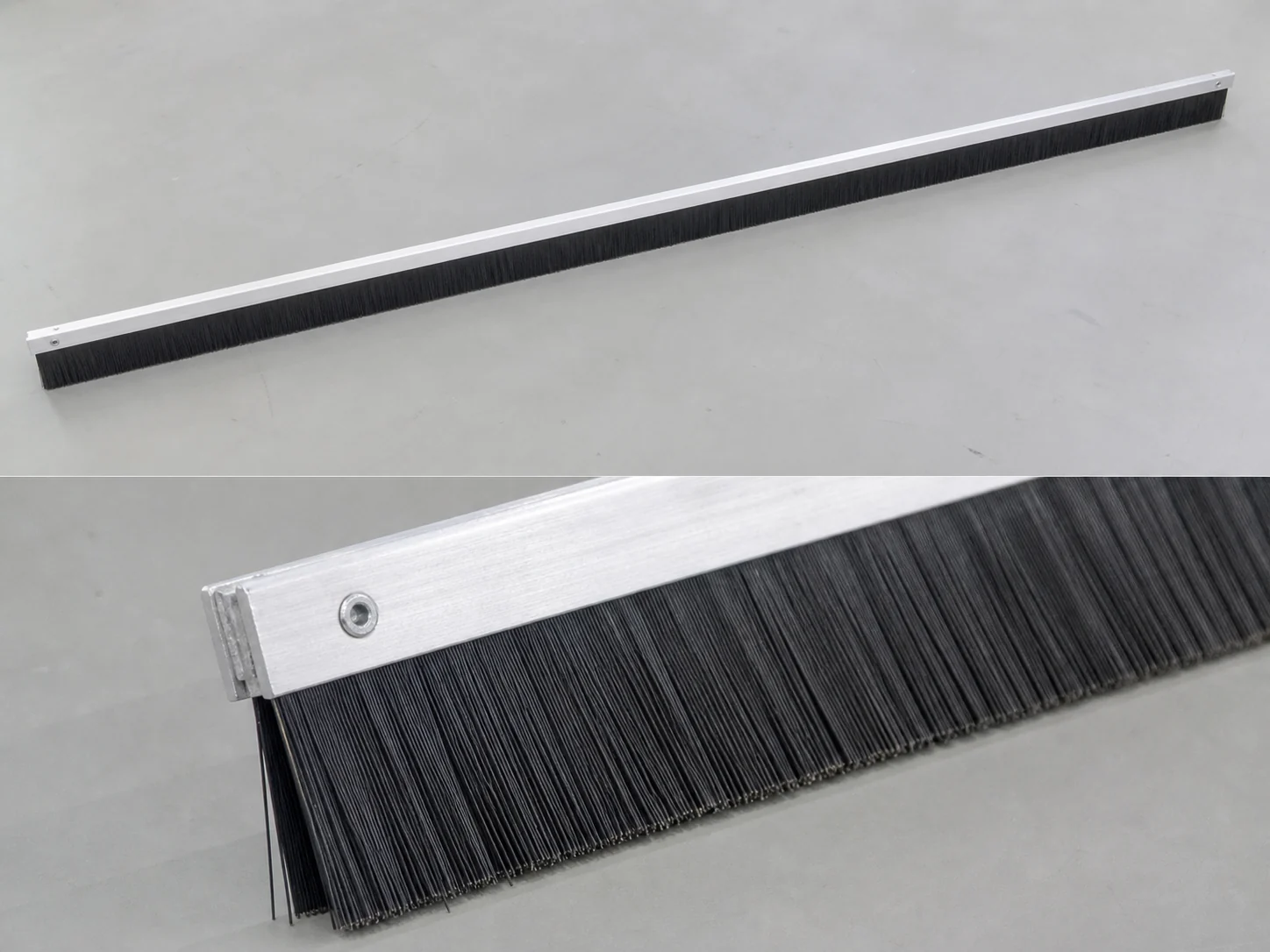
Large-format brush
100 pcs
Minimum order
Built one at a time on a core or channel: full-width rollers, sweeper brooms and long strip.
Production lead time, once the specification is confirmed
- Up to 100 pcsWithin 20 days
- 101–1,000 pcsWithin 30 days
- Over 1,000 pcsConfirmed with your quotation
Peak season can extend these times; the shipping date is confirmed in writing with your quotation. Sampling and shipping are quoted separately.
A 1000 mm conductive ESD strip brush with 30 mm conductive nylon filaments set in a 6061 aluminum channel. The brush forms a grounded, full-width contact line for removing static-attracted dust and lint from moving webs, sheets, panels, and equipment openings while draining surface charge to ground.
What can this brush do for you?
Drains static charge while it removes dust
Conductive nylon filaments are held in the electrically conductive 6061 aluminum channel. When that channel is bonded to machine ground, each contact with a passing surface drains the charge that holds fine dust and lint in place. The brush removes the dust mechanically and keeps the surface from immediately re-attracting particles.
Gives one continuous contact path across the full length
The filament row runs through the 1000 mm channel without blank zones at the ends. On a web, sheet, or moving panel, the entire contact width receives the same sweeping and charge-draining action, so dust streaks and residual static lines do not reappear where a shorter brush would have stopped.
Soft contact for sensitive surfaces
Conductive nylon filaments flex under light pressure and recover their position. The contact removes loose dry particulate without scratching or hazing thin films, coated papers, painted panels, or other smooth substrates that would show marks from a stiffer metal wire strip.
Fixed aluminum channel keeps the contact line aligned
The 6061 aluminum channel is rigid enough to hold the row straight when fastened to a bracket, guard, or machine frame. Filaments stay oriented instead of fanning, and the tip line remains predictable in continuous process applications where web speed and tension try to push the brush out of position.
Dry operation without added process chemistry
No adhesive, wetting agent, or cleaning solution is required for the brush to do its job. Dry particulate removal and contact-based charge dissipation keep the contact point clean and compatible with dry process areas.
What is a 1000x30mm Conductive ESD Strip Brush?
A 1000x30mm Conductive ESD Strip Brush is a fixed strip brush made of flexible conductive nylon filaments held in an extruded 6061 aluminum channel. The nominal profile length is 1000 mm; the free filament height, or trim length, is 30 mm. The aluminum channel acts as the structural backbone and as the electrical path to ground, while the conductive nylon remains the compliant contact that follows the passing surface.
In a typical installation, the channel is bolted to a machine frame, guard, or bracket and bonded to a verified earth ground. The filament tips make light continuous contact with a moving web, panel, roller, or sliding part. Loose dry particles are swept from the surface, and accumulated charge flows from the contact area through the conductive nylon and the aluminum channel to the grounding point.
The brush is designed for dry contact in ESD-sensitive production and assembly areas. It is not a wet scrubber, an adhesive lint roll, or an ionizing bar. Because conductivity is distributed through the filament material rather than applied as a surface coating, the electrical path remains present as the tips flex and wear.
Technical Specifications
The dimensions, filament grade, and mounting features can be adjusted to the installation. The values below describe the standard 1000x30mm configuration.
| Parameter | Standard configuration / options |
|---|---|
| Overall profile length | 1000 mm; custom cut lengths and longer multi-section runs available |
| Trim length | 30 mm free filament length; other trim lengths available |
| Filament material | Conductive nylon, bulk-conductive grade; target surface resistivity 10³–10⁶ Ω/sq matched to the grounding requirement |
| Filament diameter | 0.3–0.5 mm, selected for surface sensitivity and contact force |
| Filament row | Single row standard; double row, variable pitch, or higher density available |
| Channel material | 6061 aluminum alloy, extruded channel; natural or anodized finish available |
| Mounting | Fixed channel with drilled or punched hole pattern, countersunk screws, or custom brackets; ground bond required at installation |
| Connection | Rigid fixed connection; grounding lug or bonded ground lead can be added |
| Operating temperature | -20 °C to +80 °C for the conductive nylon contact; confirm process temperature |
| Environment | Dry contact in general ESD-control areas; not intended for wet washdown, solvent immersion, or abrasive slurry |
| Brush type | Custom Strip Seal Brushes |
| How it is driven | Fixed in place, no drive of its own |
| Cleaning target | inspection area, laminate converting line, and electronics assembly cleaning |
| Surface or part | webs, channel, panels, aluminum, guards, drain, sheets, and profiles |
| Residue or debris | lint, dust, static-attracted dust, fine dust, adhesive, and particles |
| Mounting / connection | Fixed channel with drilled or punched hole pattern, countersunk screws, or custom brackets; ground bond required at installation; Rigid fixed connection; grounding lug or bonded ground lead can be added |
Where does this brush work best?
- Film, foil, and flexible packaging webs entering print stations, coaters, lamination nips, slitting, and inspection areas where statically charged dust must be removed without scratching the web.
- Paper, label, and laminate converting lines that need dry edge-to-edge particulate removal before cutting, printing, or lamination.
- Electronics assembly, PCB handling, and component transfer conveyors where panels, carriers, trays, or belts pick up static and hold fine dust on the surface.
- Machine covers, access openings, doors, and sliding guards on static-sensitive equipment where a grounded flexible contact strip is used to close a gap and drain charge from the moving part.
- Textile, nonwoven, and synthetic material lines where webs generate triboelectric charge and shed fine lint along the full working width.
How do I choose the right one?
Confirm the grounding path first
Conductive nylon only works as an ESD contact when the aluminum channel is securely bonded to a low-resistance equipment ground. Check the mounting point before finalizing length and stiffness. An ungrounded conductive brush will still sweep dust mechanically but will not drain surface charge, so particles will continue to be attracted to the surface after the brush passes.
Match the length and mounting to the contact width
The standard profile is 1000 mm. If the moving surface is wider, use a custom continuous length or carefully aligned sections to avoid an untreated strip in the middle. If the opening or machine face is narrower, the strip can be supplied pre-cut rather than trimmed on site, which keeps the filament ends clean and reduces loose fiber contamination near the process.
Select filament stiffness by surface and load
Finer and softer conductive nylon is suitable for thin films, coated papers, and delicate ESD-sensitive surfaces. Thicker or denser filament applies more sweeping force for rigid panels, heavy webs, or lint that resists light contact. For the 30 mm trim length, verify the available clearance. Enough free length is required for compliance, but excessive deflection can flatten the row or fold the tips under web tension.
Check the residue and environment
This strip brush is for dry, loose, static-attracted dust and lint. Wet film, grease, oil, adhesive residue, baked-on deposits, or abrasive slurry require a different brush material or an upstream cleaning stage. Conductive nylon should also stay within its service temperature and should not be submerged or continuously wetted.
When another brush or device may fit better
Use a stainless steel or brass strip brush when the process requires high temperatures, aggressive scrubbing, or chemical resistance. Use an anti-static or conductive roller when the surface is too soft for filament contact. Use an ionizing bar or ionized air when the part cannot be reliably grounded or when charge levels exceed what contact-based dissipation can control.
Can I customize this brush?
The working strip brush is normally specified as a combination of cut length, trim length, filament grade, hole pattern, and grounding connection rather than supplied only as a stock size. Provide the contact width, available mounting face, clearance, grounding method, web speed, and surface material, and the following features can be adjusted before production.
- Profile length and ends: exact cut length, mitered ends, pre-drilled or punched hole pattern, countersinks, or butt-aligned multi-piece runs longer than 1000 mm.
- Filament geometry: trim length other than 30 mm, filament diameter, single or double row, density and pitch, tip treatment, or a stepped two-height contact for irregular surfaces.
- Conductive material grade: conductive or static-dissipative nylon chosen for the target surface resistivity, wear level, temperature, and grounding specification of the line.
- Aluminum channel profile: channel width, wall thickness, mounting flange or slot geometry, anodizing, or an alternative base material where the machine structure requires it.
- Grounding connection: tapped ground hole, metal insert, added earthing lug, flexible ground lead with terminal, or direct bonding to the machine frame.
- Identification and packaging: part marking, length marking, color coding, bagged strips, bundle packing, or line-specific labeling.
If the project requires resistance checks, material declarations, inspection records, or third-party verification for an ESD-controlled environment, those requirements can be supported during the customization and pre-production phase.
When is a 1000x30mm conductive ESD strip brush worn out rather than just dirty?
What resistance should I measure to confirm the brush is properly grounded?
With the channel mounted and bonded, measure between the filament row and the machine grounding point. The reading should be a low, stable resistance that meets your facility ESD limit, typically no more than a few ohms across the channel-to-ground path. A high or fluctuating reading indicates oxidation, paint under the mounting face, a loose bolt, or a broken ground lead.
Can I cut the 1000 mm strip brush to a shorter length on site?
Cutting is possible on the aluminum channel, but field cutting can leave burrs, open filament ends, and occasional loose fibers at the cut face. For production environments that are sensitive to particles, it is better to order the strip pre-cut and edge-finished from us so the ends remain sealed and neat.
How should the brush be positioned against a moving web or panel?
Mount the channel squarely across the full travel width and set the tips for light, even deflection. The filament tips should just touch the surface; too much compression can lay the row flat and reduce recovery, while too little contact can leave intermittent dust streaks. After mounting, pass a clean test piece and check the contact line for even wear or dust removal across the full width.
Will this brush remove oil, adhesive, or wet residues?
No. The conductive nylon contact is designed for dry, loose dust and lint, not for wet films, grease, adhesives, or cured deposits. Sticky or wet contamination will pack into the filament row, reduce the grounding quality, and quickly degrade contact. Use a solvent-resistant or abrasive brush after removing those residues upstream.
What are the signs that the strip brush needs replacement?
Look for uneven trim length across the row, permanently bent or flattened filaments, missing fibers, packed debris that vacuuming cannot remove, and a grounding measurement that no longer stays low. If the brush can no longer maintain an even contact line across the full width, replacing it is usually more reliable than trying to restore worn nylon.
Can the brush discharge a part that is not grounded?
No. The brush can remove charge from a surface only while that surface or its conductive path has a route to ground. A floating, isolated part may receive a local contact but will not be reliably discharged unless the part itself is grounded or the charge has another controlled path away from the surface.
Guides that go deeper on this
Anti-Static Strip Brushes: What Sets the Resistance?
Read this guideGuideCeramic Strip Brushes: Why Glass Lines Use Them
Read this guideGuideConveyor Belt Cleaning Brush Design
Read this guideGuideCustom Brush Sampling and Validation Plan
Read this guideGuideIndustrial Brush Wear Patterns and Corrective Actions
Read this guideCustom Manufacturing RFQ
Describe Your Application
For a custom quote, we need the key dimensions, surface or part, residue, material preference, quantity, and reference image or drawing.
Drawing or photo optional — it speeds things up, it does not gate the enquiry.
Custom Brush RFQ
Send Your Brush Project
Upload a drawing, product photo, or sample photo and provide the core dimensions and cleaning conditions.
“We need a brush to remove wet residue from a stainless steel conveyor, about 800mm wide. The current brush wears quickly. We can send photos.”
“We sell drinkware and need a cleaning brush to include with the product. Quantity around 5,000 pieces.”