
What Is a Gutter Cleaning Brush?
A gutter cleaning brush is a specialized scrubbing tool typically mounted on a pole, drill, pressure washer wand, or robotic system. Its core function is to dislodge and remove stubborn debris from gutter channels without damaging the gutter material. In wet conditions, brushes are often used in combination with water flushing or chemical cleaning agents to tackle mold, algae, and caked-on grime.
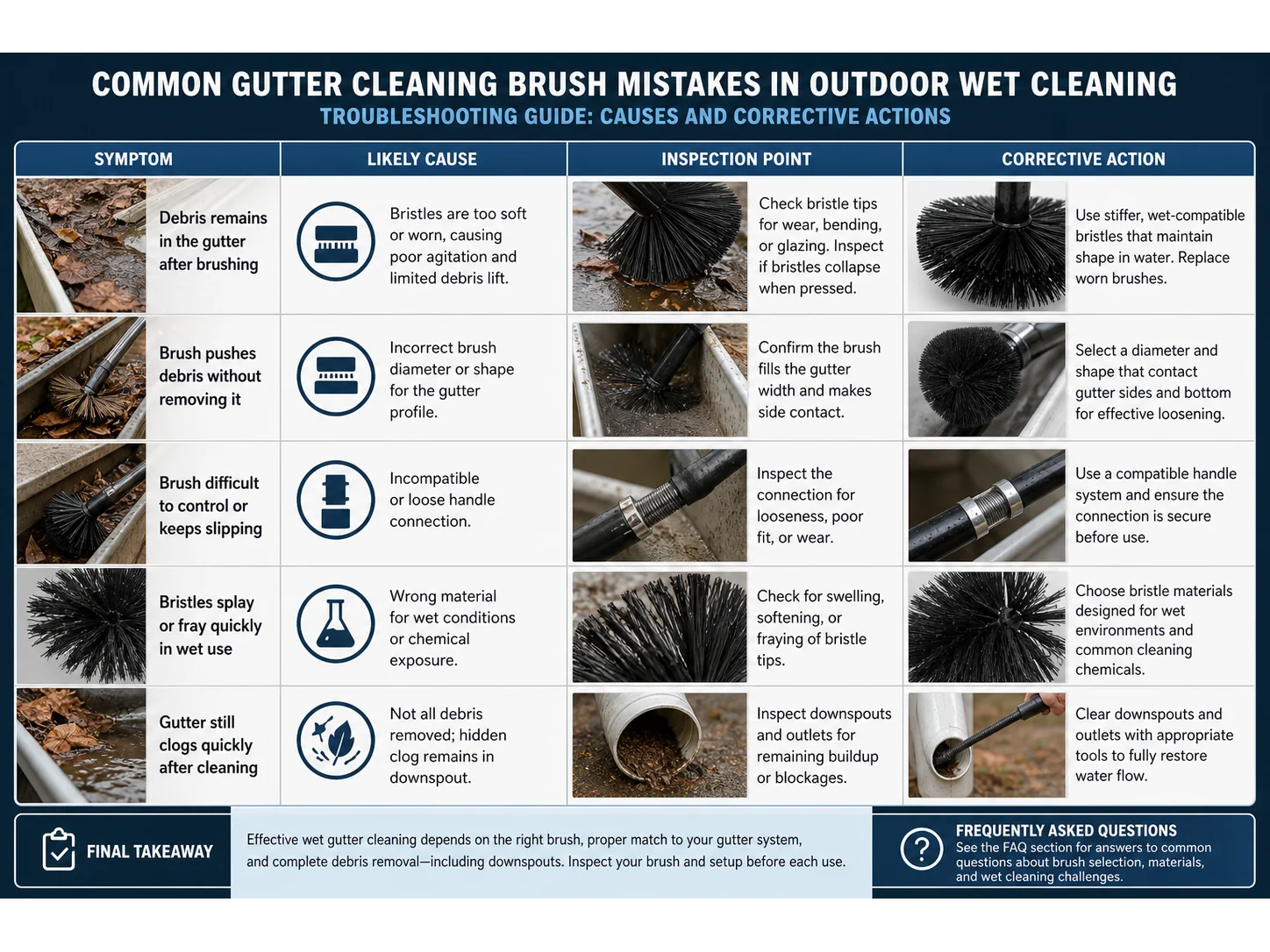
Top Mistakes When Using Gutter Cleaning Brushes in Wet Conditions
| Mistake | Why It Happens | Consequence | How to Avoid |
|---|---|---|---|
| Choosing the wrong bristle material | Assuming all synthetic brushes are waterproof; not checking chemical resistance. | Bristles soften, deform, or shed; corrosion of metal wire cores contaminates gutters. | Select nylon, polyester, or polypropylene bristles for wet use; avoid natural fibers and uncoated steel. Verify chemical compatibility with cleaning agents. |
| Using a brush with the wrong diameter or shape | Guessing size based on gutter width alone, ignoring curvature and downspout openings. | Incomplete contact, increased cleaning time, and potential gouging of gutter seams. | Measure the narrowest cross‑section the brush must pass. For curved profiles, consider a brush with a flexible core or tapered design. Request a sample draw‑over test with a supplier drawing. |
| Ignoring bristle stiffness and density | Picking a brush that feels “stiff enough” without considering wet debris types and surface sensitivity. | Too stiff: scratches paint or soft metal gutters. Too soft: fails to remove caked‑on sludge. | Match stiffness to residue: soft flag for smooth aluminum gutters with light wet leaves; medium‑stiff for PVC or copper gutters with dried mud; stiff crimped wire only on sturdy steel gutters with hard scale. |
| Neglecting handle or core connection compatibility | Focusing only on brush head and overlooking thread type, adapter, or pressure washer coupler. | Wobble, thread stripping, or detachment during use, risking injury and equipment damage. | Confirm thread size (e.g., 1/4″ NPT, Acme, Euro thread), quick‑connect type, or pole diameter before ordering. For custom rolls, provide mounting details in the inquiry. |
| Overlooking maintenance and hygiene requirements | Assuming a brush that works once will last; failing to clean and dry brushes between jobs. | Mold, bacteria growth, bristle set, and premature wear—especially in food or potable water facility gutter cleaning. | Choose brushes with a solid plastic core and open bristle patterns that shed water. Rinse after each use and store vertically. For sanitary settings, consider a brush with antimicrobial additive or a washable, autoclavable design. |
| Ordering standard off‑the‑shelf when a custom brush is needed | Trying to fit a generic brush into a non‑standard gutter profile or unusual mounting situation. | Poor cleaning results, frequent replacements, and higher lifecycle cost. | Request a custom brush design review when gutters are an odd shape, require a long reach in confined space, or need a specific bristle pattern to agitate corners. Provide a drawing or sample of the gutter profile to a brush manufacturer. |
How to Choose the Right Gutter Cleaning Brush for Wet Environments
To avoid the mistakes above, evaluate the following factors before purchasing or ordering a brush:
- Residue type: Wet leaves, mud, hardened sap, or chemical deposits require different stiffness and bristle configurations.
- Surface sensitivity: Plain steel, painted steel, copper, aluminum, and PVC each have different scratch resistance. Match bristle material and tip treatment accordingly.
- Equipment interface: Determine whether the brush will be used on a rigid pole, flexible shaft, pressure washer wand (with or without water pass‑through), or robotic arm. This affects core diameter, thread, and water channel design.
- Wet and chemical exposure: Confirm the brush materials are compatible with the cleaning solutions (e.g., hydrogen peroxide, citric acid, chlorine‑based cleaners) and that metal components are stainless steel or fully encapsulated.
- Hygiene expectations: For food processing areas, pharmaceutical sites, or water treatment facilities, choose brushes rated for cleanroom or sanitary use, with solid, non‑absorbent cores.
- Maintenance frequency: High‑cycle cleaning calls for durable, easily stripped and cleaned brushes. Look for modular designs that allow bristle strip replacement.
- Custom size requirements: If standard sizes don’t fit, work with a manufacturer that accepts outline drawings or sample parts. A drawing‑based quote prevents many of the mistakes listed above.
Comparing Brush Styles for Wet Outdoor Gutter Cleaning
| Brush Style | Best For | Material | Stiffness | Water Compatibility | Typical Mount |
|---|---|---|---|---|---|
| Spiral wound tube brush | Downspouts and narrow channels | Polypropylene or nylon with galvanized or stainless steel wire core | Medium | Excellent if core is sealed | ¼” shank or threaded adapter |
| Flagged nylon strip brush | Smooth metal gutters; light wet leaf removal | Nylon stem with flagged tips | Soft to medium | Very good; water flows freely | Pole or pressure washer lance with clamp |
| Crimped wire brush | Heavy rust and scale on robust steel gutters | Carbon steel or stainless steel wire | Stiff | Corrosion risk if carbon steel; use stainless for wet | Handheld handle or drill adapter |
| Polyester channel brush | Wide, flat‑bottom gutters with chemical use | Polyester monofilament set in plastic block | Medium‑stiff | Excellent chemical resistance | Bolt‑on or pressure washer bayonet |
| Custom core brush roll | Unusual gutter profiles or automated systems | Specified by application | Tailored | Depends on design | Per engineering drawing |
When a Gutter Cleaning Brush Is the Wrong Choice
Even the best brush cannot solve every wet cleaning challenge. Recognize these boundaries:
- Severe structural corrosion or flaking paint: A brush may remove loose debris but cannot repair damaged substrates. Chemical stripping or mechanical resurfacing may be required first.
- Hygienic systems requiring validated cleaning: In pharmaceutical or food‑contact environments, a brush alone may not meet microbial reduction requirements without a documented washdown and steam‑sterilization process. Coordinate brush selection with your sanitation standard operating procedure.
- Extremely narrow or convoluted passages: If no standard brush fits, a custom design may still be possible, but first confirm that the gutter can be accessed safely. If not, consider a high‑pressure water jet or chemical soak.
- Frequent brush replacement is accepted: If the brushing task is so abrasive that any brush wears out in days, the process may need re‑engineering—perhaps a different tooling material or a pre‑soak step to soften deposits.
When in doubt, request a sample brush test or a supplier drawing review to validate fit and performance before committing to a bulk order.
Final Takeaway
The most common gutter cleaning brush mistakes in outdoor wet cleaning stem from overlooking material compatibility, size fit, and process conditions. By assessing residue type, surface sensitivity, mounting requirements, and wet‑environment demands upfront—and by not hesitating to seek a custom design when standard options fall short—you can dramatically extend brush life, improve cleaning consistency, and reduce total operating cost.
Frequently Asked Questions
Can I use the same gutter cleaning brush for dry and wet cleaning?
Yes, if it is made with water‑resistant materials and a sealed core. However, brushes used wet should be thoroughly dried after use, and those used with aggressive chemicals may require a designated set to avoid cross‑contamination.
How do I know if the brush bristles are chemically compatible with my cleaning agent?
Check the manufacturer’s chemical resistance chart for the bristle polymer (nylon, polyester, polypropylene). For unknown mixtures, a sample immersion test at working temperature and concentration is recommended before full‑scale use.
What bristle material is best for cleaning aluminum gutters without scratching?
Flagged nylon or soft polyester is ideal for aluminum. Avoid metal wires and stiff abrasive filaments. A test patch in an inconspicuous area can confirm scratch risk.
My brush keeps shedding bristles in wet conditions. What am I doing wrong?
Shedding often indicates a core material that absorbs water and swells, a poor‑quality bonding process, or a bristle material that degrades under chemical exposure. Switch to a brush with a solid plastic core and bristles fusion‑set or mechanically crimped with a stainless‑steel wire for wet environments.
Can I mount a gutter cleaning brush on a pressure washer wand?
Yes, many brushes are designed with a threaded or quick‑connect adapter that fits pressure washer wands. Confirm the wand’s thread size and that the brush can handle the water pressure and flow rate without damage.
How do I specify a custom brush for an oddly shaped gutter?
Provide a dimensioned drawing of the gutter cross‑section, including all radii and undercuts, plus the desired brush length, core material, and bristle coverage pattern. A reputable industrial brush manufacturer can then propose a design and produce a sample for fit testing.
Is a stainless steel core always necessary for wet outdoor gutter cleaning?
Not always, but it is the safest choice. If the brush is properly dried after each use and not exposed to corrosive chemicals, a galvanized steel core may suffice. For prolonged wet exposure or compatibility with sanitizing chemicals, a stainless‑steel core or a fully plastic‑encapsulated design is recommended.
Technical References
Which bristle material fits this job — AISI 304 Stainless Steel Wire, Nylon PA or PVC?
| Material | Continuous temperature (°C) | Peak temperature (°C) | Water absorption | Hardness |
|---|---|---|---|---|
| AISI 304 Stainless Steel Wire | 400 | 500 | 0% | Rockwell B 70–95 depending on temper and cold work |
| Nylon PA | 93 | 121 | 0.3–9% by PA grade and conditioning | Medium to firm; filament diameter and trim length control bending force. |
| PVC | 50–70 | 75–90 | 0.04–0.40% | Shore A 70–95 or Shore D 70–85 |
| Polypropylene PP | 80–100 | 120–140 | ≤0.03% | Shore D 65–75 |
| UV-resistant Anti-aging Filament | 140 | 170 | 0.1–1.0% | Defined by the carrier polymer, diameter and weathering condition. |
Figures as published by Alleima; Brushtec / DuPont; Perlon. Confirm the exact grade against the supplier datasheet before ordering.
What should replace Handheld Detail Brushes for gutter cleaning?
- Handheld Detail Brushes — Handheld detail brushes cover general precision cleaning; auto-detailing brushes impose tighter controls for painted, polished, leather, display, and trim surfaces.
- AISI 304 Stainless Steel Wire — Use AISI 316 stainless steel wire for chloride, marine, dairy, beverage, chemical washdown, or higher pitting-resistance requirements. Use carbon steel for dry aggressive cutting and brass or abrasive nylon for lower marking risk.
- Nylon PA — Compare Nylon PA with PP, PBT, PET. Change material when wet stiffness, temperature, chemical resistance, conductivity, particle shedding, or surface marking becomes the limiting factor.
- PVC — Compare PVC with PE board, PP, elastomer, aluminum holder. Change material when wet stiffness, temperature, chemical resistance, conductivity, particle shedding, or surface marking becomes the limiting factor.