What Is a Dairy Pipe Brush?
A dairy pipe brush is a cylindrical, stem‑mounted brush engineered for hygienic piping systems. It typically consists of a twisted‑wire or plastic core with fill materials (bristles) that contact the pipe inner wall. The brush physically dislodges soils that water rinsing alone cannot remove. In dairy and beverage environments, the brush must be sized to match the pipe’s internal diameter, resist cleaning chemicals and high‑temperature washdowns, and be made from materials that are acceptable for incidental food contact.
Common Types of Pipe Brushes for Dairy and Beverage Applications
Not all pipe brushes are the same. In sanitary processing, you will encounter several basic types:
- Twisted‑in‑wire tube brushes: Full bristle fill around a flexible metal wire stem, good for straight runs and gentle bends.
- Spiral or coiled brushes: Bristles are looped into a continuous spiral, providing even pressure and good debris carrying capacity.
- Cylinder brushes with central shaft: Used in larger‑diameter pipes or tanks; often mounted on a rod or pipe for heavy‑duty manual cleaning.
- Bottle and fitting brushes: Shorter, tapered, or shaped for elbows, tees, and small‑diameter ports.
- Drill‑mounted or rotary brushes: Designed to attach to a power drill for faster, more consistent mechanical action in long pipe runs.
Sizing and Fit: Pipe ID, Bend Radius, and Brush Dimensions
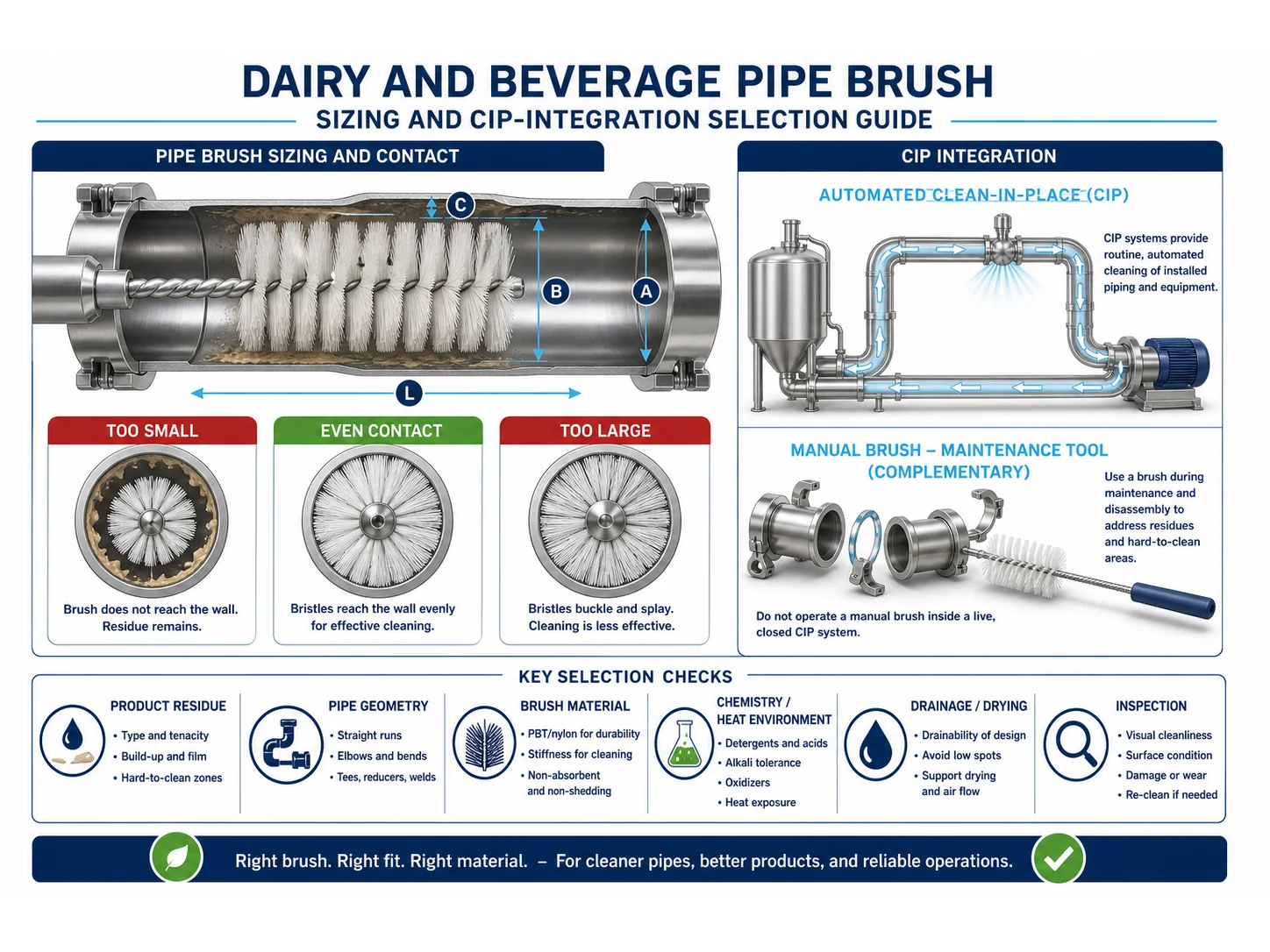
Proper sizing is the single most important factor in brush performance. A brush that is too small will leave residue; one that is too large can jam, damage pipe surfaces, or break. Consider these parameters:
- Pipe ID (internal diameter): Measure the exact ID of the pipe, including any weld beads or roughness. The brush diameter should be 0.5–1.5 mm (0.02–0.06 in) larger than the pipe ID to ensure consistent wall contact without excessive friction.
- Bend radius: For pipes with 90‑degree or tighter bends, the brush stem must be flexible enough to follow the curve without buckling. A brush that is too stiff will not pass through, while one that is too thin may break. Look for brushes with a minimum bend radius specified by the manufacturer.
- Brush length: The brushing zone should be long enough to pass completely through the pipe section. For manual push‑pull cleaning, a brush length of 1.5–2 times the pipe section length is common.
- Connection and drive compatibility: If the brush will be attached to a rod, drill, or automated drive, verify the stem diameter and connection type.
Material Selection for Food‑Grade and High‑Temperature Cleaning
Brush materials must match the chemistry, temperature, and regulatory requirements of the cleaning process. The table below summarizes common fill and stem materials for dairy pipe brushes.
| Material | Common Use | Max. Temp. (°F / °C) | Chemical Resistance | Food Contact Compliance |
|---|---|---|---|---|
| Nylon (6.6 or 6.12) | General dairy, beverage, soft soils | 250°F / 121°C | Good with alkalines, fair with acids | FDA 21 CFR compliant when unfilled, no pigments |
| Polypropylene | Acidic cleaners, high‑humidity washdown | 200°F / 93°C | Excellent with acids and bases | supported by food-contact documentation; stiffer than nylon |
| Stainless Steel Wire (304/316) | Burnt‑on deposits, heavy residues | 800°F / 426°C | Excellent overall, avoid chlorides above 160°F | Inert, but may scratch soft metal pipes |
| PTFE (Teflon) | Ultra‑pure, sticky products, chemical extremes | 500°F / 260°C | Excellent, virtually inert | supported by food-contact documentation; expensive, low abrasion |
| Natural Fiber (Tampico, Horsehair) | Historical, low‑abrasion polishing | 180°F / 82°C | Poor with chemicals, may swell or degrade | Not recommended for modern sanitary environments |
Always request a certificate of compliance or FDA letter from the brush supplier when the brush will touch product‑contact surfaces. For dairy plants, USDA acceptance can also be verified if required.
Drive Methods and the Role of Brushes in a CIP Workflow
Dairy pipe brushes are most often used in manual or semi‑automated cleaning steps that are outside the main CIP circuit. Common drive methods include:
- Manual push‑pull: Operator pushes the brush through a pipe section. Suited for short, accessible runs.
- Flexible shaft with power drill: Typical for long transfer lines, receiving tubes, or before a shutdown inspection.
- Rotary hose‑driven systems: Brush head attached to a rotating high‑pressure water hose, often used in large dairy plant drain lines.
CIP integration as a workflow consideration: CIP is a validated, automated cleaning process using chemical circulation, temperature, and flow. A pipe brush is not a substitute for a validated CIP system. However, brushes are frequently integrated into the overall sanitation plan:
- Pre‑CIP brushing to remove tenacious product deposits, reducing the chemical load and cycle time.
- Supplemental cleaning of dead ends, bypass lines, sampling ports, and transfer panels that may not receive adequate CIP flow.
- Booster cleaning of hard‑to‑reach sections identified by swab testing or inspection.
The brush selection must not compromise the pipe surface finish (Ra ≤ 0.8 µm for dairy). Deep scratches can harbor bacteria and defeat CIP validation.
Common Mistakes in Dairy Pipe Brush Selection and Use
Avoid these frequent errors to maintain cleanability and extend equipment life:
- Choosing a brush by pipe nominal size rather than actual ID: Schedule and wall thickness vary. A 2‑inch nominal pipe may have an actual ID ranging from 1.9 to 2.1 inches. Measure first.
- Ignoring brush core flexibility: Straight brushes cannot clean bends. A brush that buckles in a 90‑degree elbow will leave a soil pocket.
- Using non‑food‑grade materials without documentation: Brushes bought from general industrial suppliers may contain lubricants, colorants, or adhesives not allowed in food zones.
- Neglecting residue type: A soft nylon brush will not remove burned lactose or mineral scale. Harder bristles or wire brushes may be needed but risk surface damage if not properly specified.
- Over‑reliance on a worn brush: Bristles fatigue, flatten, and lose stiffness. A brush that appears “still working” may be leaving a biofilm layer. Replace on a schedule based on visual wear or cleaning efficacy tests.
When a Standard Pipe Brush Is the Wrong Choice
Brushing has clear limits. You should involve a sanitation specialist, process engineer, or hygienic design consultant when:
- The piping includes complex tees, reducers, and dead legs that cannot be fully accessed by a linear brush.
- Regulatory audits or customer requirements demand fully validated CIP with documented cleanability (e.g., FDA FSMA, EU 852/2004).
- The product is ultra‑heat‑treated (UHT) or aseptically processed, where any manual intervention increases contamination risk.
- Surface finish requirements are Ra ≤ 0.5 µm, and abrasive brush materials could alter the surface.
- Automated brush systems are being considered but have not been validated for consistent cleaning performance.
Final Takeaway
Choose a dairy pipe brush based on pipe ID, bend radius, soil type, chemistry, temperature, and food‑contact documentation. View the brush as a supplement to a validated CIP program, not a replacement. Size it correctly, document the material, and replace it before performance declines. When in doubt about hygienic design or audit readiness, consult a specialist rather than relying on a generic brush selection.
Frequently Asked Questions
How do I measure the pipe ID for a brush?
Use a caliper to measure the inside diameter of a clean, dry pipe end. If measuring through a fitting, account for any gasket retraction or misalignment. Purchase a brush with a diameter 0.5–1.5 mm larger than the measured ID for adequate wall contact.
Can I use a nylon brush for hot caustic CIP solutions?
Nylon 6.6 brushes can withstand typical caustic wash temperatures (160–180°F / 71–82°C) but may degrade if exposed to temperatures above 250°F or to strong oxidizing acids. Check the brush manufacturer’s chemical compatibility chart for your specific CIP chemistry.
What is the difference between a dairy pipe brush and a general‑purpose pipe brush?
Dairy brushes are made from materials with FDA‑acceptable food‑contact documentation, often with a surface finish that won’t scratch stainless steel. Standard industrial brushes may contain fillers, oils, or wire grades that are not suitable for hygienic processing lines.
How often should I replace a dairy pipe brush?
Replacement depends on frequency of use, chemical exposure, and soil load. Inspect brushes weekly for flattened bristles, corrosion on wire stems, or loss of fill density. A good rule: replace when bristle length has shortened by more than 20% or when manual cleaning requires extra strokes to achieve the same visual result.
Does using a pipe brush void my CIP validation?
Not if the brush is part of a documented manual cleaning procedure for areas not covered by CIP, and it does not damage the pipe surface. However, introducing a brush into a validated CIP circuit without changing the sanitation master plan can create a gap in your documentation. Always update your sanitation procedures and re‑verify if necessary.
Can I use a wire brush on stainless steel pipes?
Yes, but only if the wire is stainless steel (304 or 316) and the brush is designed not to scratch the surface. Carbon steel wire brushes will leave rust‑promoting iron deposits and must never be used. After using any wire brush, inspect the pipe surface for scratches that could trap bacteria.
What size brush do I need for a 2‑inch dairy line?
It depends on the actual inside diameter. A 2‑inch schedule 10S pipe may have an ID of 2.157 inches; schedule 40S may be 2.067 inches. Measure, then order a brush 2.1–2.2 inches in diameter, with a flexible stem long enough to pass through the full line length plus bends.
Are there automated brush systems that integrate with CIP?
Some plants use rotary brush stations where a brush is pushed through a pipe by water pressure or a mechanical drive as part of a pre‑rinse. These systems still require design validation and are not plug‑and‑play CIP components. Consult a hygienic design engineer before installing an automated brush into a sanitary line.