
Custom Cleaning Brush
8mm PA612 Flexible Tube Brush
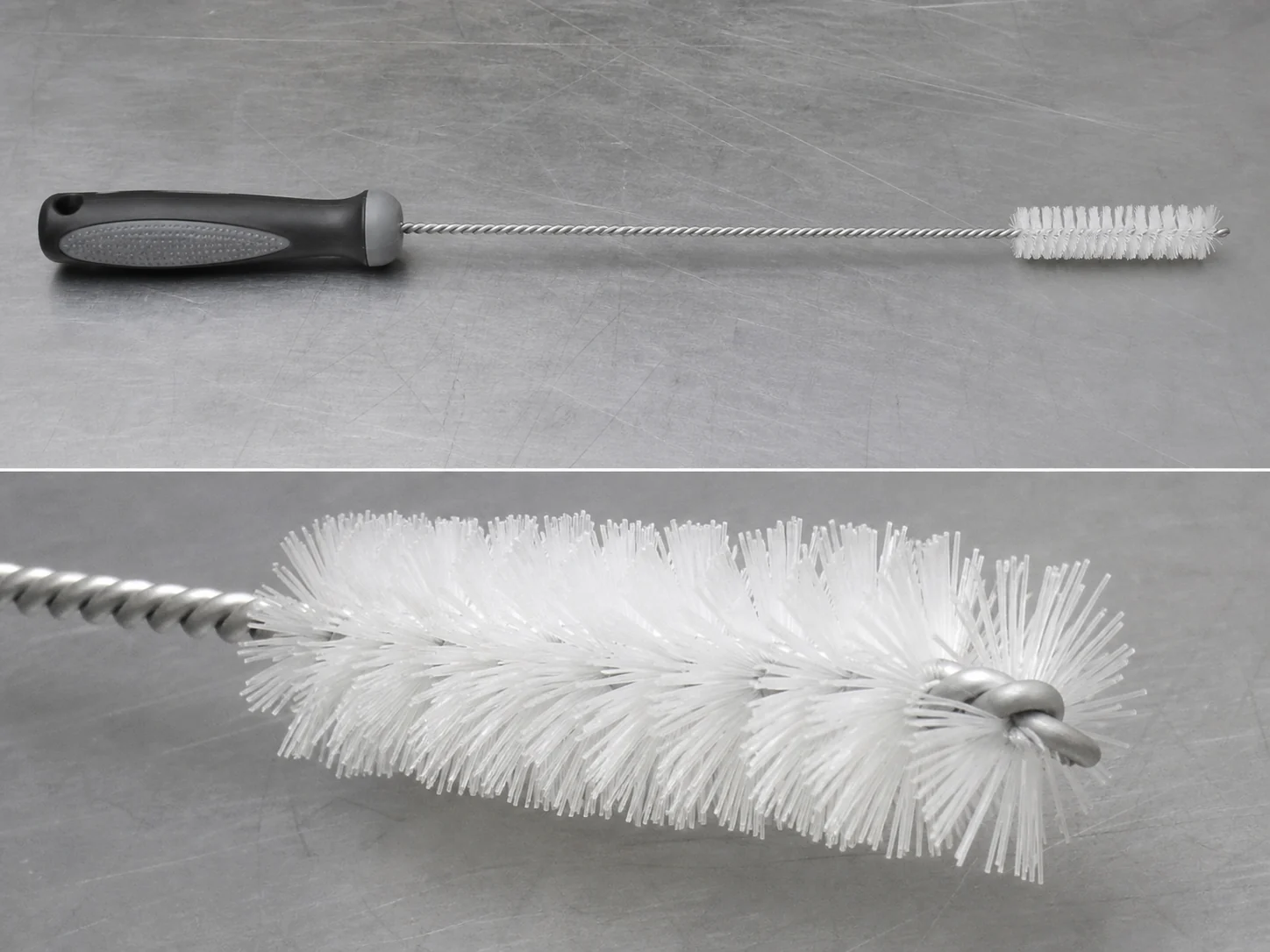
Manual 8 mm PA612 nylon tube brush with a flexible stainless core for heat exchanger tubes, ports and curved bores. Custom diameter, length and handle.
Small brush
500 pcs
Minimum order
Held in one hand: tube, bottle, detail and swab brushes — including long-handled ones with a small head.
Production lead time, once the specification is confirmed
- Up to 500 pcsWithin 7 days
- 501–50,000 pcsWithin 14 days
- Over 50,000 pcsWithin 21 days
Peak season can extend these times; the shipping date is confirmed in writing with your quotation. Sampling and shipping are quoted separately.
The 8mm PA612 flexible tube brush is a hand-guided bore-cleaning tool for heat exchanger tube interiors, curved passages, ports, and blind holes. Its twisted stainless steel wire core follows bends while the PA612 bristles loosen coolant, oil, chips, rust, scale, carbon, and process deposits with lower scratch risk than metal wire brushes.
What can this brush do for you?
Follows the tube path instead of fighting it
The twisted stainless steel wire stem flexes under bending load and returns to straight once the force is released. In U-bend exchangers, header turns, or curved ports, the brush follows the bore rather than lifting bristle contact off the far wall, so one flexible tool covers the straight run and the bend.
Carries a full 8 mm contact band through the bore
The round bristled head presents a continuous 360° PA612 contact band. In a bore close to the head diameter, each pass wipes the full circumference; in a larger bore, a slow rotation or short angled strokes brings the tips across the remaining wall. This reduces dead spots compared with a flat or one-sided scraper.
Stays stiff and scrubbing in wet, oily service
PA612 nylon absorbs less moisture than standard PA6 or PA6.6. When the brush is used with water, coolant, cutting oil, or mild alkaline wash solutions, the filaments hold more of their stiffness and scrubbing pressure instead of going limp mid-job.
Removes mixed deposits without scoring the tube wall
The filament tips are stiff enough to break up chips, dried coolant, light rust, scale, and carbon film, but they are softer than the stainless, copper, brass, or aluminum tube walls they contact. That gives operators a mechanical cleaning step with a lower scratch risk than a steel or brass wire brush.
Keeps the operator’s hand clear of the insertion point
A 150 mm handle extends the working end beyond the tube entry, so the operator can push, turn, and retract without reaching into the header. An optional TPE/TPR overmold on the grip adds a non-slip surface when hands are wet or gloved.
What is an 8mm PA612 Flexible Tube Brush?
An 8mm PA612 flexible tube brush is a hand-guided bore-cleaning tool built around a twisted stainless steel wire core. PA612 nylon filaments are captured in the twisted wire along a 70 mm head section, forming an 8 mm diameter round brush head; the remaining wire continues as a fixed 150 mm handle. The assembly is one piece: the brush head and handle are the same wire stem, so there are no joints or fittings to loosen inside the tube.
In service, the operator inserts the working end into a heat exchanger tube, oil cooler passage, hydraulic port, or similar bore and works it with push-pull and rotating strokes. The filament tips wipe the internal wall and shoulder loose chips, oil, coolant, scale, rust, carbon, powder, and process deposits; much of the debris is pulled back on the retraction stroke or pushed ahead to the next flushing point. The flexible core lets the head ride through gentle bends and off-axis entries, but the tool is not intended to be forced through a bore that pinches or jams it.
The right application starts with the actual minimum bore ID, the tube material, the deposit type, and the required reach. PA612 is a practical middle-ground filament: more chemical and moisture resistant than many general nylons, yet less aggressive than wire. It is a mechanical cleaning step, not a replacement for chemical descaling or flushing.
Technical Specifications
These are the nominal dimensions of the standard 8 mm PA612 flexible tube brush. All listed values can be adjusted to the tube geometry and cleaning process.
| Parameter | Value / Options |
|---|---|
| Brush head diameter | 8 mm nominal |
| Head profile | Round, continuous 360° bristle band |
| Head length (bristled section) | 70 mm |
| Bristle material | PA612 nylon filament |
| Stem / core | Stainless steel twisted wire, flexible; 304 or 316 grade according to service environment |
| Handle length | 150 mm |
| Grip diameter | 9 mm at the handle stem; TPE/TPR overmold optional |
| Connection | Fixed, one-piece construction |
| Overall length | Approximately 220 mm as standard; longer reach available on request |
| Recommended bore range | Approximately 8–12 mm internal diameter; larger bores require rotation or angling to contact the full circumference |
| Operating environment | Oils, coolants, water-based cleaners, mild alkaline wash solutions; confirm chemical and temperature exposure for the specific fluid |
| Brush type | Custom Tube & Pipe Bore Brushes |
| How it is driven | Hand-guided |
| Cleaning target | heat exchanger tube bundle, tube-to-tube sheet access point, and hydraulic manifold block cleaning |
| Surface or part | tubes, passages, ports, bends, holes, bores, blind holes, and walls |
| Residue or debris | oil, scale, chips, coolant, carbon, rust, process deposits, and powder |
| Mounting / connection | Fixed, one-piece construction; Approximately 8–12 mm internal diameter; larger bores require rotation or angling to contact the full circumference |
The key fit check is the minimum bore ID the brush must pass through, not the nominal tube size. If the tube has scale, deposits, or a reduced neck, the effective passage may be smaller than the clean bore dimension.
Where does this brush work best?
This brush is sized and constructed for internal cleaning of slender, curved, or difficult-to-reach passages. Common uses include:
- Heat exchanger tube bundles, oil coolers, and condensers with internal tube diameters near 8–12 mm, including straight runs and U-bend sections.
- Tube-to-tube sheet access points where the entry is short and the tube run extends well beyond hand reach.
- Hydraulic manifold blocks, valve bodies, and brake/fluid ports with cross-drilled holes and intersecting passages.
- Compressed air, lubrication, and fuel system ports where chips, powder, or dried oil must be cleared after service or machining.
- Blind holes, threaded ports, and taper seats that trap coolant, chips, or paste-like process residues.
For any of these, the tube ID and deposit type determine whether PA612 is the appropriate filament. It is generally well suited to chip and sludge removal and to light-to-moderate scale or carbon film; it is less suited to heavy calcified scale requiring a wire or abrasive tool.
How do I choose the right one?
Confirm the minimum bore first.
Measure the smallest internal diameter the brush must pass through with any scale or deposit still present. The 8 mm head should slide through with firm drag, not require hammering. If the minimum passage is clearly below about 8 mm, choose a smaller head. If the clean tube is much larger than 8–10 mm and must be fully contacted on every pass, consider a larger head, a multi-size set, or a brush with a longer filament fill. Overloading an undersized bore can kink the core or tear filaments out of the twisted wire.
Second, match the filament to the surface and residue.
PA612 is the right middle ground when the tube wall is stainless, copper, copper alloy, aluminum, or coated, and the deposit is chips, dried coolant, oil film, light rust, scale, or carbon. If the deposit is hard, thick, or calcified, use a chemical descaling step or a stainless/brass wire tube brush first, then use the PA612 brush for finish cleaning. If the surface is extremely soft or polished and scratch-free appearance is critical, a softer filament may be needed.
Third, set the reach to the tube length.
The standard brush reaches about 220 mm from handle end to working tip. If the tube run is longer, the handle or overall stem can be extended, but a very long flexible stem is harder to control and easier to kink; for deep bundles, a guide tube, extension handle, or segmented construction may be needed. The brush is a hand tool, not a rigid push rod. It follows the available bore, it does not create a path through a blocked tube.
Fourth, confirm use and environment.
For manual push-pull and rotating strokes, the fixed handle is ready to use. If the cleaning process is machine-driven or requires a chuck or drill arbor, ask for a shank-mounted configuration instead of forcing the handle into a power tool. For wash solutions containing chlorides or acids, specify a 316 stainless core and confirm PA612 compatibility with the chemical and temperature.
- Bore ID roughly 8–12 mm and accessible entry: choose the standard 8 mm head.
- Bore with bends: use the flexible wire core and confirm the bend radius before ordering.
- Tube longer than 200 mm: specify an extended handle or custom overall length.
- Machine-driven operation: request a shank or machine mount instead of a fixed hand handle.
Can I customize this brush?
Yes. The standard 8 mm PA612 flexible tube brush is a starting configuration, not a fixed stock item. Tell us the tube material, minimum bore ID, clean tube length, bend configuration, deposit type, and cleaning fluid; drawings, photos, or a used sample of the passage help us match the tool to the actual geometry.
Common adjustments include:
- Head diameter and profile — other diameters, conical or tapered head ends, or longer/shorter bristled sections to hit specific tube bands.
- Filament — PA612 diameter, trim length, filament color, or alternative nylon/PBT grades when process conditions require different stiffness or chemical resistance.
- Stem and core — stainless steel wire diameter for more or less flexibility, 304/316 grade, stem length, or looped ends.
- Handle and grip — length, TPE/TPR overmold, loop or ring handle, hanging hole, or a shank/threaded end for machine mounting.
- Marking and packaging — custom color coding, identification marking, bulk pack, individual pack, or project-specific packing.
If your project requires material declarations, inspection records, or third-party testing to qualify the brush for your cleaning process, we can arrange that support as part of the customization scope.
How do you tell when a 8mm PA612 flexible tube brush is worn out?
How tight a bend can this brush follow?
It follows the gradual curve common in U-bend heat exchanger tubes and formed ports, but there is no fixed radius number because stem flexibility depends on wire diameter and tube ID. Before ordering, bend the stem by hand to the approximate tube curve; if the wire kinks or the head refuses to pass the curve with moderate hand force, request a more flexible core or a smaller head diameter. A sharp 90° elbow with a radius much smaller than the bore diameter is often beyond what a hand-guided flexible stem can negotiate reliably.
How can I tell whether the 8 mm head is making complete contact with the tube wall?
Watch the pull resistance and the wear pattern. In a bore close to 8 mm, the brush should feel like a steady wiping drag around the whole circumference. If the drag is only on one side or the filament tips show one-sided wear, the brush is not centered or the bore is larger; slow the stroke, rotate the handle while passing, or move to a larger head. A smooth bright ring around all bristle tips after use indicates uniform contact.
Does brushing remove hard scale by itself?
It removes loose and moderately attached scale, but it is not a replacement for chemical descaling or high-pressure flushing when the tube is heavily fouled. The best sequence is usually chemical softening or descaling first, then a mechanical pass with this brush to clear loosened deposit, then flushing to carry debris out. Brushing alone on thick, hard calcification will wear the filaments quickly and may leave bonded scale behind.
Can this brush be used in a drill or rotary tool?
The standard configuration has a fixed, hand-held handle and is not designed for powered rotation. Running the long flexible stem at drill speeds can whip, kink, or injure the operator and may damage the tube. If powered cleaning is required, let us know the arbor or shank size and speed, and we can configure a machine-mount version instead.
What should I check before inserting the brush into a tube bundle?
Run a gloved hand along the full wire stem to feel for broken wire strands or sharp ends, especially at the working end and where the bristles end. Confirm the TPE/TPR grip, if used, is secure and not rotating. Visually compare the head against a new brush for shortened or deformed filaments. Any exposed wire tip or hook can score the tube wall, so replace or rework the brush before it goes into the bundle.
When should the brush be replaced?
Replace it when the bristle tips are rounded over and no longer spring back, when the head diameter has visibly shrunk so the drag is much lower, when the wire core is permanently kinked and will not straighten, or when broken filaments are appearing in the tube. A worn brush extends cleaning time and leaves residual deposits; comparing the used head to an unused one is the fastest way to judge replacement.
Guides that go deeper on this
Custom Manufacturing RFQ
Describe Your Application
Please include the main sizes, application, residue, preferred material, interface, quantity, and any drawing or sample available.
Drawing or photo optional — it speeds things up, it does not gate the enquiry.
Custom Brush RFQ
Send Your Brush Project
Upload a drawing, product photo, or sample photo and provide the core dimensions and cleaning conditions.
“We need a brush to remove wet residue from a stainless steel conveyor, about 800mm wide. The current brush wears quickly. We can send photos.”
“We sell drinkware and need a cleaning brush to include with the product. Quantity around 5,000 pieces.”