
Custom Cleaning Brush
38mm PA612 Boiler Tube Brush
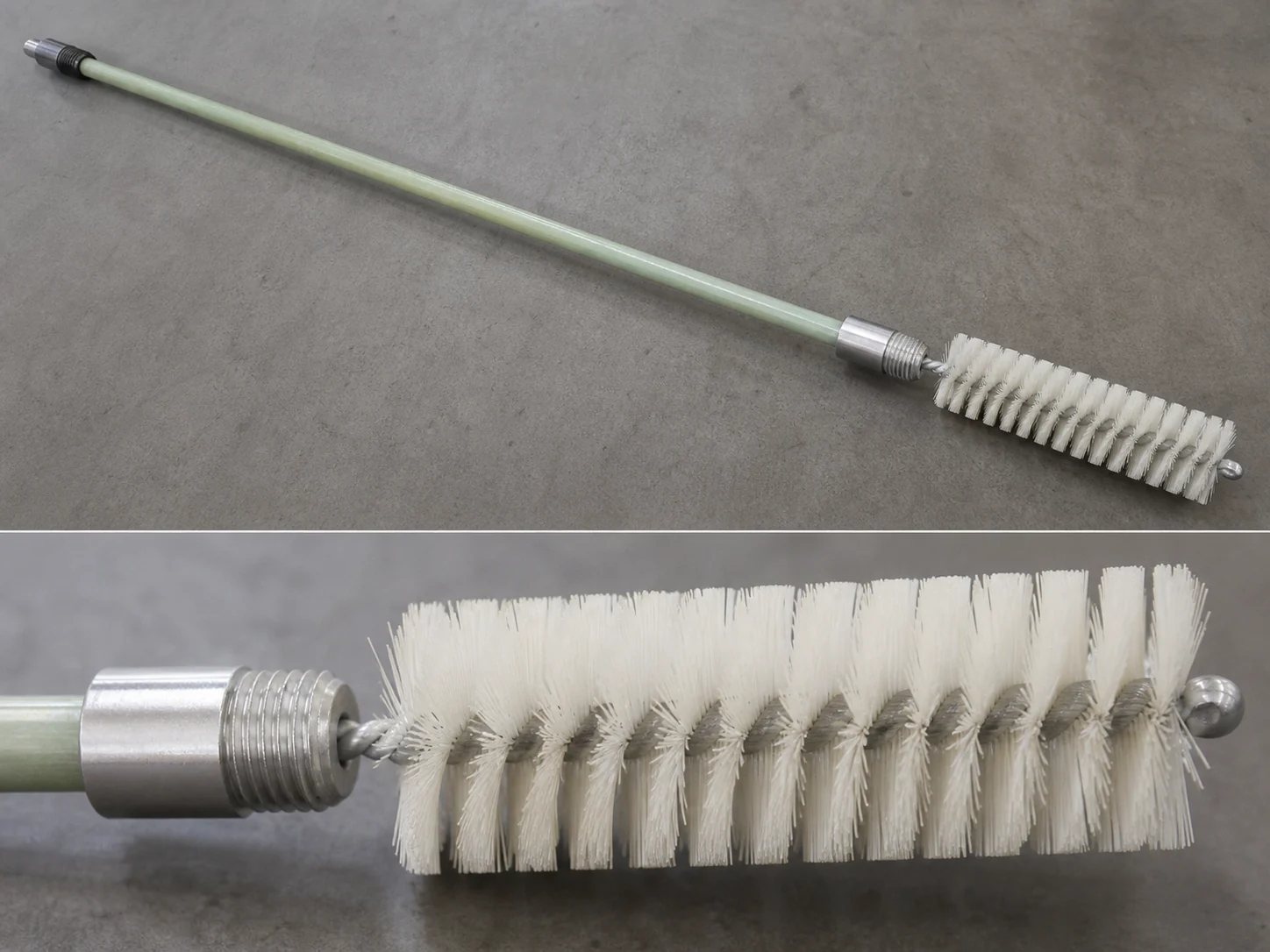
38mm PA612 boiler tube brush with a twisted stainless core and 300 mm threaded handle for soot, scale and carbon in 36–42 mm boiler and exchanger tubes.
Small brush
500 pcs
Minimum order
Held in one hand: tube, bottle, detail and swab brushes — including long-handled ones with a small head.
Production lead time, once the specification is confirmed
- Up to 500 pcsWithin 7 days
- 501–50,000 pcsWithin 14 days
- Over 50,000 pcsWithin 21 days
Peak season can extend these times; the shipping date is confirmed in writing with your quotation. Sampling and shipping are quoted separately.
A 38mm-diameter industrial boiler tube brush with PA612 nylon fill on a twisted stainless steel core, built to remove soot, scale, rust, and process deposits from the internal walls of boiler and heat exchanger tubes. The 150 mm cleaning head and 300 mm threaded handle give roughly 450 mm of reach, and the removable connection accepts extensions or a power-drive adapter.
What can this brush do for you?
Keeps Filaments on the Tube Wall Through Rotation
The 38 mm fill diameter is chosen to exceed the bore slightly, so the PA612 filament tips stay pressed into the tube wall during rotation. That removes soot, scale, and carbon across the entire circumference in one pass, not just along the wire line.
Balances Aggressive Action With Metal Protection
PA612 nylon is stiffer and more abrasion-resistant than polypropylene or natural fibers, so it breaks up soft carbon, light rust, and scale effectively. At the same time, its filament tips are far softer than steel wire, reducing the risk of scoring copper, brass, or mild steel tube walls.
Holds Its Shape in Wet Boiler Environments
The twisted stainless steel core resists corrosion and handles repeated wet/dry cycles without rusting or weakening. The core’s spiral construction keeps the head round and stable when the brush is pushed through straight tube runs.
Threaded Removable Connection Extends Reach and Life
The 300 mm handle terminates in a threaded removable connection. Attach an extension rod for deeper tube banks, connect a drive adapter for power rotation, or replace a worn head without discarding the handle.
Reduced Moisture Uptake Keeps the Fill Stiff
PA612 absorbs less water than PA6 or PA66 nylon, so the filaments keep most of their stiffness and recovery after steam or water cleaning. A wet brush still scrubs, instead of turning soft and folding over.
What is a 38mm PA612 Boiler Tube Brush?
A 38mm PA612 boiler tube brush is a twisted-in-wire tube cleaning tool built for the internal walls of boiler tubes, fire tube bundles, and heat exchanger tubes with bore diameters close to 38 mm. Filaments of PA612 nylon are captured between two twisted stainless steel wires, forming a round, full-circumference cleaning head approximately 150 mm long. The opposite end is a 300 mm handle with a 15 mm grip and a threaded connection.
In operation, the head enters the tube and the operator rotates while pushing and pulling. The filament tips scrape and loosen soot, soft carbon, scale, rust, and process residue; the core transmits rotational force through the full length. Because the filaments are held by the steel spiral, they flex outward against the wall but do not fold away from the contact surface under normal feed pressure.
The PA612 nylon fill and stainless core make this a middle-aggression tool. It is harder working than soft plastic or natural fiber brushes, but less aggressive than stainless or carbon steel wire brushes. Use it where deposits require mechanical loosening but the base tube metal must be preserved.
Technical Specifications
| Parameter | Value / Options |
|---|---|
| Brush head diameter | 38 mm (nominal fill diameter) |
| Head length | 150 mm |
| Head shape | Round, full-circumference filament fill |
| Filament material | PA612 nylon (straight or crimped, project-selectable) |
| Filament diameter | 0.30–0.50 mm standard; other diameters on request |
| Core construction | Twisted stainless steel wire (304 or 316, project-selectable) |
| Handle material | Glass-fiber-reinforced PA612 |
| Handle length | 300 mm |
| Grip diameter | 15 mm |
| Connection | Threaded, removable (size and pitch can be matched) |
| Overall length (assembled) | Approx. 450 mm; extension adds reach |
| Recommended tube ID range | 36–42 mm for light-to-moderate deposits |
| Operating environment | Wet or dry; water, steam, alkaline detergent, common solvent exposure |
| Brush type | Custom Tube & Pipe Bore Brushes |
| How it is driven | Hand-driven on rods or a flexible shaft |
| Cleaning target | firetube boiler pass, watertube boiler tube interior, and shell-and-tube heat exchanger tube bundle cleaning |
| Surface or part | tubes, walls, internal walls, tube walls, metal, carbon steel, bores, and plastic |
| Residue or debris | scale, rust, soot, carbon, coolant, oil, powder, and process deposits |
| Mounting / connection | Threaded, removable (size and pitch can be matched) |
All dimensions can be adjusted to your tube drawing; this table reflects the standard 38 mm configuration.
Where does this brush work best?
- Firetube boiler passes where soot, fly ash, and soft carbon build up on the internal tube wall.
- Watertube boiler tube interiors with light rust, scale, and sediment on the water side.
- Shell-and-tube heat exchanger tube bundles with process fouling, oil or coolant films, and powder deposits when tube ID is within the 36–42 mm range.
- Condenser and chiller water boxes and large-bore tube runs that need regular maintenance cleaning without risk of grooving copper or brass tubes.
- Air heater and economizer tube banks where accumulated fly ash or loose particulate must be cleared before inspection.
How do I choose the right one?
Check the tube ID first
A 38 mm head works best in tubes with a clean internal diameter of about 36–42 mm. If the tube ID is under 36 mm, the filament fill will compress too much and resist insertion. If the ID is above 42 mm, the brush may roll rather than scrub, and you should consider a larger diameter or a different tool.
Match the filament to the deposit and tube metal
PA612 nylon fits soot, soft carbon, light rust, scale, oil, coolant, and powder. For heavier mineral scale or hardened carbon, a stainless or carbon steel wire tube brush removes deposits faster but can scratch softer tube materials. For very soft or coated surfaces, a softer filament such as polypropylene or natural fiber may be safer.
Verify the working length and access path
The standard assembly reaches about 450 mm. If the tube is longer, add a threaded extension; if the tube has bends, confirm the twisted core can follow the curve without kinking. Deep curved runs may require a more flexible core or a pig-style brush.
Consider the operating environment
PA612 tolerates water, steam, mild alkaline detergents, and many common solvents, and its low moisture absorption keeps it useful in wet service. Do not use it continuously above about 120°C, and avoid strong acids or chlorinated solvents unless tested for your specific chemistry.
When this brush is the wrong tool
Choose a smaller brush for tubes below 36 mm ID, a wire or abrasive brush for heavy scale, and a stainless steel spiral or tube pig for very deep, curved, or fouled bundles. This 38 mm PA612 brush is a controlled-abrasion cleaning tool, not a replacement for chemical descaling or mechanical reaming.
Can I customize this brush?
The 38 mm standard head is only a starting point. We build the brush around your tube drawing, deposit analysis, and cleaning process. To specify a custom version, provide: tube ID, tube material, deposit type, reach depth, access openings, cleaning media, operating temperature, and whether the brush will be hand-rotated or power-driven.
- Head diameter and profile — set fill diameter for the correct interference; change the round shape to a tapered or cigar form for easier entry.
- Filament material and stiffness — PA612 is standard, but we can switch to polypropylene, nylon 6, PTFE, abrasive nylon, or wire filament based on the deposit and surface.
- Head length and fill arrangement — adjust the charged length, use single- or double-spiral fill, or change filament diameter and crimp.
- Core and handle — stainless steel 304 or 316 core wire, handle length, grip diameter, material, loop, or T-handle.
- Connection — thread size, pitch, male or female, hex drive, or bayonet-style quick release.
- Color, marking, and packaging — custom colors, laser or pad printing, private-label packaging, bulk or retail counts.
If your project calls for material declarations, inspection reports, or third-party testing, we can support those requirements as part of the customization scope.
Which filament survives the cleaning and still lasts on a 38mm PA612 boiler tube brush?
What tube internal diameter should I pair with a 38 mm brush?
Plan for a clean tube ID between about 36 mm and 42 mm. If heavy deposits narrow the opening, the brush may bind; test the fit dry before starting. The filament tips should deflect slightly and then spring back—if they stay flattened or the brush requires force to rotate, the bore is too tight.
Can I run this brush on a power drill?
Yes, the threaded end accepts a drill adapter. Keep spindle speed below approximately 500 rpm, use light feed pressure, and reverse out if the brush stalls. Nylon filament tips can melt from friction if the brush is run dry at high speed; wet lubrication or a slower pass gives longer fill life.
How will I know when the brush head needs replacement?
Watch for visibly shortened or flattened filaments, a reduction in head diameter, unwinding of the core wire, or the head slipping in the tube without cleaning. If the brush removes noticeably less deposit in one pass than when new, replace the head. The threaded connection lets you replace the head and keep the handle.
What should I check before inserting the brush?
Confirm the tube is cool, depressurized, and drained. Remove plugs, caps, and loose debris. Insert the head straight and stop if resistance builds suddenly; do not force the brush through a bend or obstruction. A quick flush or wetting pass helps carry loosened material out of the tube.
Will PA612 filaments mark copper or brass tubes?
PA612 is non-metallic and significantly softer than steel wire, so it is much less likely to cut or groove copper and brass. For polished or very soft metal surfaces, test in a short scrap section or a non-critical area first, and request a finer filament diameter if marks appear.
Does this brush replace chemical descaling or hydroblasting?
No. The brush removes loose and moderately adhered deposits; hardened mineral scale or baked carbon typically requires chemical treatment or high-pressure water jetting first. Many maintenance teams use the brush after chemical descaling to clear loosened material from the tube wall.
Guides that go deeper on this
Custom Manufacturing RFQ
Describe Your Application
For a custom quote, we need the key dimensions, surface or part, residue, material preference, quantity, and reference image or drawing.
Drawing or photo optional — it speeds things up, it does not gate the enquiry.
Custom Brush RFQ
Send Your Brush Project
Upload a drawing, product photo, or sample photo and provide the core dimensions and cleaning conditions.
“We need a brush to remove wet residue from a stainless steel conveyor, about 800mm wide. The current brush wears quickly. We can send photos.”
“We sell drinkware and need a cleaning brush to include with the product. Quantity around 5,000 pieces.”