
Custom Cleaning Brush
5mm PA612 Tube Brush
5mm PA612 tube brush with stainless steel twisted wire core for cleaning small heat exchanger tubes, ports, and cross holes.
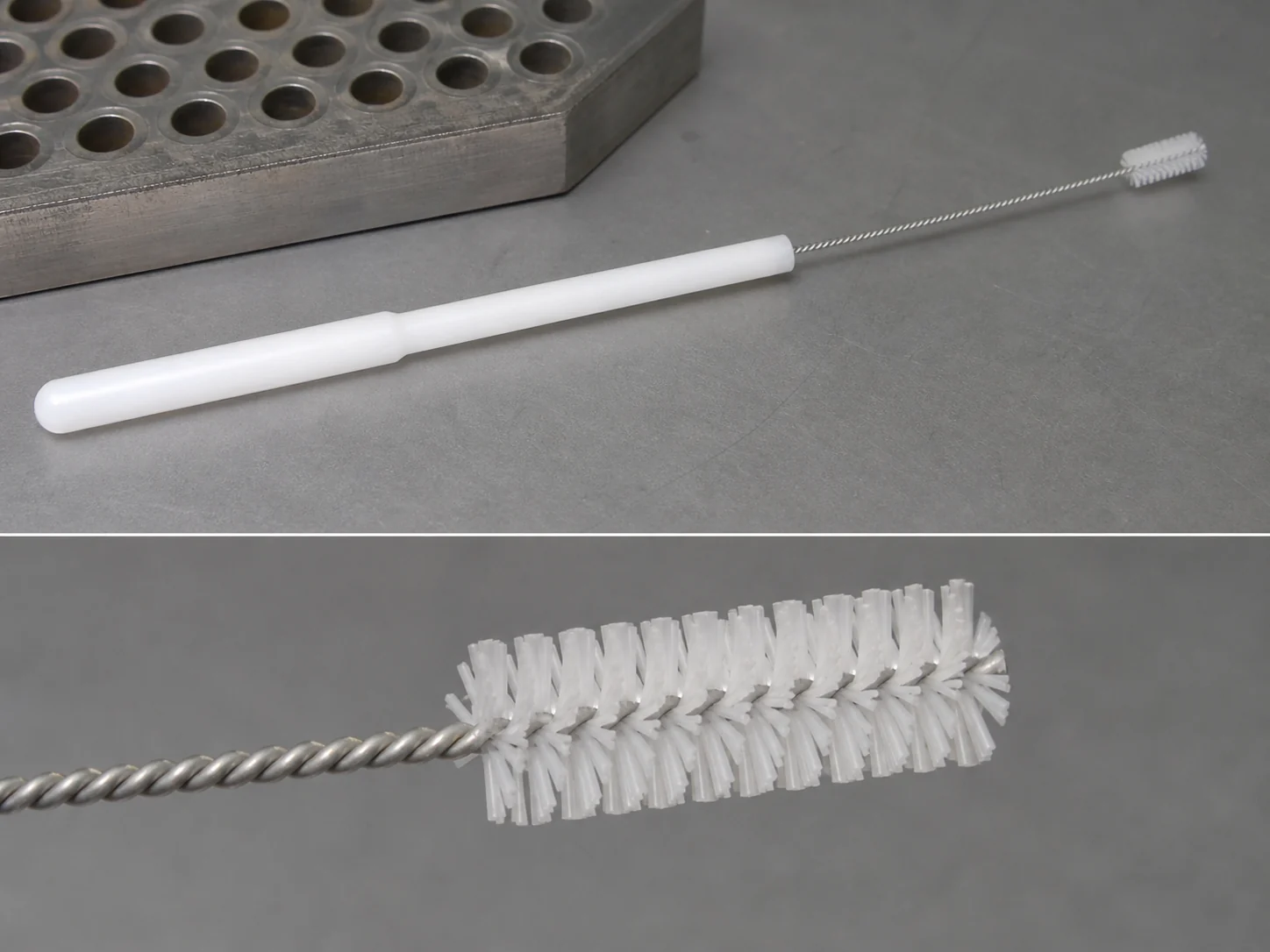
Small brush
500 pcs
Minimum order
Held in one hand: tube, bottle, detail and swab brushes — including long-handled ones with a small head.
Production lead time, once the specification is confirmed
- Up to 500 pcsWithin 7 days
- 501–50,000 pcsWithin 14 days
- Over 50,000 pcsWithin 21 days
Peak season can extend these times; the shipping date is confirmed in writing with your quotation. Sampling and shipping are quoted separately.
A 5 mm outside-diameter tube brush with PA612 nylon filaments on a twisted 304 stainless steel wire core, built for cleaning small heat exchanger tubes, valve ports, cross holes, and fluid passages where a wider brush cannot enter. The 60 mm brushing section provides full-circumference contact while the wire stem reaches through narrow openings.
What can this brush do for you?
Gets into small-bore passages that stop larger brushes
The working section is trimmed to a 5 mm outside diameter, so the brush enters 5 mm nominal holes and short-radius passages that bulkier brushes cannot pass. In a 5.0 to 6.5 mm bore, the PA612 filaments bend against the wall and maintain contact around the full circumference instead of just riding along one side.
Removes chips, coolant, oil, carbon, and process deposits
PA612 nylon stays stiff enough to dig out loose chips, dried coolant film, oil varnish, light carbon, powder, and soft scale without matting after the first pass. The material resists oils, coolants, aliphatic solvents, and mild water-based detergents, so the bristles keep their shape through repeated wet cleaning cycles.
Follows slight bends and cross-drilled passages
The twisted stainless steel wire core has controlled flexibility. The head can follow a gentle curve or align itself through a cross hole without the operator forcing the stem and kinking it. This is useful in manifolds, small valve bodies, and angled fluid channels where a rigid rod would bind.
Keeps the bore surface free of metal contamination
Because the only contact against the internal wall comes from PA612 filaments, the brush does not deposit steel particles into aluminum, copper, or brass bores. This matters in hydraulic and pneumatic components where loose metal fines can cause scoring or downstream contamination.
Fixed one-piece construction stays together in service
The brush section and wire stem are made as one continuous twisted-core assembly. There is no detachable head or press-fit connection that can loosen, separate, or become lost inside a tube bundle during pullback.
What is a 5mm PA612 Tube Brush?
A 5mm PA612 Tube Brush is a small-diameter spiral tube brush with PA612 nylon filaments mechanically captured between twisted 304 stainless steel wires. The filament fill is centered under the wire twist, then trimmed to a round 5 mm working profile. There is no adhesive bond to fail under solvent exposure.
In use, the brush is inserted through the port or tube end, then worked with push-pull and rotating strokes. The bristles flex at the wall, dislodge chips, coolant residue, oil film, and loose deposits, and the open filament spacing lets loosened material move out of the contact zone as the brush is withdrawn. The 120 mm wire stem transmits force into deep or offset holes while the 60 mm brush section covers the main contact area.
PA612 is selected for this brush because it absorbs less moisture than PA6 or PA66. That keeps the bristles reasonably stiff in wet, oily, or coolant-flooded bores and reduces the diameter change that can cause a brush to lose contact after repeated wash-downs. It is a cleaning brush for accessible small bores, not a cutting tool for hard scale or cured deposits.
Technical Specifications
The standard configuration is listed below. Each dimension and material can be adjusted to the tube drawing or cleaning procedure.
| Parameter | Standard Configuration |
|---|---|
| Working section outside diameter | 5 mm |
| Working section length | 60 mm |
| Stem length | 120 mm |
| Overall length | 180 mm |
| Filament material | PA612 nylon |
| Filament diameter | 0.10 mm (0.12 mm and 0.15 mm optional) |
| Fill pattern | Spiral fill on twisted wire core; density matched to residue |
| Core and stem | 304 stainless steel twisted wire, straight end |
| Connection | Fixed one-piece brush section and stem |
| Recommended bore ID | 5.0 to 6.5 mm |
| Compatible environment | Oils, coolants, aliphatic solvents, mild aqueous cleaners; not for strong acids, concentrated oxidizing agents, or steam service |
| Brush type | Custom Tube & Pipe Bore Brushes |
| How it is driven | Hand-guided |
| Cleaning target | heat exchanger tube, machined port, and injector nozzle bore cleaning |
| Surface or part | tubes, holes, cross holes, ports, bores, passages, valves, and blind holes |
| Residue or debris | coolant, oil, chips, carbon, powder, scale, coolant residue, and oil film |
| Mounting / connection | Fixed one-piece brush section and stem; 5.0 to 6.5 mm |
Where does this brush work best?
- Heat exchanger tubes with 5.0 to 6.5 mm inside diameter in compact coolers, condensers, evaporators, and instrument sample loops.
- Machined ports, cross holes, and internal threads in hydraulic or pneumatic bodies where chips and coolant remain after drilling or tapping.
- Injector nozzle bores, small fuel-system passages, and valve orifices with oil varnish or light carbon buildup.
- Blind holes, tapers, and curved fluid channels in molds, tooling, and fixtures where dried powder or process residue must be loosened for flush-out.
How do I choose the right one?
Start with the bore size and interference
Measure the smallest inside diameter and any cross hole or bend. The 5 mm brush works with light to medium wall pressure in a 5.0 to 6.5 mm bore. A 5 mm hole gives the tightest fill and hardest contact; a 6.5 mm hole gives easier entry and a softer sweep. Above about 7 mm, the bristles lose wall pressure and the brush will leave residue behind.
Match filament diameter and fill to the deposits
0.10 mm PA612 is the standard for oil film, coolant residue, chips, and fine powder. If the deposits are dried or carbonized, 0.12 mm or 0.15 mm filament with a higher-density spiral fill increases scraping pressure. If the passage has tight cross holes, a slightly lower fill density can prevent the head from catching instead of sliding through.
Check the reach and bend radius
The standard 180 mm overall length covers a 60 mm working zone plus 120 mm of stem reach. For deeper tubes or more offset access, the stem can be lengthened, but a very long slender stem reduces directional control and increases the chance of buckling. If the passage has sharp bends rather than gentle curves, specify a shorter brush section or a smaller core wire so the brush can follow the path.
Use the right brush for the condition
PA612 is correct when the residue is oily, powdery, or lightly adhered and the bore must not be scratched or contaminated. If the tube contains heavy rust, mineral scale, or burned-on carbon, a brass or stainless steel wire tube brush will cut faster. If the bore is smaller than 4.5 mm, switch to a smaller-diameter brush, a twisted-in-wire cleaning cord, or a flexible shaft tool. If chemical exposure includes strong acid, strong alkali, or steam, ask for a PBT, PVDF, or metal filament option instead of PA612.
Can I customize this brush?
This 5 mm brush is normally built to the customer’s tube drawing, not pulled from an off-the-shelf range. Before we build, provide the minimum bore ID, straight length, any bend or cross hole, deposit type, cleaning chemical, operating temperature, and whether the brush will be hand-used or power-rotated.
Adjustable variables include:
- Working section length from about 30 mm to 100 mm or longer, depending on core rigidity
- Stem length and total reach, extended for deep tube sheets or offset ports
- Filament diameter from 0.08 mm to 0.15 mm and fill density from open spiral to full fill
- Core and stem in 303, 304, or 316 stainless steel, with straight, loop, or chuck-compatible end
- Stem grip treatment, including a bare twisted wire end, an 8 mm diameter molded sleeve, or a small loop handle
- Brush section end finish, such as a trimmed flat end or a reduced-diameter taper for easier entry into a blind hole
- Bulk, individually bagged, or tube-set packaging for maintenance kits
If the installation requires a documented material, batch traceability, or support for a customer qualification program, we can arrange the needed inspection or third-party testing during the customization phase.
Which filament survives the cleaning chemicals a 5mm PA612 tube brush meets?
How do I confirm that the 5 mm brush will actually pass through my bore?
Check the narrowest point of the tube, including the entrance, any cross hole, and any bend. The brush section is 5 mm in outside diameter, so the straight bore must be at least that size and the bend must not pinch the head. A 5.0 mm bore gives maximum wall contact; a 6.5 mm bore still works but with lighter scraping pressure.
What should I inspect on the brush before starting a cleaning job?
Look for matted or flattened bristles, a kinked core, and filament ends that have pulled out of the twist. If the working section no longer returns to its round 5 mm profile, replace the brush. A bent stem that makes the head track off-center can bind in the tube and break the core during pullback.
Can the brush be rotated under power?
The standard item is intended for manual push-pull and slow rotation. If the site uses a drill motor, specify a shorter, heavier stem, a chuck end, and a low maximum speed. Unsupported high RPM flares the bristles outward and can bow the wire core inside the bore.
Does this brush replace solvent flushing or ultrasonic cleaning?
No. The brush loosens and removes attached residue from the wall, but loosened chips, sludge, and softened carbon still need to be flushed out. For heat exchanger tubes, complete the job with a rinse that carries loosened material from the far end. Brushing is one mechanical step in the cleaning sequence, not the entire process.
When should I choose brass or stainless wire instead of PA612?
Choose brass or stainless wire when the deposit is hard, mineralized, welded-on, or thick enough to flatten nylon bristles. PA612 is the better choice when the bore is aluminum, copper, brass, or a coated surface and the deposit is oily, powdery, or lightly adhered. If the brush loads up and stops cutting after a few strokes, the deposit is too hard for nylon.
Guides that go deeper on this
Custom Manufacturing RFQ
Describe Your Application
Please share the brush dimensions, working area, residue type, material direction, quantity, and a drawing or photo for quotation.
Drawing or photo optional — it speeds things up, it does not gate the enquiry.
Custom Brush RFQ
Send Your Brush Project
Upload a drawing, product photo, or sample photo and provide the core dimensions and cleaning conditions.
“We need a brush to remove wet residue from a stainless steel conveyor, about 800mm wide. The current brush wears quickly. We can send photos.”
“We sell drinkware and need a cleaning brush to include with the product. Quantity around 5,000 pieces.”