
Custom Cleaning Brush
10mm PA66 Tube Brush
10mm PA66 tube brush for heat exchanger tube and small bore cleaning. Custom lengths, ends, and filament options available.
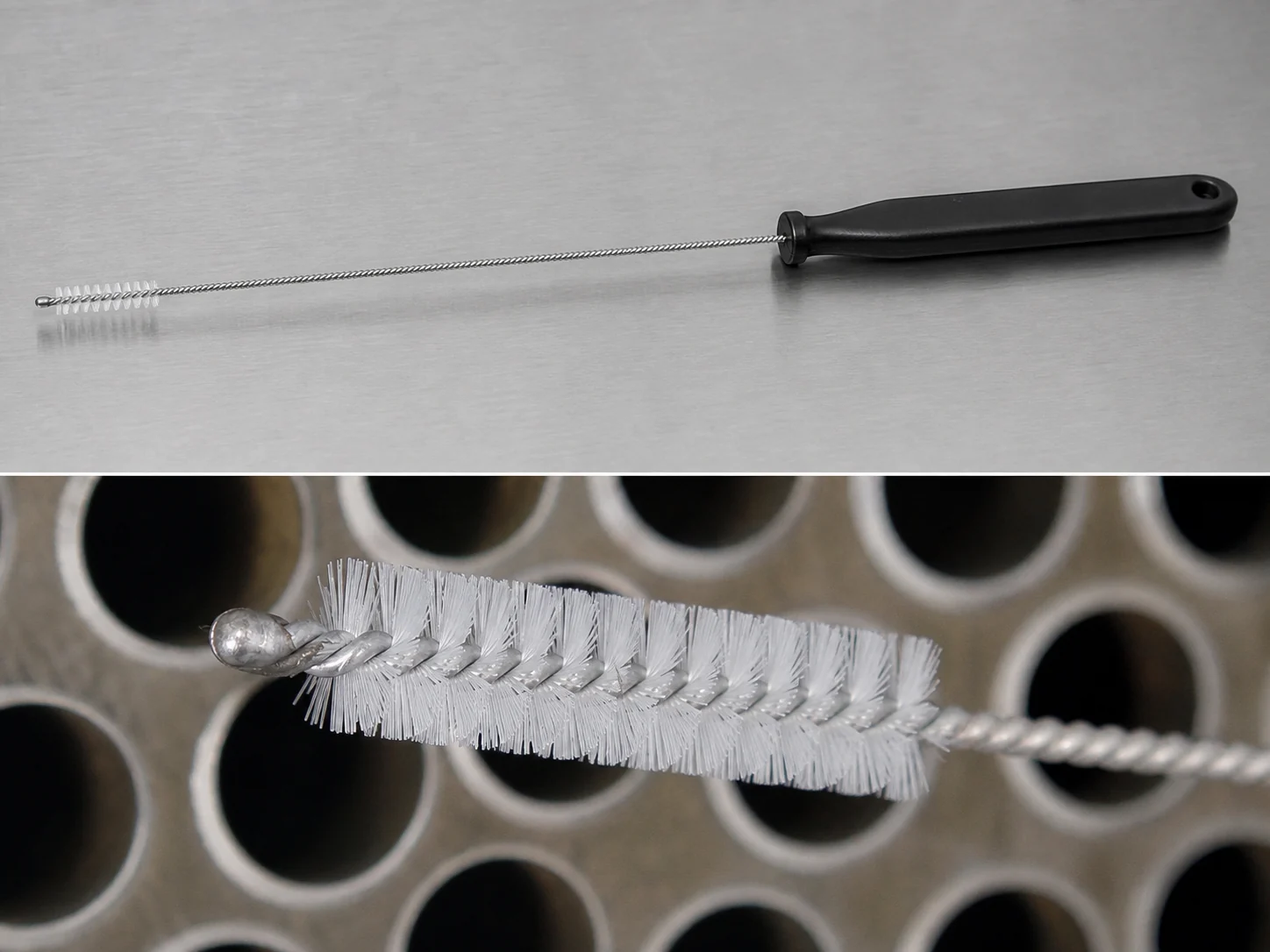
Small brush
500 pcs
Minimum order
Held in one hand: tube, bottle, detail and swab brushes — including long-handled ones with a small head.
Production lead time, once the specification is confirmed
- Up to 500 pcsWithin 7 days
- 501–50,000 pcsWithin 14 days
- Over 50,000 pcsWithin 21 days
Peak season can extend these times; the shipping date is confirmed in writing with your quotation. Sampling and shipping are quoted separately.
A 10 mm outside-diameter tube brush with PA66 nylon 66 bristles on a twisted stainless steel wire core for internal cleaning of heat exchanger tubes, ports, threads, and small bores. It removes chips, oil, coolant residue, light scale, carbon, and process deposits while keeping contact gentler than a steel wire tube brush.
What can this brush do for you?
Enters nominal 10 mm passages and holds wall contact
The PA66 filaments are trimmed to a 10 mm outside diameter, giving controlled interference in a clean 10 mm bore and light contact in slightly larger tubes. The filament tips flex during push, pull, and rotation, so the brushing action follows the tube wall instead of skipping over it.
Lifts oil, coolant, and process films without heavy metal scoring
PA66 resists oil, grease, machining coolant, and mild alkaline wash solutions, so the brush can move between service and cleanup without immediate softening. It removes chips, sludge, light oxide, and soft carbon from steel, brass, copper, and aluminum surfaces more gently than a stainless or brass wire tube brush.
Keeps bristles anchored through repetitive strokes
Each bristle is captured in the twisted stainless steel wire core. The construction holds filament density and prevents bristles from pulling loose during the push-pull and rotating motion used inside heat exchanger tubes, ports, and blind holes.
Reaches threads, cross holes, and the wall beyond the tube end
The 80 mm bristled section cleans past the opening, so internal threads, cross-drilled passages, tapers, and the wall immediately behind the tube end are contacted in the same stroke. For longer tube runs, the brush is worked in overlapping sections or the bristled length is increased on the custom build.
Keeps the operator clear of the tube mouth
The 160 mm handle extends the working position away from the opening, which helps when tubes are warm, sharp-edged, or recessed in a tube bundle. The fixed head and handle connection prevents the bristled section from separating or spinning free under load.
What is a 10mm PA66 Tube Brush?
A 10mm PA66 Tube Brush is a twisted-in-wire tube brush: PA66 bristles are captured between two stainless steel wires that are twisted together along the bristled section, with the remaining wire length forming the handle. The 10 mm reference is the outside diameter measured across the bristle tips, not the core diameter. The brush is inserted into a tube or port and worked with push, pull, and rotating strokes.
During use, the bristle tips contact the internal diameter, internal threads, cross-hole edges, tapers, and other surfaces along the passage. Each stroke loosens and moves debris toward the opening, where flushing, compressed air, or a wipe removes it. The brush can be used dry or with compatible cleaners, by hand or at low speed in a power tool when built with a straight shank.
This is a mechanical cleaning tool, not a replacement for chemical descaling or high-pressure flushing. PA66 is strong for a polymer filament but it is still softer than hard mineral scale, deep rust, and carbonized deposits. The brush is best used to release attached films and loose debris inside the bore before or between flushing steps.
Technical Specifications
The values below describe the standard 10 mm PA66 build. Diameter, lengths, filament stiffness, end configuration, and core grade can be adjusted to match the tube being cleaned.
| Parameter | Standard build / options |
|---|---|
| Brush outside diameter | 10 mm |
| Bristle material | PA66 nylon 66 |
| Trim shape | Round, uniform outside diameter |
| Bristled section length | 80 mm |
| Handle length | 160 mm |
| Overall length | Approximately 240 mm |
| Core / stem / handle | Stainless steel twisted wire |
| Grip diameter | 10 mm |
| Connection | Fixed stem-to-head construction |
| End configuration | Loop, straight shank, or adapter end by configuration |
| Filament diameter | 0.20 to 0.50 mm, selected for the required stiffness |
| Operating temperature | PA66 filament to approximately 100°C continuous; confirm wet or chemical service |
| Working environment | Oils, coolants, mild alkaline cleaners; not strong acids, oxidizers, or continuous steam |
| Brush type | Custom Tube & Pipe Bore Brushes |
| How it is driven | Hand-guided |
| Cleaning target | heat exchanger tube and small tube bundle, hydraulic and pneumatic port, and threaded hole and fitting cleaning |
| Surface or part | tubes, bores, ports, thread, passages, holes, walls, and blind holes |
| Residue or debris | oil, scale, chips, coolant, carbon, coolant residue, light scale, and process deposits |
| Mounting / connection | Fixed stem-to-head construction |
Where does this brush work best?
- Heat exchanger tubes and small tube bundles where the internal diameter is near 10 mm and residual oil, carbon, or soft scale must be loosened before flushing.
- Hydraulic and pneumatic ports, valve bodies, and manifolds where internal threads, cross-drilled passages, and short oil galleries collect machining chips and coolant.
- Threaded holes and fittings after machining, where chips and cutting fluid remain in the thread roots and need a soft, non-embedding brush contact.
- Blind holes and recessed bores in housings, blocks, and pump bodies where a hand-held tool must reach behind the opening.
- Oil coolers, condensers, aftercoolers, and other maintenance situations where small-bore tubes need a portable brush that will not attack copper, brass, or aluminum tube walls.
How do I choose the right one?
Start with the smallest bore you need to clean. A 10 mm brush is a good fit for a nominal 10 mm passage and for bores up to roughly 12 mm, depending on filament length and the contact pressure the job requires. Measure the entrance, any internal step, and the running ID before ordering. If the smallest opening is below 10 mm, the brush will not enter or the bristles will fold flat. If the tube is well above 12 mm, a larger-diameter tube brush will hold more consistent wall contact.
Then match the deposit to the filament. PA66 handles oil, grease, coolant, metal chips, powder, light oxide, and soft carbon. For hardened scale, deep rust, or baked-on carbon, a stainless or brass wire tube brush, usually combined with chemical descaling, will do the removal work faster and more completely.
Check reach and access. The 80 mm bristled section cleans one band per stroke. For tubes longer than the bristled section, plan overlapping strokes or specify a longer head and handle. In a blind hole, the brush cleans the sidewall and approaches the bottom, but a standard round trim does not fully dress a flat bottom face; ask for an end-bristled or cup configuration if the bottom itself must be cleaned.
Decide whether the brush will be hand guided or power driven. The standard loop or straight end is for manual use. For low-speed power rotation, request a straight shank and confirm the core twist direction. The twisted wire core should not be run in reverse at high speed, which can loosen the twist and release bristles.
Finally, confirm the environment. PA66 works well with oils, coolants, and mild alkaline cleaners, but it is not the right filament for strong acids, oxidizing agents, phenols, or continuous high-temperature steam. In those conditions, discuss alternative filament or core materials before the build is fixed.
Can I customize this brush?
Yes. The 10 mm PA66 build is a standard reference, but most dimensions and details can be adapted to the tube or port being cleaned. We will need the minimum bore ID, tube length or depth, surface material, deposit type, cleaning chemical, operating temperature, and whether the brush will be hand or power driven. A drawing, sample tube section, or photo of the fitting helps define the configuration.
- Brush diameter and trim: adjust the outside diameter to the target bore, including custom trim shapes for stepped passages.
- Bristled section: length, overall length, handle length, and bristle distribution can be changed to match reach and working position.
- Filament details: diameter, straight or crimped form, stiffness, density, and color can be selected; PA66 is standard, and other filaments are available when the process requires them.
- Core and stem: wire diameter, 304 or 316 stainless steel, and other metals can be specified for corrosion or operating conditions.
- End and handle: loop, straight shank, extended handle, ferrule, T-handle, or adapter interface can be configured.
- Identification and packaging: color coding, individual labeling, bulk packing, or project-specific packaging can be arranged.
If the project requires material documentation, inspection records, or third-party testing support, we can assist with those requirements during the customization phase.
How do you check that a 10mm PA66 tube brush is the right size for the opening?
What bore range does this 10 mm brush actually fit?
It is intended for internal diameters from about 10 mm to roughly 12 mm, depending on filament length and the contact pressure the job needs. Below 10 mm the bristles fold or the brush will not pass; above about 12 mm wall contact pressure drops and a larger-diameter tube brush should be selected. Check the smallest ID, including the tube entrance and any internal step, not just the nominal tube size.
Can it be used in a drill?
The standard build is manual. If you plan to power the brush, request a straight-shank end and specify the rotation direction and speed. Keep speed low, and do not reverse the twisted-wire core under load, because reverse rotation can loosen the twist and release bristles.
Will PA66 bristles damage copper, brass, or aluminum tube walls?
PA66 is softer than these metals and normally will not score the surface. A used brush can still pick up hard particles from a previous tube and carry them into the next one, so rinse the bristles between tubes and inspect the filament tips for embedded chips before using the brush on a softer surface.
How do I check that a heat exchanger tube is actually clean?
After brushing, flush the tube and observe the effluent, then pull a clean white swab through the bore or inspect with a borescope. Film, darkening, or particles remaining on the swab indicate incomplete contact, wrong filament stiffness, or a deposit that requires chemical descaling before further brushing.
What should I inspect before the brush goes back into service?
Check that the twisted core is tight, bristles are evenly distributed and not flattened or broken, the handle or shank connection is secure, and no loose filament ends are present. A brush with missing or splayed bristles leaves residue behind and can shed filament into the tube.
When is a PA66 tube brush the wrong choice?
For hard mineral scale, deep rust, or carbonized deposits, choose a stainless, brass, or abrasive nylon tube brush and usually add chemical descaling. For bores below the 10 mm trim diameter, choose a smaller brush. For strong acids, oxidizing agents, or continuous high-temperature steam, specify a chemically and thermally suitable filament instead of standard PA66.
Guides that go deeper on this
Custom Manufacturing RFQ
Describe Your Application
To prepare the correct quotation, provide the dimensions, cleaning task, residue, material, mounting details, quantity, and a drawing or photo.
Drawing or photo optional — it speeds things up, it does not gate the enquiry.
Custom Brush RFQ
Send Your Brush Project
Upload a drawing, product photo, or sample photo and provide the core dimensions and cleaning conditions.
“We need a brush to remove wet residue from a stainless steel conveyor, about 800mm wide. The current brush wears quickly. We can send photos.”
“We sell drinkware and need a cleaning brush to include with the product. Quantity around 5,000 pieces.”