
Custom Cleaning Brush
6mm PA66 Tube Brush
6mm PA66 tube brush with a 60mm round bristle head and 140mm stainless steel twisted-wire handle for cleaning small-diameter tubes, bores, and passages.
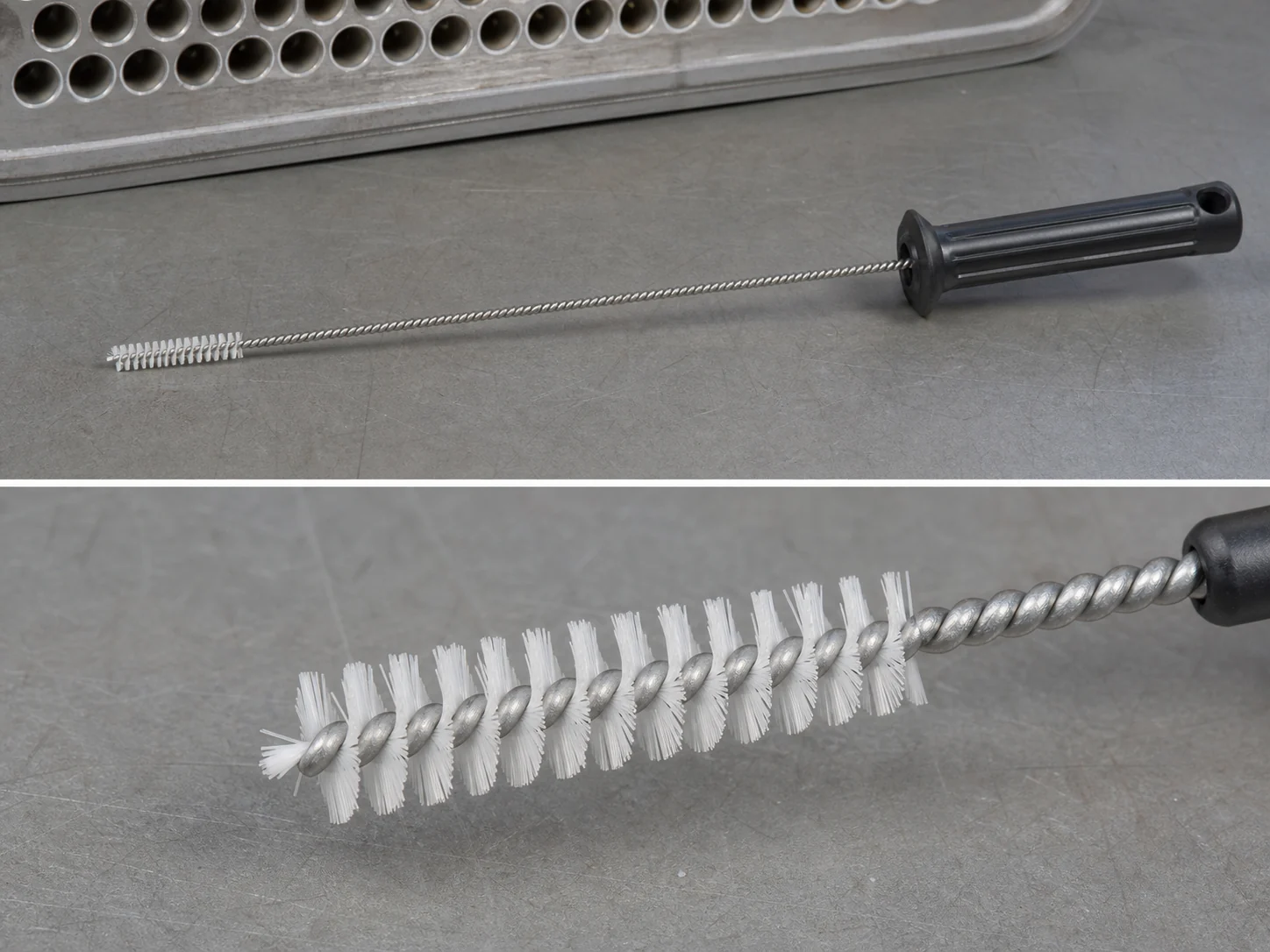
Small brush
500 pcs
Minimum order
Held in one hand: tube, bottle, detail and swab brushes — including long-handled ones with a small head.
Production lead time, once the specification is confirmed
- Up to 500 pcsWithin 7 days
- 501–50,000 pcsWithin 14 days
- Over 50,000 pcsWithin 21 days
Peak season can extend these times; the shipping date is confirmed in writing with your quotation. Sampling and shipping are quoted separately.
A 6 mm PA66 tube brush with a 60 mm round filament head and a 140 mm stainless steel twisted-wire handle, built to sweep loose particles and light process residue from the walls of small-diameter tubes, bores, and internal passages. It is used where non-abrasive nylon contact is needed inside metal or polymer lines close to 6 mm inside diameter.
What can this brush do for you?
Reach Inside 6 mm Tubes Without Snagging
The 6 mm outside diameter lets the head enter bores where larger cleaning tools stop at the opening. PA66 filaments flex as they follow the wall, so the brush moves through slight diameter changes and cross-drilled intersections without jamming the twisted stem.
360° Contact in a Single Pass
Bristles radiate around the round head, so push-pull strokes combined with rotation contact the full circumference at once. In a 6 mm tube, one insertion and a few turns cover the entire bore wall. You do not need to hold the brush at multiple angles to reach the low side of the passage.
Removes Loose Particles Without Cutting the Bore
PA66 is firm enough to dislodge chips, dust, light oils, and soft process residue, but far softer than common bore metals. The brush cleans the wall instead of scoring it, and it does not create new surface defects that later trap contamination.
Twisted Core Holds Bristles Under Push-Pull Loads
The stainless steel twisted wire stem locks bristles in a helical pattern and holds them in place through repeated pulling strokes. The brush does not shed filaments the way loose-set brush constructions often do when pulled back through a tight bore.
Fixed Stem Gives Predictable Reach
The head and 140 mm handle are one continuous stem, so the operator knows exactly how deep the brush can go. There is no joint to loosen inside the tube, and the end loop provides a secure finger grip for controlled rotation.
What is a 6mm PA66 Tube Brush?
The 6mm PA66 Tube Brush is a hand-guided internal cleaning brush made from PA66 nylon bristles retained in a twisted stainless steel wire core. The brush head is round, with filaments radiating from the center core to an outside diameter of 6 mm over a 60 mm working length. From the base of the head, the twisted core continues as a 140 mm handle ending in an 8 mm loop.
In use, the operator inserts the head into the tube or bore and works it with a combination of push-pull strokes and rotation. The bristle tips follow the bore wall, dislodge loose particles and soft residue, and carry some of the loosened material back toward the opening. The brush is normally used dry or with a light solvent, oil, or aqueous cleaner compatible with PA66 and stainless steel.
Because the core is twisted wire, the brush is flexible along its length but stiff enough to push through straight and gently curved passages. It is not designed for aggressive scrubbing that requires wire bristles, nor for hot, highly alkaline, or strong-acid environments that attack nylon. For those jobs, material selection must change.
Technical Specifications
| Parameter | Standard configuration |
|---|---|
| Brush head diameter | 6 mm |
| Brush head length | 60 mm |
| Head shape | Round, full-circumference bristle coverage |
| Bristle material | PA66 nylon 6/6 filament |
| Core / stem | Stainless steel twisted wire |
| Handle length | 140 mm |
| Handle end | Loop grip, 8 mm opening |
| Overall length | Approximately 200 mm (head + handle) |
| Connection | Fixed, one-piece twisted core from head to handle |
| Working temperature | -20°C to 80°C continuous in wet or humid conditions; up to 100°C short-term dry contact |
| Typical chemical exposure | Compatible with oils, greases, aliphatic hydrocarbons, weak acids, and mild alkaline cleaners; avoid strong acids at elevated temperature, phenols, and strong oxidizing media |
| Brush type | Custom Tube & Pipe Bore Brushes |
| How it is driven | Hand-guided |
| Cleaning target | heat exchanger tube bundle, hydraulic and pneumatic system bore, and instrument sample port cleaning |
| Surface or part | bores, tubes, passages, metal, walls, internal passages, channel, and glass |
| Residue or debris | loose particles, process residue, dust, scale, light process residue, oil, chips, and light scale |
| Mounting / connection | Fixed, one-piece twisted core from head to handle |
All values in the table describe the standard 6 mm configuration. For tube bundles, deep bores, or special access, we can adjust head diameter, head length, handle length, loop size, and core material to your drawing.
Where does this brush work best?
- Heat exchanger tube bundles where soft deposits, silt, algae, or light scale need removal after chemical cleaning or between mechanical cleanings.
- Hydraulic and pneumatic system bores, fittings, and manifolds where machining chips, dust, or assembly debris must be cleared before component installation.
- Instrument sample ports, sensor wells, and small process lines where a 6 mm internal passage needs light wiping without scratching.
- Mold cooling channels and small machine tool bores where loose material collects in tight diameters.
- Laboratory glass or metal tubing with inside diameters close to 6 mm, where a non-metal brush avoids scratching or contaminating the surface.
How do I choose the right one?
Check bore clearance first
Measure the smallest internal diameter the brush must pass through, including any ridge or weld seam. The 6 mm brush works best in nominal bore IDs between about 5.5 mm and 6.5 mm. A 5 mm bore will bind; a 7 mm bore will allow bristle tips to barely touch the wall. For stronger contact, choose a head 0.1 to 0.2 mm larger than the bore ID; for a tight fit, no more than 0.5 mm over.
Think about what you are removing
PA66 is the right filament for loose particles, dust, light oil films, and soft process residue. It will not remove hard scale, corrosion, carbon deposits, or cured coatings. If your deposit needs a chisel or wire-brush action, switch to stainless steel, brass, or abrasive filament. If the bore wall is a very soft polymer or has a delicate coating, specify a softer filament or a flagged tip.
Match head length and handle to access
The 60 mm head covers 60 mm of bore per pass; for long tube bundles, longer head sections keep the stroke count down. The 140 mm handle gives about 200 mm total reach from the open end before the loop contacts the tube face. For deeper insertion, extend the handle length and keep the core diameter large enough to prevent buckling.
Check the environment
Wet, hot, or chemically aggressive service reduces PA66 stiffness and service life. For continuous hot-water or steam-side use, confirm the temperature limit and run a trial. For chloride-containing rinse waters, specify a 316 stainless core instead of 304. For metal-free or ESD-sensitive areas, a different core material is required.
When to use a different brush
Use a wire tube brush for scale, rust, or heavy fouling. Use a bottle brush with a flexible stem for passages with bends too tight for the twisted core. Use an abrasive nylon brush for surface finishing or deburring. The 6mm PA66 tube brush is for light, non-destructive wiping of small bores, not material removal.
Can I customize this brush?
Yes. The 6mm PA66 Tube Brush is normally built as a project-specific cleaning tool. To define your configuration, provide the bore ID and tolerance, bore depth, access constraints, residue type, rinse or solvent, process temperature, and any handle preference. A sketch or photo of the tube end helps.
- Head geometry — head diameter (e.g., 5, 6, 6.5, or 7 mm), head length from 30 to 150 mm, round or slightly tapered profile, single or double-spiral trim.
- Bristle configuration — straight, crimped, or flagged PA66 filament; filament diameter from about 0.10 to 0.25 mm for different stiffness and liquid pickup.
- Core and stem — 304 or 316 stainless steel twisted wire; stem length and core diameter adjusted for reach and buckling resistance; optional coating for specific chemical exposure.
- Handle — loop end size and orientation, straight stem without loop, extended length, optional plastic or metal grip, or shank end for fixture mounting.
- Connection — fixed is standard; machine-mount or threaded interface available when the brush will be attached to a rotating or reciprocating drive.
- Color and marking — natural, white, black, or custom-colored PA66; pad printing or labeling on the handle or grip for identification.
- Packaging — bulk carton, individual sleeve, set packaging, or project-specific packing.
If your project needs material declarations, dimensional inspection reports, or third-party testing, we can support those documentation requirements during the custom build.
Which filament survives the cleaning chemicals a 6mm PA66 tube brush meets?
What tube IDs are a good match for the 6 mm head?
For general wiping, use the 6 mm head in bores between about 5.5 mm and 6.5 mm inside diameter. A 5 mm bore will pinch the head and make insertion difficult; a 7 mm bore leaves the sidewall lightly contacted. If your tube is outside that range, we can adjust the head diameter.
Can this brush be used in a drill or powered rotary tool?
The standard twisted-wire stem can be gripped in a chuck for occasional low-speed rotation, but the brush is built for hand push-pull and rotation cycles. Continuous powered use increases fatigue in the twisted core and can accelerate bristle wear. For machine-driven cleaning, request a reinforced stem and a shank or threaded end.
How can I check whether the brush is still serviceable?
Hold the brush against a calibrated pin or caliper and check that the head still measures close to 6 mm. Look for flattened, missing, or matted bristles, an unwinding twist, or a bent or cracked stem. If the head diameter has dropped below about 5.5 mm or the bristle pattern shows gaps, replace the brush.
Will PA66 bristles damage a soft metal bore if abrasive particles become trapped?
Fresh PA66 is softer than common bore metals and will not scratch hardened steel, brass, or aluminum under normal contact. However, if the brush picks up hard particles and is reused without rinsing, those particles can score the surface. Rinse the bristles and inspect them before cleaning critical or precision bores.
Can the brush clean a blind hole all the way to the bottom?
Yes, if the hole depth is within the total 200 mm reach and the end is rounded or gently contoured. The brush head can contact the bottom face with rotation, but on flat-bottom holes the tips tend to fold rather than scour the corner. For a flat or threaded bottom, we can adjust the head end profile to provide better end contact.
Is the brush suitable for food-contact or high-purity process cleaning?
Polyamide 66 and stainless steel are widely used engineering materials, but suitability for food-contact, medical, or pharmaceutical cleaning depends on your specific cleaning agents, rinse requirements, and validation standards. Tell us the process so we can provide material declarations and support your assessment; do not assume suitability simply from the general material names.
Guides that go deeper on this
Custom Manufacturing RFQ
Describe Your Application
To prepare the correct quotation, provide the dimensions, cleaning task, residue, material, mounting details, quantity, and a drawing or photo.
Drawing or photo optional — it speeds things up, it does not gate the enquiry.
Custom Brush RFQ
Send Your Brush Project
Upload a drawing, product photo, or sample photo and provide the core dimensions and cleaning conditions.
“We need a brush to remove wet residue from a stainless steel conveyor, about 800mm wide. The current brush wears quickly. We can send photos.”
“We sell drinkware and need a cleaning brush to include with the product. Quantity around 5,000 pieces.”