
Custom Cleaning Brush
32mm SS316 Heat Exchanger Brush
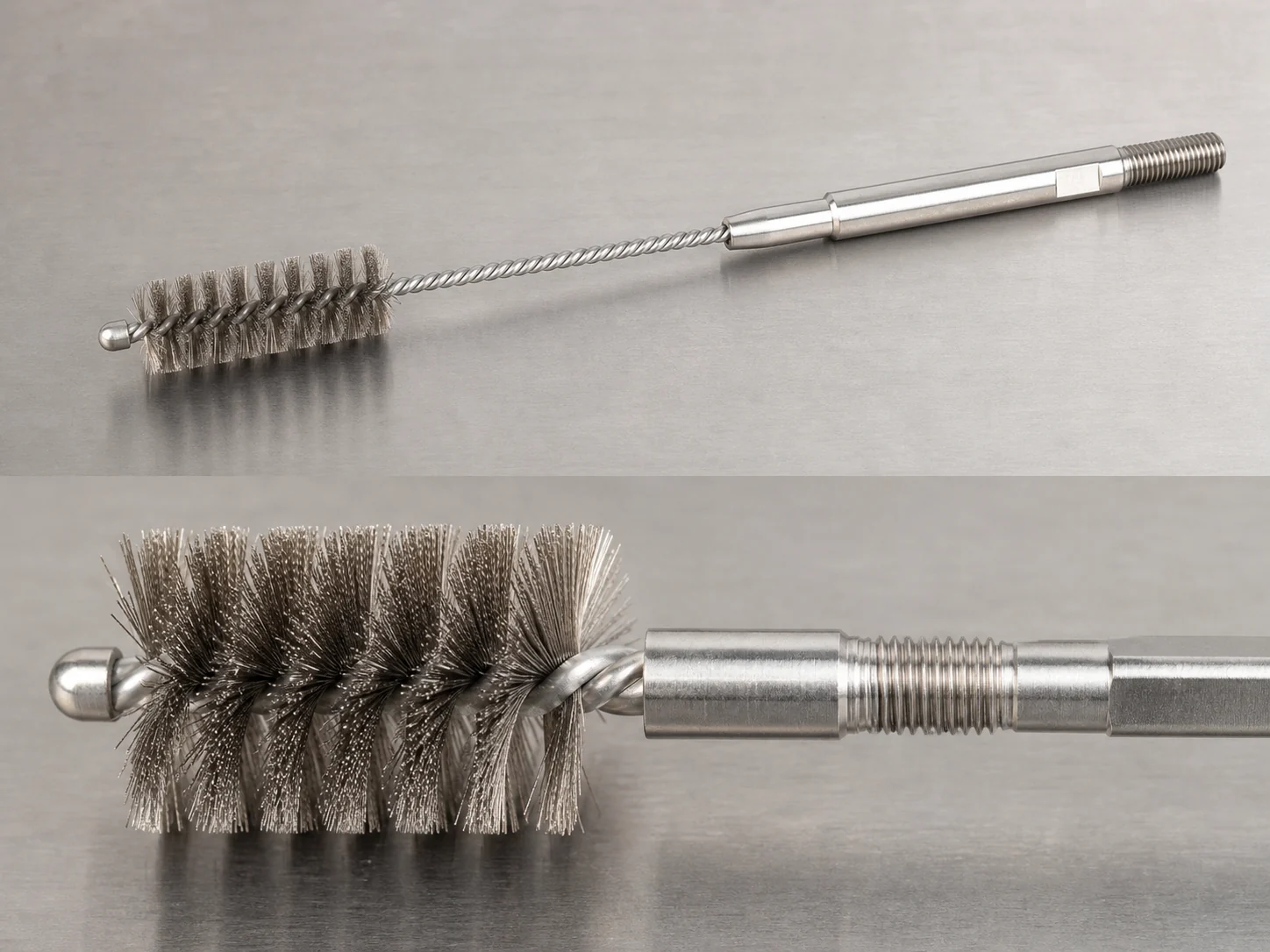
32mm SS316 heat exchanger brush with round head, 120mm head length, and threaded removable connection.
Small brush
500 pcs
Minimum order
Held in one hand: tube, bottle, detail and swab brushes — including long-handled ones with a small head.
Production lead time, once the specification is confirmed
- Up to 500 pcsWithin 7 days
- 501–50,000 pcsWithin 14 days
- Over 50,000 pcsWithin 21 days
Peak season can extend these times; the shipping date is confirmed in writing with your quotation. Sampling and shipping are quoted separately.
A 32mm-diameter twisted-in-wire stainless steel 316 tube brush for cleaning the internal surfaces of heat exchanger tubes, condensers, and other cylindrical passages. The round SS316 wire head scrubs off scale, rust, carbon, oil, and process deposits while the threaded removable stem allows mounting on manual or powered drive rods.
What can this brush do for you?
Fits Common Heat Exchanger Tube IDs with Positive Contact
The 32mm head diameter is selected to create an interference fit in tubes with an internal diameter around 30–34mm. The bristles press outward against the tube wall, so a single pass removes film and light deposits instead of just sliding over them.
SS316 Wire Stands Up to Corrosive Cleaning Chemicals
Stainless steel 316 contains molybdenum, which improves resistance to chlorides, acids, and washdown solutions compared with standard 304 wire. If your cleaning process uses citric acid, inhibited hydrochloric acid, or salt-laden process water, the bristles and twisted core are less likely to corrode between uses.
Twisted Core Holds the Bristles Under Rotation
The wire bristles are locked between two twisted stainless steel 316 wires along the entire 120mm head length. This construction keeps the bristles in place when the brush is rotated by hand or by a driver, so the brush does not shed wire into the tube while working.
Threaded Removable Connection Speeds Changeover
The 12mm-diameter stem ends in a threaded connection. You can swap the brush head onto a longer drive rod, a flexible extension, or a powered rotary unit without replacing the whole tool. When the head wears, the stem and grip can be reused if they are still straight and undamaged.
Round Profile Covers the Full Circumference Evenly
The round head shape distributes bristle pressure around the entire tube ID, which is important for removing uniform deposits like water-side scale or process film. Flat or partial brush profiles tend to skip areas and demand multiple offset passes.
What is a 32mm SS316 Heat Exchanger Brush?
A 32mm SS316 Heat Exchanger Brush is a cylindrical wire tube brush built around a twisted stainless steel 316 wire core. Stainless steel 316 bristles project radially from the core and form a round cleaning head measuring 120mm long. The remaining 250mm of the brush is the stem and grip, which the operator holds or clamps into a driver.
In use, the brush is inserted into the open end of a heat exchanger tube and moved back and forth, rotated by hand, or spun with a low-speed power driver connected through the threaded end. The bristle tips scrape the internal tube wall, loosening scale, rust, carbon deposits, coolant films, oil, and process residues. Loose debris is then flushed out with water, solvent, or compressed air as part of the same cleaning sequence.
This brush is a mechanical cleaning tool. It is not a chemical descaler and it does not replace flushing, passivation, or hydrotesting. It is specified when the tube ID is close to 32mm, the deposits are soft to moderately adherent, and the tube material can tolerate stainless steel wire contact. For soft metals such as copper, brass, or aluminum, a brass or nylon filament brush is often a safer choice because SS316 wire can leave scratches.
The SS316 grade matters because heat exchanger cleaning frequently involves acidic descalers, alkaline degreasers, or brackish process water. Standard carbon steel wire would rust almost immediately in these conditions and could contaminate the tube surface. SS316 wire resists corrosion and does not transfer rust to the tubes being cleaned.
Technical Specifications
| Parameter | Value / Options |
|---|---|
| Head diameter | 32 mm |
| Head shape | Round |
| Head length | 120 mm |
| Bristle material | Stainless steel 316 wire |
| Core / stem | Twisted stainless steel 316 wire |
| Handle length | 250 mm |
| Grip diameter | 12 mm |
| Connection | Threaded removable |
| Overall length | Approx. 370 mm (head + handle) |
| Bristle wire diameter | 0.3–0.8 mm, project-configurable |
| Fill density | Standard or custom |
| Operating environment | Corrosive, chloride, or washdown conditions where SS316 is specified |
| Brush type | Custom Tube & Pipe Bore Brushes |
| How it is driven | Hand-guided |
| Cleaning target | shell-and-tube heat exchanger, condenser and chiller, and boiler tube and evaporator tube cleaning |
| Surface or part | tubes, walls, passages, carbon steel, aluminum, metal, bends, and ports |
| Residue or debris | scale, rust, carbon, oil, coolant, corrosion, process deposits, and coolant residue |
| Mounting / connection | Threaded removable |
The head diameter, head length, stem length, thread size, and wire diameter can be adjusted to match a specific tube bundle or drive system. If you are replacing an existing brush, provide the worn sample or a dimensional drawing so we can match the fit.
Where does this brush work best?
- Shell-and-tube heat exchangers with tube IDs between 30 and 34mm, where the brush is pushed through straight tube runs to remove water-side scale, silt, and biofilms.
- Condensers and chillers where soft fouling such as algae, sludge, and light mineral scale builds up on the inside of copper-nickel or stainless steel tubes.
- Boiler tubes and evaporator tubes when the internal deposit is loose rust, carbon, or soot that can be removed mechanically before chemical flushing.
- Process piping and straight cylindrical ports that collect oil, coolant residue, dried process fluid, or powder buildup and need a corrosion-resistant wire brush for periodic maintenance.
- Heat exchanger tube cleaning during turnaround or preventive maintenance, where a mechanical pass reduces chemical consumption and shortens the total cleaning time.
Avoid using this brush on heavily scaled tubes with hard, glassy mineral deposits unless the scale has first been softened with a chemical descaler. SS316 wire will polish hard scale but may not remove it quickly enough, and forcing the brush can bend the stem or pack the scale into the bristles.
How do I choose the right one?
Start with the actual tube ID. Measure the internal diameter of the tube after any liner or coating has been accounted for. The brush head should be 1–3mm larger than the tube ID to create enough interference for effective scrubbing. A 32mm head generally fits IDs from 29 to 33mm. If your ID is below 29mm, the brush will bind; if it is above 34mm, the bristle tips will not reach the wall reliably.
Match the stem length to the tube length. The 250mm handle works for tubes up to roughly 600mm when the operator holds the grip near the tube sheet. For longer tubes, you need a longer stem or a threaded extension rod. A stem that is too short forces the operator to reach inside, which reduces control and increases fatigue.
Check the drive connection. If you plan to rotate the brush with a power driver, confirm the thread size and pitch. The stock connection is threaded, but the thread can be changed to match your existing rods or adapters. Never run the brush above 500 rpm unless the brush is specifically built for high-speed use; excessive speed flattens the bristles and can cause the stem to whip.
Evaluate the tube material before choosing SS316. Stainless steel 316 wire is intended for stainless steel, carbon steel, or titanium tube surfaces. If the tubes are copper, brass, or aluminum, the SS316 bristles can scratch the surface, which may accelerate future fouling or create corrosion sites. In that case, choose a brass wire brush or a nylon filament tube brush instead.
Consider the deposit type. For soft films, oils, and light rust, a standard fill with 0.3–0.5mm wire is usually sufficient. For heavier carbon or scale, select a stiffer fill with larger diameter wire, or increase the fill density. If the deposit is very hard or baked on, a power-driven brush with a more aggressive fill may be needed, but that should be paired with chemical pre-treatment to avoid damaging the tube.
Can I customize this brush?
Yes. The 32mm SS316 heat exchanger brush can be configured to match your tube bundle and cleaning process. To define the custom configuration, we need the tube ID, tube length, tube material, deposit type, cleaning chemical, rotational speed, and the thread or drive interface you use.
We can adjust:
- Head diameter and length — from smaller diameters for tighter tubes to larger diameters for worn or oversized tube IDs, with head lengths from 50mm up to 200mm or more.
- Bristle wire — wire diameter from 0.2 to 0.8mm, fill density, and stainless steel grade (316 for corrosion resistance, 304 for lower cost).
- Stem and core — length from 100mm to over 1,000mm, twisted wire core flexibility, or optional rigid rod core for powered use.
- Connection — thread size and pitch, hex end, quick-release, or custom adapter to fit existing drive equipment.
- Grip and handle — plastic, metal, or loop handle; knurled or overmolded grip; color and marking for identification.
- Packaging — bulk box, individual polybag, or project-specific packing with labeling.
If your project requires material certificates, dimensional inspection reports, or third-party testing documentation, we can assist with those requirements during the customization process.
Which size and filament should a 32mm SS316 heat exchanger brush be built with?
How do I check whether the 32mm head will fit my heat exchanger tubes?
Measure the tube ID with a bore gauge or caliper at several points along the tube, including the tube sheet area. The brush head should be 1–3mm larger than the measured ID. If the brush cannot be inserted without excessive force, or if it slides through with no bristle contact, the head size is wrong for that tube.
Can I use this brush with a power drill or rotary machine?
Yes, the threaded removable connection allows the brush to be mounted on a drive rod or adapter. Keep the rotation below 500 rpm unless the brush is built for higher speed. Check that the stem is straight before starting, and stop immediately if the stem whips or the brush binds in the tube.
Will the SS316 brush rust after using acidic descalers?
SS316 resists rust far better than carbon steel, but it is not completely immune. Rinse the brush with clean water after contact with acids or chlorides, and dry it before storage. If light surface staining appears, it does not usually affect performance, but heavy pitting means the brush should be replaced.
Does brushing remove all the scale from a heavily fouled tube?
No. Brushing removes loose and moderately adherent deposits. Hard, glassy mineral scale often requires chemical descaling or high-pressure water jetting before brushing becomes effective. Using the brush alone on heavy scale will wear the bristles quickly and may bend the stem.
What is the typical bristle wire diameter for this brush?
The standard configuration uses a 0.3–0.8mm stainless steel 316 wire depending on the deposit and tube hardness. Softer films work well with fine wire; heavier carbon or rust requires thicker wire for stiffness. We can adjust the wire diameter to match your cleaning test results.
When should I replace the brush?
Inspect the head before each use. Replace the brush when the bristles are flattened, missing, or permanently bent, when the twisted core is kinked or unraveling, or when the stem is no longer straight. A worn brush loses contact with the tube wall and can score the tube surface. The threaded connection means you can replace just the head if the stem and grip are still serviceable.
Guides that go deeper on this
Custom Manufacturing RFQ
Describe Your Application
Send the key measurements, cleaning requirement, residue, material direction, mounting method, quantity, and drawing or photo.
Drawing or photo optional — it speeds things up, it does not gate the enquiry.
Custom Brush RFQ
Send Your Brush Project
Upload a drawing, product photo, or sample photo and provide the core dimensions and cleaning conditions.
“We need a brush to remove wet residue from a stainless steel conveyor, about 800mm wide. The current brush wears quickly. We can send photos.”
“We sell drinkware and need a cleaning brush to include with the product. Quantity around 5,000 pieces.”