
Custom Cleaning Brush
100mm Carbon Steel Chimney Brush
Scrub soot, tar, and carbonized deposits from chimney flues and boiler passages with a 100mm round carbon steel wire brush.
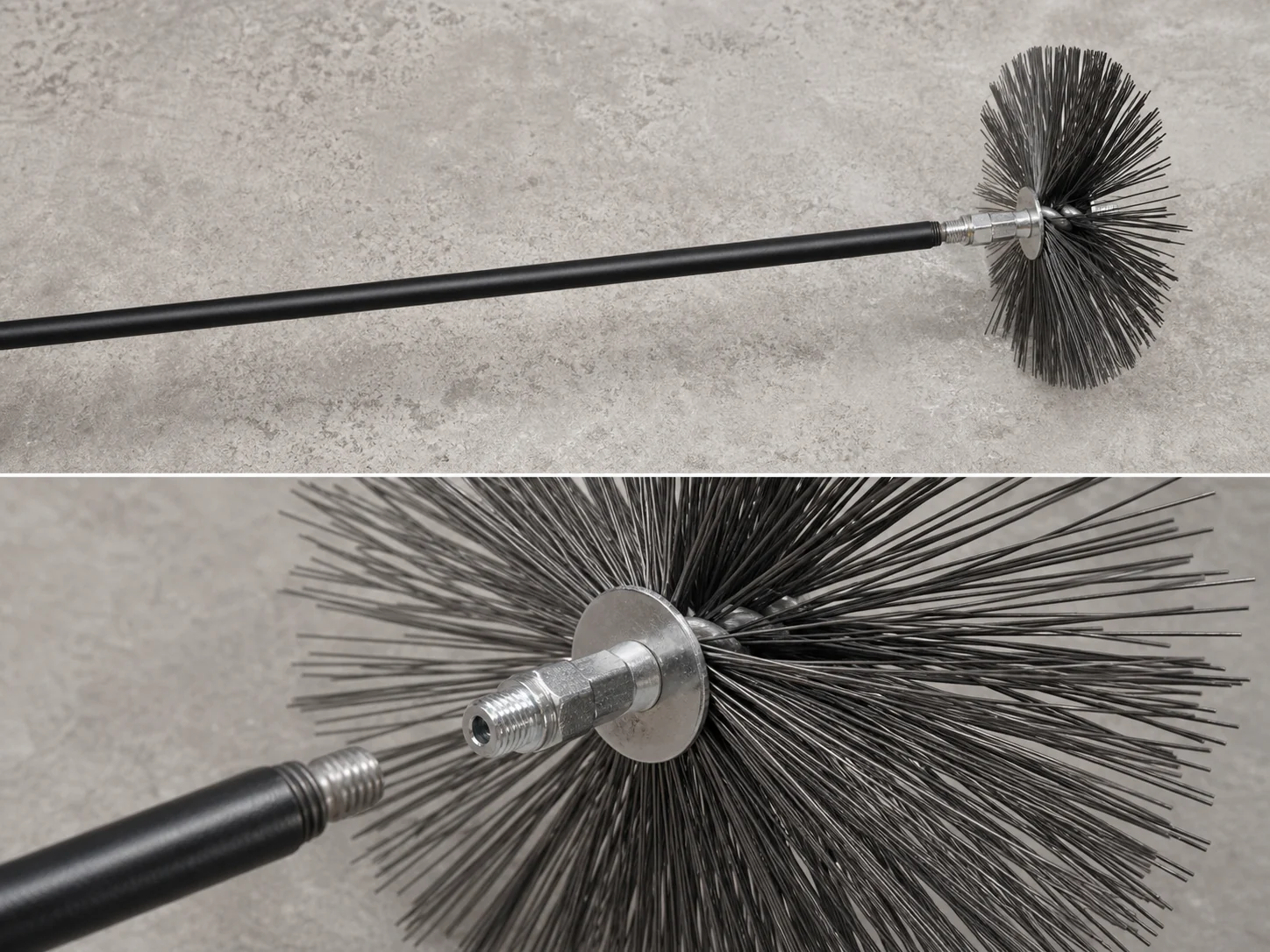
Medium brush
100 pcs
Minimum order
Worked with two hands or on a pole: chimney, gutter and pond-filter brushes, discs, cups and tank brushes.
Production lead time, once the specification is confirmed
- Up to 100 pcsWithin 7 days
- 101–5,000 pcsWithin 14 days
- 5,001–50,000 pcsWithin 21 days
- Over 50,000 pcsConfirmed with your quotation
Peak season can extend these times; the shipping date is confirmed in writing with your quotation. Sampling and shipping are quoted separately.
A 100mm round carbon steel wire chimney brush for scrubbing soot, tar, and carbonized deposits from chimney flues, boiler passages, and vent liners. The threaded removable head mounts to standard chimney rods for manual up-and-down and rotating cleaning.
What can this brush do for you?
Carbon Steel Wire Cuts Through Hard Soot and Tar
The 0.5–0.8 mm carbon steel bristles are stiff enough to break up hardened deposits instead of folding over, but still flexible enough to follow mortar joints and flue corners. That means each pull removes more material, so the flue clears with fewer strokes.
100 mm Round Head Sweeps Every Side in One Pass
The full-circumference head contacts all flue walls at the same time, including the recessed corners of square or rectangular clay tile liners. There is no dead side that gets skipped while you rotate or reverse the brush.
250 mm Head Length Covers Long Sections per Stroke
The extended wire fill works a taller working band on every upward or downward stroke. Instead of cleaning only a few inches at a time, the brush loosens soot and tar along the full head length, reducing the number of rod changes and passes needed to finish the job.
Threaded Removable Connection Speeds Rod Setup
The head threads onto standard chimney rods, so the brush can be attached or swapped without tools and without replacing the handle. When the bristle head eventually wears, a fresh head can go onto the same rod set.
Powder-Coated Carbon Steel Handle Resists Corrosion and Improves Grip
The handle’s powder coating protects the steel from moisture during use and storage, while the 25 mm grip diameter works with gloved hands. Less slip and less rust mean better control and longer service life between replacements.
What is a 100mm Carbon Steel Chimney Brush?
A 100mm Carbon Steel Chimney Brush is a manual flue-cleaning tool that uses a circular carbon steel wire fill fixed to a removable powder-coated steel handle. It is built for vertical or near-vertical flue passages where the operator works from the top or bottom using connected rods.
During use, the brush head is lowered or raised through the flue while the operator pushes, pulls, and occasionally rotates the rod. The carbon steel bristles scrape the flue walls as they pass, breaking away soot, tar, ash, and loose scale. The round head shape maintains contact on all sides, while the threaded connection lets the head be removed for rod storage or replacement.
This is an abrasive mechanical cleaning tool. It is not designed for glazed creosote removal by itself, and it should not be used where the flue liner is soft, coated, or where scratch-free cleaning is required. For those cases, a poly or nylon chimney brush is more appropriate.
Technical Specifications
The table below lists the standard configuration. All listed dimensions and materials can be adjusted to match your flue or rod system.
| Parameter | Specification |
|---|---|
| Head diameter | 100 mm |
| Head shape | Round |
| Head length | 250 mm |
| Bristle material | Carbon steel wire |
| Wire diameter | 0.5–0.8 mm |
| Handle/base material | Powder-coated carbon steel |
| Handle length | 500 mm |
| Grip diameter | 25 mm |
| Connection | Threaded removable |
| Overall assembled length | Approx. 750 mm |
| Working orientation | Manual push / pull / rotation |
| Brush type | Custom Tube & Pipe Bore Brushes |
| How it is driven | Hand-driven on rods or a flexible shaft |
| Cleaning target | residential and commercial masonry chimney, boiler exhaust passage and flue pipe, and metal flue and vent section cleaning |
| Surface or part | flues, carbon steel, passages, vents, joints, tile, connectors, and boiler passages |
| Residue or debris | carbon, soot, tar, carbonized deposits, loose scale, clay, ash, and corrosion |
| Mounting / connection | Threaded removable |
If your project requires a different thread size, head diameter, or length, these parameters can be set during customization.
Where does this brush work best?
- Residential and commercial masonry chimneys with clay tile flue liners where soot and soft creosote accumulate along mortar joints and inside corners
- Boiler exhaust passages and flue pipes with carbonized deposits, fly ash, or loose scale
- Metal flues and vent sections with heavy soot accumulation where surface finish is not critical
- Furnace flue connectors and short vertical risers in scheduled maintenance programs
- Restaurant or commercial kitchen exhaust flues where hardened grease carbon needs aggressive mechanical removal before chemical treatment
How do I choose the right one?
- Confirm the narrowest flue dimension first. The 100 mm head fits flues with an inner diameter around 95–110 mm. Measure the tightest point — damper frame, offset, or connector — because the brush must pass through that too. A brush that is too large binds and can jam the rods; one that is too small leaves a layer of soot behind.
- Match wire stiffness to the deposit you are removing. The thinner 0.5 mm wire is more forgiving on irregular mortar joints and lighter soot. The thicker 0.8 mm wire handles heavy tar and carbonized layers. If the deposit is glazed creosote, stage the job with a chemical treatment or chain whip before brushing.
- Check the liner material before ordering carbon steel. Carbon steel wire is correct for masonry, clay tile, and unlined or mild steel flues. For stainless steel liners where scratches can lead to corrosion, a poly or nylon brush is the better choice.
- Verify the rod connection and handle length. Confirm the thread size and gender on your existing rods before ordering. The standard 500 mm handle works for most top-down or bottom-up access; add extension rods if the flue is deeper than the handle reach.
- Use a flexible brush system if the flue has bends or a corrugated liner. This rigid round head is not intended for tight offsets or flexible stainless liners. For those, choose a flexible rod and brush configuration.
Can I customize this brush?
The 100mm carbon steel chimney brush can be configured for your flue size, rod system, and cleaning process. We will need the flue inner diameter, narrowest restriction, liner material, deposit type, rod thread standard, and preferred handle length.
- Head diameter — reduce or increase from 100 mm to match the measured flue ID
- Head length — shorten or lengthen the wire fill to change the working band per stroke
- Wire diameter — 0.3 mm to 0.8 mm range for more flexibility or more aggressive cutting
- Wire material — carbon steel, stainless steel, brass, or nylon depending on liner and corrosion requirements
- Handle length and grip diameter — extended handles for deep flues or thicker grips for heavy gloves
- Powder coating and marking — custom color, company logo, or identification code on the handle
- Threaded connection — match your standard rod thread, quick-connect interface, or locking pin requirements
- Packaging — bulk cartons, individual poly bags, or retail-ready sleeves
If your project requires material documentation, inspection reports, or third-party testing coordination, we can support those requirements during the customization process.
Which filament lasts longest on a 100mm carbon steel chimney brush?
What is the smallest flue diameter this 100 mm brush can pass through without jamming?
The brush is sized for flues with an inner diameter around 100 mm. It can usually pass through a short restriction 10–15 mm narrower if the opening is clean and straight. Any bend, damper frame, or offset below roughly 90 mm will cause binding. Measure the narrowest point first and choose a smaller head diameter if needed.
How do I attach this brush head to my existing chimney rods?
The head uses a standard threaded connection. Match the thread size and gender to your rod set before ordering. Hand-tighten firmly. If the brush will be rotated mechanically, use rods with locking clips or a safety pin to prevent the head from unscrewing inside the flue.
How can I tell when the carbon steel wire bristles need replacement?
Inspect the head before each job. Replace it when bristles are bent or flattened and no longer spring back, when worn wire ends are short and stiff, or when the head diameter is visibly smaller than the flue ID. A brush that slides through the flue without resistance is no longer removing deposits.
Can this brush remove glazed creosote or hardened tar by itself?
Carbon steel wire will loosen medium soot, tar, and carbonized scale. Heavy, glazed third-degree creosote often requires a chemical treatment or rotary chain whip first. Brushing alone may polish the surface without removing the deposit. If glaze is present, stage the cleaning rather than forcing the brush.
Is this brush safe to use on a stainless steel chimney liner?
Carbon steel wire can scratch stainless steel and leave embedded particles that promote corrosion. If the liner surface must remain smooth or the appliance warranty restricts wire brushing, use a poly or nylon brush. For unpolished mild steel or masonry flues, this carbon steel head is appropriate.
What routine maintenance should the brush receive between jobs?
Knock out loose soot, rinse the head with water, and dry it to slow rusting. Inspect the threads and powder coating for chips, and apply a light rust-preventive oil to the wire if the brush will be stored in a damp environment. Replace the head when bristle wear reduces wall contact.
Guides that go deeper on this
Custom Manufacturing RFQ
Describe Your Application
To quote this brush accurately, send the size, material, cleaning target, residue, quantity, and any available drawing or sample photo.
Drawing or photo optional — it speeds things up, it does not gate the enquiry.
Custom Brush RFQ
Send Your Brush Project
Upload a drawing, product photo, or sample photo and provide the core dimensions and cleaning conditions.
“We need a brush to remove wet residue from a stainless steel conveyor, about 800mm wide. The current brush wears quickly. We can send photos.”
“We sell drinkware and need a cleaning brush to include with the product. Quantity around 5,000 pieces.”