
What Is a Carpet Machine Brush?
A carpet machine brush is a cylindrical or roller-type brush used in carpet cleaning machines such as extractors, bonnet cleaners, and encapsulation systems. Its longer, softer bristles are designed to comb through carpet fibers, dislodge dry soil, and groom the pile without snagging or damaging the backing. Unlike a floor scrubber brush, it relies more on agitation and fiber lift than on direct scrubbing pressure.
What Is a Floor Scrubber Brush?
A floor scrubber brush is typically a disc-shaped or cylindrical brush mounted on automatic scrubbers, swing machines, or rotary floor machines. It features shorter, stiffer bristles made from nylon, polypropylene, or abrasive materials. Its job is to apply water, detergent, and mechanical action to scrub hard surfaces such as concrete, tile, VCT, or epoxy floors. The contact behavior is aggressive, focusing on breaking the bond between soil and the hard floor.
Carpet Machine Brush vs Floor Scrubber Brush: Key Differences
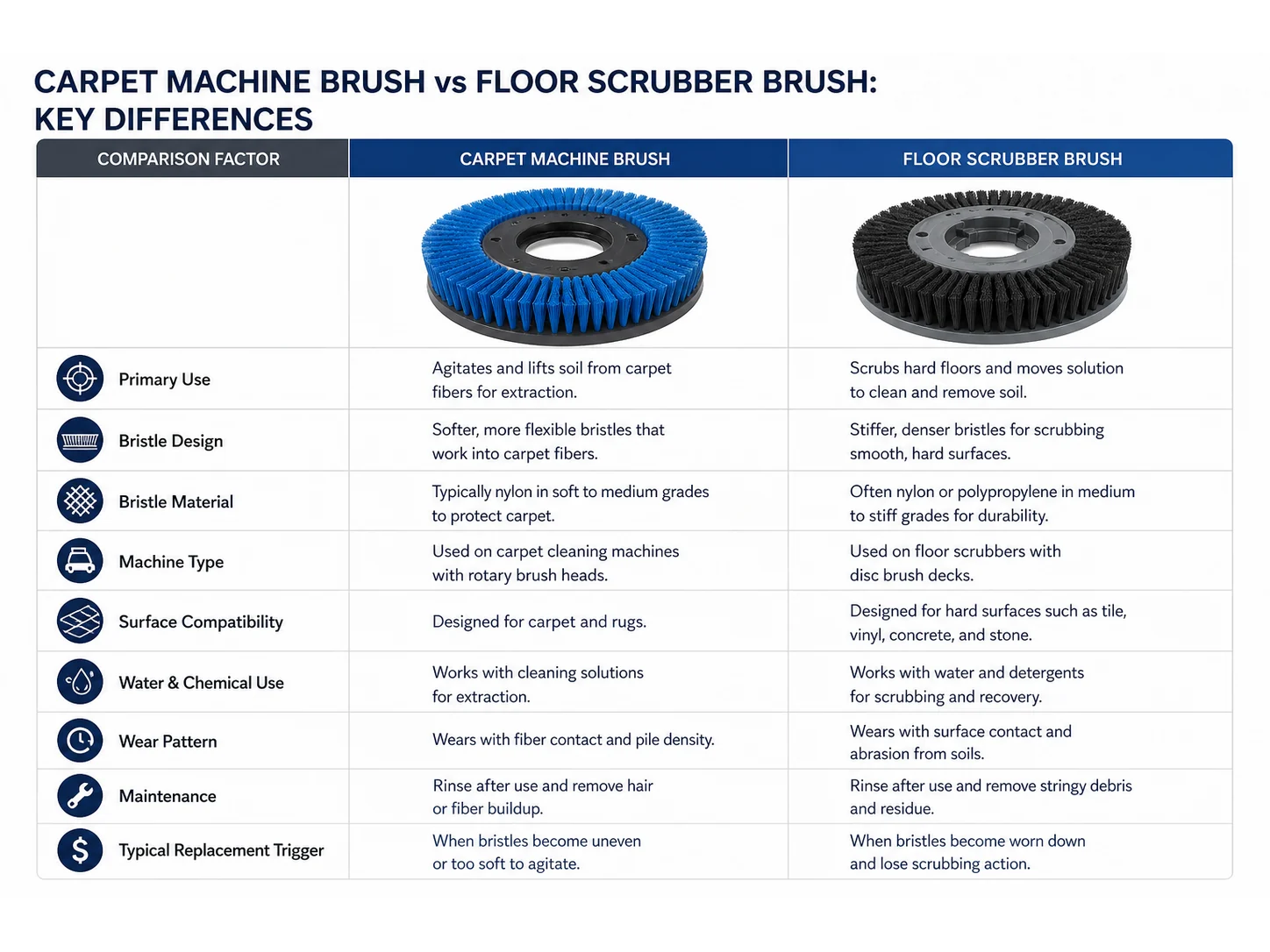
The table below summarizes the main contrasts that matter for cleaning tasks.
| Factor | Carpet Machine Brush | Floor Scrubber Brush |
|---|---|---|
| Primary Use | Carpet grooming, dry soil removal, pile lifting | Hard floor scrubbing, stain removal, deep cleaning |
| Bristle Material | Nylon, polyester, or blended flagged bristles | Nylon, polypropylene, steel wire, or abrasive grit |
| Bristle Length & Stiffness | Longer, softer, flagged tips to protect fibers | Shorter, stiffer, designed for aggressive scrubbing |
| Brush Shape & Mounting | Cylindrical/roller, direct drive or belt-driven | Disc or cylindrical, center‑lock or snap‑on hub |
| Surface Contact Action | Lift, comb, and restore pile direction | Cut through soil, emulsify dirt, pressure scrubbing |
| Moisture Compatibility | Low‐moisture or controlled flow; seldom submerged | Works with continuous water/detergent feed |
| Typical Machines | Carpet extractors, bonnet buffers, encapsulation units | Walk‑behind or ride‑on automatic scrubbers |
| Effect on Fibers/Surface | Gentle; maintains pile integrity and appearance | Can abrade or dull soft surfaces if misapplied |
How to Choose Between the Two
Use the following decision factors to pick the correct brush for your task:
- Floor material: Carpet (any pile type) → carpet machine brush; hard surfaces (concrete, tile, VCT) → floor scrubber brush.
- Pile height and construction: Low‑profile loop carpets may tolerate a softer interface, but a carpet brush is still safer than a scrubber brush. Cut‑pile and shag carpets demand flagged, non‑aggressive bristles.
- Moisture level: Carpet cleaning uses controlled moisture; floor scrubbing floods the surface. A carpet brush exposed to standing water can lose shape and become less effective.
- Brush diameter and core: Match the exact diameter, core ID, and mounting type to your machine’s drive. A 17‑inch or 20‑inch disc scrubber brush will not fit a cylindrical carpet extractor.
- Machine speed and pressure: Rotary scrubbers operate at 150–300 rpm with pad/brush pressure; carpet machines often have faster cylindrical rotation but lighter contact. Exceeding the brush’s design speed can cause bristle breakage.
- Cleaning goal: To restore pile, remove surface dust, and leave carpets ready for vacuuming → carpet machine brush. To remove grease, food residue, or tire marks on sealed concrete → floor scrubber brush.
Common Types of Carpet Machine Brushes
While many configurations exist, the most common include:
- Soft flagged nylon roller brush: For everyday grooming and light soil removal.
- Stiff crimped brush (sometimes called a “groomer”): For high‑traffic matted carpet in commercial settings.
- Counter‑rotating brushes: Found in some extractors; one brush lifts while the other agitates.
- Handheld or portable machine brushes: Small cylindrical brushes for spot cleaning and stairs.
Common Mistakes When Selecting a Brush
- Using a floor scrubber brush on carpet. The stiff bristles snag fibers, cause matting, and can delaminate carpet backing.
- Using a carpet brush on a hard floor. It barely removes soil, can spread dirty water, and may leave behind bristle marks.
- Ignoring pile height. A brush that is too soft won’t reach the base of a thick shag; one too stiff can shred delicate fibers.
- Choosing by diameter alone. Core size, locking mechanism, and bristle fill pattern are just as critical for fit.
- Skipping chemical compatibility checks. Some bristles degrade when exposed to strong alkaline or acidic cleaners.
- Assuming universal fit. Different brands and models use proprietary mounts; a brush that “looks right” may not lock securely.
When a Carpet Machine Brush Is the Wrong Choice
Even a well‑chosen carpet brush cannot solve every filtration or restoration problem. Recognize these boundaries:
- Heavily saturated or flood‑damaged carpet: Requires extraction, drying equipment, and possibly replacement—not just brushing.
- Seams or edges with heavy wear: The brush may aggravate loose seams; manual spot correction is safer.
- Heat‑sensitive synthetic fibers: High‑speed friction can melt olefin or polyester pile; a lower‑speed machine or bonnet method may be necessary.
- Extreme soil levels: Grease, mud, or chemical residues may need a pre‑scrub with a specialized hard‑brush or encapsulation; a carpet brush alone won’t lift the load.
- Color transfer or bleed risk: Brushing can spread dyes; always test in an inconspicuous area.
When in doubt, consult the carpet manufacturer’s care guide and request a brush sample or drawing review from your supplier before placing a large order.
Final Takeaway
The choice between a carpet machine brush and a floor scrubber brush boils down to the floor surface and the cleaning goal. Carpet brushes protect fibers while agitating soil out of the pile; floor scrubber brushes deliver the mechanical action needed to scrub hard surfaces. Always verify machine compatibility, bristle material, and moisture tolerance before buying. Matching the brush to the task avoids costly rework and prolongs the life of both the floor and the equipment.
Frequently Asked Questions
Can I use a floor scrubber brush on a low‑pile carpet?
No. Even low‑pile carpet is a soft textile. The stiff bristles and rotational scrubbing action can mat fibers, pull loops, and damage the carpet backing. Always use a brush designed specifically for carpet.
What bristle material is best for a carpet machine brush?
Soft flagged nylon or a nylon‑polyester blend is the most common choice. Flagged (split) tips create agitation without cutting fibers, and nylon resists moisture and chemicals better than natural bristles.
How do I know if a brush fits my machine?
Check three specifications: brush core inside diameter (ID), overall brush length or diameter, and the drive type (e.g., splined shaft, hex, or snap‑on housing). Always cross‑reference the machine’s parts manual or request a dimension drawing from the supplier.
What’s the difference between a disc brush and a cylindrical brush for carpets?
Cylindrical (roller) brushes lift and groom the pile in the direction of rotation and are common in extractors. Disc brushes, used on rotary machines with bonnet pads or shampoo methods, clean in a circular motion and tend to work more on the surface rather than combing deep into the pile.
Can a carpet machine brush be used with wet cleaning methods?
Yes, most carpet brushes are designed for low‑moisture encapsulation or hot‑water extraction machines. However, they are not made to be submerged for long periods; excessive water can degrade the core and bristle adhesive over time.
How often should I replace a carpet machine brush?
Check the brush after every 300–500 hours of use. When bristles appear matted, worn down, or no longer visibly lift the pile, replacement is due. A worn brush reduces cleaning effectiveness and can leave carpet looking fuzzy.
Why is my floor scrubber brush not spinning?
This is a machine issue, not a brush type problem. Common causes include a slipping drive belt, faulty brush motor, worn drive hub, or debris jamming the mount. Check the machine’s troubleshooting guide before assuming the brush is faulty.
Is a carpet machine brush suitable for bathroom or kitchen hard floors?
No. A carpet brush cannot scrub grout lines or remove grease from tile or vinyl. Use a dedicated floor scrubber brush with appropriate bristle stiffness for those surfaces.
Technical References
Which bristle material fits this job — Nylon PA, PET Polyester or Polypropylene PP?
| Material | Continuous temperature (°C) | Peak temperature (°C) | Water absorption | Hardness |
|---|---|---|---|---|
| Nylon PA | 93 | 121 | 0.3–9% by PA grade and conditioning | Medium to firm; filament diameter and trim length control bending force. |
| PET Polyester | 120–150 | 170–190 | 0.10–0.30% | Shore D 80–90 |
| Polypropylene PP | 80–100 | 120–140 | ≤0.03% | Shore D 65–75 |
| Rubber | 100 | 130 | very low | Specified by compound and Shore hardness; published TPE families can span roughly 50–80 Shore A, but that is a product-family example rather than a universal rubber range. |
| PBT | 120–140 | 160–180 | 0.05–0.20% | Shore D 80–90 |
Figures as published by Brushtec / DuPont; Perlon. Confirm the exact grade against the supplier datasheet before ordering.
What should replace Floor Scrubber Sweeper Brushes for carpet machine?
- Floor Scrubber Sweeper Brushes — Floor scrubber and indoor sweeper brushes are selected around a scrub deck and controlled downforce; road-sweeper brooms are designed for outdoor debris pickup, gutter reach, impact, and dust-control systems. Closest alternative: Road Sweeper Brooms.
- Roller and Conveyor Brushes — Roller and conveyor brushes hold cylindrical line contact across a working width, including helix-wound builds where the filament path is set to move loosened material toward one side; a strip brush holds the same line without rotating, so it seals or wipes but cannot carry residue along the width.
- Disc Brushes — Disc brushes use a flat circular working face; cylindrical floor or roller brushes use tangential line contact and are better when debris pickup or continuous width contact is important. Closest alternative: Floor Scrubber Sweeper Brushes.
- Nylon PA — Compare Nylon PA with PP, PBT, PET. Change material when wet stiffness, temperature, chemical resistance, conductivity, particle shedding, or surface marking becomes the limiting factor.