
What Is an Electrode Powder Removal Brush?
An electrode powder removal brush is a cleaning device designed to gently lift and remove residual electrode powder from substrates without damaging the delicate coating. It typically features anti-static nylon bristles arranged in a specific pattern and is mounted in a cleaning station along the web path. Its primary function is to maintain surface cleanliness, help reduce defect risk after validation, and prolong downstream tooling life.
Common Types of Electrode Powder Removal Brushes
Three main brush configurations dominate production lines:
- Roller Brush: A cylindrical brush that rotates against the moving web, delivering continuous, full-width cleaning. Ideal for high-speed lines where uniform coverage is essential.
- Strip Brush: A narrow, straight brush used for targeted edge cleaning or cleaning along specific zones. Often installed in pairs to cover both edges of the electrode.
- Disc Brush: A flat, round brush that oscillates or rotates to clean localized spots or small areas. Commonly used in repair stations or for compact machinery.
Roller Brush vs. Strip Brush vs. Disc Brush: A Comparison
| Feature | Roller Brush | Strip Brush | Disc Brush |
|---|---|---|---|
| Cleaning Coverage | Continuous full-width | Narrow, edge-focused | Localized spot |
| Best Use | High-speed, wide webs | Edge debris, narrow lanes | Repair, small areas |
| Line Speed Compatibility | Up to 80 m/min | Up to 60 m/min | Manual or low-speed |
| Bristle Density | High, adjustable | Medium to high | Low to medium |
| Maintenance Complexity | Moderate | Low | Low |
Bristle Material Selection: Why Anti-Static Nylon Matters
Standard nylon bristles can generate static electricity during friction, causing removed powder to re-attach to the electrode surface. Anti-static nylon bristles dissipate charges effectively, preventing this re-attraction. They are often infused with carbon or conductive additives. Bristle diameter and stiffness also matter: too soft and cleaning is ineffective, too stiff and the coating may scratch. Most electrode cleaning applications use soft to medium stiffness with anti-static treatment.
How to Choose the Right Brush: Key Selection Factors
Consider the following when specifying an electrode powder removal brush:
- Electrode Width: Roller brushes must match or exceed the web width; strip brushes work for edges.
- Line Speed: Higher speeds need continuous-action roller brushes or vacuum assist.
- Powder Characteristics: Fine, sticky powders may require anti-static bristles and closer density.
- Cleaning Frequency: Intermittent lines may use disc brushes; continuous lines benefit from roller brushes.
- Space Constraints: Compact machines may only fit strip or disc brushes.
- Maintenance Access: Easier-to-remove brushes reduce downtime.
Common Problems and Troubleshooting
Even well-chosen brushes can experience issues. Here are the most frequent ones:
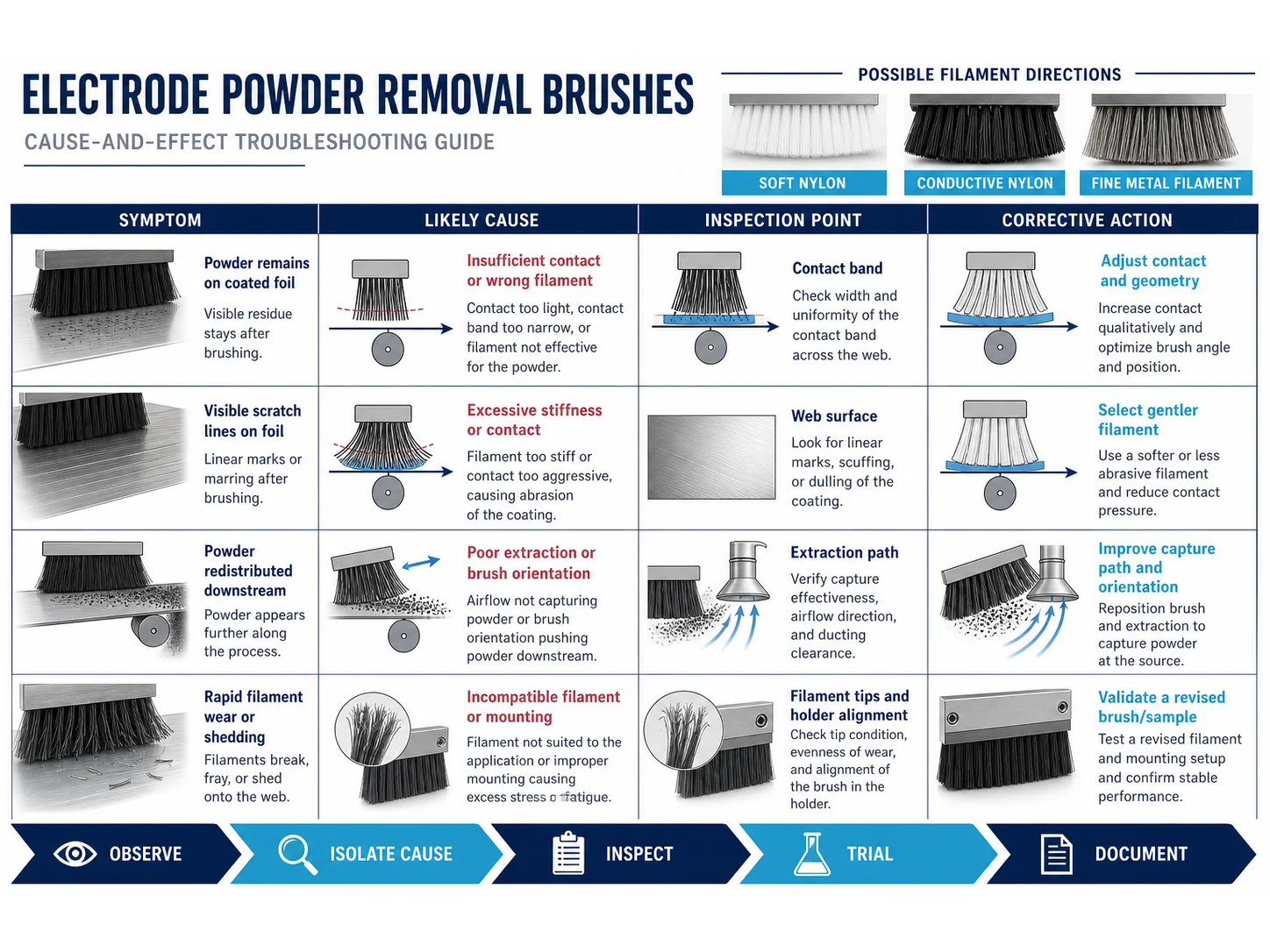
- Brush Loading / Clogging: Powder accumulates between bristles, reducing cleaning efficiency. This occurs when bristle density is too high for the powder particle size or when line speed exceeds the brush’s self-cleaning ability. Solution: Reduce density, increase cleaning frequency, or add vacuum assist.
- Static Re-Attraction: After removal, powder jumps back onto the electrode due to static charge. Solution: Use anti-static bristles, ground the brush holder, and control humidity.
- Uneven Wear: The brush wears more in the center or at edges, leading to inconsistent cleaning. Solution: Check alignment, web tension, and oscillation settings.
- Bristle Bending / Deformation: Over time, bristles lose their original shape, especially with heavy loading. Solution: Choose a stiffer bristle material or increase brush replacement frequency.
Cleaning and Maintenance Methods
Proper brush maintenance extends life and performance:
- Manual Cleaning: Remove the brush and tap or blow off accumulated powder. Simple but labor-intensive.
- Vacuum Assist: Connect a vacuum line near the brush to continuously extract powder, reducing loading and airborne contamination.
- Automated Brush Cleaning: Some roller brushes have built-in combs or secondary brushes to self-clean during rotation.
- Replacement Intervals: Monitor bristle wear and replace when cleaning effectiveness drops, typically after condition-based inspection shows meaningful wear or loss of function for continuous lines.
When Vacuum Assist Becomes Necessary
A standalone brush is sufficient for low-speed lines with light, non-fine powders. However, vacuum assist becomes necessary when:
- Line speed exceeds 30–40 m/min and powder volume is high.
- Powder particles are very fine (below 10 µm) and easily become airborne.
- Regulatory or cleanroom standards demand minimal ambient contamination.
- Brush clogging occurs frequently despite regular manual cleaning.
In these cases, an integrated vacuum nozzle near the brush captures powder immediately, preventing re-deposition and keeping the brush cleaner longer.
Final Takeaway: Matching Brush Type to Your Production Line
Selecting an electrode powder removal brush is not a one-size-fits-all decision. Start by mapping your electrode width and line speed, then match a brush type (roller, strip, disc) accordingly. Prioritize anti-static bristle material to prevent re-attraction, and don’t overlook maintenance access. If powder loading or static issues persist, add vacuum assist rather than forcing a mechanical-only solution. Regular inspection and timely replacement will keep your coating line running cleanly and efficiently.
Common Mistakes to Avoid
- Choosing only by product name instead of access, residue, and surface limits.
- Using a brush that is too aggressive because the first trial looks faster.
- Ignoring where loosened debris will go after brushing.
- Keeping the brush in service after bristles bend, shed, load with residue, or stop reaching the target area.
- Treating brushing as the whole cleaning method when inspection, flushing, vacuuming, machine adjustment, or sanitation controls are also needed.
When an Electrode Powder Removal Brush Is the Wrong Choice
This brush is not enough when the main problem is blocked access, unsafe working conditions, damaged equipment, incompatible chemicals, or a process setting that keeps recreating the residue. In those cases, review access, residue type, surface sensitivity, brush stiffness, operating environment, and replacement routine and confirm the surrounding cleaning method before increasing brush stiffness or contact pressure.
Frequently Asked Questions
What bristle density is right for my electrode powder removal brush?
Density depends on powder particle size and line speed. Coarse powders need lower density to avoid clogging; fine powders may require higher density for thorough removal. Start with a medium density and adjust based on observed loading.
Can a roller brush handle narrow electrodes or just full-width webs?
Roller brushes can be manufactured in custom lengths to match narrow webs; they are not limited to full-width lines. For very narrow electrodes, strip or disc brushes might be more practical.
How often should I clean or replace the brush?
Cleaning frequency is typically daily for high-volume lines, while brush replacement occurs based on wear condition, operating load, and the equipment maintenance plan depending on wear. Signs of replacement include flattened bristles, persistent clogging, or reduced cleaning performance.
Is an anti-static brush absolutely necessary, or can I use standard nylon?
Standard nylon can work if static is well-controlled in the environment, but most operators find that anti-static treatment reduces re-attraction and improves overall cleaning consistency. In dry environments, it is strongly recommended.
When should I add vacuum assist instead of relying on the brush alone?
Add vacuum assist when you notice powder re-deposition after cleaning, frequent brush clogging, or when line speed exceeds 30 m/min with fine powders. It is also beneficial in cleanroom applications.
Can a disc brush replace a roller brush in a continuous production line?
Not usually. Disc brushes cover a small area and are not designed for full-width, high-speed cleaning. They are better suited for spot repair or low-speed off-line cleaning.
What causes powder to build up on the brush so quickly?
Excessive loading can be due to bristle density being too high for the particle size, line speed exceeding the brush’s capacity, or insufficient vacuum assist. Adjust one of these variables to reduce build-up.
How do I prevent static re-attraction without changing the whole brush?
Ensure the brush holder is grounded, maintain relative humidity above 40% if possible, or install an ionizing bar near the cleaning station to neutralize static charge on the moving web.
Technical References
Which nylon grade fits this job — Nylon PA, PA6 Nylon or PA66 Nylon?
| Grade | Continuous temperature (°C) | Peak temperature (°C) | Water absorption | Hardness |
|---|---|---|---|---|
| Nylon PA | 93 | 121 | 0.3–9% by PA grade and conditioning | Medium to firm; filament diameter and trim length control bending force. |
| PA6 Nylon | 80–100 | 130–160 | 1.5–3.0% | Shore D 75–85 |
| PA66 Nylon | 100–120 | 150–180 | 1.0–1.8% | Shore D 80–88 |
| PA610 Nylon | 90–110 | 130–150 | 0.5–1.0% | Shore D 72–82 |
| PA612 Nylon | 90–110 | 130–150 | 0.3–0.7% | Shore D 70–80 |
Figures as published by Brushtec / DuPont. Confirm the exact grade against the supplier datasheet before ordering.
What should replace Strip Seal Brushes when they stop working?
- Strip Seal Brushes — Strip brushes create a linear barrier or guide; machine-table brush plates distribute load and support products over a broad area. Closest alternative: Machine Table Brush Plates.
- Roller and Conveyor Brushes — Roller and conveyor brushes hold cylindrical line contact across a working width, including helix-wound builds where the filament path is set to move loosened material toward one side; a strip brush holds the same line without rotating, so it seals or wipes but cannot carry residue along the width.
- Disc Brushes — Disc brushes use a flat circular working face; cylindrical floor or roller brushes use tangential line contact and are better when debris pickup or continuous width contact is important. Closest alternative: Floor Scrubber Sweeper Brushes.
- Nylon PA — Compare Nylon PA with PP, PBT, PET. Change material when wet stiffness, temperature, chemical resistance, conductivity, particle shedding, or surface marking becomes the limiting factor.