
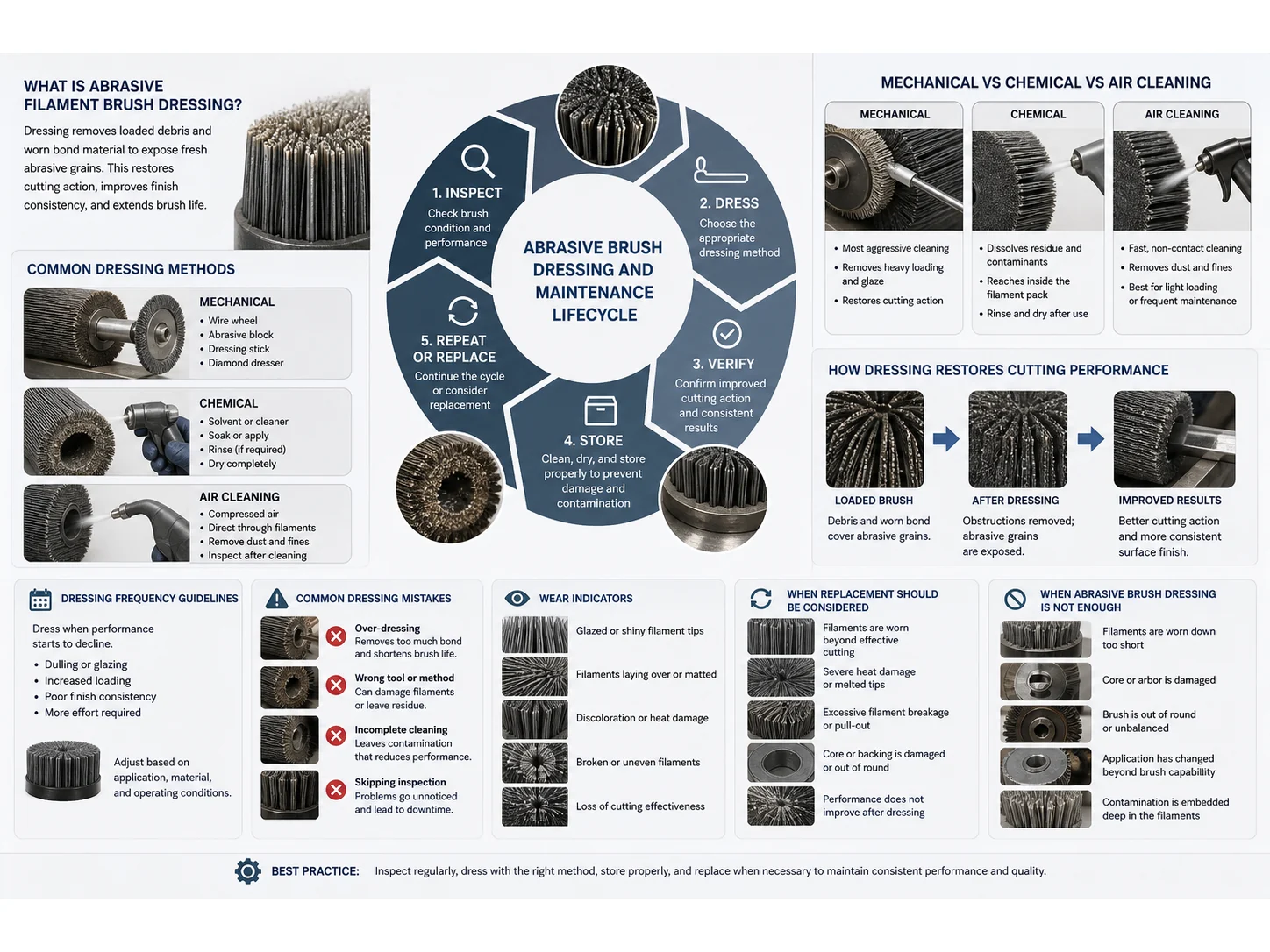
What Is Abrasive Filament Brush Dressing?
Abrasive filament brush dressing is the process of removing worn abrasive grains, debris, and glazed material from the tips of abrasive‑impregnated nylon filaments to restore the brush’s cutting ability and surface finish consistency. It is a periodic maintenance task, not a one‑time setup. Without regular dressing, a brush may burnish instead of cut, produce inconsistent finishes, and wear unevenly.
Common Dressing Methods
Three main dressing methods are used in production environments:
- Mechanical dressing (grinding): A dressing stick, abrasive stone, or wire brush is applied to the rotating brush face to grind away a thin layer of the filament tips, exposing sharp new abrasive grains.
- Chemical dressing: The brush is soaked in a chemical solution that dissolves the nylon surface just enough to uncover fresh abrasive. This method is gentle on the grains and can reach complex bristle patterns.
- Air cleaning: Compressed air is directed at the brush face to blow out loose debris and lightly reposition bent bristles. While not a true dressing method, it can temporarily improve performance between deeper dressings.
Mechanical Dressing vs Chemical Dressing vs Air Cleaning
| Method | How It Works | Best For | Limitations | Typical Frequency |
|---|---|---|---|---|
| Mechanical dressing | Abrasive stick or wire brush grinds off worn filament tips | Heavy‑duty deburring, cup and disc brushes, quick in‑situ dressing | Can remove too much material if overdone; may generate dust | based on wear condition, operating load, and the equipment maintenance plan of run time, or when cut drops |
| Chemical dressing | Chemical solution softens and removes a thin layer of nylon | Complex brush shapes, small‑diameter brushes, or when uniform dressing is critical | Requires brush removal and drying time; chemical compatibility must be verified | Weekly or between job changeovers, depending on chemistry |
| Air cleaning | Compressed air blows out loose debris and dust | Light contamination, interim cleaning to avoid buildup | Does not expose fresh abrasive; only a temporary fix | At the end of each shift or anytime loading is visible |
How Dressing Restores Cutting Performance
Abrasive filament brushes cut because sharp abrasive grains protrude from the nylon carrier. During use, these grains gradually fracture, dull, or become encapsulated by smeared metal or plastic debris. The filament tips also round over, reducing the effective cutting angle. Dressing removes a thin layer from the tip, eliminating dull grains, cleaning away contaminants, and exposing a fresh set of sharp abrasive particles. This restores the aggressive cutting action and brings the surface finish back to specification without changing the brush’s base stiffness.
Dressing Frequency Guidelines
There is no single universal schedule because dressing needs depend on the workpiece material, brush grit, and duty cycle. Instead, look for these practical signs that dressing is needed:
- Reduced material removal rate or longer cycle times.
- Glazed or shiny appearance on the bristle tips.
- Surface finish changing from cutting to burnishing or smearing.
- Increased operator pressure required to achieve the same result.
- Inconsistent finish across the part or from part to part.
As a general rule, check brush condition based on wear condition, operating load, and the equipment maintenance plan in high‑volume applications. Light‑duty finishing may only require a light dressing once per shift. Keeping a simple log of dressing intervals and observed performance helps establish the right frequency for your specific process.
Common Dressing Mistakes
- Over‑dressing: Removing too much filament shortens brush life unnecessarily. Remove only what is needed to expose fresh grain.
- Wrong dressing tool: Using a dressing stick coarser than the brush grit can tear out grains; using one too fine may not dress effectively.
- Dressing without cleaning first: Debris‑loaded bristles can pack contaminants deeper into the filament when dressed, reducing performance.
- Ignoring safety: Mechanical and air dressing produce abrasive dust. Always use dust collection or wear a properly fitted respirator and safety glasses.
- Neglecting brush type differences: Cup brushes, wheel brushes, and end brushes may require different dressing approaches; applying the same method uniformly can damage the brush.
When Abrasive Brush Dressing Is the Wrong Choice
Dressing only refreshes the tips of the filaments. It cannot restore a brush that has:
- Filaments worn so short that contact pressure is lost or the brush no longer reaches corners.
- Severe asymmetrical wear that causes vibration or inconsistent contact.
- Broken or missing bristles from accidental impact or extreme use.
- Base material fatigue where the filament is no longer securely anchored.
If dressing fails to bring back sufficient cutting performance after two attempts—or if the brush is visibly undersized for the application—it is time to replace the brush. Continuing to use a worn‑out brush can lead to poor part quality, increased cycle times, and even damage to the machine or fixturing.
Final Takeaway
Effective abrasive brush dressing is about removing just enough material to maintain a fresh cutting face, not about reshaping the brush. Choose the method that works for your brush design and production constraints: mechanical for speed, chemical for precision, and air cleaning for routine maintenance. Monitor brush condition continually, dress proactively, and know when a brush has simply reached the end of its service life. A consistent dressing routine helps you get the most value from every abrasive filament brush.
Frequently Asked Questions
What is the best dressing method for small‑diameter brushes?
For brushes under 1 inch in diameter, chemical dressing is often the safest choice because it reaches all bristles uniformly without mechanical force. Air cleaning can handle light contamination, but for true cutting restoration a short chemical soak works well. Always verify chemical compatibility with both the nylon and the abrasive grain.
Can I dress a brush without removing it from the machine?
Yes. Mechanical dressing sticks can be applied while the brush is mounted and spinning, provided safe access is available. Air cleaning is also done in place. Chemical dressing usually requires removal to avoid splashing or contaminating the workpiece, but some shops design a dedicated dressing station where the brush is briefly demounted.
How do I know if I am over‑dressing the brush?
Signs of over‑dressing include a rapid reduction in brush diameter, a brittle or jagged bristle tip appearance, and occasional grain pull‑out. If dressing does not improve cutting after multiple attempts, stop and inspect the brush length. Over‑dressing wastes usable filament and shortens brush life.
Is chemical dressing safe for all abrasive filament brushes?
No. Chemical dressing solutions are typically designed for specific nylon types. Some solvents can attack the nylon base, weaken the filament, or degrade the bond holding the abrasive grain. Always consult the brush manufacturer’s recommendation before using any chemical agent.
Can dressing fix a brush that has developed a groove or uneven wear?
Usually not. A groove indicates a localized wear pattern often caused by misalignment or a fixed workpiece feature. Dressing removes material from the entire face and will not selectively rebuild worn areas. If uneven wear is significant, correct the machine setup and replace the brush.
Does dressing produce hazardous dust?
Mechanical dressing generates dust containing spent abrasive grains (silicon carbide, aluminum oxide) and the workpiece material. This dust can be irritating to the lungs and eyes. Use local exhaust ventilation or wear appropriate respiratory protection and safety glasses whenever dressing a brush.
How often should I dress a brush in a high‑volume deburring cell?
In continuous heavy‑duty deburring, check based on wear condition, operating load, and the equipment maintenance plan initially and dress when cut performance drops. After establishing a baseline, many shops find a predictable interval—such as every 4 hours of run time—works well. Keep a log and adjust based on part quality checks.
What is the difference between dressing a cup brush and a disc brush?
The principle is identical, but the working face geometry differs. Cup brushes are dressed on the end face, typically with a flat dressing stick held perpendicular to the brush axis. Disc brushes are dressed on the circumferential edge, so the dressing tool must be applied to the outer diameter. Access and tool positioning are the main differences; always dress the face that contacts the workpiece.
Technical References
Which bristle material fits this job — Nylon PA, Silicon Carbide Abrasive Nylon or Aluminum Oxide Abrasive Nylon?
| Material | Continuous temperature (°C) | Peak temperature (°C) | Water absorption | Hardness |
|---|---|---|---|---|
| Nylon PA | 93 | 121 | 0.3–9% by PA grade and conditioning | Medium to firm; filament diameter and trim length control bending force. |
| Silicon Carbide Abrasive Nylon | 80–120 | 140–170 | 0.3–2.0% | Carrier Shore D 70–85; SiC Mohs Hardness Approximately 9.2 |
| Aluminum Oxide Abrasive Nylon | 80–120 | 140–170 | 0.3–2.0% | Carrier Shore D 70–85; Al2O3 Mohs Hardness Approximately 9 |
Figures as published by Brushtec / DuPont; Perlon. Confirm the exact grade against the supplier datasheet before ordering.
What should replace Wheel Brushes when they stop working?
- Wheel Brushes — Wheel brushes give narrow edge contact; cup brushes cover a broader open face, while end brushes concentrate contact at the end of a small stem for recesses.
- Cup Brushes — Cup brushes cover a broader face than wheel brushes; end brushes are better for small recesses or pockets where the cup body blocks access.
- End Brushes — End brushes concentrate contact at the end of a small stem; wheel brushes work along a longer edge and cup brushes cover a broader open face.
- Disc Brushes — Disc brushes use a flat circular working face; cylindrical floor or roller brushes use tangential line contact and are better when debris pickup or continuous width contact is important. Closest alternative: Floor Scrubber Sweeper Brushes.