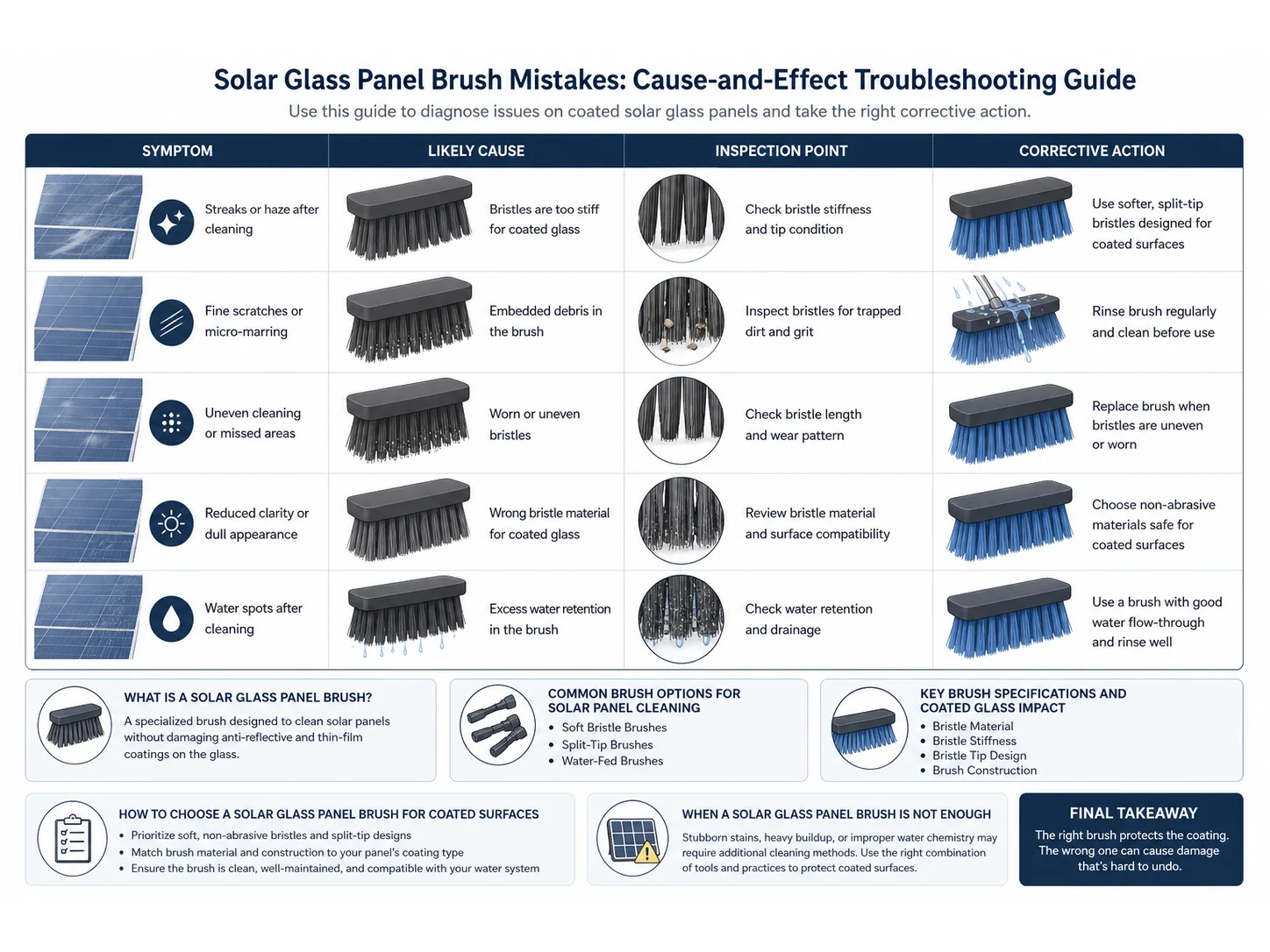
What Is a Solar Glass Panel Brush?
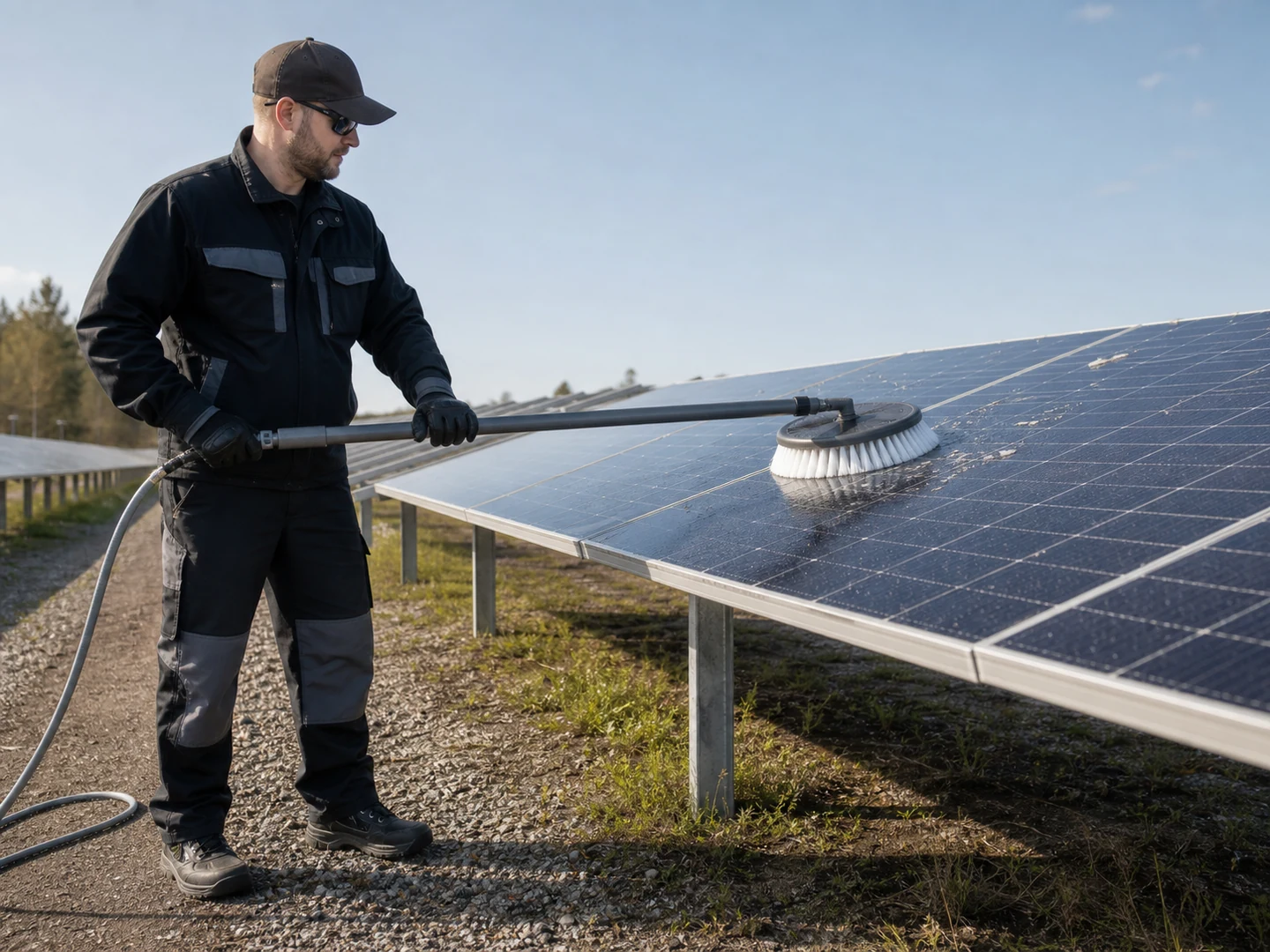
A solar glass panel brush is any bristle-based tool — strip brush, roller brush, disc brush, or custom assembly — used with manual handles, telescopic poles, robotic cleaners, or mechanized cleaning vehicles to remove dirt from photovoltaic glass. It is typically made from polymer filaments such as nylon, polypropylene, or polyester, and may include natural fibers, abrasive grit, or specialty tips. The brush’s primary functions are to agitate and lift particulate matter while avoiding surface damage, especially on modern solar coatings that are thinner and more sensitive than standard glass.
Why Coated Glass Demands a Different Brush Approach
For solar-panel and PV-glass context, the article references Department of Energy — Solar Photovoltaic Technology Basics.
For the environmental or chemical-safety point in this section, the supporting reference is EPA — Safer Choice.
For brush terminology and construction language, this section references American Brush Manufacturers Association — Brush Lingo.
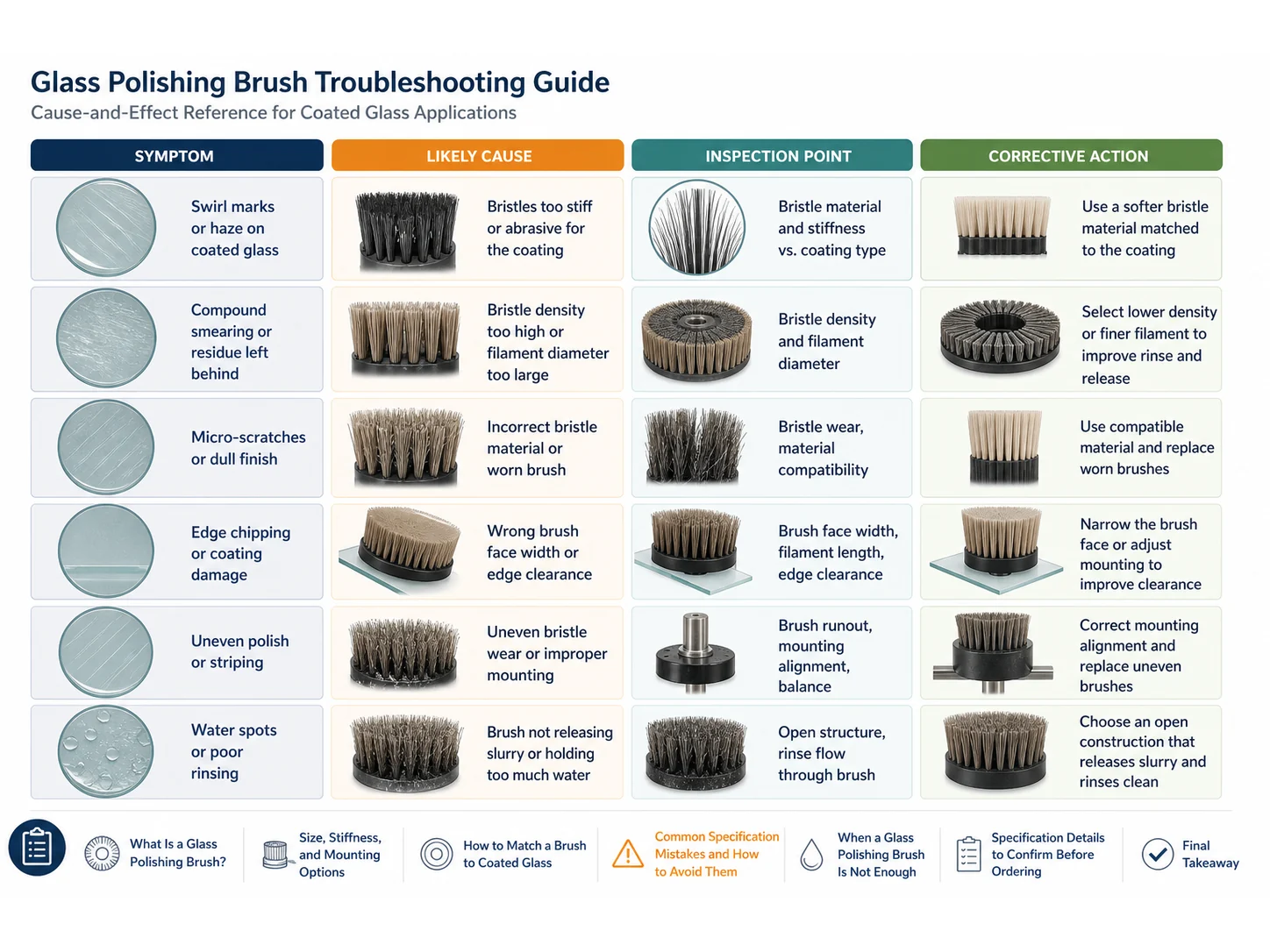
Most utility-scale and new commercial modules now feature an anti-reflective coating (often a thin silica or porous layer) that boosts light transmission but can be easily scratched by hard or angular bristles. Hydrophobic or anti-soiling coatings add another fragile layer. Aggressive brushing, incorrect filament stiffness, or contaminated bristles can cause micro-scratches, haze, chemical wear, or coating delamination — all of which reduce panel output and may void coating warranties. A brush safe for raw glass might ruin a coated surface within a few cleaning cycles.
Common Brush Options for Solar Panel Cleaning
Before selecting a brush for coated glass, it helps to understand the main form factors and materials available:
- Strip brushes: Long, linear holders with bristles protruding on one side; often ganged into assemblies for cleaning robots or handheld tools.
- Roller brushes: Cylindrical brushes that rotate; common in mechanized sweepers and some push-behind cleaners.
- Disc brushes: Round, rotating brushes used for spot cleaning or small-area machines.
- Bristle materials: Nylon (common, available in many hardness grades), polypropylene (soft, good chemical resistance), polyester (intermediate stiffness), natural fibers (e.g., horsehair, tampico – very soft but may absorb water), and abrasive-impregnated filaments (avoid on coated glass unless specifically engineered for it).
- Tip treatments: Flagged (split tips) for gentle dusting, un-flagged (stiffer scrubbing) – flagged tips reduce contact pressure per filament.
Key Brush Specifications and Coated Glass Impact
The table below compares the main specification factors and how they influence coated glass safety.
| Specification Factor | Coated Glass Risk / Impact | Recommended Approach |
|---|---|---|
| Bristle Material | Hard nylon or abrasive-impregnated filaments can leave micro-scratches on AR layers. Certain plastics may chemically interact with coatings. | Use soft to medium nylon, polypropylene, or specially engineered polyester. Avoid abrasives. If using natural fibers, ensure consistent wet/dry performance. |
| Bristle Diameter | Thicker bristles (≥0.3 mm) concentrate force and may scratch. Too thin may bend and be ineffective. | Select a diameter of 0.15–0.25 mm for gentle but effective cleaning. Test smaller diameters on highly sensitive thin-film coatings. |
| Bristle Stiffness | High stiffness increases tip pressure and abrasion risk. Low stiffness may not remove bird droppings or caked dust. | Choose the lowest stiffness that still breaks the soil bond. Flagged tips reduce effective pressure. Consider dual-stiffness brushes. |
| Fill Density | Too dense: can trap grit and create a sandpaper effect. Too sparse: uneven cleaning and possible missed spots. | A medium density with good filament spacing allows debris to fall away and reduces grit entrapment. Brush design should promote self-cleaning. |
| Core Material & Mount | Corroding metal cores can drip rust onto glass; incompatible plastics may warp or degrade under UV and moisture. | Use stainless steel, aluminum, or UV-stabilized polymer cores. Ensure mounting does not create pressure points that flex the glass. |
| Brush Length / Size | Too short: requires multiple passes, increasing contact time. Too long: may apply uneven pressure across modules. | Match brush length to module width or cleaner mechanism stroke. For custom assemblies, account for panel frame edges to avoid collisions. |
How to Choose a Solar Glass Panel Brush for Coated Surfaces
Practical selection should answer the following:
- Residue type: Dry dust requires only soft flagged brushes; bird droppings or oily deposits may need slightly higher stiffness or a wet cleaning system, but never abrasive filaments.
- Surface sensitivity: AR and hydrophobic coatings need gentler stiffness and smaller diameters than uncoated glass. Thin-film (CdTe, CIGS) may have polymer top sheets that scratch even more easily.
- Equipment interface: Whether the brush is hand-wielded, mounted on a telescopic pole, or integrated into a robot determines the required mounting hole pattern, overall weight, and ability to control contact pressure.
- Wet vs. dry cleaning: Wet cleaning lubricates bristles and reduces friction but may require bristles that resist swelling (polypropylene or nylon) and cores that don’t corrode. Dry cleaning demands more effective dust separation.
- Chemical exposure: If detergents or deionized water with additives are used, verify that bristle material, core, and ferrule are chemically resistant to prevent embrittlement or softening.
- Hygiene and prevention of cross-contamination: In desert environments, brushes can carry abrasive sand from one site to another. Dedicated brushes per solar plant or thorough rinsing between jobs is recommended.
- Maintenance frequency: High-volume cleaning fleets need brushes that resist bristle fatigue and wear, but not at the cost of stiffness increase over time (some filaments harden with UV exposure).
- Custom size requirements: Off-the-shelf brush lengths often come in standard increments. For unique module sizes or robotic interfaces, you may need custom brush rolls. In such cases, review a supplier drawing and request a material certificate that confirms tip treatment and filament composition.
Common Mistakes When Selecting and Using Solar Glass Panel Brushes
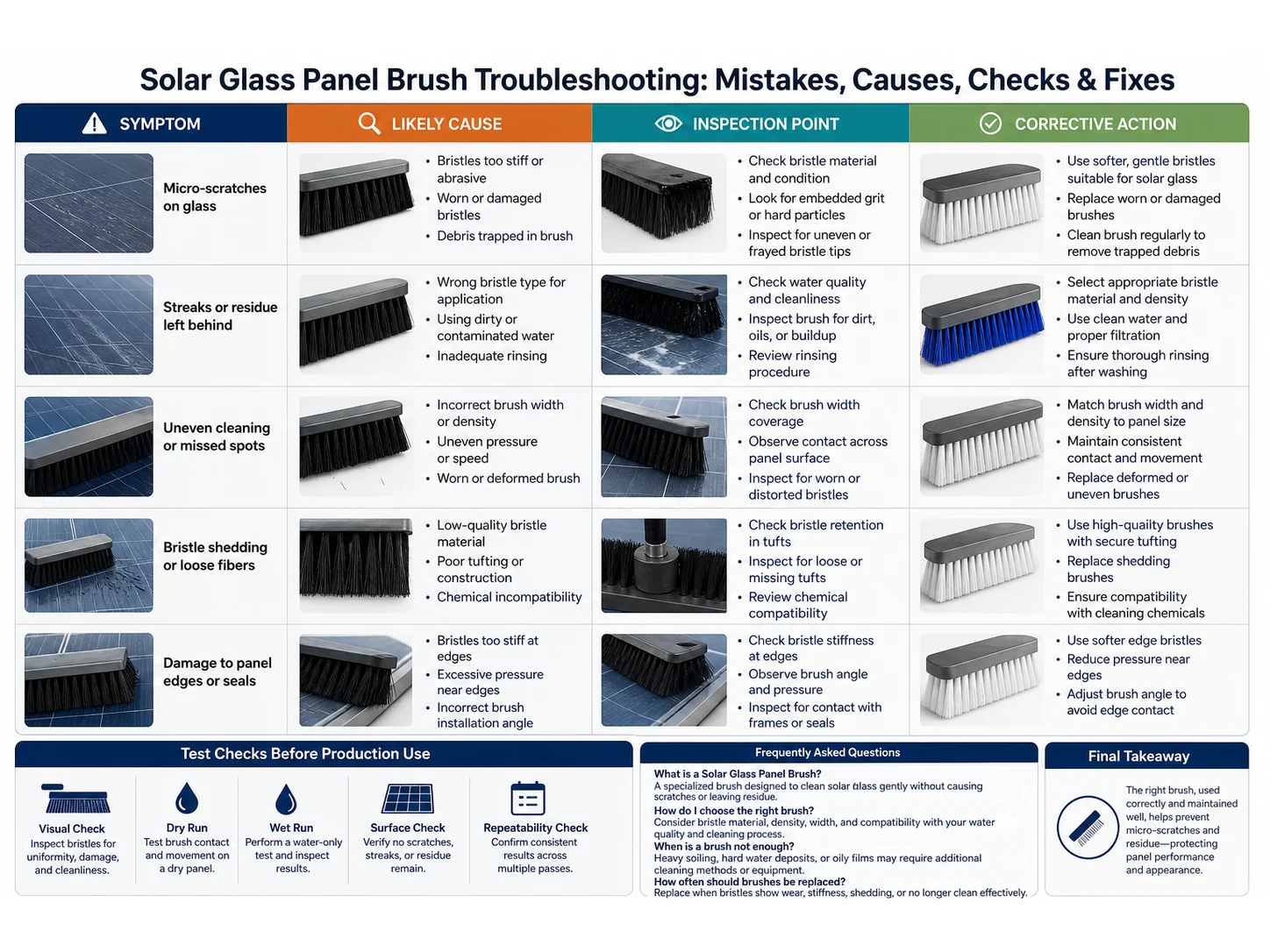
The following mistakes frequently lead to coating damage or poor cleaning results:
- Assuming all “solar cleaning brushes” are safe for coated glass. Many generic brushes are designed for raw glass or building windows and will damage AR layers.
- Choosing by cost drivers or size alone. Ignoring filament material, diameter, and tip finish leads to unnecessary abrasion.
- Using overly stiff bristles. Operators sometimes want “better scrubbing,” but excessive stiffness causes microscratches that accumulate into haze.
- Neglecting flagged-tip geometry. Un-flagged or trimmed bristles act like tiny chisels on soft coatings; flagged bristles spread the load.
- Allowing grit build-up in the brush. A dirty brush becomes an abrasive tool. Regular cleaning or using self-clearing brush designs is essential.
- Applying uneven pressure. Inconsistent mounting or worn bristles create banding patterns of clean and scratched zones.
- Using the same brush for different panel types. Thin-film and crystalline silicon coatings differ; a brush validated for one may not be safe for the other.
- Skipping sample testing. Deploying a new brush across an entire site without first testing on a few coated modules can result in widespread damage.
- Overlooking chemical compatibility. Some detergents soften or swell bristles, changing their effective stiffness and risking chemical residue that attacks the coating.
- Not specifying mounting details. A brush that fits the holder but leaves a gap near the frame edge can cause edge abrasion or incomplete cleaning.
When a Solar Glass Panel Brush Is Not Enough
A brush alone cannot solve every coating-related cleaning challenge:
- Baked-on or mineralized deposits: Hard water spots, cement dust, or baked bird droppings may require a low-pressure water rinse, specialized chemistry, or a very soft sponge before brush contact. Aggressive brushing in this situation grinds the deposit into the coating.
- Already degrading coatings: If the AR coating is flaking or delaminating, any brush will accelerate the failure. The correct approach is a no-contact method (air blow, low-pressure water) until the coating can be assessed.
- Automated systems with poor force control: Robots that apply constant high pressure need brushes with compliance or load-limiting features. A standard stiff brush may be unsuitable.
- When the residue is oily or sticky: A dry brush smears the contaminant. You need a wet system and a brush material that releases oil (polypropylene is a good choice).
- Custom or curved module surfaces: Standard straight brushes may miss edges or apply uneven force. In these cases, a custom brush roll with a contoured profile should be drawn and tested with the supplier.
If you remain uncertain, request a small sample brush from a reputable supplier, obtain the technical datasheet showing filament specs, and run a controlled cleaning test on a few coated panels under normal operating conditions. Inspect under direct light for any micro-scratching after multiple cycles before scaling.
Final Takeaway
Selecting a solar glass panel brush for coated glass is not about finding the lowest cost or highest cleaning speed. It is about matching bristle material, diameter, stiffness, and tip geometry to the fragility of the coating and the type of soiling. Avoid the ten common mistakes listed above, test on sample panels, and keep brushes clean. When conditions exceed what a brush can safely handle, combine it with appropriate wet systems or alter the cleaning method entirely. Proper brush specification protects both energy yield and coating warranty.
Frequently Asked Questions
Can I use a standard nylon brush on AR-coated solar glass?
It depends on the nylon grade and tip finish. Standard stiff nylon with un-flagged tips can scratch AR coatings. A soft nylon with flagged ends is much safer, but always test on a small area first.
What bristle diameter is safest for thin-film coated panels?
For thin-film modules (e.g., CdTe with a polymer top sheet), ultra-soft bristles around 0.1–0.15 mm with flagged tips are recommended to avoid scuffing the softer surface.
How often should I replace solar panel cleaning brushes?
There is no fixed interval. Replace when bristles show permanent deformation, matting, hardening, or when cleaning effectiveness drops. A good practice is to inspect after every 50 cleaning cycles and keep a log.
Should I wet or dry clean coated glass with a brush?
Wet cleaning reduces friction and the risk of scratching, provided the brush material does not degrade in water. Dry cleaning is acceptable if the brush is very soft and soil is light. For heavy soiling, a pre-rinse before brushing is safer.
Can I use a wire brush for solar panel cleaning?
Never. Wire bristles (steel, brass, etc.) will instantly destroy any photovoltaic glass coating and likely scratch the glass itself. Wire brushes have no place in solar panel cleaning.
How do I know if a brush will scratch my solar panel coating?
The best way is a controlled test on a sacrificial coated panel or a module in a non-critical area. Run the brush for the equivalent of 10–20 cleaning cycles and inspect under a bright light at a low angle. Send a brush sample to your coating manufacturer if possible.
What is the difference between flagged and un-flagged bristles for solar cleaning?
Flagged bristles have split, fuzzy tips that increase surface contact area and reduce point pressure, making them gentler. Un-flagged bristles are cut clean and provide more scrubbing action, which can harm coatings.
Do I need a custom brush for curved solar panels?
If your panels have a curved profile or tight frames, a standard straight brush may leave edges dirty or press too hard in the center. A custom contour brush or a brush with compliant backing can improve contact uniformity. In such cases, work with a brush manufacturer on a drawing and a sample trial.