
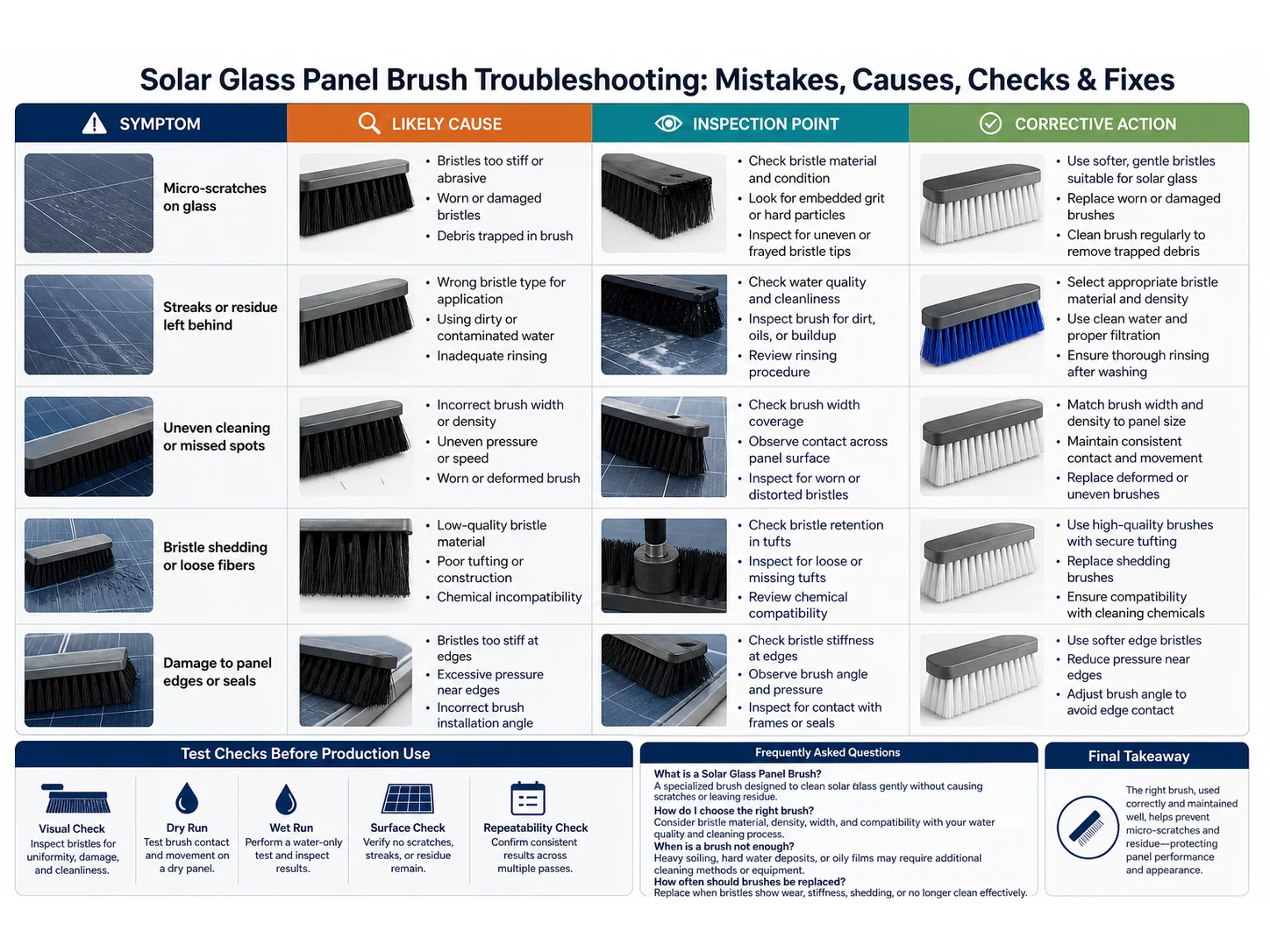
What Is a Solar Glass Panel Brush?
A solar glass panel brush is a rotating cleaning tool designed to scrub flat glass sheets as they pass through a washer. It typically features a core (aluminum, PVC, or steel) with densely packed bristles or filaments arranged in a spiral or straight pattern. The brush contacts the glass under controlled pressure and speed, working with water or cleaning chemistry to remove particles, oils, and dust. In solar glass production, surface cleanliness directly affects light transmission and coating adhesion, so the brush must clean effectively without causing damage.
Common Types and Key Options
No single solar glass panel brush fits every line. The table below compares the main variables that lead to mistakes if misunderstood.
| Feature | Common Options | Typical Use Case | Risk If Chosen Wrongly |
|---|---|---|---|
| Bristle Material | Nylon (6/6.6/6.12), polypropylene, horsehair, abrasive-impregnated nylon | General solar glass: medium nylon; sensitive coatings: soft polypropylene or natural fiber | Hard nylon scratches coated glass; soft bristles fail to remove stubborn residues |
| Bristle Stiffness | Soft, medium, hard (measured by filament diameter and flex modulus) | Soft: thin anti-reflective coatings; medium: standard float glass; hard: heavy grinding residue (rare in solar) | Too hard causes micro-scratches; too soft leaves a film |
| Brush Diameter | Typically 80–250 mm, depending on machine | Matched to washer’s brush mounting center distance and glass thickness range | Wrong diameter alters contact pressure and coverage, causing uneven cleaning or glass breakage |
| Core Material | Aluminum, PVC, stainless steel | Aluminum: most common for rigidity; PVC: lightweight, chemical-resistant; stainless: high-temperature or aggressive chemistry | Core corrosion contaminates glass; PVC may flex under high pressure |
| Mounting Type | Shaft-end keyway, flange mount, quick-release coupling | Compatibility with existing machine drive; quick-release reduces downtime | Incorrect mounting causes vibration, misalignment, and premature wear |
How to Choose the Right Solar Glass Panel Brush
The right brush depends on your specific washing conditions. Work through these decision factors in order:
- Residue type: Identify the main contaminant—glass powder from edging? Protective film adhesive? Atmospheric dust? Each requires a different filament material and surface energy.
- Surface sensitivity: Is the glass bare or coated with anti-reflective (AR) layers? AR coatings are easily scratched; use softer filaments and lower pressure.
- Equipment interface: Measure the brush shaft diameter, length, and mounting style. The brush must fit without modification.
- Wet or chemical exposure: Confirm pH range of cleaning agents. Nylon is generally good, but prolonged exposure to strong acids or alkalis may require polypropylene or stainless core.
- Hygiene expectations: For high-end optical or solar glass, choose a brush that resists shedding and bacterial growth if the process is water-recirculating.
- Maintenance frequency: Hard filaments last longer but may be too aggressive. Balance wear life with cleaning performance.
- Custom size requirements: If your machine is non‑standard, provide exact drawings to the brush supplier. Never guess the length or diameter.
Common Mistakes When Selecting and Using Solar Glass Panel Brushes
Even experienced teams fall into these traps. Recognising them is the first step to prevention.
- Mistake 1 – Choosing by cost drivers or availability instead of performanceA low-cost brush may use inconsistent filament diameters that scratch the glass. Always request a sample and test under actual line conditions.
- Mistake 2 – Ignoring bristle stiffness matchingUsing the same stiffness for all glass types. A medium brush that works on raw float glass can ruin an AR‑coated panel.
- Mistake 3 – Overlooking core material compatibilityAluminum cores can corrode in acidic cleaners, dripping oxides onto the glass. Match the core to the chemistry.
- Mistake 4 – Incorrect brush diameter or mounting alignmentEven a 5 mm diameter error changes the contact footprint. Always verify with a feeler gauge or pressure film during installation.
- Mistake 5 – Neglecting brush rotation direction and speedSome brushes are spiralled for a specific rotation. Running them backward reduces cleaning and accelerates wear.
- Mistake 6 – Skipping regular brush inspection and cleaningBristles trap glass particles; eventually they become abrasive pads. Schedule periodic cleaning or replacement based on visual check, not just runtime.
- Mistake 7 – Using one brush for multiple dissimilar operationsA brush used on heavy grinding residue will carry abrasive particles into the final wash stage. Dedicate brushes per process step.
When a Solar Glass Panel Brush Is the Wrong Choice
Rotary brushes solve most solar glass cleaning needs, but they have limits. If you still see defects after correcting the above, consider these situations:
- Extremely sensitive surfaces: Some next‑gen coatings are softer than human hair. Even the softest brush may leave micro‑scratches. Look into non‑contact cleaning methods like ultrasonic or CO₂ snow cleaning.
- Static charge attraction: If dust re‑attracts after washing, the brush might be building static. Anti‑static brush filaments or ionization bars may be needed.
- Complex edge shapes: For deeply embossed or textured glass, a brush alone cannot clean recesses. A combination of high‑pressure spray and brush may be required.
- Chemical incompatibility: When the cleaning fluid attacks both bristles and core, a specialised coating on the brush or a complete material change (e.g., PTFE) might be the answer—but this requires supplier testing.
- Persistent residue: If standard brush adjustments fail, ask your supplier for a drawing review. A slight change in filament density or pattern can solve the issue without replacing the entire washer.
Final Takeaway
Every solar glass washing line has a sweet spot where the brush material, diameter, stiffness, and mounting all align with the residue type and surface sensitivity. Avoid the common mistakes by systematically verifying each parameter—starting with a sample test and a drawing check—rather than guessing. The goal is consistent, scratch‑free glass, and the right brush decision is a technical one, not a purchasing shortcut.
Frequently Asked Questions
What is the best bristle material for a solar glass panel brush?
It depends on the glass surface and cleaning chemistry. Medium nylon (6.12) works well for most uncoated solar glass, while soft polypropylene or horsehair is safer for anti‑reflective coatings.
How often should solar glass panel brushes be replaced?
There is no fixed schedule. Inspect weekly for wear, bristle loss, or embedded particles. Replace when the cleaning quality drops or the brush no longer maintains its original diameter.
Can one brush handle both raw glass and coated glass?
Not recommended. Abrasive particles from raw glass cleaning can embed in the bristles and later scratch coated surfaces. Keep separate brushes for each stage.
What diameter brush should I order for my machine?
Always measure the distance from the brush center to the glass surface when the brush is installed. Order a diameter that gives a 1–2 mm interference fit. Do not rely on old part numbers alone; machines can be modified over time.
How do I know if the brush stiffness is too high?
After a test run, inspect the glass under angled light. Visible micro‑scratches or a hazy appearance indicate the bristles are too aggressive. Also check the cleaning solution for glass dust.
What mounting type is easiest for quick changes?
Quick‑release couplings or flange mounts with hand‑tightened knobs reduce downtime. If using a keyway shaft, ensure the key fits snugly to avoid vibration.
Can I use a solar glass panel brush with recirculated water?
Yes, but the brush material must resist bacterial growth and chemical breakdown if the water contains cleaning agents. Polypropylene brushes often perform better in recirculating systems than natural fibers.
When should I consider a non‑brush cleaning method?
If even the softest brush leaves scratches, or if the coating is extremely delicate, explore ultrasonic cleaning, carbon dioxide snow, or high‑pressure deionized water rinsing.
Technical References
Which bristle material fits this job — Nylon PA, PVC or Horsehair?
| Material | Continuous temperature (°C) | Peak temperature (°C) | Water absorption | Hardness |
|---|---|---|---|---|
| Nylon PA | 93 | 121 | 0.3–9% by PA grade and conditioning | Medium to firm; filament diameter and trim length control bending force. |
| PVC | 50–70 | 75–90 | 0.04–0.40% | Shore A 70–95 or Shore D 70–85 |
| Horsehair | 60–80 | 100–120 | 8–15% | — |
| AISI 304 Stainless Steel Wire | 400 | 500 | 0% | Rockwell B 70–95 depending on temper and cold work |
Figures as published by Brushtec / DuPont; Perlon; Alleima. Confirm the exact grade against the supplier datasheet before ordering.
What should replace Nylon PA for glass surface?
- Nylon PA — Compare Nylon PA with PP, PBT, PET. Change material when wet stiffness, temperature, chemical resistance, conductivity, particle shedding, or surface marking becomes the limiting factor.
- PVC — Compare PVC with PE board, PP, elastomer, aluminum holder. Change material when wet stiffness, temperature, chemical resistance, conductivity, particle shedding, or surface marking becomes the limiting factor.
- Horsehair — Compare Horsehair with Boar bristle, goat hair, microfiber. Change material when wet stiffness, temperature, chemical resistance, conductivity, particle shedding, or surface marking becomes the limiting factor.
- AISI 304 Stainless Steel Wire — Use AISI 316 stainless steel wire for chloride, marine, dairy, beverage, chemical washdown, or higher pitting-resistance requirements. Use carbon steel for dry aggressive cutting and brass or abrasive nylon for lower marking risk.