
What Is a Glass Polishing Brush?
A glass polishing brush is a cylindrical or wheel‑shaped brush designed to scrub polishing compounds, slurry, and debris from glass surfaces during or after the polishing stage. Unlike general cleaning brushes, polishing brushes are engineered to maintain consistent pressure and bristle contact without marring the glass. For coated glass, the brush must be gentle enough to preserve the thin layer while effectively removing residue.
Common Materials for Glass Polishing Brushes
The bristle material directly affects cleaning performance and the risk of scratching coated glass. Options include:
- Nylon (soft/medium): Good chemical resistance, moderate stiffness, works well with mild polishing compounds. Choose softer grades for coated glass.
- Natural hair (horsehair, tampico): Very soft, holds water well, ideal for delicate coatings and final polishing stages. Wear faster than synthetics.
- Abrasive‑impregnated nylon (e.g., silicon carbide): For heavy residue removal on uncoated glass; too aggressive for most coatings.
- Foam or PVA (polyvinyl alcohol): Non‑abrasive, sponge‑like; suitable for drying and light residue removal on coated surfaces.
Selection depends on the polishing compound type and the coating’s hardness.
Size, Stiffness, and Mounting Options
Brush diameter, bristle length, and core type determine fitment and performance. Consider these factors:
| Parameter | Typical Range | Influence on Coated Glass |
|---|---|---|
| Brush diameter (mm) | 40–200+ | Matches workpiece curvature; wrong size causes uneven pressure. |
| Bristle length (mm) | 10–50 | Longer bristles flex more, reducing scratching but may lack cleaning aggression. |
| Stiffness (shore / soft–hard) | Soft, medium, hard | Soft is safer for coatings; hard can strip coatings. |
| Core / Mount | Shaft, shank, arbor, or hook‑and‑loop | Must match your machine’s interface (rotary, orbital, manual handle). |
| Bristle density (fill %) | Low to high | Higher density gives more uniform cleaning but may trap slurry. |
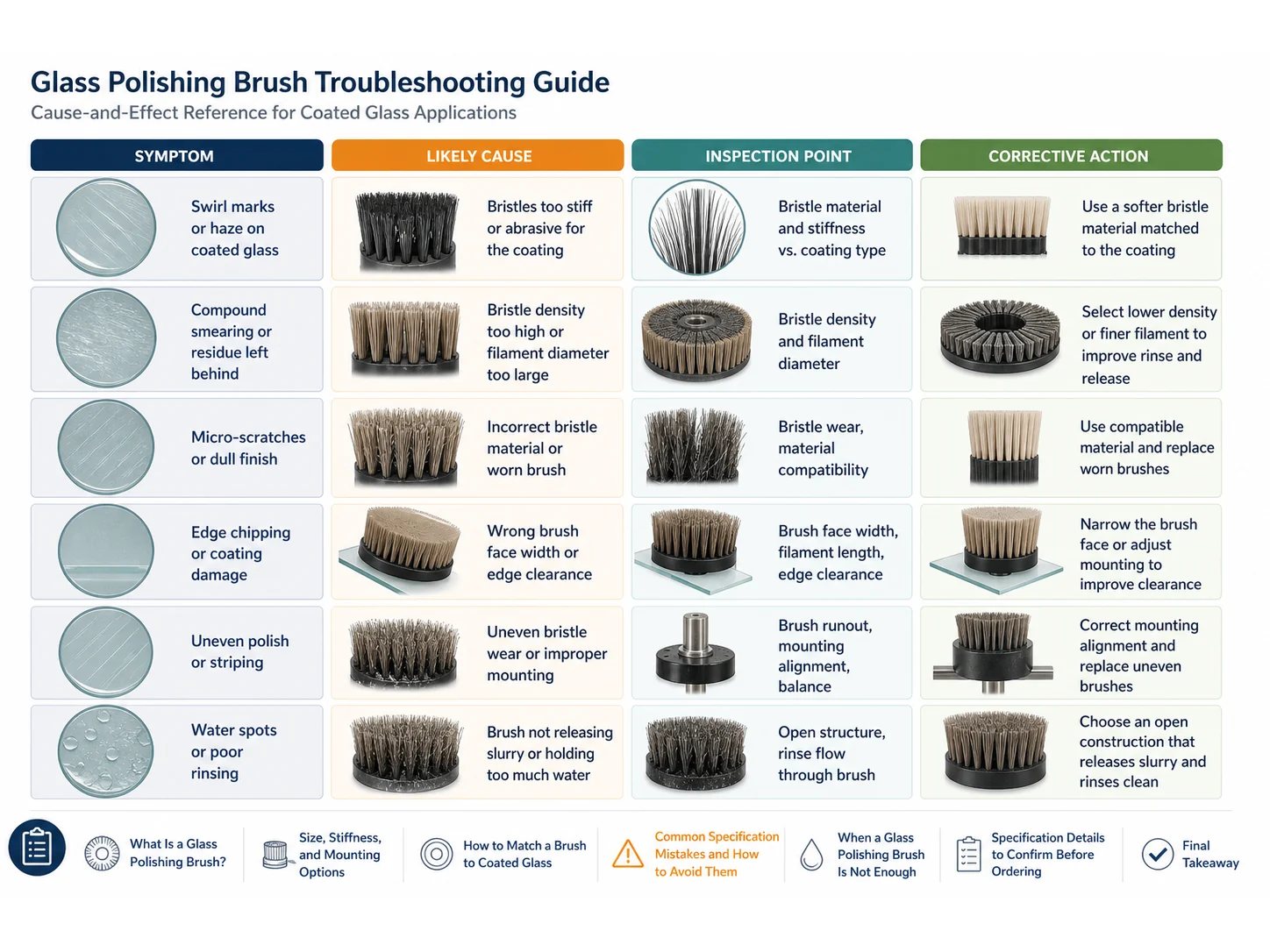
For coated glass, start with a soft, medium‑density brush with a diameter slightly larger than the workpiece flat portion to ensure full contact without edge pressure.
How to Match a Brush to Coated Glass
Select the right brush by evaluating these real‑world factors:
- Polishing residue type: Heavy cerium oxide slurry requires a brush that can loosen particles without scratching. Soft nylon or natural hair works. For light haze, a foam brush may suffice.
- Coating sensitivity: Anti‑reflective coatings are easily scratched; use the softest effective bristle. Low‑E coatings tolerate slightly stiffer brushes but still need care.
- Equipment interface: Rotary machines need a centered shaft mount; orbital sanders may use a hook‑and‑loop pad; manual handles need a secure core.
- Wet or chemical exposure: If using cleaning fluids (pH‑neutral detergents), ensure bristle material resists swelling. Nylon is a safe default.
- Hygiene requirements: For solar glass or optics, brushes must not shed fibers or introduce contaminants. Use monofilament nylon or sealed natural hair.
- Maintenance frequency: Brushes in continuous use wear quickly. Choose materials with known endurance and easy cleaning (rinse and dry).
- Custom size needs: If standard diameters leave gaps, consider custom brush rolls. Specify exact OD, bristle length, and core to match your glass shape.
Common Specification Mistakes and How to Avoid Them
Avoid these errors when ordering or using a glass polishing brush on coated glass:
- Choosing a brush by cost drivers alone: Inexpensive brushes often have inconsistent bristle stiffness or shed fibers, damaging coatings.
- Using the wrong stiffness: A hard brush removes coatings; a stiff brush intended for uncoated glass will scratch coated surfaces.
- Ignoring bristle tip shape: Square‑cut bristles may scratch; feathered or flagged tips are gentler.
- Oversizing the brush: A brush too wide concentrates pressure at edges, wearing the coating faster in those spots.
- Forgetting chemical compatibility: Some bristles degrade in acidic or alkaline slurries, leaving softened residue on the glass.
- Not verifying mounting fit: A loose shaft connection causes wobble and uneven polishing marks.
- Skipping a test sample: Always test a new brush style on scrap coated glass before full production.
When a Glass Polishing Brush Is the Wrong Choice
A polishing brush excels at residue removal, but it cannot:
- Remove deep scratches or chips from the glass itself. That requires re‑grinding or specialized pads.
- Repair damaged coatings. If the coating is already peeling, brushing can worsen it.
- Replace a full polishing pad system when heavy stock removal is needed. The brush is a finishing tool, not a primary abrasive.
In such cases, consult your glass supplier or a process engineer. For custom applications, request a supplier drawing review and sample testing before committing to a batch order.
Final Takeaway
Match your glass polishing brush to the coating first, then to the residue type, then to the machine. Soft materials and correct sizing prevent damage; testing prevents costly mistakes. Document what works for your specific glass and process—this builds a repeatable specification that saves time and waste.
Frequently Asked Questions
What is the best bristle material for coated glass?
Soft nylon or natural hair is generally safe. Avoid abrasive‑impregnated nylon on coatings unless the manufacturer confirms compatibility.
Can I use a wire brush on coated glass?
No. Wire brushes scratch and strip coatings. Use only non‑metallic bristle types.
How do I know if my brush stiffness is too high?
If you see hazing, micro‑scratches, or coating removal after a test run, switch to a softer bristle grade.
What diameter brush should I choose for curved glass?
Select a diameter that matches the smallest curvature radius to ensure full contact without forcing the brush to bend excessively.
How often should I replace a glass polishing brush?
Replace when bristles become permanently bent, worn short, or shed excessively. A uniform bristle length is critical for even cleaning.
Can I clean the brush to extend its life?
Yes. Rinse thoroughly with water after each use to remove slurry. Hang to dry; do not store compressed. For natural hair, use mild soap if needed.
What should I do if a custom brush size is not available?
Contact a brush manufacturer that offers custom fabrication. Provide exact OD, bristle length, material, and mounting requirements. Request a drawing for approval before production.
Does brush speed affect coating safety?
Yes. Higher speeds generate more friction and heat. For delicate coatings, use lower RPMs and test in stages.
Technical References
Which nylon grade fits this job — Nylon PA, PA6 Nylon or PA66 Nylon?
| Grade | Continuous temperature (°C) | Peak temperature (°C) | Water absorption | Hardness |
|---|---|---|---|---|
| Nylon PA | 93 | 121 | 0.3–9% by PA grade and conditioning | Medium to firm; filament diameter and trim length control bending force. |
| PA6 Nylon | 80–100 | 130–160 | 1.5–3.0% | Shore D 75–85 |
| PA66 Nylon | 100–120 | 150–180 | 1.0–1.8% | Shore D 80–88 |
| PA610 Nylon | 90–110 | 130–150 | 0.5–1.0% | Shore D 72–82 |
| PA612 Nylon | 90–110 | 130–150 | 0.3–0.7% | Shore D 70–80 |
Figures as published by Brushtec / DuPont. Confirm the exact grade against the supplier datasheet before ordering.
What should replace Nylon PA for polishing?
- Nylon PA — Compare Nylon PA with PP, PBT, PET. Change material when wet stiffness, temperature, chemical resistance, conductivity, particle shedding, or surface marking becomes the limiting factor.
- Horsehair — Compare Horsehair with Boar bristle, goat hair, microfiber. Change material when wet stiffness, temperature, chemical resistance, conductivity, particle shedding, or surface marking becomes the limiting factor.