What Is a Conveyor Belt Cleaner Brush?
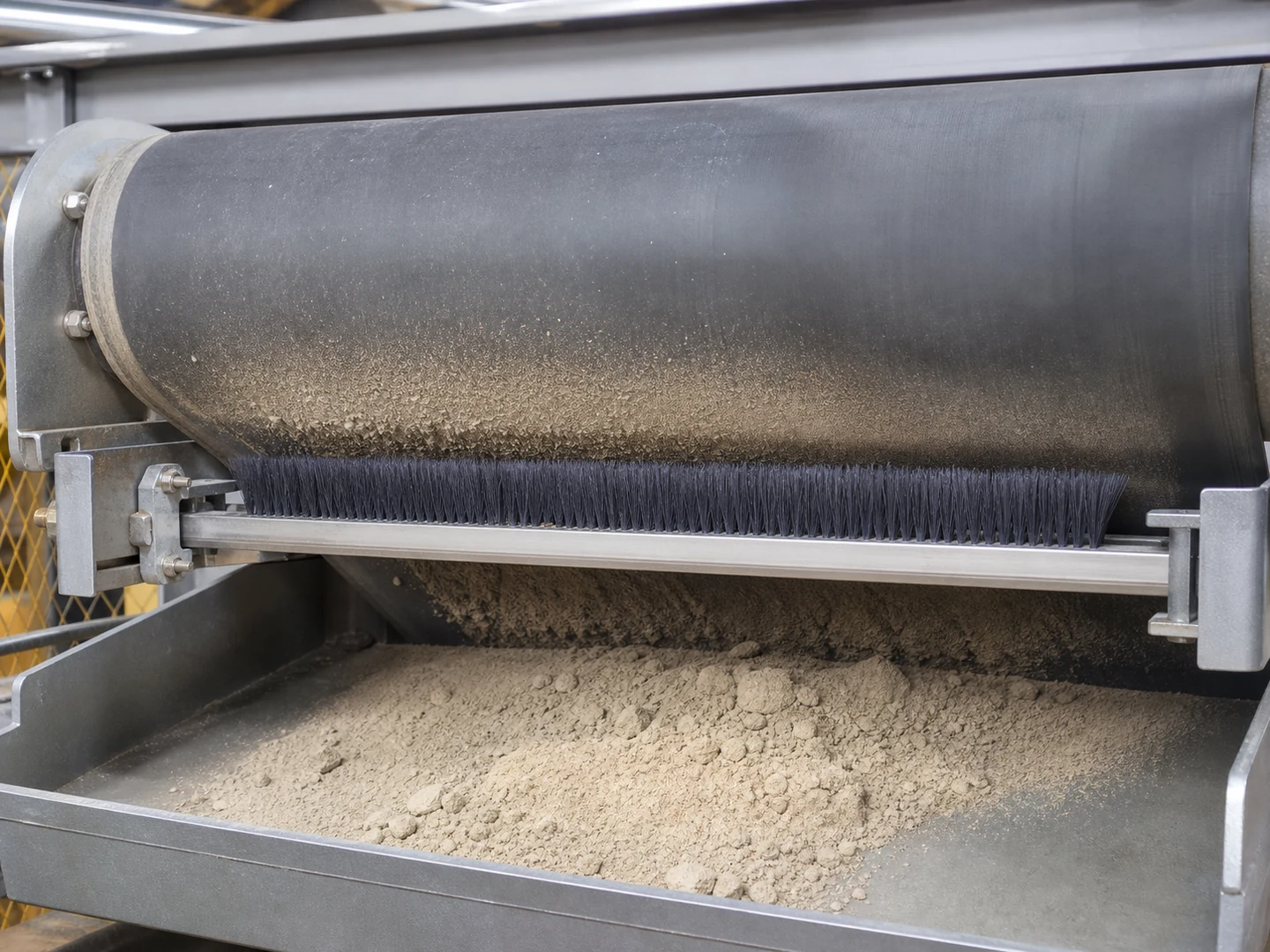
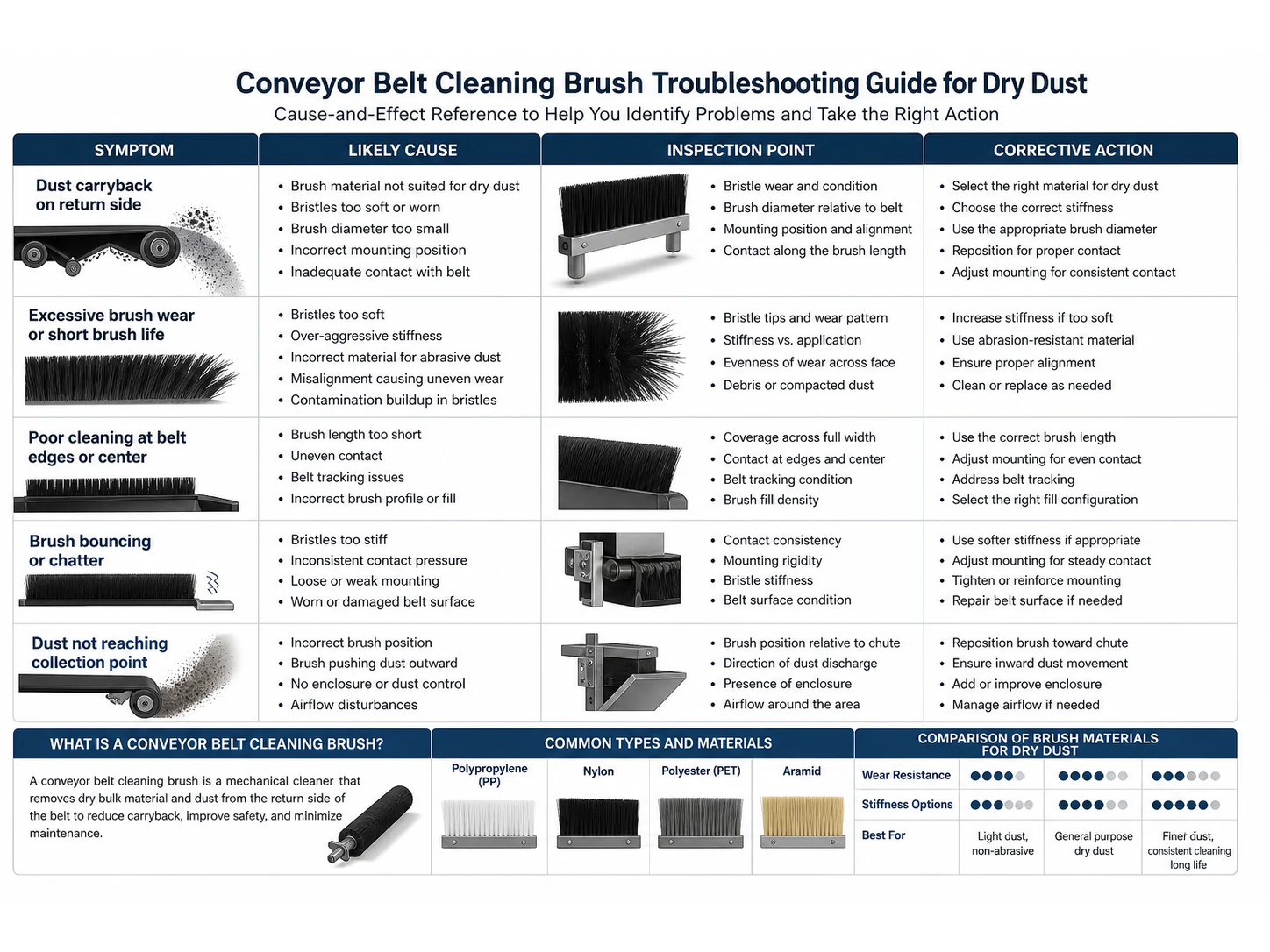
A conveyor belt cleaner brush is a long cylindrical or strip brush mounted along or across a conveyor belt to mechanically sweep off dry residue without scratching the belt surface. Unlike a simple handheld brush or a generic roller brush, it is engineered for continuous contact, specific mounting patterns, and compatibility with the belt speed, width, and material being conveyed. These brushes often use flexible filaments set into a sturdy metal or polymer core and are positioned under the return strand or at the head pulley.
Common Types of Conveyor Belt Cleaning Brushes
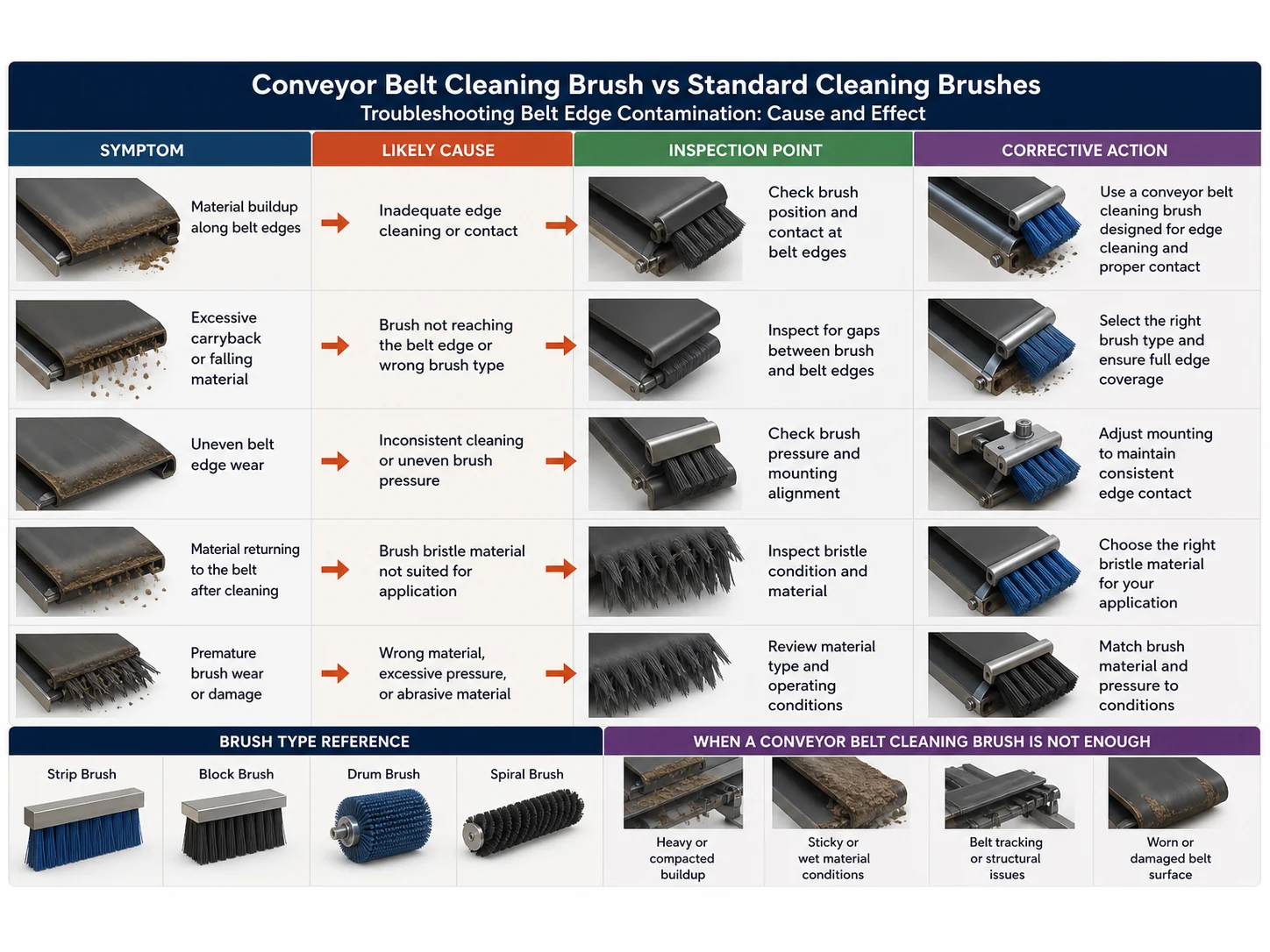
- Rotary brush cleaners: cylindrical brushes driven by a motor or belt contact roll to actively scrub the belt surface.
- Static tension brushes: fixed brush assemblies pressed against the belt with adjustable spring or pneumatic tensioning.
- Strip brush cleaners: linear brush segments mounted in a holder across the belt width; easy to replace individual strips.
- Link brush cleaners: coiled strip brushes that form a continuous cleaning surface, often used in confined spaces.
- Spiral wound brushes: multiple filament rows wound in a helix for even wear and smoother contact across the belt.
Standard Cleaning Brushes for Dry Dust: When They Fall Short
For the safety point in this section, the relevant OSHA reference is OSHA — Machine Guarding.
For the safety point in this section, the relevant OSHA reference is OSHA — Control of Hazardous Energy.
For the safety point in this section, the relevant OSHA reference is OSHA — Combustible Dust.
For the environmental or chemical-safety point in this section, the supporting reference is EPA — Particulate Matter Basics.
For brush terminology and construction language, this section references American Brush Manufacturers Association — Brush Lingo.
Standard cleaning brushes—such as utility brushes, wide floor brooms, paintbrushes, or hand-held dusting brushes—are designed for manual cleaning or intermittent use. While they can remove dust when applied by hand, they rarely deliver consistent contact force, wear quickly against moving belts, and lack mounting interfaces for automated conveyor lines. Using these in a conveyor application often leads to uneven cleaning, filament shedding, and unsafe operator interaction.
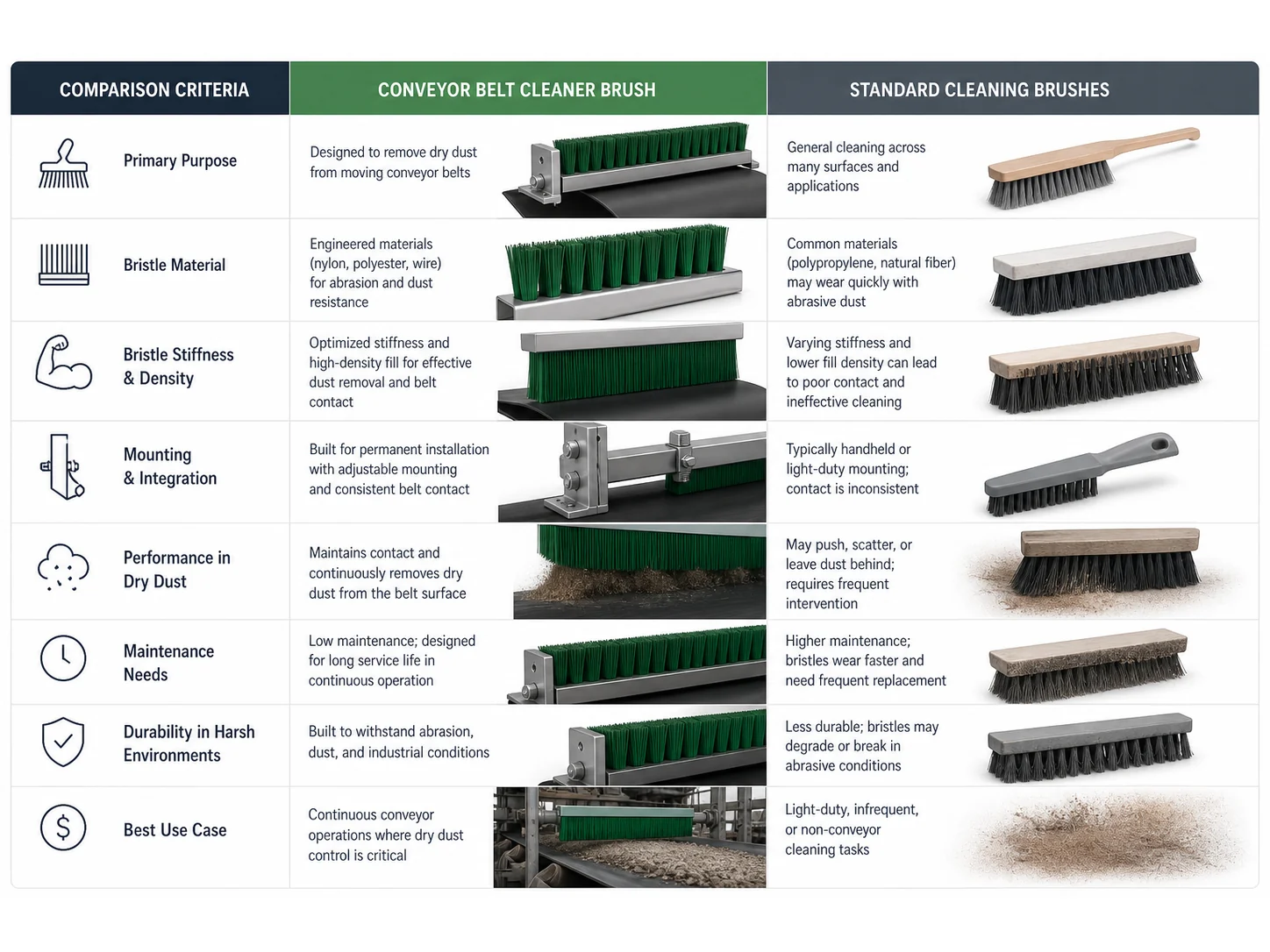
Conveyor Belt Cleaner Brush vs Standard Brushes: Key Comparison Table
| Feature | Conveyor Belt Cleaner Brush | Standard Cleaning Brush |
|---|---|---|
| Design purpose | Continuous, automated belt cleaning | Manual or general-purpose cleaning |
| Mounting | Fixed brackets, pillow blocks, or shaft adapters | Usually hand-held or with a simple handle; no conveyor interface |
| Filament material | Nylon, polypropylene, abrasive nylon, horsehair, or blended filaments selected for wear and belt safety | Often polypropylene, polyester, or natural fibers; chosen for general scrubbing |
| Face width / length | Cut to exact belt width; typically available up to several meters | Standard off-the-shelf sizes; rarely match exact belt width |
| Core/handle | Solid metal shaft, tube, or U‑channel core for rigidity and rotation | Plastic or wooden handle, or simple molded back |
| Stiffness selection | Multiple filament diameters and trim lengths for adjustable stiffness; matched to belt type | Limited stiffness choices; often too stiff for sensitive belts or too soft for heavy dust |
| Maintenance | Designed for quick strip or segment replacement; minimal downtime | Entire brush replaced when worn; not meant for frequent changeover |
| Belt surface contact | Even pressure across full width; adjustable tension | Uneven pressure unless manually held; no consistent contact on moving belt |
| Wet/chemical exposure | Can be built with stainless steel hardware and chemical-resistant filaments | Often have mild steel or unprotected handles that corrode |
| Typical belt speed capability | Up to 3–5 m/s or more, depending on brush dynamics | Not rated for belt speed; manual operation only |
How to Choose the Right Brush for Dry Dust Removal
When comparing options, focus on these real-world factors rather than only cost drivers or availability:
- Dust characteristics: Fine, sticky dust like cement requires softer, denser filaments to avoid smearing; abrasive dust needs more wear-resistant materials like nylon with silicon carbide grit.
- Belt surface sensitivity: Thin or mechanically spliced belts can be damaged by overly stiff bristles. Softer polypropylene or feathered nylon ends are safer.
- Mounting interface: Check whether the brush must fit into an existing cleaner frame, tensioner, or shaft. Standard brushes lack mounting journals or shaft extensions.
- Wet or chemical exposure: In food processing or wet environments, choose stainless steel cores and non-absorbent filaments to meet hygiene expectations and resist corrosion.
- Maintenance frequency: Conveyor belt cleaner brushes designed with segmented strips allow replacement of only worn sections, reducing downtime compared to replacing an entire standard brush.
- Custom sizing: Most conveyor belt cleaner brushes can be built to exact belt width, core diameter, and bore size from a supplier drawing, while standard brushes usually come in fixed increments.
Common Mistakes When Selecting a Conveyor Belt Cleaner Brush
- Guessing filament stiffness: Using the stiffest available brush often causes belt wear or filament fracture. Start with the supplier’s recommendation based on belt type and dust, then adjust after testing.
- Neglecting the mounting pattern: Even the best brush fails if it cannot be installed rigidly and aligned correctly. Verify bracket spacing and shaft diameter before ordering.
- Using plant-floor brooms on conveyors: This creates a safety hazard, inconsistent cleaning, and rapid brush destruction. A proper conveyor belt brush cleaning system is engineered for the task.
- Ignoring speed ratings: A rotary brush that runs too fast for its filament trim and diameter can flare out or vibrate, reducing cleaning effectiveness and increasing wear.
- Overlooking chemical compatibility: Using a standard polypropylene brush with certain solvents or oily dust can cause premature softening or swelling. Match filament material to the chemical environment.
- Buying by cost drivers alone: A low-cost standard brush that must be replaced weekly often costs more in labor and belt damage than a purpose-built conveyor belt cleaner brush that lasts months.
When a Conveyor Belt Cleaner Brush Is Not Enough
A conveyor belt cleaner brush works well for dry, loose dust, but it may not solve the following problems:
- Wet, sticky slurry or mud: Primary belt scrapers or wash box systems are more effective for caked-on wet material.
- Heavy carryback on high-speed belts: When the belt speed exceeds 5 m/s and dust load is high, a combination of a pre-cleaner scraper followed by a brush may be needed.
- Belt surface irregularities: If the belt has deep gouges, cupping, or mechanical splices, even a flexible brush cannot clean the recessed areas evenly.
- Static dust adhering due to high static charge: Anti-static belts or ionizing bars may be required before the brush can effectively remove charged dust.
- Final hygiene in food contact zones: In direct food contact applications, a brush alone may not meet sanitation standards; an additional wash-down or sterilization step is typically required.
If you encounter any of these conditions, request a supplier drawing review and sample testing before committing to a brush-only solution.
Final Takeaway
For dry dust removal from conveyor belts, a purpose-built conveyor belt cleaner brush outperforms any standard cleaning brush by delivering consistent contact, full-width coverage, and long service life in an automated environment. The right brush choice depends on matching filament material, stiffness, core construction, and mounting to the specific dust, belt, speed, and facility conditions. When in doubt, request a sample test or an engineering drawing from the brush supplier before placing a bulk order.
Frequently Asked Questions
Can I use a standard floor broom to clean a moving conveyor belt?
No. A floor broom is not designed for continuous contact with a running belt and can snag, throw debris, or cause operator injury. Always use a properly mounted conveyor belt cleaning brush or strip brush system.
What filament material works best for fine dry dust like cement or flour?
Soft-to-medium nylon filaments are often recommended because they flex to release dust without grinding it into the belt. For very fine dust, consider a high-density brush with flagged (split) filament tips to trap and flick particles away.
How do I know if the brush stiffness is right for my belt?
Start with a filament diameter and trim length that the supplier recommends for your belt type and dust. Perform a test by running the brush at minimal contact pressure first; check for belt shine or scratching. Increase pressure gradually only if cleaning is insufficient.
Can a conveyor belt cleaner brush be used in wet or washdown environments?
Yes, if it is built with a stainless steel core, shaft, and compatible filaments. Standard carbon steel cores will rust. Always specify moisture-resistant materials and bearings when ordering for wet conditions.
What is the difference between a rotary brush cleaner and a static brush cleaner?
A rotary brush is driven to spin against the belt, providing aggressive cleaning for stubborn dust. A static brush is held under tension without powered rotation, relying on belt movement to sweep the surface. Rotating types are better for very fine or sticky dust, while static types are simpler and require less maintenance.
How often should conveyor belt cleaner brushes be replaced?
Replacement depends on dust abrasiveness, belt speed, and contact pressure. Check the brush weekly during the first month; if filaments wear more than 25% within that time, reduce pressure or choose a harder filament. Segmented strip brushes allow you to replace only the worn sections.
Can I cut a standard brush to fit my belt width?
Most standard brushes are not designed for cutting to custom widths because the core or handle cannot be resized. A conveyor belt cleaner brush can be manufactured to your exact belt dimensions and shaft requirements from a supplier drawing.
What if my dust keeps hanging up on the brush instead of falling away?
This usually indicates filament density is too high, brush speed is too low, or the brush is mounted too far from the belt edge. Try a brush with wider spacing between filament rows or adjust the mounting angle so dust can shed freely.