
What Is a Conveyor Belt Cleaning Brush?
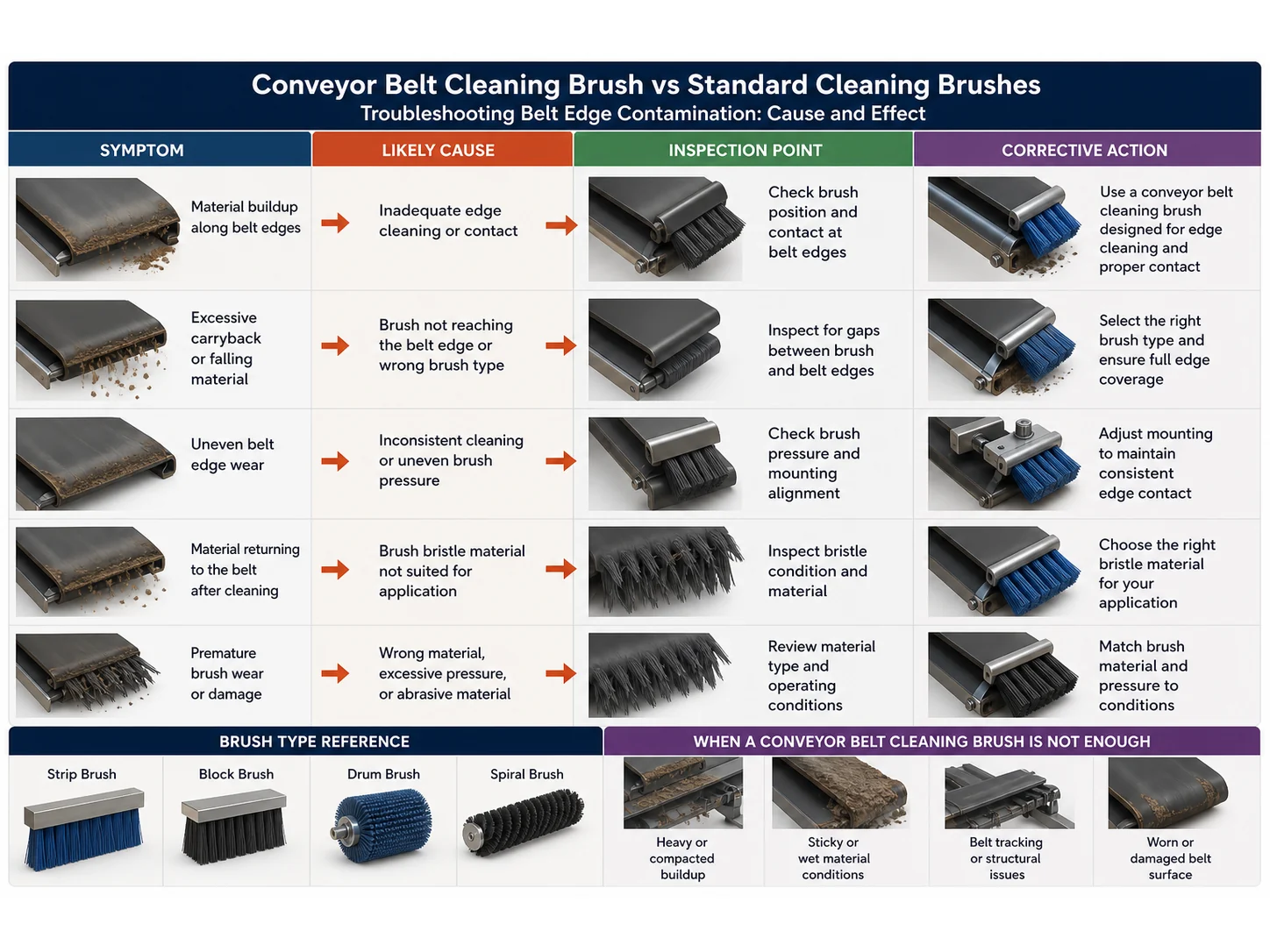
A conveyor belt cleaning brush is a purpose-built brush engineered to match the profile of a conveyor belt, typically featuring dense, strategically angled filaments and a robust mounting system that can be fixed near the belt return path. Unlike generic cleaning brushes, these brushes are optimized for continuous contact with a moving belt, even at edges where material tends to accumulate. They come in configurations like strip brushes, roller brushes, or tube brushes, and are commonly used in food processing, aggregate handling, recycling, and packaging lines to keep belts clean without causing excessive wear.
Understanding Belt Edge Contamination
Belt edge contamination refers to the buildup of product residue, dust, or debris along the sides of a conveyor belt. Because edges are often outside the main cleaning zone of scrapers or fixed surface cleaners, material can pack into belt edges, leading to tracking problems, belt mistracking, sanitation risks, and increased maintenance. Standard brushes—like handheld scrubbing brushes or simple rotary brushes—often fail here because they lack the correct profile, stiffness, or mounting to maintain consistent pressure against a narrow, moving edge.
Conveyor Belt Cleaning Brush vs Standard Brushes: Key Differences
| Feature | Conveyor Belt Cleaning Brush | Standard Brush |
|---|---|---|
| Design Profile | Contoured to wrap around or target the belt edge precisely; often multiple rows of filaments | Flat, block, or simple rotary shape not optimized for belt geometry |
| Edge Cleansing Precision | High; maintains constant contact along the narrow belt edge even with slight belt wander | Low; often skips, bounces, or misses the edge entirely unless manually aimed |
| Material Options | Wide range: nylon, polypropylene, polyester, abrasive-impregnated, stainless steel, horsehair | Limited to common fill materials; may not offer food-grade or high-chemical-resistant options |
| Mounting System | Integrated brackets, holders, or threaded cores designed for conveyor frames; easy to align and adjust | Typically handheld or requires custom fabrication for fixed mounting |
| Wear Resistance & Life | Engineered for continuous duty; filaments resist splaying and maintain stiffness longer | Shorter life in fixed applications because filaments are not reinforced for constant belt contact |
| Typical Application | Automated belt edge cleaning in production lines, washdown environments, dusty operations | Manual cleanup, occasional scrubbing, or light-duty tasks where edge precision is not critical |
Common Types of Conveyor Belt Cleaning Brushes
Several core designs are used for belt edge cleaning, each suited to different belt widths, speeds, and contamination types:
- Strip Brushes: Long, linear brushes with a backing that can be mounted on a holder. Often bent or angled to ride the belt edge. Excellent for medium to heavy residue on straight belt runs.
- Roller Brushes: Cylindrical brushes that rotate with the belt or are motor-driven. Ideal for high-speed belts and for knocking off loose debris along the full width, but edge-focused versions have tapered or stepped profiles.
- Tube Brushes: Smaller, twisted-wire brushes inserted into a mounting tube. Good for tight spaces and for cleaning the inner edge of troughed belts or around pulleys.
- Profile Belt Edge Brushes: Custom-shaped brushes with a notch or channel specifically cut to hug the belt edge. Best for belts carrying sticky or wet residues.
How to Choose the Right Brush for Belt Edge Contamination
Use the following decision factors to match the brush to your specific operation. Testing a sample before full purchase is strongly recommended.
| Decision Factor | What to Evaluate |
|---|---|
| Residue Type | Dry and powdery: soft to medium nylon or polypropylene. Wet or sticky: stiffer filaments or crimped wire. Abrasive: heavy-duty filled nylon or stainless steel. |
| Belt Surface Sensitivity | Food-grade or polished belts need soft, non-marring materials like horsehair or soft nylon. Heavy rubber belts can tolerate medium to stiff polypropylene. |
| Chemical Exposure | For washdown with caustics or acids, use polypropylene or polyester. Avoid natural fibers that degrade. |
| Hygiene Requirements | Food zones: FDA-compliant filaments, stainless steel bases, and design free of crevices. Consider quick-release mounts for sanitation. |
| Mounting & Interface | Check clearance, frame geometry, and available mounting points. Strip brush holders can be bolted or clamped; roller brushes need bearings and a drive mechanism if powered. |
| Custom Sizing | Precision matters: overall length, trim length, and filament density all affect cleaning effectiveness and belt life. Provide a detailed drawing or sample belt section to your supplier. |
Common Mistakes When Dealing with Belt Edge Buildup
- Using a standard stiff brush off the shelf: Can wear grooves into the belt edge, causing premature belt failure.
- Ignoring brush material compatibility: A wire brush on a food-grade belt introduces contamination risk and may scratch stainless steel support frames.
- Mounting the brush with too much or too little pressure: Too much causes drag and wear; too little leaves residue behind.
- Neglecting brush maintenance: Even conveyor belt cleaning brushes wear out. A flattened or matted brush will stop cleaning effectively and can become a secondary contamination source.
- Assuming one brush fits all belts: Edge profiles, belt thickness, and tension vary. Always verify that the brush matches the specific belt and operating conditions.
When a Conveyor Belt Cleaning Brush Is the Wrong Choice
A conveyor belt cleaning brush excels at edge decontamination, but it has limits. If the residue is extremely hardened or baked on, a brush alone may only polish the surface. In such cases, a pre-softening step (steam, water spray, or chemical application) combined with a belt scraper or a full conveyor belt brush cleaning system may be necessary. Also, if belt edges are already frayed or damaged, a brush can worsen the condition. In those scenarios, first repair or replace the belt, then implement a correctly specified edge brush. When in doubt, request a sample test or a supplier drawing review before committing to a large purchase order.
Final Takeaway
For persistent belt edge contamination, a dedicated conveyor belt cleaning brush almost always outperforms a standard brush. The right brush—chosen by residue type, belt sensitivity, mounting style, and material compatibility—pays for itself in reduced downtime, longer belt life, and fewer sanitation incidents. Avoid the mistake of treating edge cleaning as an afterthought; integrating the correct brush into your conveyor system is a low-cost, high-impact reliability upgrade.
Frequently Asked Questions
Can I use a standard wire brush to clean a food-grade conveyor belt edge?
No. Wire brushes can shed metal fragments that contaminate food products and may scratch stainless steel equipment. Always use food-grade filament materials like nylon or polyester with FDA-compliant bases for direct food contact zones.
How often should I replace a conveyor belt cleaning brush?
Replacement intervals depend on abrasiveness of the residue, belt speed, and filament material. Inspect monthly. Replace when filaments show significant wear, flattening, or excessive splaying. A worn brush becomes ineffective and can trap contaminants.
What filament diameter works best for sticky residues on belt edges?
For sticky or tacky buildup, choose medium to stiff filaments (around 0.020–0.040 inch diameter) made from crimped nylon or polypropylene. Crimped filaments provide better scraping action without being overly aggressive.
Does a softer brush clean less effectively?
Not necessarily. Soft brushes (like horsehair or fine nylon) are better for light dust or dry particles on sensitive belts. They apply less friction and are less likely to damage the belt edge. The key is matching stiffness to the residue type and belt tolerance, not maximum force.
Should I test a sample brush before ordering a full set?
Yes, especially for custom edge profiles. A sample test run over several days can verify cleaning performance, wear rate, and compatibility with your belt and mounting setup. This is a small cost compared to the risk of an ineffective full purchase.
Can a conveyor belt cleaning brush also clean the carry side of the belt?
Edge brushes are often designed for the narrow contact zone. For full-width cleaning, a separate surface cleaning brush or belt scraper is typically used in combination. Some systems integrate both edge and surface brushes on the same mounting frame.
What mounting method is easiest to retrofit onto an existing conveyor?
Strip brush holders with bolt-on or clamp-on brackets are generally the simplest retrofit. They adjust easily and don’t require precise alignment like roller brushes. Ensure the frame can support the mounting hardware and dynamic load.
How do I know if I need a custom brush size?
If your belt edge has an unusual profile, your mounting space is restricted, or standard lengths don’t fit, custom sizing is the safe path. Provide a drawing or belt sample to the brush manufacturer so the trim length, filament density, and overall dimensions are tailored to your exact conditions.
Technical References
- OSHA — Machine Guarding
- OSHA — Control of Hazardous Energy
- OSHA — Combustible Dust
- EPA — Particulate Matter Basics
Which bristle material fits this job — Nylon PA, AISI 304 Stainless Steel Wire or Horsehair?
| Material | Continuous temperature (°C) | Peak temperature (°C) | Water absorption | Hardness |
|---|---|---|---|---|
| Nylon PA | 93 | 121 | 0.3–9% by PA grade and conditioning | Medium to firm; filament diameter and trim length control bending force. |
| AISI 304 Stainless Steel Wire | 400 | 500 | 0% | Rockwell B 70–95 depending on temper and cold work |
| Horsehair | 60–80 | 100–120 | 8–15% | — |
| Rubber | 100 | 130 | very low | Specified by compound and Shore hardness; published TPE families can span roughly 50–80 Shore A, but that is a product-family example rather than a universal rubber range. |
| AISI 316 Stainless Steel Wire | 400 | 500 | 0% | Rockwell B 70–95 depending on temper and cold work |
Figures as published by Brushtec / DuPont; Alleima. Confirm the exact grade against the supplier datasheet before ordering.
What should replace Roller and Conveyor Brushes for conveyor belt cleaning?
- Roller and Conveyor Brushes — Roller and conveyor brushes hold cylindrical line contact across a working width, including helix-wound builds where the filament path is set to move loosened material toward one side; a strip brush holds the same line without rotating, so it seals or wipes but cannot carry residue along the width.
- Nylon PA — Compare Nylon PA with PP, PBT, PET. Change material when wet stiffness, temperature, chemical resistance, conductivity, particle shedding, or surface marking becomes the limiting factor.
- AISI 304 Stainless Steel Wire — Use AISI 316 stainless steel wire for chloride, marine, dairy, beverage, chemical washdown, or higher pitting-resistance requirements. Use carbon steel for dry aggressive cutting and brass or abrasive nylon for lower marking risk.
- Horsehair — Compare Horsehair with Boar bristle, goat hair, microfiber. Change material when wet stiffness, temperature, chemical resistance, conductivity, particle shedding, or surface marking becomes the limiting factor.