
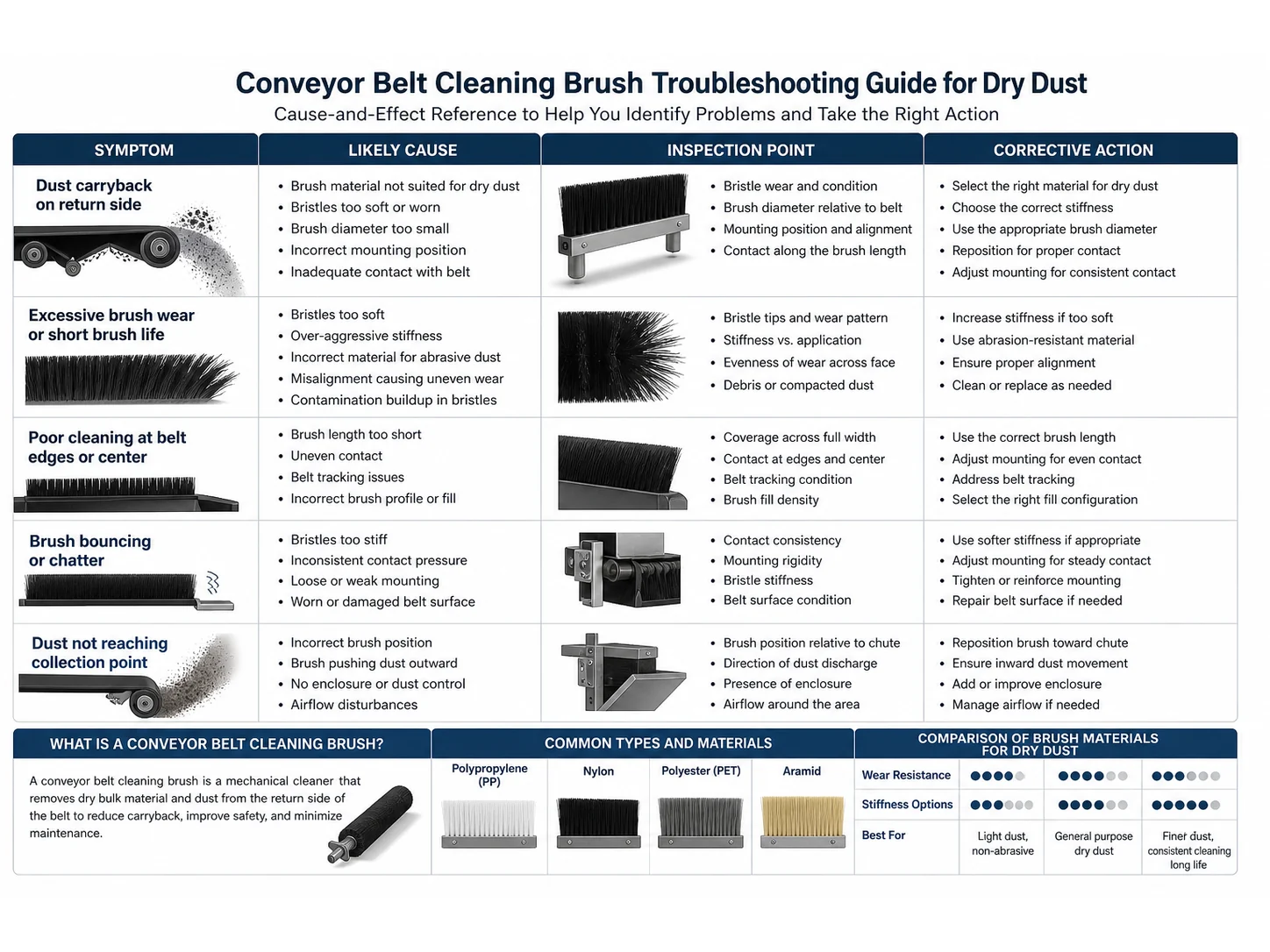
What Is a Conveyor Belt Cleaning Brush?
A conveyor belt cleaning brush is a cleaning device that uses bristles to sweep loose, dry material off a conveyor belt’s return path. Unlike scraper blades that rely on a straight edge, a brush reaches into surface textures, cracks, and minor irregularities to dislodge trapped dust. The brush can be driven by the belt (passive) or by its own motor (active). Common installations include the head pulley area, the return side before take-up pulleys, or designated cleaning stations. In dry dust applications, the brush reduces carryback, airborne dust, and buildup on idlers and pulleys—improving housekeeping, safety, and belt life.
Common Types and Materials
Most conveyor belt cleaning brushes fall into three design families: cylindrical roller brushes that rotate against the belt, strip brushes held in a fixed mount, and spiral-wound brushes that self-clean and eject debris to one side. For dry dust, material choice matters more than brush shape. Common bristle materials include nylon (polyamide), polypropylene, horsehair blend, and antistatic variants. Each behaves differently with static-prone dust, abrasive loads, and heat.
Comparison of Brush Materials, Diameter, and Stiffness for Dry Dust
| Option | Material / Typical Diameter | Stiffness & Wear | Best Use for Dry Dust | Limitations |
|---|---|---|---|---|
| Nylon 6/6 (standard) | 0.010–0.020 in (0.25–0.50 mm), brush OD 4–12 in | Medium stiff, good abrasion resistance, holds shape | General plant dust, light mineral dust, packaging dust | Can generate static without antistatic treatment; moisture absorption may soften bristles |
| Antistatic Nylon | 0.010–0.020 in, same diameter range | Similar to standard nylon | Combustible dust (flour, grain, plastic powder) where static discharge is a hazard | Slightly higher cost; verify surface resistivity specs with supplier |
| Polypropylene | 0.012–0.024 in, OD 4–14 in | Softer, good flex fatigue, resists most chemicals | Sticky dry dust that clings, lightweight powder, food zone compatible (FDA grades available) | Lower temperature limit (~180 °F / 82 °C); not ideal for sharp, heavy abrasives |
| Horsehair Blend | 0.008–0.016 in, often smaller diameters | Very soft, high flexibility, good fine dust pickup | Delicate belt surfaces, very fine cosmetic dust, optical industry | Natural fiber, may wear faster; not for wet or high-heat; sourcing and consistency can vary |
| Nylon with Abrasive Grit | 0.015–0.035 in, OD 6–12 in | Aggressive, harder tips | Stubborn dry residue, baked-on dust, textured belts where standard bristles slip | Higher belt wear risk; only use on tough belt covers; not for light-duty belts |
How to Choose the Right Conveyor Belt Cleaning Brush for Dry Dust
Start with the residue, not the brush. Your decision should follow these factors in order:
- Residue type and particle size: Fine, powdery dust (e.g., cement, talc) needs dense, soft bristles for gentle sweeping. Coarser, granular dust (e.g., sand, crushed mineral) tolerates stiffer bristles and larger trim diameters. Measure bulk density and particle size range.
- Belt surface sensitivity: Delicate covers like thin PVC, polyurethane, or lightweight rubber require softer materials (horsehair or fine polypropylene). Hard-wearing rubber belts (e.g., DIN-X, Grade 1) can handle nylon or even abrasive-filled brushes if properly adjusted.
- Brush mounting and interface: Check available frame space, shaft diameter, and mounting pattern. Does the brush mount in a fixed bracket, a spring-loaded arm, or a self-aligning holder? For motor-driven brushes, confirm power and control interface.
- Static electricity and ATEX/explosion risks: In dust zones, specify antistatic bristle material and a grounding path. Conductive core options or static dissipation brushes may be required.
- Cleaning frequency and duty cycle: Continuous operation (24/7) calls for wear-resistant nylon with a shaft that can handle full-speed rotation without whip. Intermittent cleaning may allow lighter materials.
- Washdown or humidity: If the area sees occasional washdown, avoid moisture-absorbing nylon unless stabilized. Polypropylene is better in damp areas, but dry dust cleaning typically stays dry.
- Custom size and fit: Standard brushes come in lengths up to 1600 mm in one piece with segmented options for wider belts. Measure belt width precisely and allow for a brush that is 50–100 mm wider than the belt to ensure full coverage.
Common Mistakes When Specifying a Conveyor Belt Cleaning Brush
- Choosing by diameter alone: A larger brush does not automatically clean better. Diameter affects surface speed and angulation; if the brush is too large, it may skip or bounce on the belt.
- Ignoring bristle density and fill pattern: Two brushes of the same OD can have completely different cleaning performance based on bristle count per unit area and whether the fill is straight, wavy, or spiral. Always review the fill specification.
- Overlooking core material and shaft construction: For dry dust, a steel core may be fine, but in corrosive environments or food zones, stainless or plastic cores are needed. Hollow or solid shafts affect ease of removal and cleaning.
- Setting contact pressure by guesswork: Too much pressure wears bristles and belt; too little leaves dust behind. Use a contact width of 3–5 mm as a starting point for a brush against the belt, not a deep indentation.
- Forgetting about direction and rotation: A brush rotating with the belt direction at a slightly higher surface speed is usually most effective for dry dust lift-off. Counter-rotation can pack dust into the bristle base.
- Mixing brush types without testing: What works for one dust may not work for another. Order a sample section or a trial brush before standardizing across multiple conveyors.
When a Conveyor Belt Cleaning Brush Is the Wrong Choice
A conveyor belt cleaning brush excels at removing loose, dry dust, but it has clear boundaries. Do not rely on a brush alone when:
- The dust is oily, sticky, or hygroscopic and forms a hardened layer. A combination with a pre-cleaner scraper or a washing system may be needed.
- The belt is heavily pitted or cracked; dirt becomes embedded below the surface, and a brush cannot reach it.
- Abrasive dust loading is extreme (e.g., primary crusher discharge). The brush may wear out too quickly. A heavy-duty scraper or a separate dust suppression system should be considered first.
- Hygiene requires no bristle shedding. In that case, solid scraper blades or washdown systems are preferred.
- Static charge accumulation persists even with antistatic brushes. You may need active ionizing bars or improved housekeeping ventilation.
In these situations, consult with your equipment supplier about a staged cleaning approach or request a sample test with your actual dust under representative conditions. A drawing review of the brush assembly in context with the belt and existing cleaners helps prevent conflicts.
Final Takeaway
For dry dust control, the right conveyor belt cleaning brush minimizes carryback without damaging the belt or generating static hazards. Match the bristle material and stiffness to the dust type and belt cover, verify mounting compatibility, and always run a short test before deploying across a site. Avoid the common trap of assuming one brush fits all conveyors—small differences in diameter, fill density, or rotation direction can transform performance.
Frequently Asked Questions
What is the ideal bristle material for fine cement dust?
For fine cement dust, a dense fill with soft to medium nylon bristles (around 0.012–0.016 inch) works well. If static buildup is a concern, switch to antistatic nylon. Polypropylene can also be used if moisture is occasionally present.
How do I measure the correct brush diameter?
Brush outside diameter (OD) should match the pulley curve or be large enough to avoid excessive shaft deflection. Common ODs for medium-duty cleaning are 6–10 inches. Always confirm that the brush OD leaves enough clearance with the belt and frame when new and when worn to its minimum usable diameter.
Can I use a conveyor belt cleaning brush on a chevron or rough-top belt?
Standard straight brushes struggle with deep-profile belts. Spiral-wound brushes or brushes with longer, more flexible bristles can help, but coverage will be uneven in the grooves. Often, a combination of a narrow scraper bar for the cleats and a brush for the flat surfaces is more effective.
How often should I replace a dust cleaning brush?
Replacement depends on dust abrasiveness, contact pressure, and operating hours. Monitor performance weekly and set a change-out point when bristle length reduces to 50–60% of the original trim or when dust carryback visibly increases. Proactive rotation of segmented brushes can extend life.
What is the difference between a conveyor belt brush cleaner and a dust cleaning brush roller?
Both terms are often used interchangeably. However, a dust cleaning brush roller usually implies a rotating cylindrical brush driven by a motor or belt friction, while a conveyor belt brush cleaner can include fixed strip brushes or motorized units. For dry dust removal, a motor-driven roller brush provides more consistent cleaning action.
Can I clean a brush mid-operation without removing it?
Some designs include an internal water spray or air purge to blow dust out of the bristles. In purely dry applications, a self-cleaning spiral design or a stationary comb can help eject dust while running. Always ensure any added cleaning system does not introduce moisture into the dust stream if that is a process constraint.
Is a conveyor belt cleaning brush enough for food-grade conveyor belts?
For dry food dust (flour, starch), a brush can be part of the cleaning protocol, but it must meet FDA material requirements for incidental food contact and be designed for easy removal and sanitation. Brushes alone usually cannot replace a full dry-cleaning or vacuuming HACCP procedure. Work with your hygiene team to integrate the brush into your master cleaning schedule.
Technical References
- OSHA — Machine Guarding
- OSHA — Control of Hazardous Energy
- OSHA — Combustible Dust
- EPA — Particulate Matter Basics
- NIST — Metric SI
Which bristle material fits this job — Nylon PA, Horsehair or Rubber?
| Material | Continuous temperature (°C) | Peak temperature (°C) | Water absorption | Hardness |
|---|---|---|---|---|
| Nylon PA | 93 | 121 | 0.3–9% by PA grade and conditioning | Medium to firm; filament diameter and trim length control bending force. |
| Horsehair | 60–80 | 100–120 | 8–15% | — |
| Rubber | 100 | 130 | very low | Specified by compound and Shore hardness; published TPE families can span roughly 50–80 Shore A, but that is a product-family example rather than a universal rubber range. |
| PVC | 50–70 | 75–90 | 0.04–0.40% | Shore A 70–95 or Shore D 70–85 |
| AISI 316 Stainless Steel Wire | 400 | 500 | 0% | Rockwell B 70–95 depending on temper and cold work |
Figures as published by Brushtec / DuPont; Perlon; Alleima. Confirm the exact grade against the supplier datasheet before ordering.
What should replace Roller and Conveyor Brushes for conveyor belt cleaning?
- Roller and Conveyor Brushes — Roller and conveyor brushes hold cylindrical line contact across a working width, including helix-wound builds where the filament path is set to move loosened material toward one side; a strip brush holds the same line without rotating, so it seals or wipes but cannot carry residue along the width.
- Nylon PA — Compare Nylon PA with PP, PBT, PET. Change material when wet stiffness, temperature, chemical resistance, conductivity, particle shedding, or surface marking becomes the limiting factor.
- Horsehair — Compare Horsehair with Boar bristle, goat hair, microfiber. Change material when wet stiffness, temperature, chemical resistance, conductivity, particle shedding, or surface marking becomes the limiting factor.
- Rubber — Compare Rubber with Silicone elastomer, TPE, PVC profile, PVA sponge. Change material when wet stiffness, temperature, chemical resistance, conductivity, particle shedding, or surface marking becomes the limiting factor.