What Is a Return Belt Cleaning Brush?
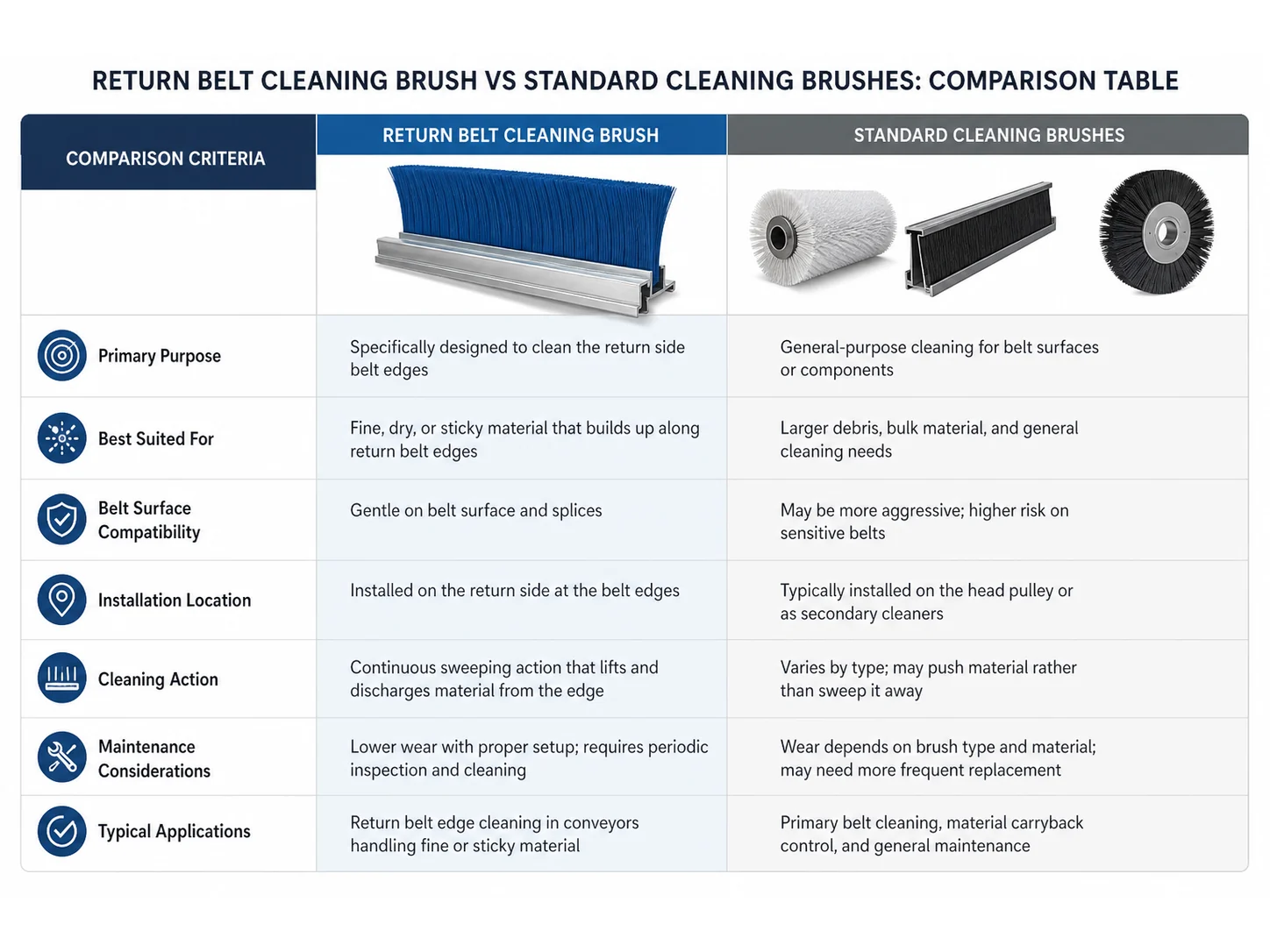
A return belt cleaning brush is a rotating or stationary brush assembly positioned against the return side of a conveyor belt to dislodge and remove dry, non-sticky residues such as fines, powders, and light dust. It prevents carryback that can build up on idlers, pulleys, and floors, reducing safety hazards and maintenance costs. The brush typically mounts after the head pulley, where the belt is still flat, and uses bristle contact to sweep the surface continuously.
Common Materials and Configuration Options
For the safety point in this section, the relevant OSHA reference is OSHA — Machine Guarding.
For the safety point in this section, the relevant OSHA reference is OSHA — Control of Hazardous Energy.
For the safety point in this section, the relevant OSHA reference is OSHA — Combustible Dust.
For the environmental or chemical-safety point in this section, the supporting reference is EPA — Particulate Matter Basics.
For dimension and measurement language, NIST — Metric SI supports the use of consistent SI/metric specifications.
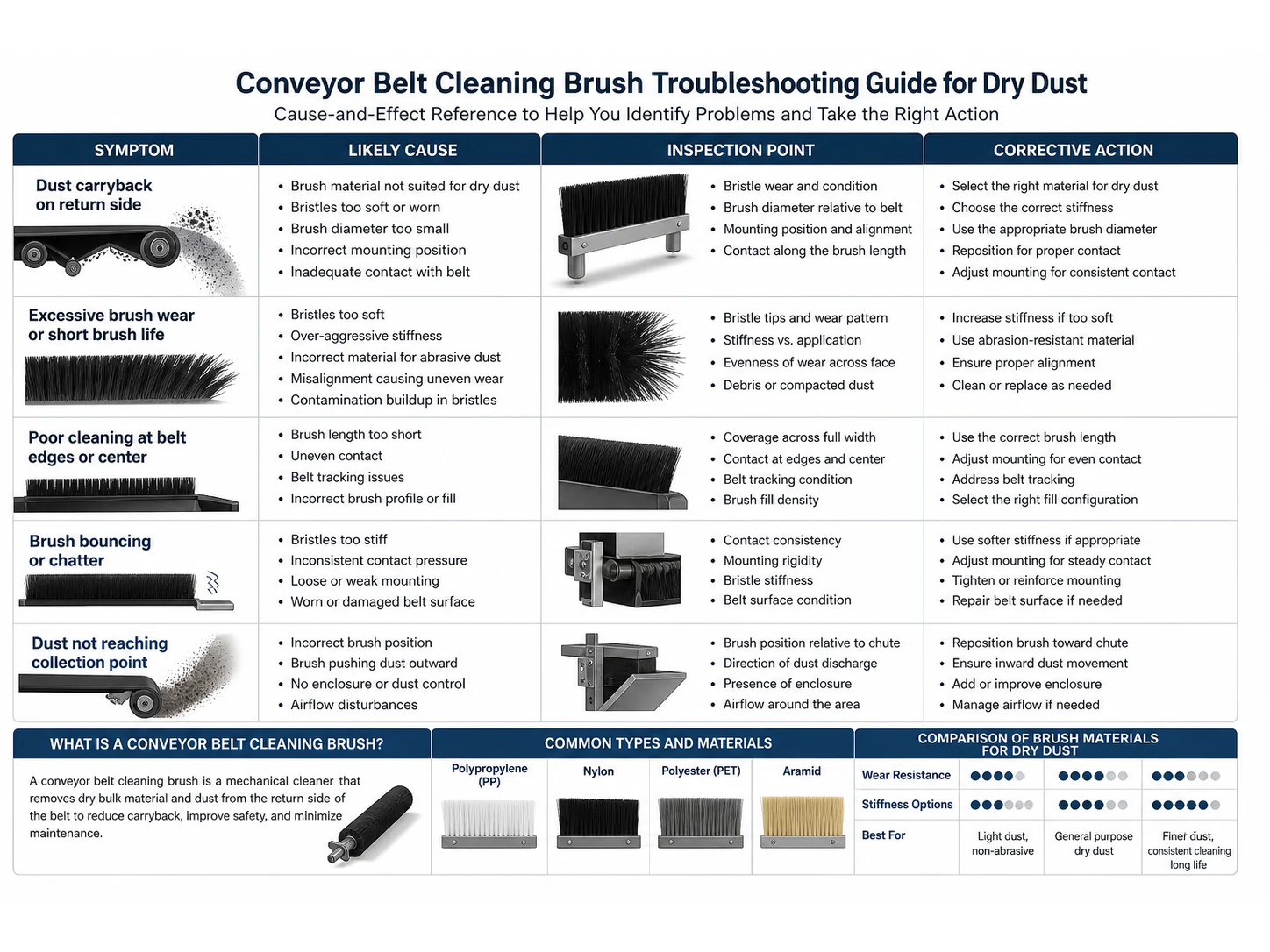
The performance of a return belt cleaning brush depends heavily on its bristle material, diameter, stiffness, core design, and mounting style. Below are the most common options for dry bulk dust removal.
- Bristle Materials: Nylon (abrasion‑resistant, good general‑purpose), Polypropylene (chemical‑resistant, lower temperature limit), Horsehair (soft, for delicate or polished belts), Tampico (natural fiber, excellent for fine static dust but absorbs moisture).
- Diameter: Standard industrial brush diameters range from 8″ to 14″ (200‑350 mm). Larger diameters increase contact area and bristle life but require more space and a stronger drive.
- Stiffness (Hardness): Soft – for sensitive belt covers; Medium – typical for most dry dust; Hard – for stubborn, embedded particles (risk of belt abrasion if overused).
- Core and Handle: Solid metal core with keyway, split‑hub design for easy removal, or molded plastic core for light‑duty applications. Shaft mounting can be fixed, quick‑release, or adjustable pillow block bearings.
- Drive Type: Motorized (independent electric drive) or friction‑driven (a roller presses against the belt to rotate the brush). Motorized offers more consistent speed; friction‑driven simplifies installation but may slip in wet or dusty environments.
Quick Comparison of Bristle Materials for Dry Dust
| Material | Best For | Moisture Tolerance | Temperature Limit | Surface Abrasion Risk |
|---|---|---|---|---|
| Nylon | General dry dust, abrasive fines | Excellent (non‑hygroscopic) | Up to 250°F (121°C) | Medium (can be polished with use) |
| Polypropylene | Dry dust in chemical or wet‑surface areas | Excellent | Up to 180°F (82°C) | Low |
| Horsehair | Delicate belt covers, fine polishing | Poor (absorbs water) | Up to 160°F (71°C) | Very low |
| Tampico | Fine static dust, food‑grade appearance | Poor (absorbs moisture) | Up to 160°F (71°C) | Very low |
How to Choose the Right Brush for Your Dry Dust Application
Answering the following questions will narrow down the specification quickly:
- Dust Characteristics: Is the dust fine and free‑flowing, or does it contain coarse, abrasive grains? Fine dust may require denser, softer bristles for effective sweep; abrasive dust calls for tough, wear‑resistant nylon.
- Belt Surface: Check the belt cover material and condition. A rough‑top belt or a belt with mechanical fasteners will wear a soft brush quickly, while a smooth belt can be cleaned with a softer material.
- Belt Width and Speed: The brush face length should exceed the belt width by at least 2‑4 inches on each side to ensure full contact. Belt speed affects centrifugal force; above 600 fpm, a larger diameter brush or motorized drive is often necessary.
- Environmental Conditions: Humidity, washdowns, or low pH environments influence material choice. Avoid natural fibers in damp or wet locations. High‑temperature belts require nylon or specialist materials.
- Mounting Space and Interface: Measure the available clearance after the head pulley, shaft diameter, and end‑connection style (keyed, hex, or plain). Match the brush core bore and keyway to the drive shaft.
- Maintenance Access: If the brush will be changed frequently, a split‑hub or quick‑release design saves downtime. Consider a removable shield to capture dislodged dust.
Setup and Mounting Considerations
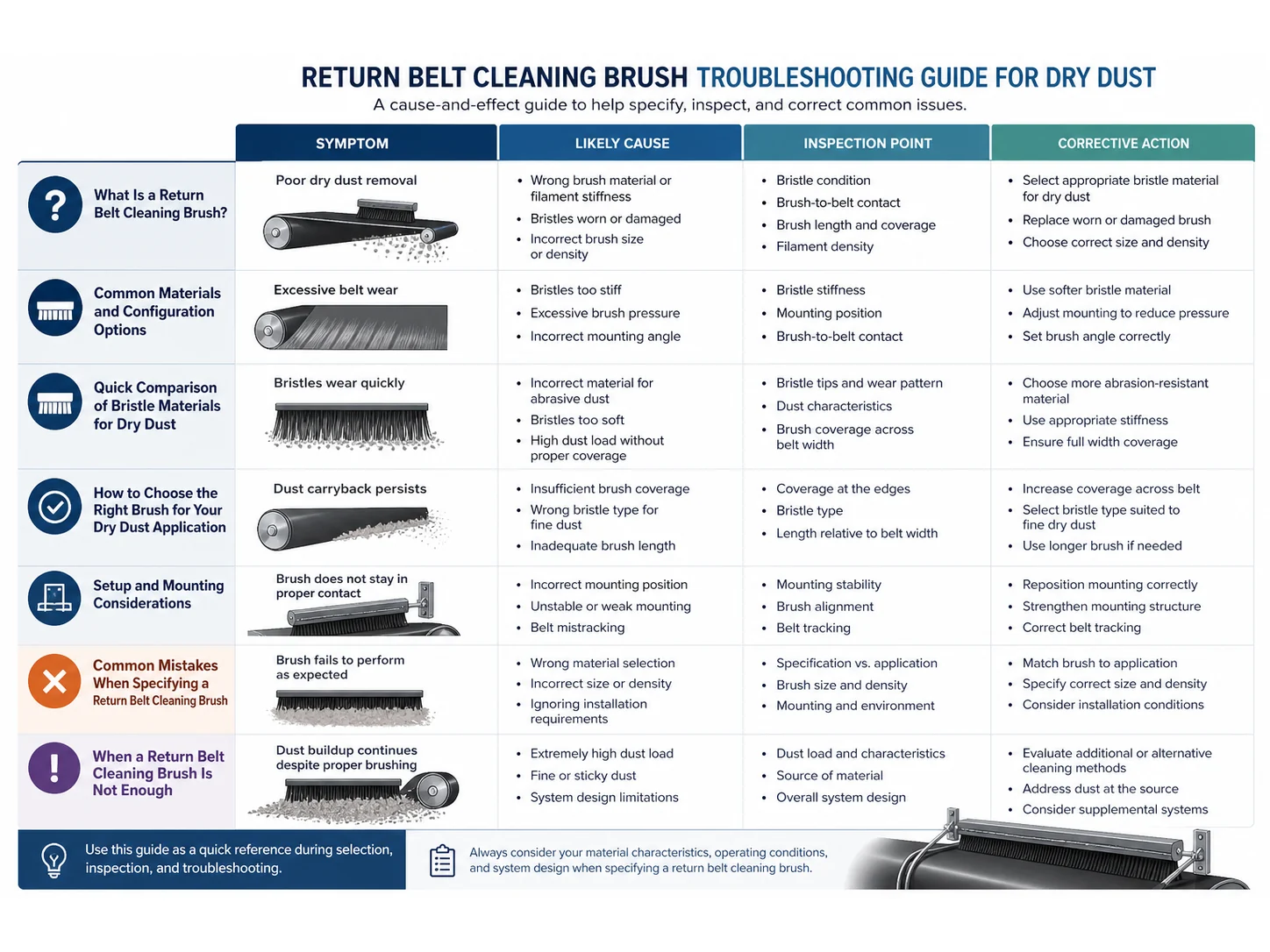
Proper placement and alignment are as important as the brush itself. The brush should be positioned on the flat return side of the belt, ideally within 1‑2 meters of the head pulley, to catch particles before they settle or spread. Contact pressure must be evenly adjusted across the belt width; too much pressure accelerates bristle wear and can damage the belt cover, while too little leaves a dust film behind. A spring‑loaded or counterweight tensioner helps maintain consistent contact as the brush wears. The brush axis must be parallel to the belt surface and square to the direction of travel—otherwise, the brush will wear unevenly and may cause belt tracking issues.
Common Mistakes When Specifying a Return Belt Cleaning Brush
- Selecting by cost drivers alone. A low-cost brush with low‑fill density or mixed‑fiber bristles may wear out in weeks, causing unplanned downtime and higher long‑term cost.
- Ignoring bristle stiffness. A very hard brush on a thin belt cover can scuff or groove the surface, while a brush that is too soft leaves fines behind.
- Mismatching shaft size. Verify the brush core inside diameter matches the shaft and keyway—field modifications often lead to wobble and failure.
- Overlooking belt width. Specifying a brush face length exactly equal to belt width leaves no margin for belt wander, resulting in uncleaned edges.
- Using water‑absorbent bristles in humid environments. Natural fibers swell, lose stiffness, and may rot, causing brush imbalance.
- Neglecting brush self‑cleaning. Dust can pack into the bristles, reducing sweep efficiency. A stationary comb or a small external vacuum nozzle often solves this.
- Skipping a sample trial. For new dust types or critical applications, a short test with a sample brush roll can reveal wear rate, cleaning quality, and belt interaction before ordering a full set.
When a Return Belt Cleaning Brush Is Not Enough
Return belt cleaning brushes work best with dry, free‑flowing dust. They are not a complete solution in every case. Sticky, oily, or hygroscopic residues that adhere to the belt require a scraper‑type cleaner, possibly followed by a brush. Heavy, compacted layers may call for a pre‑cleaner blade to remove the bulk before the brush finishes. If the collected dust is hazardous, a return belt brush must be enclosed and coupled with a dust collection system to prevent airborne release. In high‑temperature belts (above 250°F) or washdown environments requiring frequent sanitation, consult the brush manufacturer for specialized materials and sealed bearing designs. Additionally, if the belt surface is severely cracked or gouged, a brush alone cannot achieve a satisfactory clean; belt repair or replacement should be considered first.
When in doubt, request a supplier‑provided application drawing or a sample brush roll for on‑site testing. A drawing review ensures that mounting brackets, clearances, and drive connections are compatible before purchase.
Final Takeaway
Choosing the right return belt cleaning brush for dry dust boils down to defining your dust type and belt conditions first, then selecting a bristle material and stiffness that balance cleaning efficiency with belt preservation. Pay close attention to sizing, mounting interface, and environmental factors—and don’t overlook the value of a trial sample. A well‑matched brush reduces carryback, extends belt and idler life, and keeps maintenance budgets under control.
Frequently Asked Questions
What bristle material holds up best against abrasive dust?
Nylon with a high fill density and a medium‑hard stiffness grade typically offers the best wear life for abrasive dry dust. For extremely sharp particles, some manufacturers offer abrasion‑resistant nylon blends or filled polypropylene.
Can a return belt cleaning brush handle intermittent wet spots?
Occasional moisture is tolerable if you select a non‑hygroscopic material like nylon or polypropylene. Natural fibers like horsehair or Tampico will absorb water, lose shape, and deteriorate quickly. If wet conditions are frequent, add a secondary scraper system and ensure the brush drive can maintain torque when damp.
How do I determine the correct brush face length for my belt?
Measure the flat belt width and add 2 to 4 inches on each side (total 4‑8 inches extra). This allows the brush to clean the entire surface even if the belt wanders slightly. Always confirm with the brush supplier that the face length is the effective cleaning width, not the overall cylinder length.
What shaft diameter is standard for return belt brushes?
Common shaft diameters are 1″ (25 mm), 1‑1/4″ (32 mm), and 1‑1/2″ (38 mm) for industrial brushes, but this varies by brush length and load. Measure your existing conveyor brackets and drive connection before ordering. Custom bores and keyways are widely available.
How often should return belt cleaning brushes be replaced?
Replacement intervals depend on dust abrasiveness, brush contact pressure, and hours of operation. In mild dry dust applications, a brush may last 6‑12 months; in heavy‑duty mining conveyors, replacement every 3‑4 months is common. Monitor bristle wear, cleaning effectiveness, and brush roundness to schedule changes.
Does belt speed affect brush performance?
Yes. At speeds above 600 fpm (3 m/s), a motorized drive is often preferred because friction drives may slip. Larger brush diameters (12‑14″) also help maintain centripetal force and sweeping action at higher speeds without excessive bristle deflection.
Should I always include a dust collection hood with the brush?
If the dislodged dust creates a respiratory hazard, a cross‑draft hood or vacuum pickup is strongly recommended. Even for nuisance dust, a simple shroud reduces housekeeping and protects adjacent equipment.
Why does my new brush wear unevenly?
Uneven wear usually points to misalignment (brush not parallel to belt), inconsistent contact pressure, or a slightly crowned belt. Check the mounting hardware, shim adjustments, and belt tracking before assuming a brush quality defect.