What Is a Disposable Surgical Endoscope Brush?
A disposable surgical endoscope brush is a single-use cleaning tool designed to remove organic debris, biofilm, and particulate matter from the internal channels of flexible endoscopes and similar narrow-lumen medical instruments. It features a small-diameter shaft with bristles or a cleaning tip that fits inside channels as narrow as 1.0 mm. Disposable brushes eliminate the risk of cross-contamination between patients and reduce the reprocessing burden associated with reusable brush sterilization.
For reusable medical-device cleaning claims, the practical boundary is the device maker’s validated instructions and the FDA — Reprocessing Medical Devices in Health Care Settings rather than a brush-only rule.
For healthcare cleaning language, this article keeps its claims within the general boundary of the CDC — Disinfection and Sterilization Guideline, which is written for disinfection and sterilization in healthcare facilities.
Where the article discusses healthcare settings rather than ordinary cleaning, the CDC — Core Infection Prevention and Control Practices is used as the general infection-control frame.
For brush terminology and construction language, this section references American Brush Manufacturers Association — Brush Lingo.
Narrow instrument channels—such as the working channel of a gastroscope or the auxiliary water channel of a colonoscope—are prone to bioburden buildup because their small diameter restricts flushing and manual access. A correctly chosen brush physically disrupts adherent soil without scratching the channel lining, which could create pockets for future bacteria. The brush’s single-use nature ensures that each reprocessing cycle begins with a clean, undamaged tool, supporting infection control protocols.
Common Brush Characteristics for Narrow Channels
When evaluating brushes for narrow endoscopic channels, five characteristics drive performance and compatibility:
- Bristle Material: Nylon, polypropylene, or specialized polymers. Nylon offers flexibility and good debris removal; polypropylene is stiffer for stubborn deposits. Metal bristles are avoided to prevent channel damage.
- Shaft/Core Material: Typically twisted stainless steel wire, plastic-coated wire, or solid polymer. Twisted wire provides stiffness and pushability for long channels, while plastic-coated wire reduces the risk of scratching. Solid polymer shafts may be used for very short or curved channels.
- Diameter: Must be undersized relative to the channel inner diameter to prevent binding. Common diameters range from 1.0 mm to 4.0 mm, with precise matching to the instrument’s manufacturer specifications.
- Tip Design: Brushes may have end bristles only, side bristles, or full radial coverage. Some have a tufted tip for cleaning the distal end or a sponge-tipped design for biofilm removal. The choice depends on the residue location (e.g., biofilm along the channel wall vs. debris at the distal tip).
- Handle/Connection: May include a finger loop, a threaded connector for powered drivers, or a flat tab for manual rotation. Powered options are used for heavily soiled channels but require careful torque control.
Brush Type Comparison: Material, Diameter, and Stiffness
The table below summarizes typical brush configurations for narrow instrument channels. Use it as a starting point for matching a brush to your reprocessing needs.
| Feature | Nylon Bristle, Twisted Wire Shaft | Polypropylene Bristle, Coated Wire Shaft | Sponge-Tip, Solid Polymer Shaft |
|---|---|---|---|
| Typical Channel Size | 1.2–3.2 mm | 1.5–4.0 mm | 1.0–2.0 mm |
| Stiffness | Moderate, good pushability | Firm, resists buckling | Flexible, follows curves |
| Bristle Aggressiveness | Gentle to moderate | Moderate to aggressive | Low (non-abrasive) |
| Channel Lining Safety | Low risk if properly sized | Higher risk if oversized | Very low risk |
| Best For | Routine biofilm and soft organic debris | Stubborn, dried-on residue or proteinaceous buildup | Critical channels where scratching must be avoided; biofilm removal by absorption |
| Typical Use Case | General flexible endoscope reprocessing | Heavily used suction channels, biopsy ports after polypectomy | Very narrow auxiliary channels, air/water nozzles |
| Cost Consideration | Economical for high-volume cycles | Moderate; longer brush life during single use due to durability | Typically higher per unit due to specialized tip |
How to Choose the Right Brush Based on Your Cleaning Challenge
Selecting a brush requires a step-by-step assessment of the instrument, the soil, and the reprocessing workflow. Follow this decision path:
- Measure or Identify the Channel Size: Obtain the exact inner diameter from the instrument’s IFU (Instructions for Use). The brush diameter must be at least 0.1–0.2 mm smaller than the channel to allow clearance and prevent jamming. For channels with varying diameters along the length, size to the narrowest point.
- Characterize the Residue: Is it soft biofilm, dried blood, lubricating gel, or inorganic particles? Soft biofilm can be removed with gentle nylon bristles; dried or proteinaceous soils may need stiffer polypropylene bristles. For channels where scratching is a critical failure mode (e.g., air/water passages with small orifices), opt for a sponge-tipped brush or a very soft nylon brush.
- Assess Channel Material and Sensitivity: Most flexible endoscopes have a PTFE (Teflon) lining that is relatively durable, but repeated aggressive brushing can cause microfractures. For delicate materials or proprietary linings, choose a brush with a coated shaft and softer bristles. Avoid twisted wire shafts without coating if there is any risk of exposed metal.
- Determine the Required Stiffness and Length: For long channels (1.5 m or more), a stiffer twisted wire shaft helps push the brush through without buckling. Shorter or curved channels may work better with a more flexible solid polymer shaft. If using a powered rotary driver, ensure the brush is rated for rotation and the channel can tolerate the torque.
- Consider Wet or Chemical Exposure: Brushes used with enzymatic cleaners or high-level disinfectants must be chemically compatible. Nylon and polypropylene resist most chemicals, but verify the shaft coating does not degrade. Sponge tips may absorb chemicals and require attention to saturation and rinsing.
- Match the Tip Design to the Problem Area: If debris accumulates at the distal tip opening, a brush with a concentrated end tuft can plunge and clean that area. For biofilm along the entire channel length, a full radial bristle design is more effective. Some brushes combine side bristles with a soft end wiper for thorough cleaning.
- Factor in Hygiene and Workflow: Single-use brushes are discarded after one reprocessing cycle. Ensure the packaging allows aseptic presentation if the brush is used in a clean area. Check that the brush can be easily tracked in your reprocessing documentation (e.g., lot numbers for recall capability).
Common Mistakes When Selecting a Brush for Narrow Channels
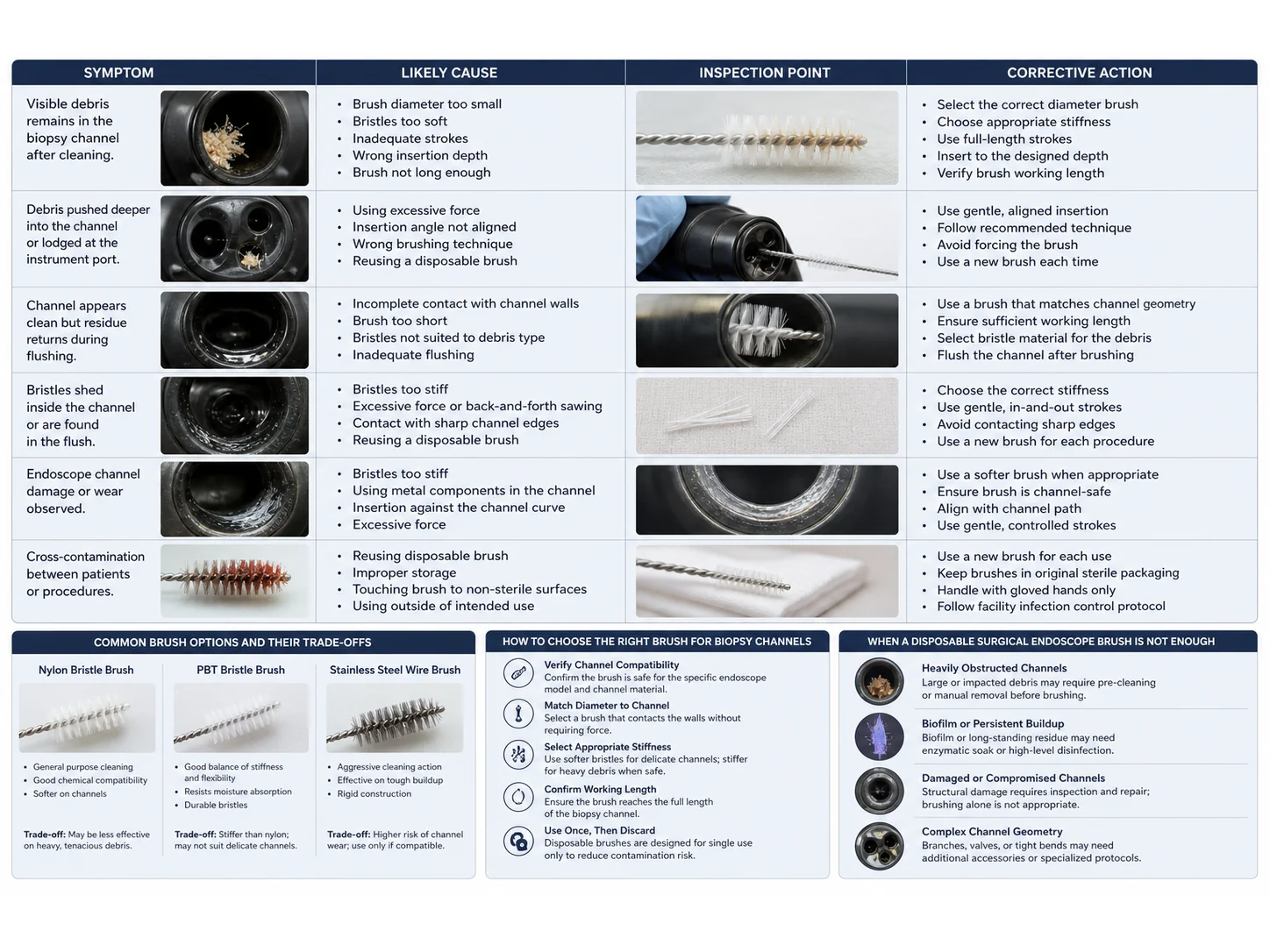
- Choosing by Diameter Alone: A brush that “fits” in terms of diameter may still be too stiff or have an abrasive shaft that damages the channel lining. Always evaluate the combined size, material, and stiffness.
- Assuming All Plastics Are Non-Abrassive: Polypropylene bristles can be harsh on soft linings if used aggressively. Match the bristle material to the soil and surface, not just the chemical compatibility.
- Reusing Disposable Brushes: Disposable brushes are validated for single use only. Re-cleaning and reusing them introduces risks of bristle deformation, contamination, and channel damage from fatigued materials. Stick to the manufacturer’s intended use.
- Ignoring Shaft Coating: A bare twisted metal shaft in a narrow channel can scrape the lining, especially at bends. If in doubt, choose a coated shaft or request a shaft sample for inspection.
- Using Rotary Power Without Validation: Powered drivers may generate excessive torque or heat, potentially melting channel linings or breaking bristles. Always verify that the brush and instrument are rated for powered use.
- Overlooking Residual Chemical Transfer: Some sponge materials can retain and then release disinfectant residues, which might irritate patient tissues. Ensure thorough rinsing protocols match the brush tip material.
- Skipping a Visual or Borescope Inspection Post-Brushing: Even with the right brush, debris can be missed. Always inspect channels after brushing (e.g., with a borescope leak tester) to confirm cleanliness.
When a Disposable Surgical Endoscope Brush Is Not Enough
A single-use channel brush is a critical part of manual cleaning, but it is not a standalone solution. Recognize its limits:
- Automated Endoscope Reprocessors (AERs): Brushing is a prerequisite step before loading the scope into an AER. The brush removes gross soil, but the AER provides high-level disinfection and flushing that a brush cannot replace. Do not skip brushing even if your facility uses an AER.
- Severe Biofilm Accumulation: If a channel has built-up biofilm that resists standard brushing, the instrument may require extended soaking, chemical agitation, or specialized enzymatic treatments before another brush attempt. Repeated aggressive brushing can drive biofilm deeper into scratches.
- Damaged or Irregular Channels: Channels with dents, scratches, or internal obstructions can trap bristles or cause shaft breakage. In such cases, the endoscope should be evaluated by the manufacturer or a specialized repair service, and a custom brush size might be needed—but only after repair.
- User Verification: Even with the best brush, staff training on insertion speed, rotation technique, and withdrawal is essential. Brush selection alone cannot compensate for improper technique. Conduct regular competency assessments for reprocessing staff.
Bottom Line
The best result comes from matching disposable surgical endoscope brush for narrow instrument channels to the real cleaning task rather than forcing one brush to solve every condition. Confirm access, residue, surface limits, and replacement routine first; then use a small trial or inspection step before scaling the method into daily work.
Frequently Asked Questions
What is the minimum channel size that can be brushed?
Brushes are available for channels as small as 1.0 mm. However, consult the endoscope manufacturer’s IFU; some very narrow channels (e.g., 0.8 mm) may not have a validated brush and rely solely on flushing. Attempting to brush a channel smaller than the brush tip can cause obstruction.
Can I use a reusable brush instead of a disposable one?
Reusable brushes require cleaning, disinfection, and sterilization between uses. Many facilities have moved to disposable brushes to eliminate the risk of inadequate reprocessing and cross-contamination. If reusable brushes are used, they must be validated for the same number of cycles and inspected for wear after each use. Disposable brushes simplify compliance and reduce long-term cost by avoiding reprocessing labor and tracking.
How do I know if the brush is too stiff for my endoscope?
A simple test: when inserting the brush, it should slide with minimal resistance and not require excessive force. If you feel scraping or if the shaft bows significantly, the brush may be too stiff or too large. Also, check the shaft material: bare metal poses a higher scratch risk. If in doubt, use a coated shaft or request sample brushes for compatibility testing before full adoption.
Are there brushes designed for specific endoscope brands?
Some manufacturers offer brushes validated for specific endoscope models (e.g., Olympus, Pentax, Fujifilm). It is advisable to use the brush recommended in the instrument’s reprocessing manual. However, generic disposable brushes with equivalent specifications can be used if they meet the diameter, length, material, and safety requirements. Always verify that the brush does not void the instrument warranty due to improper compatibility.
How often should the brush be replaced during a single reprocessing cycle?
Since it is a single-use device, a new brush is used for each endoscope. If multiple channels need brushing, use a separate brush for each channel to prevent cross-channel contamination. Never reuse a brush on a different scope or retain it for the next procedure.
What if the brush tip breaks off inside the channel?
This is a rare but serious event. Immediately stop using the endoscope and quarantine the instrument. Do not attempt to retrieve the fragment with another tool, as this may push it further or damage the channel. Contact the endoscope manufacturer or a certified repair center for safe removal and inspection. The endoscope must not be used until the fragment is retrieved and channel integrity is confirmed.