What Is a Disposable Surgical Endoscope Brush?
A disposable surgical endoscope brush is a single-use cleaning device typically consisting of a flexible or rigid core, a handle or mounting end, and bristles made from materials such as nylon, polypropylene, or soft stainless steel. It enters narrow instrument channels to dislodge bioburden, biofilm, and other organic residue. Because it is discarded after one use, it helps prevent cross-contamination between procedures and reduces the risk of biofilm buildup from improperly reprocessed reusable brushes.
Common Types and Material Options
For reusable medical-device cleaning claims, the practical boundary is the device maker’s validated instructions and the FDA — Reprocessing Medical Devices in Health Care Settings rather than a brush-only rule.
For healthcare cleaning language, this article keeps its claims within the general boundary of the CDC — Disinfection and Sterilization Guideline, which is written for disinfection and sterilization in healthcare facilities.
Where the article discusses healthcare settings rather than ordinary cleaning, the CDC — Core Infection Prevention and Control Practices is used as the general infection-control frame.
For brush terminology and construction language, this section references American Brush Manufacturers Association — Brush Lingo.
Disposable brushes vary in design based on the endoscope type and channel dimensions. The table below outlines the most common configurations, including typical materials and their primary use cases.
| Type | Typical Material | Stiffness | Handle / Mount | Best For |
|---|---|---|---|---|
| Flexible channel brush | Soft nylon or polypropylene | Low to medium | Ring, Luer lock, or plain end | Delicate flexible endoscopes (colonoscopes, gastroscopes) |
| Semi-rigid brush | Nylon with stiffer core | Medium | Threaded or snap-on | Suction/biopsy channels that require more scrubbing power |
| Short rigid brush | Stainless steel or hard plastic bristles | High | Integrated handle | Valves, ports, and external surfaces on rigid instruments |
| Tapered tip brush | Nylon with varying diameter | Low | Plain or Luer lock | Channels with changing diameters |
| Micro-brush (extra small) | Ultra-soft nylon | Very low | Thin wire handle | Narrow air/water channels |
How to Choose the Right Disposable Brush for Your Reprocessing Protocol
Selecting a disposable surgical endoscope brush requires specific evaluations beyond simply matching diameter. Consider these factors:
- Residue type: Heavy proteinaceous deposits may require stiffer bristles or a combination brushing and flushing action.
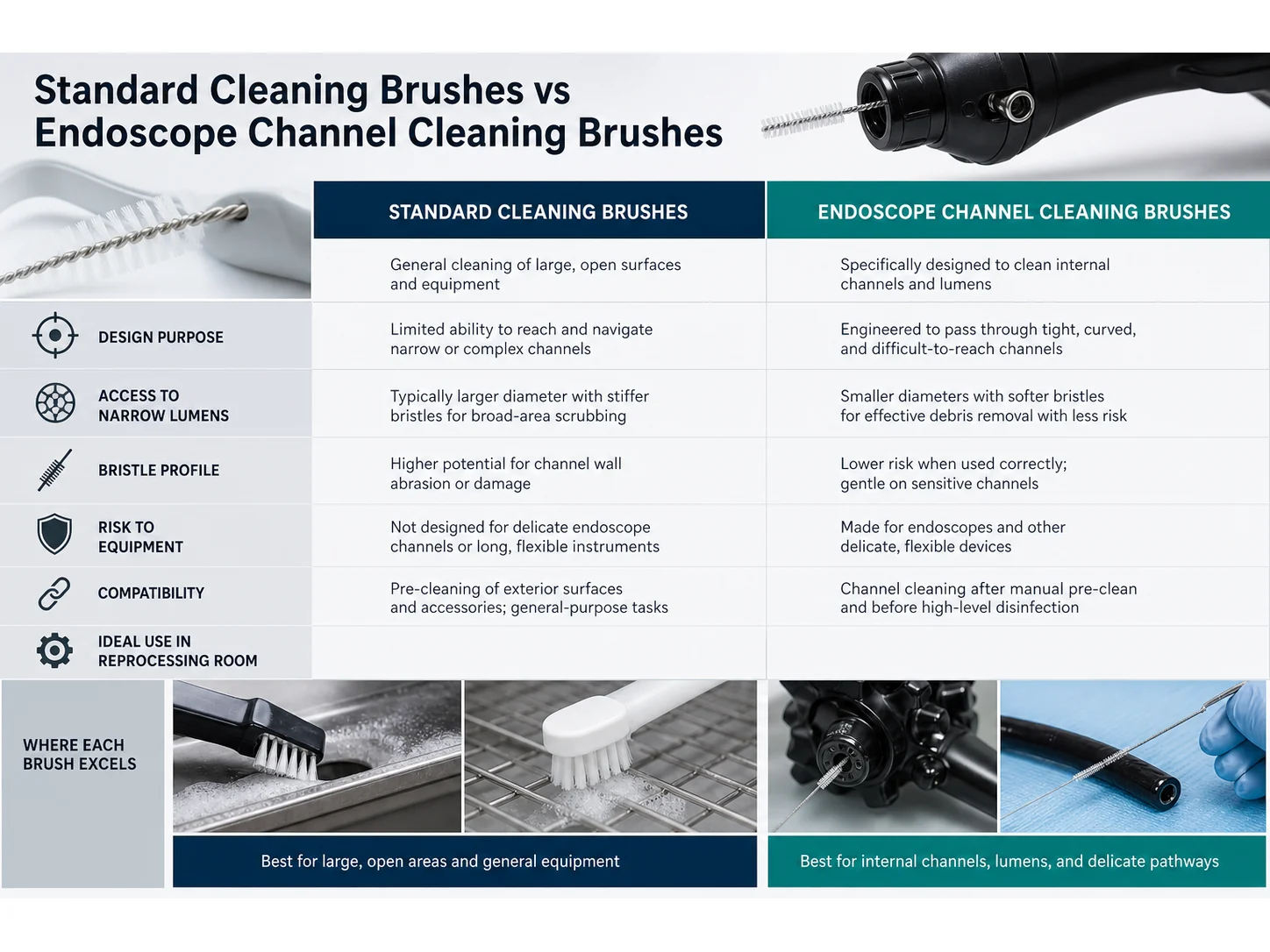
- Surface sensitivity: Delicate channel linings in flexible endoscopes require non-abrasive, soft nylon to avoid scratches that could harbor future biofilm.
- Equipment interface: Verify that the brush attachment (Luer lock, plain end, threaded) is compatible with your automated flush systems or manual setup.
- Chemical compatibility: Bristle and core materials must withstand enzymatic cleaners, detergents, and disinfectants without swelling, shedding, or degradation.
- Hygiene expectations: Single-use brushes eliminate the risk of inadequate reprocessing of reusable brushes and reduce verification steps.
- Maintenance frequency: High-volume reprocessing centers often prefer disposable systems to avoid the labor and validation required for reusable brush maintenance.
- Custom sizing: Verify whether standard off-the-shelf brushes cover all instrument channels; if not, a custom-sized disposable brush may be necessary.
Disposable vs. Reusable vs. Alternative Cleaning Tools
The table below compares a disposable surgical endoscope brush with other common reprocessing tools to help identify when single-use is the most appropriate choice.
| Factor | Disposable Surgical Endoscope Brush | Reusable Brush | Sponge / Cloth | Ultrasonic / Automated Flush |
|---|---|---|---|---|
| Cross-contamination risk | Very low (new each use) | Medium to high if not properly validated | High if reused | Low when properly maintained |
| Cost per procedure | Higher consumable cost, no reprocessing overhead | Lower consumable cost, high labor/validation cost | Low | High capital cost, low per-cycle cost |
| Cleaning efficacy | High when matched to channel | High if undamaged and validated | Moderate for surfaces, poor for channels | Effective when combined with brushing |
| Labor required | Minimal (unpack, use, discard) | High (manual cleaning, inspection, sterilization) | Moderate | Low during cycle, high for maintenance |
| Application | All endoscope channels, especially narrow/delicate | Sturdy channels, low-urgency settings | External surfaces only | Supplementary to brushing |
Common Mistakes When Using Disposable Endoscope Brushes
Avoid these pitfalls to ensure safe and effective reprocessing:
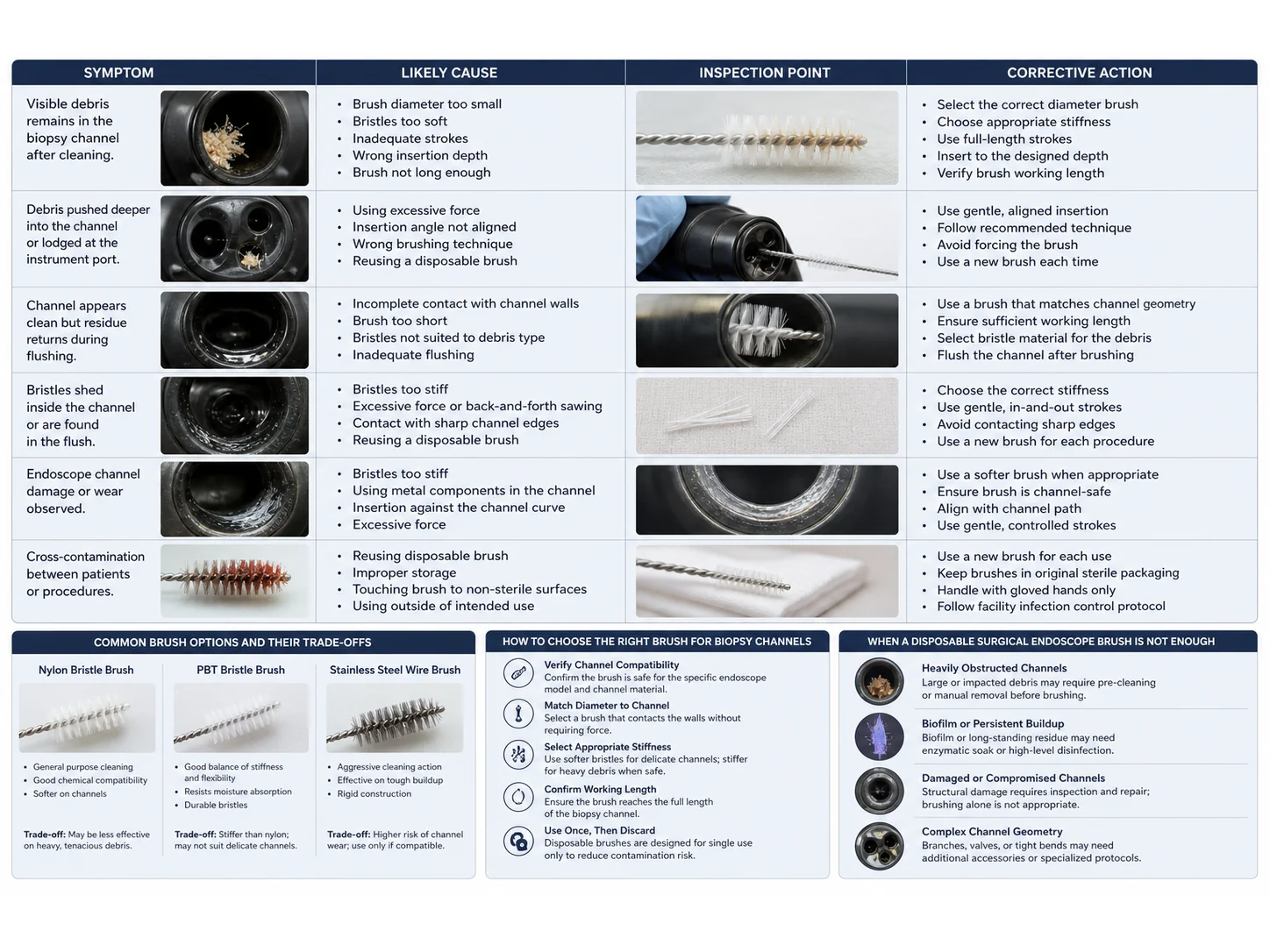
- Using the wrong diameter: A brush too large can damage channel walls; too small leaves residue behind.
- Choosing excessive stiffness: Stiff bristles on a flexible endoscope can scratch the lining, creating biofilm niches.
- Ignoring attachment compatibility: Mismatched connectors can lead to brush detachment inside the instrument or inadequate flushing.
- Re‑using a disposable brush: Even if it looks clean, multiple uses compromise sterility assurance and can transfer pathogens.
- Skipping visual inspection: Always check that bristles are intact after use; a lost bristle inside a channel becomes a serious patient safety risk.
- Incompatible storage conditions: Exposure to heat or humidity before use can degrade nylon bristles, reducing cleaning effectiveness.
When a Disposable Surgical Endoscope Brush Is Not Enough
While disposable brushes are essential for channel cleaning, they should not be the sole method in every scenario:
- Heavy biofilm or dried soil: Extensive biofilm may require enzymatic soaking, ultrasonic pre-treatment, or multiple brushing passes with different diameters.
- Complex or branched channels: Some specialty endoscopes have side branches that a straight brush cannot reach; supplementary flushing or a custom-designed brush may be needed.
- Chemical resistance demands: If the cleaning protocol uses aggressive solvents, verify with the supplier that the brush material can withstand the exposure without degradation.
- Validation and verification gaps: For critical instruments, a physical brush alone does not confirm cleanliness—combine with visual inspection, borescope verification, or ATP testing.
- When a reusable brush might be safer: In very low throughput settings where a reusable brush can be thoroughly validated, a disposable brush may not offer additional safety benefit and simply increases waste.
Final Takeaway
A disposable surgical endoscope brush is the right choice when cross-contamination risk must be minimized, labor for brush reprocessing is limited, or channel sensitivity demands pristine, undamaged bristles every time. Match the brush exactly to channel diameter, stiffness, and attachment type. Always integrate brushing into a complete manual or automated cleaning protocol that includes flushing, enzymatic cleaning, and verification steps. When in doubt about sizing or material compatibility, request a sample or drawing review from the supplier and test a small batch in your real workflow before full adoption.
Practical Use Note
In daily use, the practical test is simple: check whether the brush reaches the full contact area, removes the target residue, and leaves the surface in the required condition. Record what changes when access shape, residue type, manufacturer instructions, and whether the task is general cleaning or validated reprocessing changes, because many brush failures are caused by the working condition shifting rather than by the brush body alone.
Frequently Asked Questions
Can a disposable surgical endoscope brush be used on all types of endoscopes?
Generally yes, but you must select the correct diameter, length, and tip configuration for each endoscope model. Flexible endoscopes require non-abrasive, flexible brushes; rigid scopes may tolerate slightly stiffer materials.
How do I determine the right brush diameter for a specific channel?
Refer to the endoscope manufacturer’s instructions for channel inner diameter. The brush should be 0.1–0.2 mm smaller than the channel to allow smooth passage without excessive friction but still make full contact with the wall.
Is it safe to re-use a disposable brush if it appears clean after a single use?
No. Disposable brushes are validated for single use only. Re-use can introduce pathogens, compromise sterility, and may leave invisible residues that interfere with high-level disinfection.
What is the most common material for disposable endoscope brush bristles?
Nylon is most common because it is soft, chemically resistant, and non-abrasive. Polypropylene is sometimes used for more aggressive cleaning, and stainless steel for rigid instruments.
Do I still need to use enzymatic detergent if I’m using a disposable brush?
Yes. The brush physically removes debris, but enzymatic detergent breaks down proteinaceous soil that brushing alone cannot fully remove. The two work together as part of a complete protocol.
Can a disposable brush replace automated endoscope reprocessors (AERs)?
No. Manual brushing is a required pre-cleaning step before most AER cycles. The brush removes gross soil; the AER then provides consistent, validated high-level disinfection.
How should I store disposable surgical endoscope brushes before use?
Keep them in a cool, dry environment away from direct sunlight and chemicals. Avoid crushing or bending that could deform the brush shaft. Follow the supplier’s packaging instructions.
What should I do if a bristle detaches inside an endoscope channel?
Stop processing immediately and follow your facility’s foreign body retrieval protocol. This often involves flushing, using a different retrieval tool, or sending the scope for professional repair. Report the incident for quality tracking.