
What Is an Endoscope Channel Cleaning Brush?
An endoscope channel cleaning brush is a single-use or reusable instrument with a carefully engineered bristle configuration, core, and dimensions matched to endoscope lumens. The brush is designed to navigate curves and narrow passages without abrading or damaging the internal lining, while still providing enough mechanical action to disrupt biofilm. Unlike standard brushes, every component—from bristle material to wire shaft—is selected for chemical compatibility with enzymatic cleaners and high-level disinfectants.
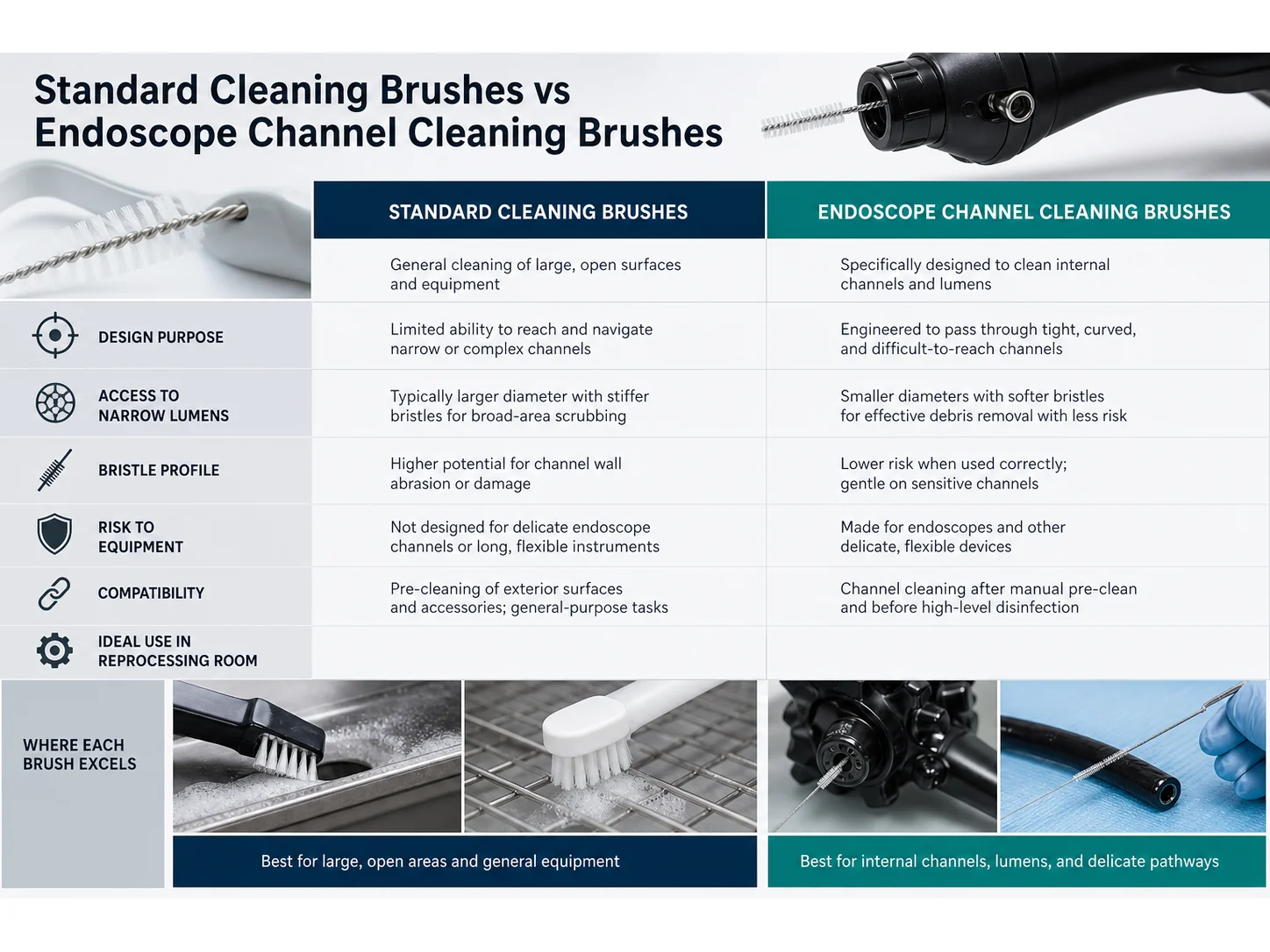
Standard Cleaning Brushes vs Endoscope Channel Cleaning Brushes
The following table highlights the key differences between a standard cleaning brush and a brush specifically intended for endoscope channel reprocessing.
| Factor | Standard Cleaning Brush | Endoscope Channel Cleaning Brush |
|---|---|---|
| Material | May include wire bristles, coarse nylon, or abrasive fibers; can scratch delicate surfaces | Soft, non-abrasive nylon, polyester, or natural bristles; often with rounded tips to prevent luminal damage |
| Diameter Range | Typically not sized for narrow lumens; diameters are inconsistent and often too large or too small for endoscope channels | Precisely sized to match common endoscope channel diameters (e.g., 1.0 mm, 1.6 mm, 2.8 mm, 3.2 mm); ensures full circumferential contact without binding |
| Stiffness and Flexibility | Often rigid or uniformly flexible, making it impossible to navigate bends without risking kinks or channel damage | Engineered multi-layer core or coiled wire shaft that combines pushability with flexibility to pass through curvature sections safely |
| Handle/Core Construction | Simple twisted wire or plastic handle; may shed fibers or corrode | Sealed, smooth handles; core made of medical-grade stainless steel or polymer-encased wire to resist chemical degradation |
| Mounting/Attachment | Rarely compatible with standardized reprocessing workflows; no built-in length markers or ergonomic grips | Often includes marked insertion depth indicators, ergonomic grips, and compatibility with cleaning gun adapters if needed |
| Chemical Compatibility | May degrade, swell, or leach contaminants when exposed to enzymatic detergents, disinfectants, or sterilization heat | Designed for repeated exposure to aldehyde-free chemicals, peracetic acid, and automated endoscope reprocessors (AERs) |
| Regulatory Considerations | No cleaning-specific validation; often general-purpose industrial or household brush | Often validated for cleaning efficacy per guidelines from organizations like SGNA, AAMI, or EN/ISO standards for washer-disinfectors |
Common Types and Material Options for Endoscope Channel Cleaning Brushes
When evaluating an endoscope channel cleaning brush, consider these main categories:
- By Bristle Material: Soft nylon (most common), polyester, or natural fibers. Nylon offers a good balance of stiffness and flexibility without scratching. Polyester resists moisture absorption and may be preferred in humid reprocessing environments.
- By Core/Shaft Design: Coiled wire (stainless steel or nickel-titanium) for flexibility and pushability, or solid plastic core for single-use disposable brushes where metal is avoided.
- By Tip Configuration: Brushes with a rounded, non-abrasive tip to prevent channel damage during insertion; some have a small sponge or foam tip for soaking channels with cleaning solution.
- By Diameter and Length: Sized for specific endoscope models (gastroscope, colonoscope, bronchoscope, ureteroscope). Lengths must match the working length of the endoscope plus the umbilical channel.
How to Choose the Right Brush for Your Reprocessing Room
Use these decision factors to select a brush that matches your cleaning task:
- Residue Type: Heavy biofilm, dried mucoid residues, or thick bioburden may require a brush with slightly firmer, non-abrasive bristles. Light soil or daily post-procedure cleaning might only need a softer, single-use brush.
- Surface Sensitivity: Flexible endoscopes with delicate internal lumens (e.g., bronchoscopes, pediatric scopes) demand the gentlest bristle material and a flexible non-metallic core.
- Equipment Interface: Confirm the brush is compatible with your cleaning method—manual brushing, flushing console, or automated endoscope reprocessor (AER). Some AERs require brushes with specific connectors.
- Wet or Chemical Exposure: In environments with aggressive enzymatic solutions or peracetic acid, choose materials that will not swell, fray, or degrade. Nylon and certain polymers offer better chemical resistance.
- Hygiene Expectations and Maintenance Frequency: High-volume reprocessing centers may prefer single-use disposable brushes to eliminate cross-contamination risk. Reusable brushes require thorough cleaning, inspection, and sterilization between uses.
- Custom Size Requirements: If you have non-standard endoscopes or very old equipment, a standard channel brush might not fit. In such cases, work with a reputable supplier to match brush dimensions to your exact channel diameter and length; request a sample or drawing for verification.
Common Mistakes When Selecting or Using Channel Cleaning Brushes
Avoid these practical mistakes:
- Choosing by cost drivers alone: A cheaper standard brush that damages the channel can lead to expensive endoscope repairs or patient safety incidents.
- Using a brush with the wrong diameter: An oversize brush can cause channel damage or become lodged; an undersize brush leaves bioburden behind.
- Ignoring shaft flexibility: A too-stiff shaft can perforate the channel at bends, while a too-weak shaft may kink inside the scope.
- Assuming one brush fits all scopes: Different endoscopes (GIF, CF, BF, etc.) have different channel dimensions and lengths. Using a generic brush risks incomplete cleaning.
- Skipping inspection of reusable brushes: Frayed bristles or corroded cores become a contamination source and can scratch channels.
- Overlooking chemical compatibility: Brushes not rated for the disinfectant used may degrade, leaving residue inside the channel.
When an Endoscope Channel Cleaning Brush Is the Wrong Choice
Even the right channel brush cannot replace thorough manual cleaning, flushing, and inspection. It is not a substitute for:
- Proper bedside pre-cleaning to remove gross soil before transport.
- Enzymatic soaking and flushing to loosen organic material before brushing.
- Visual inspection and borescope examination to verify cleanliness post-brushing.
- Automated endoscope reprocessor (AER) validation—brushing is only one step in a multi-step disinfection process.
If you encounter persistent biofilm, complex small-diameter lumens (e.g., balloon channels), or long uncharted working lengths, you may need a custom brush design, a specialty pull-through cleaning device, or a review of your entire reprocessing protocol. In such cases, consult the endoscope manufacturer’s instructions for use (IFU) and consider a supplier drawing review or a cleaning efficacy test with a surrogate device before committing to a purchase.
Final Takeaway
Standard cleaning brushes are not designed for the tolerances, materials, and chemical exposures of endoscope reprocessing. An endoscope channel cleaning brush is a necessary, validated tool for safe and effective manual cleaning. Decision makers should match brush diameter, bristle softness, and chemical compatibility to each scope type, and never substitute a general-purpose brush for a validated channel brush. When in doubt, prioritize brush specifications that align with the scope manufacturer’s IFU and your chosen disinfectant chemistry.
Frequently Asked Questions
Can I use a standard pipe cleaner or wire brush for endoscope channels?
No. Standard wire brushes or pipe cleaners can scratch the delicate internal lumen, leave metal fragments, or fail to navigate curves safely. Only use brushes specifically validated for endoscope channels.
What bristle material is safest for flexible endoscopes?
Soft, rounded-tip nylon or polyester bristles are generally safest. Avoid metal or abrasive nylon. The brush should be soft enough to prevent scratching yet firm enough to dislodge biofilm.
How do I know which brush diameter to order?
Check the endoscope’s IFU for channel diameter specifications. Brushes are often labeled with a compatible channel size (e.g., 1.6 mm, 2.8 mm). If in doubt, request a sample or dimensional drawing from the brush supplier.
Are disposable or reusable channel brushes better?
Disposable brushes eliminate cross-contamination risk and inspection burden. Reusable brushes can be cost-effective if you have strict reprocessing protocols and can verify brush integrity after each use. Both are acceptable if compatible with your workflow and guidelines.
Can the same brush be used for all endoscopes in a reprocessing room?
Unlikely. Endoscopes vary widely in channel diameter and length. Using one brush for all scopes risks either damaging smaller channels or inadequately cleaning larger ones. Match each brush to the specific scope model.
What should I do if a brush tip breaks off inside the channel?
Stop reprocessing immediately. Do not force other instruments down the channel. Follow your facility’s protocol for retained foreign objects; this may involve manufacturer guidance, borescope retrieval, or endoscope repair service.
How often should reusable channel brushes be replaced?
Inspect before each use for bristle wear, kinks, or corrosion. Replace immediately if any defect is found. Follow the brush manufacturer’s recommended maximum number of uses or sterilization cycles.
Technical References
- CDC — Disinfection and Sterilization Guideline
- CDC — Core Infection Prevention and Control Practices
- FDA — Reprocessing Medical Devices in Health Care Settings
Which bristle material fits this job — Nylon PA, AISI 304 Stainless Steel Wire or Abrasive Nylon?
| Material | Continuous temperature (°C) | Peak temperature (°C) | Water absorption | Hardness |
|---|---|---|---|---|
| Nylon PA | 93 | 121 | 0.3–9% by PA grade and conditioning | Medium to firm; filament diameter and trim length control bending force. |
| AISI 304 Stainless Steel Wire | 400 | 500 | 0% | Rockwell B 70–95 depending on temper and cold work |
| Abrasive Nylon | 120 | 150 | 0.1–1.0% | Abrasive filament; stiffness and cutting level is controlled by PA base, grit type, grit size, filament diameter and trim height. |
Figures as published by Brushtec / DuPont; Alleima; Perlon. Confirm the exact grade against the supplier datasheet before ordering.
What should replace Nylon PA for endoscope channel cleaning?
- Nylon PA — Compare Nylon PA with PP, PBT, PET. Change material when wet stiffness, temperature, chemical resistance, conductivity, particle shedding, or surface marking becomes the limiting factor.
- AISI 304 Stainless Steel Wire — Use AISI 316 stainless steel wire for chloride, marine, dairy, beverage, chemical washdown, or higher pitting-resistance requirements. Use carbon steel for dry aggressive cutting and brass or abrasive nylon for lower marking risk.
- Abrasive Nylon — Compare Abrasive Nylon with PP, PBT, PET. Change material when wet stiffness, temperature, chemical resistance, conductivity, particle shedding, or surface marking becomes the limiting factor.