
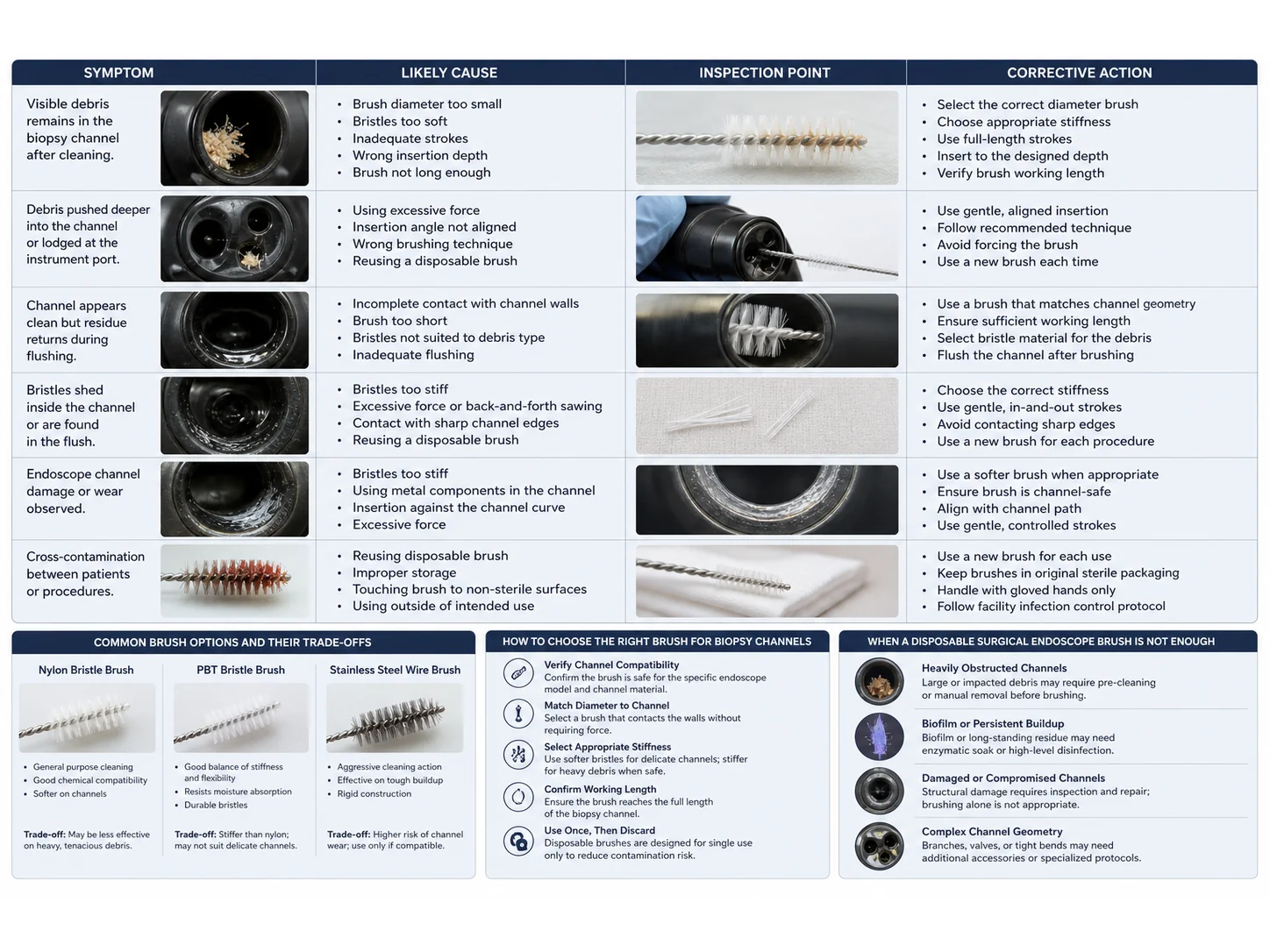
What Is a Disposable Surgical Endoscope Brush?
A disposable surgical endoscope brush is a sterile, single-patient-use tool with a flexible shaft and a brushed tip engineered to pass through the narrow, often tortuous working channels of surgical endoscopes. Its primary job is to dislodge adherent debris from the inner surfaces of biopsy and suction channels before high-level disinfection or sterilization. Because the brush is discarded after one use, cross-contamination risk is reduced compared to reusable brushes that require their own reprocessing cycles.
Common Biopsy Channel Cleaning Mistakes
Even well-trained teams can fall into predictable traps. The mistakes below are the most costly in terms of cleaning efficacy, instrument longevity, and patient safety:
- Using a brush with an incorrect diameter that either fails to contact the channel wall or creates excessive friction.
- Selecting a brush that is too stiff, which can scratch or kink the working channel.
- Reusing a brush labeled as disposable, which increases the risk of bioburden transfer.
- Relying on a single pass when multiple passes with a rotating motion are needed to remove tenacious biofilm.
- Failing to inspect the brush tip before insertion, allowing a damaged or malformed brush to introduce foreign material.
- Using the same brush design for all endoscopes without matching the brush to the specific channel length and diameter.
Material, Diameter, and Stiffness Selection
Choosing the right disposable surgical endoscope brush means balancing three core characteristics: bristle material, shaft diameter, and overall flexibility. Bristles are typically nylon, polypropylene, or a blend; each offers a different trade-off between cleaning aggressiveness and surface gentleness. A brush that is too abrasive can micro-scratch the channel lining, creating niches for future biofilm. A shaft that is too narrow will not apply adequate wall contact, while an oversized shaft can buckle within the channel or cause insertion trauma. Endoscope manufacturers typically specify the maximum brush diameter and recommended stiffness for each model; deviating from these guidelines is a frequent root cause of damage.
Common Brush Options and Their Trade-offs
| Brush Feature | Option A: Soft Nylon, Narrow Core | Option B: Medium Nylon, Standard Core | Option C: Stiffer Polypropylene, Aggressive Design |
|---|---|---|---|
| Typical Use Case | Delicate pediatric or neonatal scopes; channels with thin walls | Most adult endoscopes; routine maintenance cleaning | Heavily soiled or reprocessed channels with stubborn debris; larger working channels |
| Wall Contact Pressure | Low | Moderate | High |
| Risk of Channel Damage | Very low | Low when used within spec | Moderate; must be verified against manufacturer instructions guidelines |
| Biofilm Removal Efficiency | Sufficient for light soiling and routine use | Good for mixed loads | High, but may over-clean and remove protective passivation layers on some surfaces |
| Shaft Kink Resistance | Lower; can fold in tight bends | Better; maintains shape | Highest; often reinforced with a wire core |
| Cost Factor | Moderate | Low to moderate | Higher due to complex construction |
How to Choose the Right Brush for Biopsy Channels
Always begin with the endoscope manufacturer’s instructions for use (IFU). They will specify the acceptable brush diameter range, material compatibility, and any prohibited designs. Beyond the IFU, consider these decision points:
- Channel Diameter and Length: Measure the actual working channel or reference the endoscope model specification. Select a brush that fills approximately 80–90% of the channel diameter for optimal wall contact without binding.
- Residue Type: Fresh mucus and blood may be removed with a soft brush, but dried or baked-on debris often requires a slightly stiffer bristle or a multi-pass protocol.
- Surface Sensitivity: Some endoscope channels have a special lining or coating. A brush that is too abrasive can breach this layer, leading to fluid invasion and costly repairs.
- Wet or Dry Environment: Brushes should always be used with an appropriate cleaning solution. A dry pass, even with a soft brush, can create static drag and increase the risk of channel distortion.
- Hygiene Expectations: In settings with high-consequence infections, a single-use brush eliminates reprocessing variability entirely. In lower-risk areas, a disposable brush still simplifies compliance.
- Frequency of Use: High-volume reprocessing departments benefit from brushes with ergonomic handles and consistent batch quality to reduce operator fatigue and error.
Usage and Handling Mistakes
Even the best brush will fail if handled incorrectly. Common operator errors include:
- Forcing the brush through a resistance point: If the brush catches, stop and retract; forcing it can separate the tip or embed the shaft in the channel.
- Using a straight pull motion instead of a rotating advance: Rotating the brush as it moves through the channel ensures bristle tips engage the entire circumference.
- Omitting a post-brush flush: Dislodged debris must be immediately flushed out. Brushing without following with a fluid rinse simply redistributes the soil.
- Storing brushes in non-sterile conditions: Even though they are single-use, a brush left exposed to environmental contaminants before insertion defeats the purpose.
- Cutting open a brush package too early: Some packaging is designed as a sterile barrier; opening it hours before use increases the risk of particulate contamination.
When a Disposable Surgical Endoscope Brush Is the Wrong Choice
A disposable brush is a critical first step in channel cleaning, but it has limitations. It cannot correct underlying endoscope design flaws, nor can it replace automated reprocessing systems that deliver standardized flush volumes and contact times. If a channel has deep scoring, a brush may not reach biofilm embedded in crevices; in such cases, the endoscope may need to be sent for major repair or replacement. Additionally, some residue types—such as certain surgical sealants or bone wax—may require a customized brush shape or a different cleaning chemistry altogether. When standard catalog brushes do not fit, a review of the endoscope manufacturer’s original specifications and a supplier drawing review for a custom brush may be necessary. Finally, if repeated cleaning validation tests (like ATP or protein swabs) fail despite proper brushing technique, the entire reprocessing protocol should be audited, not just the brush selection.
Final Takeaway
Avoiding common disposable surgical endoscope brush mistakes comes down to three actions: match the brush exactly to the channel dimensions and manufacturer’s guidelines, never reuse a disposable brush, and train all operators on proper rotational insertion and post-brush flushing. When selection is rooted in channel geometry, residue type, and material safety, the risk of incomplete cleaning or mechanical damage drops significantly.
Frequently Asked Questions
Can I use the same disposable brush for multiple endoscopes if they appear clean?
No. Disposable brushes are validated for a single use only. Sharing a brush between endoscopes risks cross-contamination and may invalidate reprocessing records.
How do I know if the brush diameter is too large?
If the brush requires more than light finger pressure to advance through the channel, or if it buckles at the insertion point, the diameter is likely oversized. Always measure against the endoscope specification.
What should I do if a brush tip breaks off inside the channel?
Stop immediately. Do not attempt to push the fragment further. Notify your biomedical engineering team or the endoscope manufacturer; the fragment may need to be removed using specialized retrieval tools to prevent permanent damage.
Are softer brushes always safer for channel surfaces?
Not necessarily. A brush that is too soft may require excessive passes, increasing abrasion time, while still leaving biofilm behind. The safest brush is one that matches the manufacturer’s recommended stiffness and is used according to protocol.
Why is the rotating motion important during cleaning?
A linear pull alone only cleans the portion of the channel wall directly under the bristle tips at that moment. Rotating the brush ensures 360-degree contact, dislodging debris from all surfaces.
Can I rely solely on a visual inspection to confirm cleaning?
Visual inspection is a minimum check, but it cannot detect biofilm or residual protein. Facilities should combine visual inspection with validated tests such as ATP monitoring or protein swabs to confirm cleaning effectiveness.
What if our endoscope model is older and the original brush specification is no longer available?
Contact the endoscope manufacturer for archival IFU documents, or work with a brush supplier that can provide drawing reviews and sample brushes for fit testing before placing a bulk order.
Technical References
- CDC — Disinfection and Sterilization Guideline
- CDC — Core Infection Prevention and Control Practices
- FDA — Reprocessing Medical Devices in Health Care Settings
Which nylon grade fits this job — Nylon PA, PA6 Nylon or PA66 Nylon?
| Grade | Continuous temperature (°C) | Peak temperature (°C) | Water absorption | Hardness |
|---|---|---|---|---|
| Nylon PA | 93 | 121 | 0.3–9% by PA grade and conditioning | Medium to firm; filament diameter and trim length control bending force. |
| PA6 Nylon | 80–100 | 130–160 | 1.5–3.0% | Shore D 75–85 |
| PA66 Nylon | 100–120 | 150–180 | 1.0–1.8% | Shore D 80–88 |
| PA610 Nylon | 90–110 | 130–150 | 0.5–1.0% | Shore D 72–82 |
| PA612 Nylon | 90–110 | 130–150 | 0.3–0.7% | Shore D 70–80 |
Figures as published by Brushtec / DuPont. Confirm the exact grade against the supplier datasheet before ordering.
What should replace Nylon PA for biopsy channels?
- Nylon PA — Compare Nylon PA with PP, PBT, PET. Change material when wet stiffness, temperature, chemical resistance, conductivity, particle shedding, or surface marking becomes the limiting factor.
- Polypropylene PP — Compare Polypropylene PP with Nylon, PBT, PET. Change material when wet stiffness, temperature, chemical resistance, conductivity, particle shedding, or surface marking becomes the limiting factor.