What Is an Enteroscope Cleaning Brush?
An enteroscope cleaning brush is a narrow‑diameter, flexible or semi‑rigid brush used during the manual cleaning phase of endoscope reprocessing. It consists of a thin shaft (often made from stainless steel, nitinol, or plastic) with soft nylon, polyester, or natural bristles at one or both ends. A handle or hub at the proximal end allows the user to gently push and rotate the brush through the instrument channel, dislodging protein, mucus, blood, and other patient‑derived residues. This mechanical cleaning step is critical because residual organic material can shield microorganisms from high‑level disinfectants or sterilants, compromising patient safety.
Why Narrow Instrument Channels Require a Specialized Brush
For reusable medical-device cleaning claims, the practical boundary is the device maker’s validated instructions and the FDA — Reprocessing Medical Devices in Health Care Settings rather than a brush-only rule.
For healthcare cleaning language, this article keeps its claims within the general boundary of the CDC — Disinfection and Sterilization Guideline, which is written for disinfection and sterilization in healthcare facilities.
Where the article discusses healthcare settings rather than ordinary cleaning, the CDC — Core Infection Prevention and Control Practices is used as the general infection-control frame.
For brush terminology and construction language, this section references American Brush Manufacturers Association — Brush Lingo.
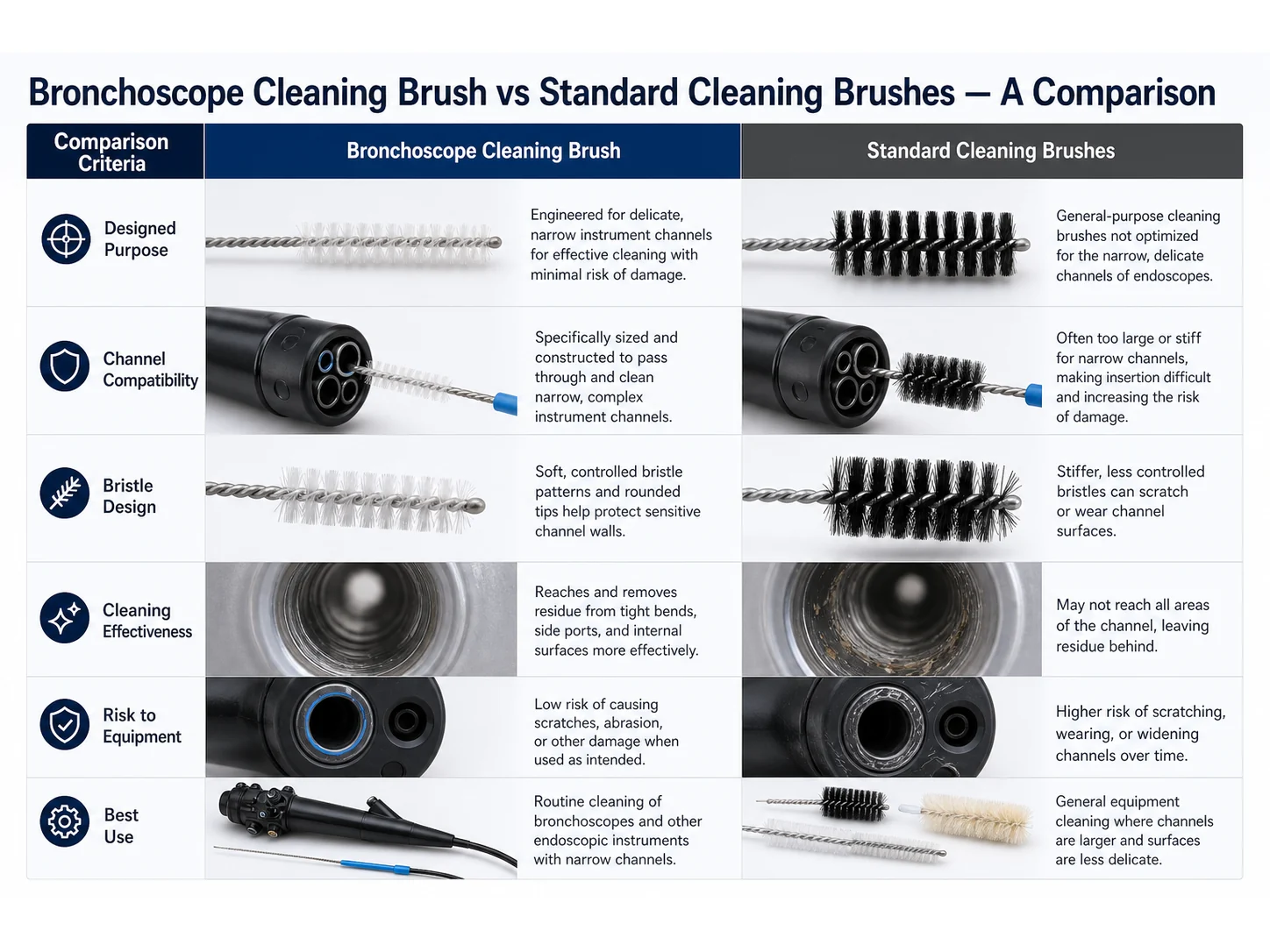
Enteroscope channels typically range from 1.0 mm to 3.2 mm in diameter and may be several meters in length. The small internal diameter and multiple bends (such as the elevator mechanism) create dead‑space areas where biofilm can accumulate. A standard cleaning brush, pipe cleaner, or cotton swab is either too large, too stiff, or too abrasive, potentially scratching the channel surface. Scratches create crevices that harbor bacteria and make future cleaning more difficult. A dedicated enteroscope cleaning brush is engineered to:
- Match the exact channel diameter for full luminal contact.
- Use materials soft enough to avoid damaging the lining (e.g., hydrophilic nylon).
- Be sufficiently flexible to follow the scope’s articulation without kinking.
- Withstand exposure to enzymatic detergents and high‑level disinfectants.
Key Factors to Consider When Choosing an Enteroscope Cleaning Brush
Selecting the right brush involves more than just finding the correct diameter. Decision‑makers should evaluate:
- Channel diameter and length: The brush must be narrow enough to pass freely but wide enough to contact the walls. Length must reach the distal end plus several centimeters excess for manipulation.
- Bristle material: Nylon is common for its softness and chemical resistance. PTFE‑coated bristles reduce friction. Avoid metal bristles for enteroscope channels.
- Shaft stiffness and flexibility: A nitinol or plastic core may be more flexible than stainless steel for deeply looped scopes. The brush must navigate the elevator guidewire channel without jamming.
- Tip design: A rounded, non‑traumatic tip prevents perforation of the sealed distal end. Double‑ended brushes offer a spare or a different bristle configuration.
- Handle ergonomics: A textured, slip‑resistant handle improves grip during long protocols. Some handles include a luer lock for attaching a cleaning adapter.
- Compatibility with cleaning chemistry: Confirm the brush materials are rated for enzymatic solutions, peracetic acid, or other chemicals used in your facility.
- Sterilization compatibility: If reusable, the brush must withstand steam autoclave, ethylene oxide, or plasma sterilization cycles without degrading.
Common Brush Options and Their Trade-offs
The table below compares typical enteroscope cleaning brush designs and their practical considerations. Specifications are general ranges; always confirm exact dimensions with the brush supplier and the scope manufacturer’s instructions for use (IFU).
| Brush Type | Description | Best For | Limitations | Typical Diameter |
|---|---|---|---|---|
| Standard single‑channel brush | Straight shaft with bristles on one end; basic handle | Routine manual cleaning of straight channels | May not effectively clean elevator mechanism; single use often recommended | 1.0–3.2 mm |
| Biopsy port cleaning brush | Very small diameter brush designed for biopsy channel and suction port | Pre‑cleaning before full channel brushing | Too short for full channel length; can shed bristles if worn | 0.8–2.0 mm |
| Double‑ended brush | Two brushes on opposite ends of one handle, often different sizes or bristle stiffness | Cleaning two channel sizes without changing tools; cost‑effective | Risk of cross‑contamination between channels if not handled properly; may be too stiff for tight bends | 1.2–2.8 mm each end |
| Sponge‑tipped brush | Soft open‑cell foam tip behind bristles, or a separate sponge brush | Gentle scrubbing of lint‑sensitive surfaces; absorbent cleaning | Foam may degrade faster in enzymatic cleaners; not suitable for heavy biofilm | 1.5–3.0 mm |
| Channel cleaning adapter brush | Brush integrated into a flush port adapter that connects to an irrigation pump | Combined flushing and brushing; reduces manual handling | More complex setup; requires specific adapter for each scope model | Varies with adapter |
How to Match Brush Design to Your Cleaning Protocol
Modern endoscope reprocessing guidelines (e.g., AAMI ST91, SGNA) emphasize single‑use brushes to eliminate the risk of cross‑contamination from inadequate sterilization. However, some facilities still use reusable brushes for cost reasons. The decision should be based on:
- Infection control policy: Does your facility mandate single‑use accessories for critical (semi‑critical) devices?
- Reprocessing workflow: Can a single‑use brush be disposed of after each case without logistical disruption?
- Validation: Do you have data proving that reusable brushes can be cleaned and sterilized effectively?
- Chemical exposure: Reusable brushes must survive repeated exposures to high‑level disinfectants and heat, which can degrade bristles over time.
When in doubt, matching the brush exactly to the scope manufacturer’s IFU is the safest path. Some scope manufacturers even specify a recommended brush model or supplier.
Common Mistakes When Selecting a Cleaning Brush
- Choosing by diameter alone: Even if the diameter fits, a brush that is too stiff can damage the channel lining or get stuck at a bend.
- Using a worn brush: Bristles that are bent, twisted, or missing can scratch the channel and fail to remove biofilm. Frayed metal shafts are a safety hazard.
- Assuming universal compatibility: Not all brushes are safe for all scope brands; the elevator mechanism, channel tolerances, and bends vary. Always check with the scope manufacturer.
- Using the wrong brush length: A brush that is too short leaves the distal channel uncleaned; too long may kink or wrap around internal components.
- Neglecting pre‑inspections: Brushes should be inspected before each use for damage, loose bristles, or corrosion. Damaged brushes must be discarded immediately.
- Over‑brushing: Excessive force or high‑speed rotation can generate friction heat and potentially damage the channel lining.
When an Enteroscope Cleaning Brush Is Not Enough
Even the best brush cannot compensate for inadequate pre‑soaking, wrong cleaning chemistry, or a brush that is fundamentally ill‑suited to the channel geometry. Consider alternatives or additional steps when:
- Extremely narrow channels (<1.0 mm): A micro‑brush or a specialized cleaning wire may be required. Flushing with detergent alone is insufficient for biofilm removal.
- Sharp bends or loops: If the brush core repeatedly kinks or fails to traverse the elevator guidewire channel, a more flexible core material (e.g., nitinol) or a different cleaning technique (e.g., automatic endoscope reprocessor with channel irrigation) may be needed.
- Calcified or dried debris: Hardened residue must first be softened with an enzymatic soak. Brushing alone only pushes debris deeper.
- Validation uncertainty: If the brush cannot be tested on the actual scope model, request a supplier drawing or sample for fit and friction testing. For high‑risk protocols, a cleaning verification test (e.g., protein test, ATP test) is advisable.
- Cross‑contamination risk: In reusable brush programs, if sterilization logs show failures or brush degradation, switching to single‑use may be the safer choice.
Final Takeaway
An enteroscope cleaning brush is the right choice for narrow instrument channels when it matches the channel diameter, length, and bend radius, and when its materials are compatible with the cleaning chemicals and sterilization method. Start with the scope manufacturer’s instructions, select a brush that falls within those specifications, and always validate the brushing protocol with visual inspection and cleaning efficacy tests. When the brush cannot fully meet the channel’s demands, do not force it; instead, explore more flexible designs, supplementary cleaning steps, or a different reprocessing strategy.
Frequently Asked Questions
What is the typical diameter range for enteroscope cleaning brushes?
Enteroscope channel brushes are commonly available in diameters from 1.0 mm to 3.2 mm. The exact size should match the scope manufacturer’s specification for each channel (biopsy, suction, elevator).
Can I use the same brush for multiple endoscope models?
Only if the brush’s diameter, length, and material are explicitly approved for each scope model. Using an unvalidated brush risks channel damage and inadequate cleaning. Check the scope manufacturer’s IFU or contact them for a list of compatible accessories.
How do I know if a brush is too stiff for my scope?
Insert the brush gently without forced rotation. If resistance is felt at bends or markings appear on the brush shaft afterwards, the brush may be too stiff. A proper brush should pass smoothly with minimal friction.
Should I choose single‑use or reusable brushes?
Single‑use brushes eliminate reprocessing failures and cross‑contamination but produce more waste. Reusable brushes lower per‑use cost but require strict sterilization protocols, regular inspection, and eventual replacement. Infection control policies and published guidelines increasingly favor single‑use for endoscope channels.
What is the difference between a cleaning brush and a channel cleaning adapter?
A cleaning brush provides manual mechanical scrubbing. A channel cleaning adapter combines a brush with a flush port, allowing simultaneous irrigation and brushing. Adapters require a compatible water or air supply and are scope‑model‑specific.
How often should I replace a reusable cleaning brush?
Follow the brush manufacturer’s recommended usage limit or inspect it before each use. Replace immediately if bristles are deformed, broken, or the shaft shows signs of metal fatigue, kinking, or corrosion. A typical reusable brush is often rated for 20–50 sterilization cycles, depending on the material.
Can an enteroscope cleaning brush be used for other narrow instrument channels, such as those in a laparoscope?
Possibly, but laparoscope channels are often shorter and may have different lining materials. Always check the laparoscope manufacturer’s cleaning instructions before using any brush across different device types. A brush validated for a specific enteroscope is not automatically safe for other instruments.