
What Is a Bronchoscope Cleaning Brush?
A bronchoscope cleaning brush is a specialized reprocessing tool made for manually cleaning the internal channels of flexible endoscopes. It has a long, flexible shaft (often nylon-coated or of reinforced wire) and a tip with precisely positioned bristles that effectively scrub the inner walls without damaging the delicate lining. The brush diameter is matched to the channel size to ensure full contact without excessive force or risk of perforation. These brushes are typically single-use or designed for high-level disinfection and sterilization between uses.
Common Types and Materials for Narrow Channel Brushes
Narrow channel brushes vary in construction based on the intended application, channel material, and level of contamination expected. The following options are commonly seen in both bronchoscope-specific and general-purpose designs:
- Nylon bristles on flexible plastic shaft: Soft and gentle, ideal for sensitive and easily scratched channels. Common in bronchoscope brushes.
- Brass core with nylon bristles: Adds stiffness for more aggressive scrubbing but must be used cautiously in flexible scopes.
- Stainless steel shaft with wire bristles: Very durable and aggressive, typically for industrial or rigid instrument cleaning. Too abrasive for flexible endoscopes.
- Foam or sponge tip brushes: Used for fluid absorption and light debris removal in very narrow catheters, but not effective for adherent biofilm.
- Single‑use vs. reusable designs: Single‑use brushes reduce cross‑contamination risk; reusable brushes require validated sterilization after each use.
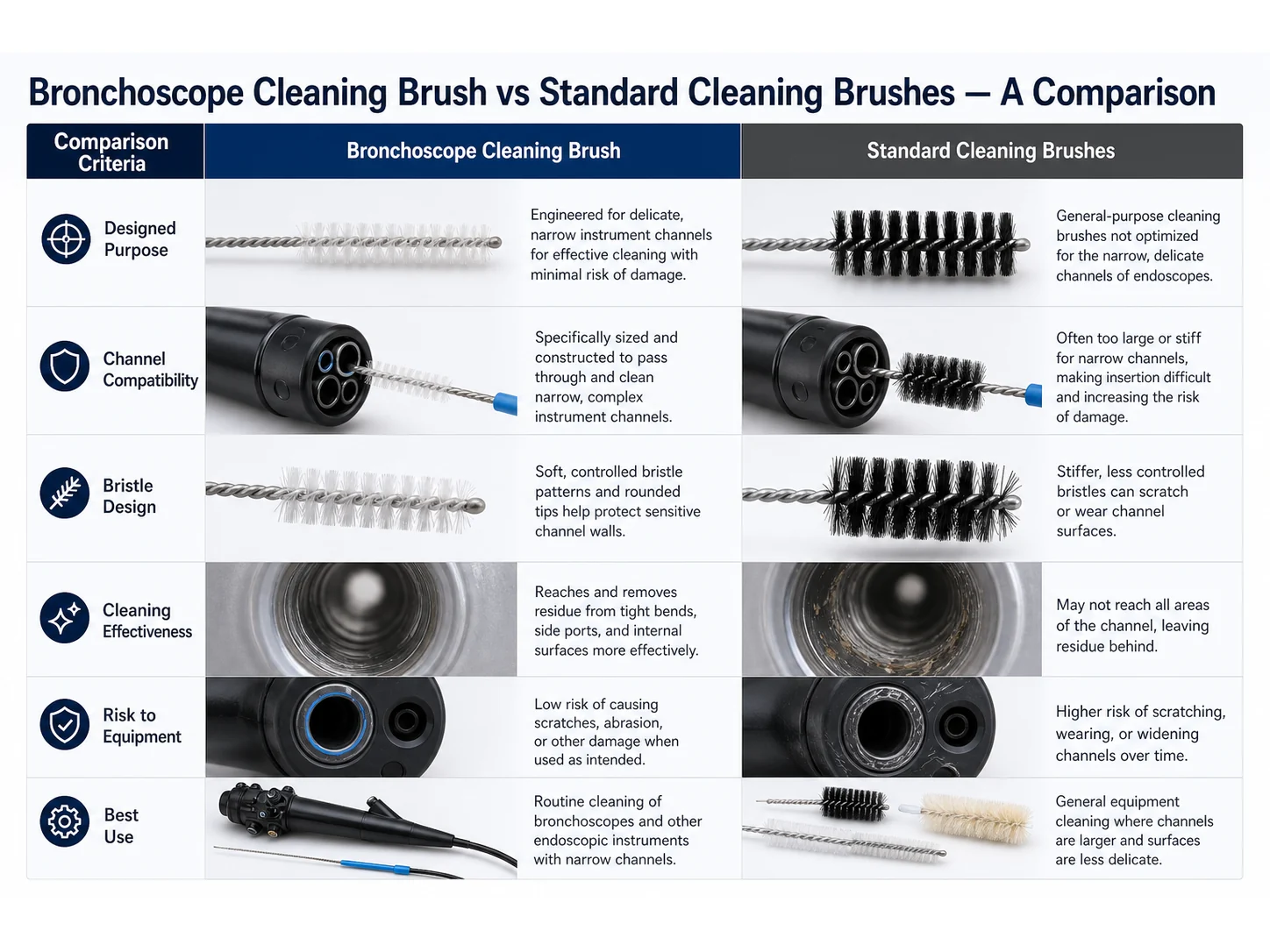
Bronchoscope Cleaning Brush vs Standard Cleaning Brushes — A Comparison
| Feature | Bronchoscope Cleaning Brush | Standard Cleaning Brush (e.g., test tube brush, pipe cleaner, wire brush) |
|---|---|---|
| Typical Diameter | 1.0 – 3.2 mm, tightly matched to channel | Often > 3 mm or not precisely sized |
| Bristle Material | Soft nylon or similar synthetic fibers | Nylon, wire, or natural fibers; often coarse |
| Shaft Flexibility | High, for navigating curved channels without kinking | Low to moderate; may kink, buckle, or snap |
| Risk of Channel Damage | Minimal when correct size is used | High — may scratch, stretch, or puncture lining |
| Cleaning Efficacy | Excellent for biofilm and organic residue removal in narrow lumens | Poor to fair — bristles may not fully contact walls or may skip areas |
| Chemical Compatibility | Tested with enzymatic cleaners and high‑level disinfectants | Often unknown or limited |
| Sterilization Method | Designed for ETO, autoclave (if reusable), or single‑use disposal | Not usually validated for medical sterilization |
| Cost per Use | Moderate; justified by infection prevention | Lower initial cost but higher long‑term risk |
How to Choose the Right Brush for Narrow Instrument Channels
Selecting the appropriate channel brush requires evaluating the physical constraints of the instrument and the nature of the contamination. Use the following checklist to guide your decision:
- Channel diameter: Measure the working channel ID precisely. The brush diameter should be slightly smaller than the channel to avoid binding, but large enough for bristle contact.
- Residue type: Light bodily fluids may only need a soft brush; dried mucus, blood, or biofilm may require a brush with denser bristles or a more aggressive tip.
- Surface sensitivity: Bronchoscope channels have delicate linings. Only non‑abrasive bristles should be used; metal wire brushes are never acceptable.
- Chemical exposure: Ensure the brush material withstands the enzymatic and disinfectant chemicals used in your reprocessing protocol.
- Reprocessing workflow: Single‑use brushes eliminate risks of incomplete sterilization. If you select reusable brushes, verify that your facility can validate the sterilization process.
- Frequency of use: High‑volume reprocessing centers may benefit from durable, reusable brush designs; low‑volume or high‑risk settings often favor single‑use.
- Custom size requirements: For non‑standard channel diameters (e.g., some pediatric scopes), off‑the‑shelf brushes may not fit properly. Request a technical drawing from the supplier to verify compatibility.
Common Mistakes When Cleaning Narrow Instrument Channels
Even with a dedicated bronchoscope cleaning brush, mistakes can compromise patient safety. Watch out for these pitfalls:
- Using a brush that is too large or too stiff: This can damage the channel lining and create crevices where bacteria hide.
- Relying on automated flushing without manual brushing: Biofilm removal requires physical scrubbing; chemicals alone are often insufficient.
- Re‑using a single‑use brush: Manufacturers validate cleaning efficacy only for the first use. Re‑use may leave residual debris and cross‑contaminate.
- Neglecting to flush the channel after brushing: Dislodged debris must be rinsed out immediately; otherwise it can re‑adhere or block the channel.
- Ignoring brush tip inspection: Worn or bent bristles reduce cleaning effectiveness and may shed particles inside the scope.
- Using a brush with an unknown chemical compatibility: Some standard brush materials degrade when exposed to peracetic acid or glutaraldehyde, leaving residues.
- Assuming all “thin brushes” are equivalent: A test tube brush or a piece of pipe cleaner cannot substitute for a validated medical‑grade brush.
When a Bronchoscope Cleaning Brush Is the Wrong Choice
A bronchoscope cleaning brush is a critical tool, but it is not a standalone solution. Consider these limitations:
- Heavy biofilm or calcified deposits: If the channel shows visible buildup despite brushing, additional enzymatic soak or ultrasonic cleaning may be needed.
- Damaged or eroded channels: If the channel lining is compromised, no brush can clean it effectively, and the scope may need repair or replacement.
- Failure to pass a leak test: A damaged channel must be identified before brushing, as a brush could worsen the leak or introduce contaminants.
- Non‑standard channel geometries: Some specialized endoscopes have branching or angled channels that a straight brush cannot fully reach. A custom‑designed brush or an alternative cleaning method may be required.
- Lack of validated sterilization: Even a perfect cleaning brush is useless if the subsequent disinfection process fails. Always follow manufacturer instructions and AAMI standards.
Final Takeaway
For narrow instrument channels like those in a bronchoscope, a purpose‑built bronchoscope cleaning brush is the usually safer and effective choice. Standard brushes may appear similar, but their mismatched diameters, harsher bristles, and unvalidated materials significantly increase the risk of channel damage, incomplete cleaning, and infection transmission. Decide based on channel size, residue challenge, surface sensitivity, and the sterility requirements of your reprocessing workflow. When in doubt, consult the instrument manufacturer’s IFU and request technical documentation from your brush supplier to ensure a proper match.
Frequently Asked Questions
Can I use a test tube brush to clean a bronchoscope channel?
No. Test tube brushes are typically too large, too stiff, and have bristles that can scratch the delicate channel lining. They are not designed for the chemical exposures or sterilization methods used in medical reprocessing.
What bristle material is safest for bronchoscope cleaning brushes?
Soft nylon or synthetic fibers are the gold standard. They effectively remove biofilm without scratching the channel. Wire bristles, even when coated, are too abrasive for flexible endoscope channels.
How do I know if a brush is the right diameter for my scope?
Check the bronchoscope’s Instructions for Use (IFU) for the working channel internal diameter. The brush diameter should be slightly less than that—usually 0.5 to 1.0 mm smaller—to allow smooth passage while maintaining full wall contact.
Are single‑use brushes really better than reusable ones?
Single‑use brushes eliminate the risk of inadequate sterilization and cross‑contamination between patients. Reusable brushes are acceptable only if your facility has validated a sterilization method that does not degrade the brush after multiple cycles.
What should I do if a brush tip breaks off inside the channel?
Stop reprocessing immediately. Do not attempt to push the broken piece further. Notify the biomedical engineering department. Retrieve the fragment under direct visualization, if possible, and inspect the channel for damage before returning the scope to service.
Can I use the same brush for different endoscopes?
No. Even if the channel diameter is similar, cross‑contamination risks are unacceptable. Single‑use brushes should be disposed of after one procedure. Reusable brushes must be reprocessed according to a validated protocol before being used in a different scope.
How often should reusable bronchoscope cleaning brushes be replaced?
There is no universal rule, but inspect bristles for wear, bending, or debris buildup before each use. Many guidelines suggest replacing reusable brushes after a certain number of reprocessing cycles or when any sign of degradation is visible. Follow the brush manufacturer’s recommendations.
Do I still need to use an enzymatic cleaner if I’m brushing manually?
Yes. Manual brushing is a mechanical step that works best in conjunction with enzymatic or detergent-based chemicals to break down proteins and biofilm. Chemical action plus physical scrubbing provides the most reliable cleaning outcome.
Technical References
- CDC — Disinfection and Sterilization Guideline
- CDC — Core Infection Prevention and Control Practices
- FDA — Reprocessing Medical Devices in Health Care Settings
Which bristle material fits this job — Nylon PA, AISI 304 Stainless Steel Wire or PBT?
| Material | Continuous temperature (°C) | Peak temperature (°C) | Water absorption | Hardness |
|---|---|---|---|---|
| Nylon PA | 93 | 121 | 0.3–9% by PA grade and conditioning | Medium to firm; filament diameter and trim length control bending force. |
| AISI 304 Stainless Steel Wire | 400 | 500 | 0% | Rockwell B 70–95 depending on temper and cold work |
| PBT | 120–140 | 160–180 | 0.05–0.20% | Shore D 80–90 |
| Polypropylene PP | 80–100 | 120–140 | ≤0.03% | Shore D 65–75 |
Figures as published by Brushtec / DuPont; Alleima; Perlon. Confirm the exact grade against the supplier datasheet before ordering.
What should replace Handheld Detail Brushes when they stop working?
- Handheld Detail Brushes — Handheld detail brushes cover general precision cleaning; auto-detailing brushes impose tighter controls for painted, polished, leather, display, and trim surfaces.
- Nylon PA — Compare Nylon PA with PP, PBT, PET. Change material when wet stiffness, temperature, chemical resistance, conductivity, particle shedding, or surface marking becomes the limiting factor.
- AISI 304 Stainless Steel Wire — Use AISI 316 stainless steel wire for chloride, marine, dairy, beverage, chemical washdown, or higher pitting-resistance requirements. Use carbon steel for dry aggressive cutting and brass or abrasive nylon for lower marking risk.
- PBT — Compare PBT with Nylon, PP, PET. Change material when wet stiffness, temperature, chemical resistance, conductivity, particle shedding, or surface marking becomes the limiting factor.