What Is a Carbon Brush?
In an industrial context, a carbon brush is a tool with bristles made from carbon-based materials—pure carbon fiber, carbon-impregnated polymers, or conductive carbon yarn—used for tasks like static dissipation, gentle surface cleaning, polishing, or abrasive finishing. Unlike standard nylon or steel brushes, carbon brushes offer a balance of conductivity, low particle shedding, and controlled stiffness, making them essential in electronics assembly, textile machinery, and metalworking where contamination or static buildup must be avoided.
For static-control claims, this article uses EOS/ESD Association — ESD Fundamentals as the ESD reference.
For static-control claims, this article uses EOS/ESD Association — Principles of ESD Control as the ESD reference.
For the safety point in this section, the relevant OSHA reference is OSHA — Combustible Dust.
For the environmental or chemical-safety point in this section, the supporting reference is EPA — Particulate Matter Basics.
For material-selection language, this section is supported by British Plastics Federation — Thermoplastics.
For brush terminology and construction language, this section references American Brush Manufacturers Association — Brush Lingo.
Carbon brushes come as rollers, cups, strips, disks, or hand-held tools, and they must match the machine interface, rotational speed, and the specific residue or finish requirement.
Common Types of Carbon Brushes
Industrial carbon brushes vary by structure and bristle composition:
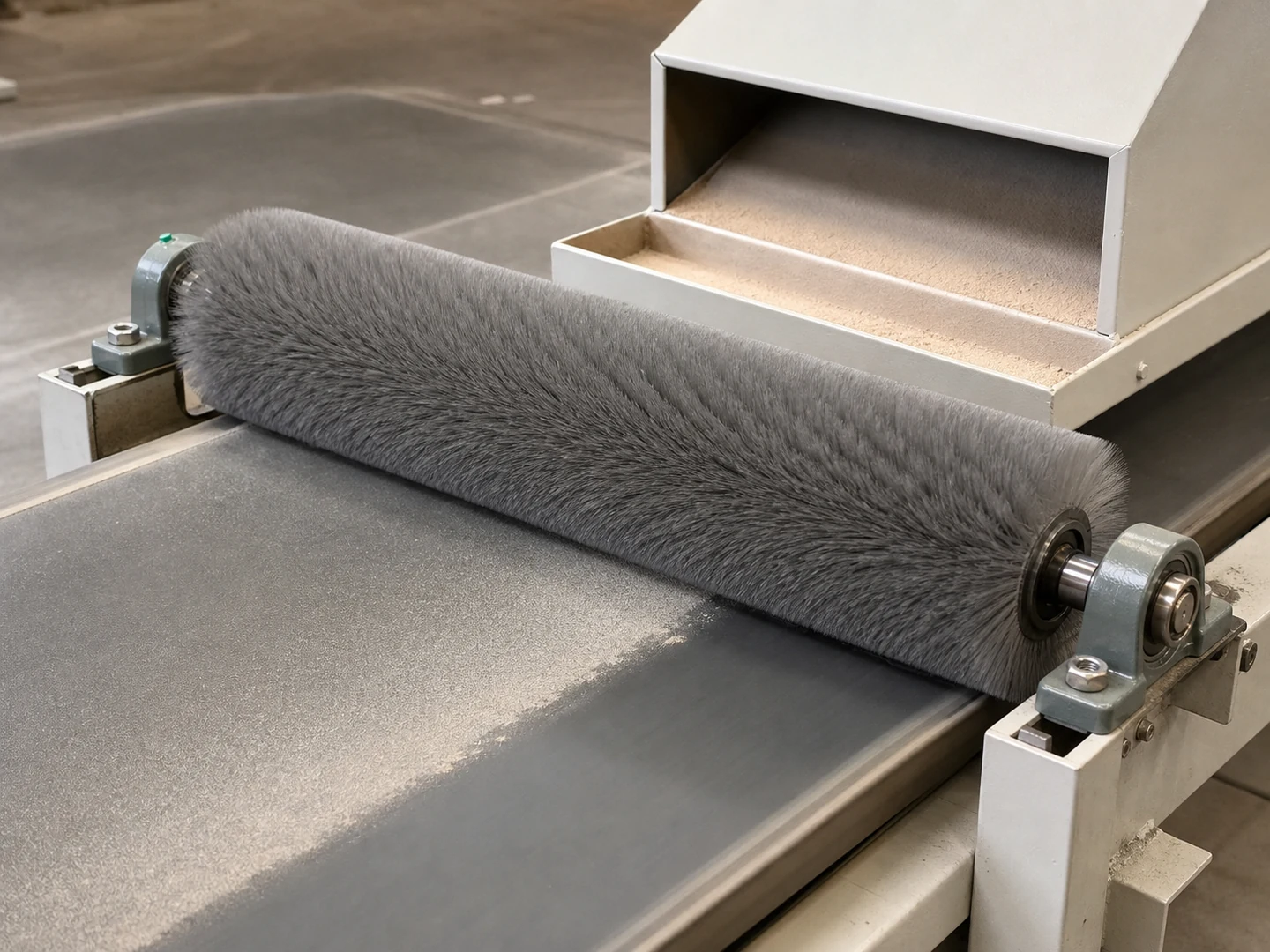
- Roller brushes: Cylindrical brushes that mount on a shaft; used in continuous web cleaning, textile sueding, or panel brushing.
- Cup brushes and wheel brushes: Attach to power tools for deburring, weld cleaning, or surface prep.
- Strip brushes: Linear profiles with a metal channel, often used as seals or static dissipation strips on conveyors.
- Hand brushes: Manual tools for bench-top anti-static cleaning or touch-up work.
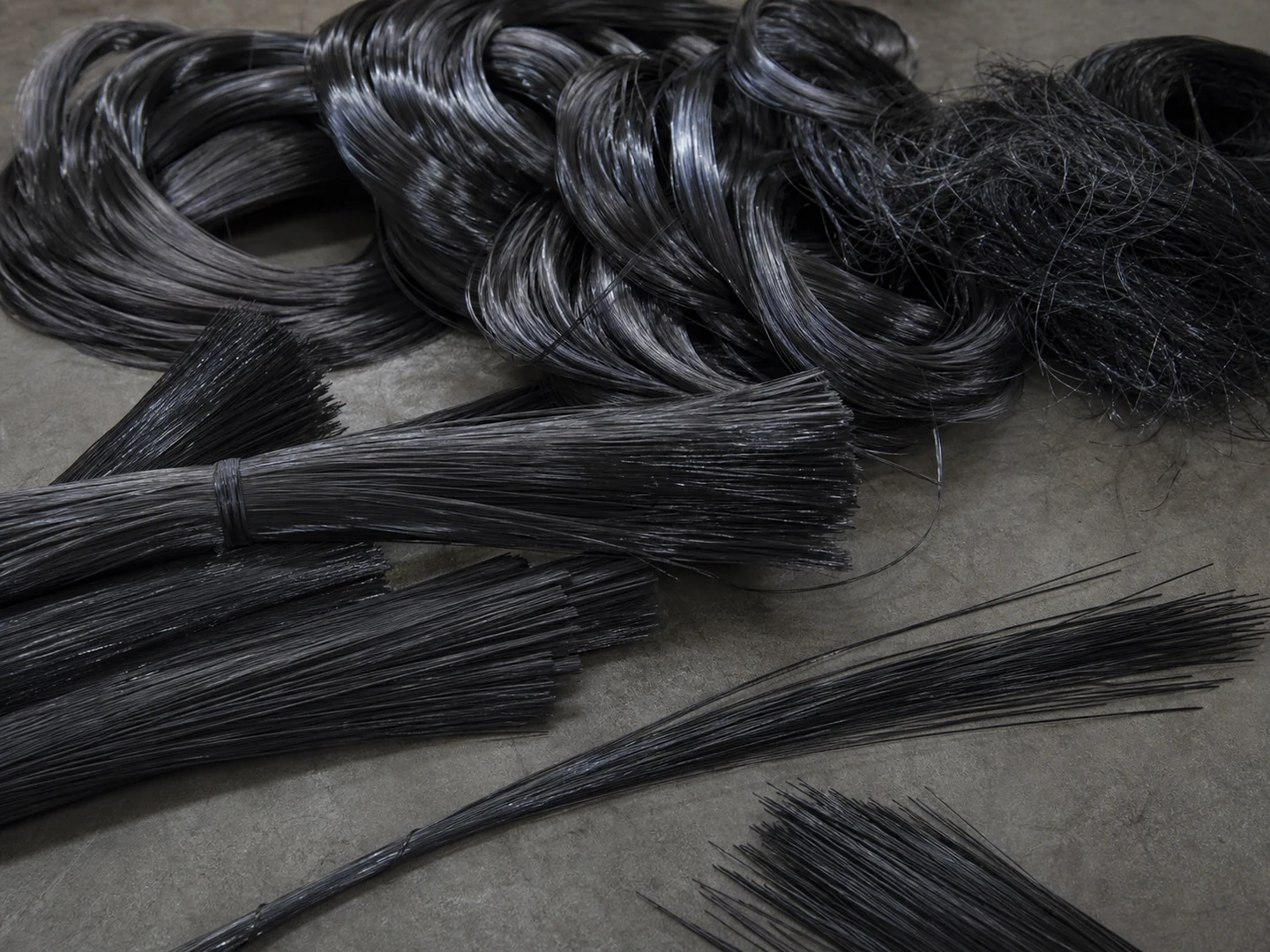
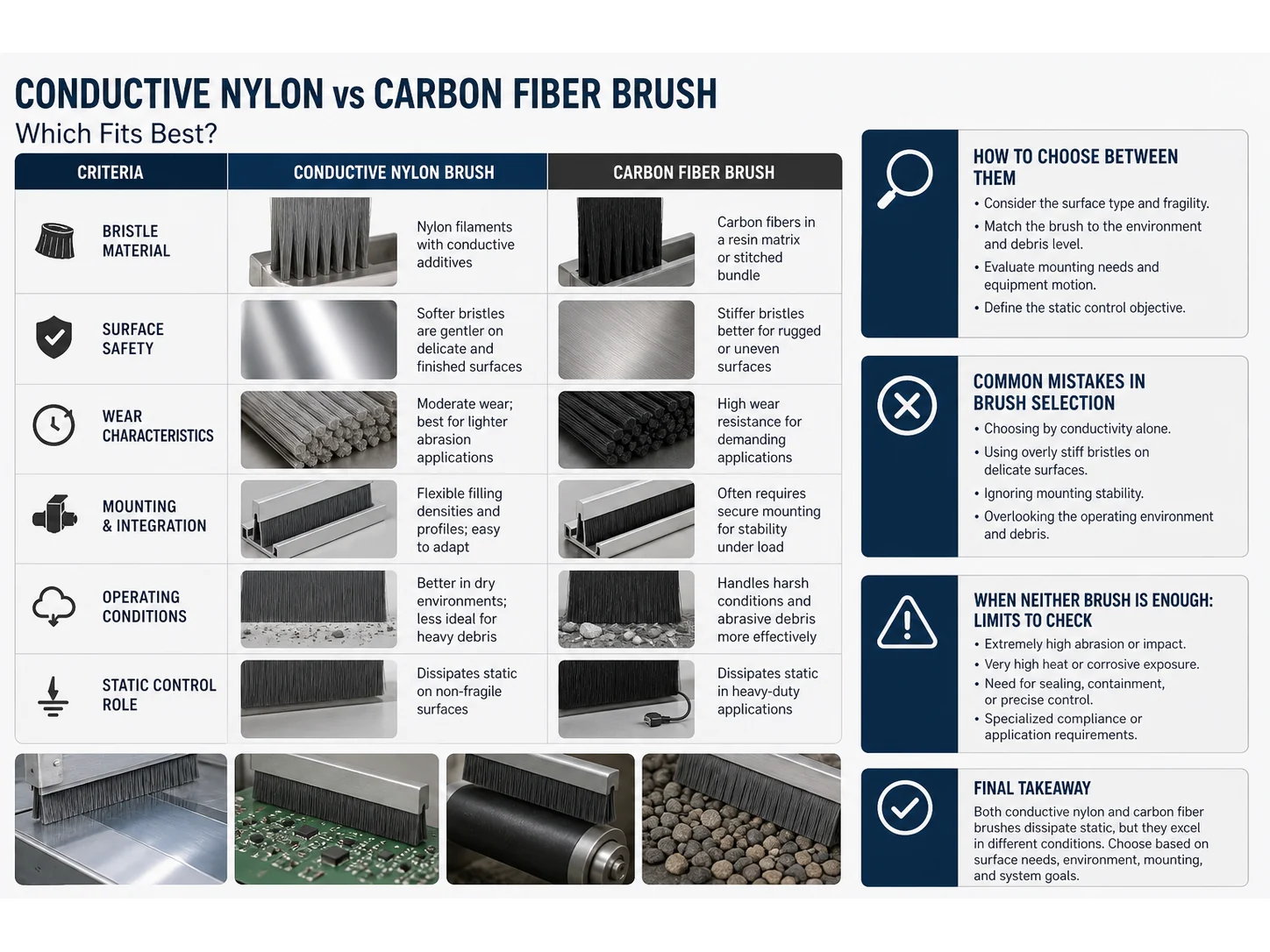
- Bristle materials: Pure carbon fiber (conductive, low dust), carbon‑nylon blends (moderate stiffness, low cost), carbon steel wire (abrasive, durable), and conductive acrylic (soft, for delicate surfaces).
Carbon Brush Bristle Comparison
| Bristle Type | Stiffness | Conductivity | Temp. Limit | Best For | Typical Mounting |
|---|---|---|---|---|---|
| Pure carbon fiber | Medium‑soft | High | ~350°F (177°C) | Anti‑static cleaning, sensitive electronics | Roller, strip |
| Carbon‑nylon blend | Medium | Moderate | ~250°F (121°C) | General dust removal, light surface finishing | Roller, cup, strip |
| Carbon steel wire | Very stiff | Conductive | ~500°F (260°C) | Rust removal, weld scale, heavy deburring | Cup, wheel, coil |
| Conductive acrylic | Soft | High (with fillers) | ~200°F (93°C) | Optical films, medical device wiping | Strip, disk |
How to Choose the Right Carbon Brush
Move step-by-step from the machine interface to the application environment:
1. Measure the Equipment Interface
Record the shaft diameter, keyway, overall length, and mounting style (clamp‑on, keyed, flanged) before anything else. A wrong bore will make even the best bristle unusable.
2. Define the Contact Surface and Action
Is it a flat plate, curved roll, or irregular profile? Does the process require light wiping, aggressive scrubbing, or uniform surface treatment? Match bristle stiffness and density to the force required without marking the substrate.
3. Identify Residue Type
Dry dust needs a softer, high‑surface‑area bristle; sticky oils or polymers demand a stiffer bristle and possibly a lubricant‑resistant core. Conductive residues may short‑circuit static‑sensitive products—choose a material with controlled surface resistivity.
4. Check Operating Speed and Temperature
High‑RPM roller brushes require a balanced core and a bristle that won’t deflect excessively. Near ovens or in warm environments, verify the temperature limit of both bristle and adhesive.
5. Estimate Replacement Cycle
A cheaper brush that wears out twice as fast can inflate maintenance costs. In continuous‑duty textile or metal lines, choose a brush known for consistent wear life under your specific load and speed.
Installation and Usage Factors That Affect Performance
Even the best brush can fail if it is not set up correctly:
- Proper mounting alignment: A shaft brush that runs eccentric will create uneven wear and vibration.
- Contact pattern: Aim for even bristle contact across the work surface; a tilted or partially engaged brush wastes capacity.
- Pressure adjustment: Too much pressure accelerates wear and generates heat; too little fails to clean or dissipate static.
- Speed limits: Exceeding the manufacturer’s rated RPM can throw bristles or damage the core.
- Routine inspection: Check for bristle loss, fraying, or foreign material buildup that could scratch the product.
Common Mistakes When Selecting Carbon Brushes
- Ordering by size alone. A brush that physically fits may have the wrong bristle material for your residue or temperature.
- Ignoring rated RPM. A small cup brush on a high‑speed grinder can disintegrate dangerously if not designed for that speed.
- Choosing an overly aggressive bristle. Carbon steel wire on a soft substrate can gouge the surface instead of cleaning it.
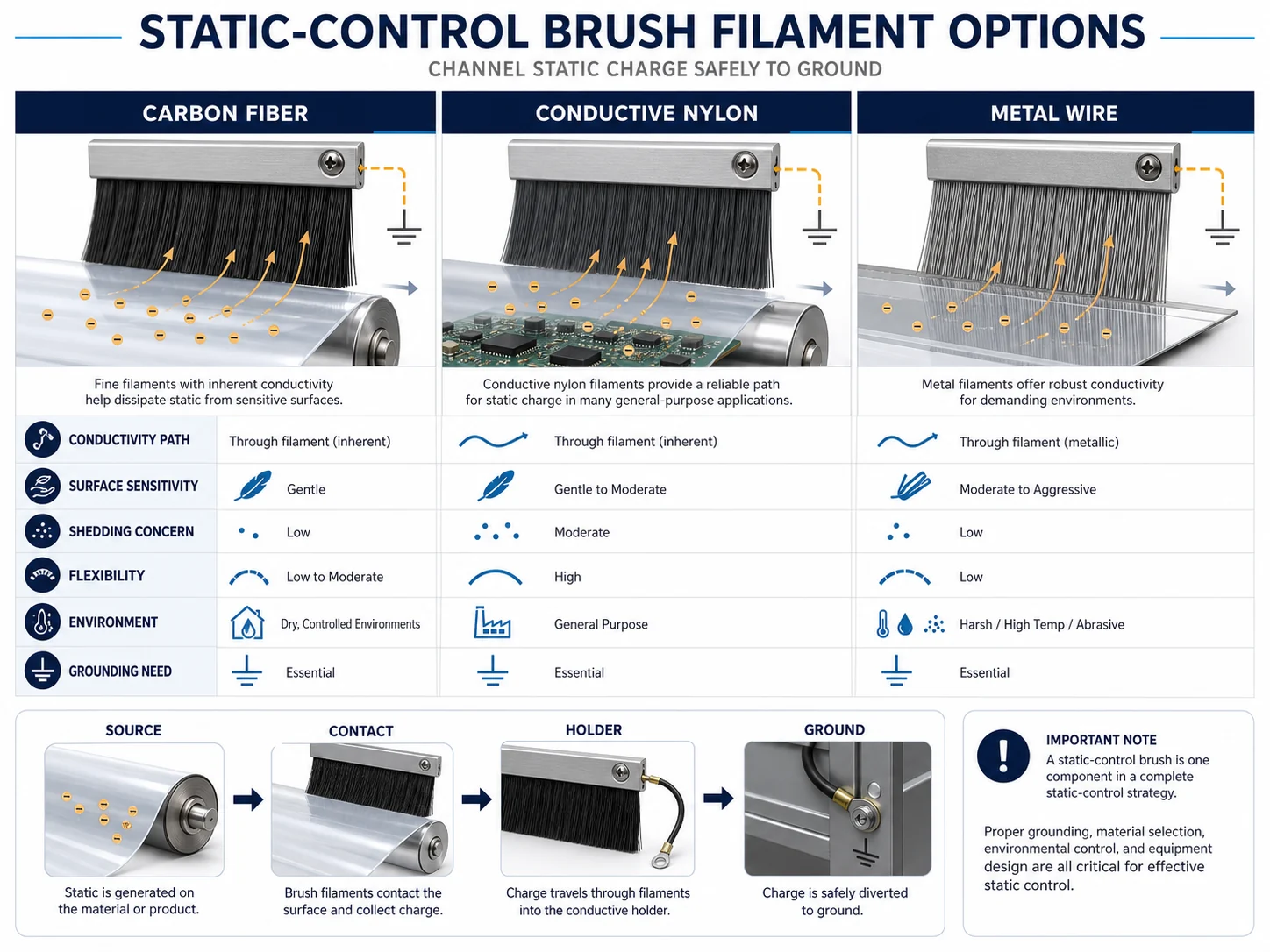
- Using a conductive brush in a non‑insulated setup. Static‑dissipative brushes need a proper grounding path; otherwise they build a charge.
- Neglecting bristle density. A sparse brush may not cover the contact area, while an over‑dense brush can stall a low‑torque drive.
- Assuming all carbon brushes are anti‑static. Only those with specified surface resistivity values are fit for static control.
When Standard Carbon Brushes Are Not Enough
Off‑the‑shelf brushes solve many tasks, but certain conditions demand a custom design:
- Unusual machine interfaces: Non‑standard shaft diameters, special keyways, or integrated flanges require a custom roller print.
- Extreme environments: Oven temperatures above 500°F, cleanroom protocols, or food‑grade requirements call for materials and adhesives that stock brushes may not offer.
- Very high speeds: Rotational speeds over 3,000‑4,000 RPM often need a balanced core and a bristle tested at that velocity.
- Tight electrical specifications: A precise surface resistivity target (e.g., 10³ to 10⁶ ohms‑square) may not be met by general‑purpose conductive bristles.
- Non‑standard dimensions: Extra‑long roller lengths, narrow strips, or unusual brush diameters must be engineered from scratch.
In these cases, work with a brush manufacturer to submit a drawing or request a sample. Confirm the construction method (channel‑back, coil‑wound, molded) and discuss project quantity requirement quantities and production schedules upfront so the custom solution fits your downtime window.
Final Takeaway: Making a Confident Carbon Brush Choice
Start with the machine interface measurements, then match bristle material to the cleaning task and operating conditions. Verify speed and temperature ratings, and don’t overlook bristle density and mounting precision. If a standard option falls short, a custom drawing or sample can prevent costly trial and error. With the right brush, you’ll see consistent finishes, longer run times, and fewer unplanned changeovers.
Practical Use Note
In daily use, the practical test is simple: check whether the brush reaches the full contact area, removes the target residue, and leaves the surface in the required condition. Record what changes when surface finish, solvent exposure, access angle, scratch tolerance, and soil severity changes, because many brush failures are caused by the working condition shifting rather than by the brush body alone.
Frequently Asked Questions
What is the difference between carbon fiber and carbon steel wire brushes?
Carbon fiber brushes are softer, non‑sparking, and ideal for static dissipation and gentle cleaning. Carbon steel wire brushes are much stiffer and abrasive, suited for rust removal, weld scale, and heavy‑duty surface prep.
Can I use a carbon brush for wet applications?
It depends on the bristle and core material. Pure carbon fiber and some carbon‑nylon blends can tolerate moisture, but the adhesive and hub must also be water‑resistant. Always check the manufacturer’s specifications before using a brush in a washdown area.
How do I measure the correct size for a replacement brush roller?
Measure the existing roller’s core diameter, core length, overall brush diameter, and shaft bore. If the shaft is keyed, note the keyway dimensions. Compare these against a supplier’s standard size chart or provide them when requesting a quote.
What causes premature bristle shedding on a new carbon brush?
Common causes include running the brush above its rated RPM, excessive pressure against the work surface, or a manufacturing defect. Ensure the brush is properly installed, aligned, and operated within its design limits. New brushes may shed a small amount of loose fiber initially—this should stop quickly.
How often should I replace a carbon brush in a continuous operation?
There is no single number; it depends on bristle material, contact pressure, and the abrasiveness of the residue. Monitor the brush diameter or strip profile over time and set a replacement threshold based on when cleaning performance drops or when the bristle length reaches its minimum usable value, typically established during the first few weeks of use.
Can I trim a brush strip to length to fit a narrower machine?
Yes, most strip brushes can be cut with a fine‑tooth saw or good snips. However, take care to leave a clean edge and ensure the bristle material is not frayed. For conductive brushes, verify that cutting does not expose grounding conductors in a dangerous way.
What are anti‑static carbon brushes used for?
They remove static charges from surfaces such as plastic film, paper webs, or electronic assemblies. The conductive carbon bristles provide a safe path to ground, preventing dust attraction, sparking, or damage to sensitive components.
How do I choose the right bristle density for a roller brush?
Higher bristle density gives more cleaning points per square inch and typically longer wear life, but it also increases rotational resistance. Choose density based on the drive motor’s torque capacity and the level of contact required—a dense brush for uniform finishing, a less dense one where debris must be released easily.