
What Is a Conductive Nylon Brush?
A conductive nylon brush is a cleaning or static control tool made with nylon bristles that contain conductive fillers such as carbon black. The bristles can be abrasive (with embedded grit) or non-abrasive, and they are commonly formed into cup wheels, disc brushes, or strip brushes. Conductive nylon brushes are designed to remove fine residue while safely dissipating static charge, making them popular for light deburring, surface cleaning, and anti-static treatment of electronic components, plastic parts, or coated metal surfaces.
What Is a Carbon Fiber Brush?
A carbon fiber brush uses bristles made of pure carbon fiber filaments, often bundled and trimmed to a specific length. Carbon fiber offers excellent electrical conductivity and high stiffness, so these brushes are widely used in static elimination applications, particularly in printing, packaging, and electronics manufacturing. Carbon fiber brushes can be configured as anti-static brushes, cleaning brushes, or even in specialized abrasive forms. They withstand higher temperatures than nylon and resist many chemicals, but the bristles are generally stiffer and more prone to snapping under extreme flex conditions.
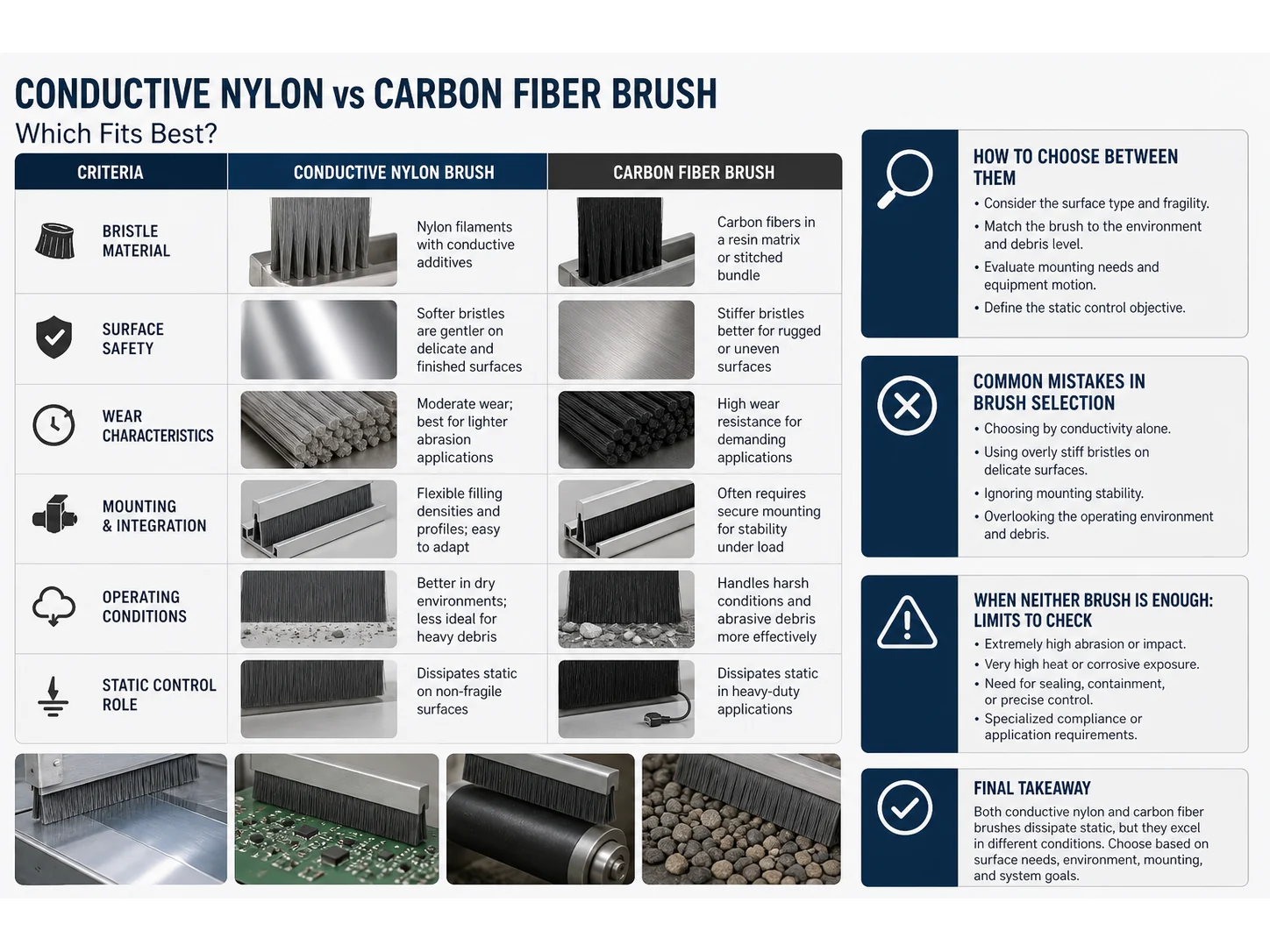
Conductive Nylon vs Carbon Fiber Brush: Key Differences
| Factor | Conductive Nylon Brush | Carbon Fiber Brush |
|---|---|---|
| Bristle material | Nylon with conductive additive (carbon-loaded) | Pure carbon fiber filaments |
| Stiffness | Moderate; can be formulated for soft or firm flex | High stiffness; minimal flex |
| Surface safety | Generally gentle; non-abrasive grades safe for delicate surfaces | Stiffer bristles may scratch soft substrates if not properly designed |
| Wear behavior | Gradual wear; abrasive grades maintain finish consistency | Brittle fracture; bristles snap rather than wear down |
| Electrical conductivity | Surface resistivity typically 10³–10⁶ Ω/sq | Very low resistivity, often <1 Ω per fiber |
| Heat resistance | Limited; nylon may soften above ~180°C (356°F) | Excellent; withstands >300°C (572°F) without degradation |
| Chemical resistance | Good resistance to many solvents, acids, and alkalis | Excellent; inert to most chemicals |
| Mounting options | Wide variety: cup, wheel, disc, strip brush designs | Typically strip or channel mounts; less common in cup form |
| Typical use cases | Light deburring, cleaning of PCBs, anti-static wiping, floor cleaning, pipe cleaning | Static elimination in printing, web cleaning, film handling, high-temperature cleaning |
How to Choose Between Conductive Nylon and Carbon Fiber Brushes
The decision depends on your specific operating conditions and workpiece requirements. Use these factors to guide your selection:
- Workpiece material: If you are cleaning soft metals, coated surfaces, or plastics that scratch easily, a non-abrasive conductive nylon brush is often safer. For harder, more resilient substrates or applications where surface finish is not critical, carbon fiber can be used.
- Residue type: For dry fine dust and static dissipation, both brush types work well. If you need light mechanical cleaning with a mild abrasive effect, opt for an abrasive nylon version. Carbon fiber excels at static removal but may not clean as effectively if physical scrubbing is required.
- Dry or wet use: Conductive nylon brushes tolerate moisture well and can be used in wet cleaning processes. Carbon fiber is generally stable in dry conditions; wet environments may not damage the fibers but can reduce their static-dissipation efficiency if water interferes with electrical contact.
- Replacement constraints: Carbon fiber brushes often have a longer useful life in static-only applications but can break bristles under repeated flex. Conductive nylon wears more predictably and may be easier to replace in standardized cup or wheel forms.
- Temperature: For high-temperature operations (e.g., near ovens, in plastic film extrusion), carbon fiber maintains its properties where nylon would soften.
- Mounting style: If your equipment already uses cup wheels or disc brushes, conductive nylon may be an easier drop-in fit. Carbon fiber often comes in linear strip form, which suits web cleaners or anti-static bars.
Common Mistakes in Brush Selection
Even experienced buyers can make errors when choosing between these two brush types. Watch out for these pitfalls:
- Assuming all nylon brushes are non-abrasive: Conductive nylon can be loaded with abrasive grit, so verify the grade if surface safety is a priority.
- Choosing only by cost: A cheaper brush may wear faster or cause product defects, leading to higher total cost.
- Ignoring static decay time requirements: Carbon fiber almost instantly dissipates static, while nylon may have a slight delay. If you need rapid discharge at high line speeds, test the actual performance.
- Overlooking bristle breakage risks: Carbon fiber filaments can snap and become particulate contaminants in cleanroom or painted-surface applications. Nylon is generally more durable in dynamic flex applications.
- Using the wrong brush for the cleaning method: A cup brush may not access narrow channels, while a thin strip brush might not cover enough area. Match the brush shape to the workpiece geometry.
When Neither Brush Is Enough
Conductive nylon and carbon fiber brushes handle many static control and light cleaning tasks, but some scenarios require a different approach:
- Heavy deburring or thick coating removal demands a more abrasive tool such as a wire brush or grinding disc. Conductive brushes are not designed for aggressive stock removal.
- Extremely delicate surfaces (optical lenses, certain thin films) may be damaged by any brush contact. In such cases, ionizing air nozzles or non-contact static eliminators are a safer alternative.
- Complex 3D contours may need a custom brush design with mixed filament types, specific trim lengths, or flexible backings that go beyond standard conductive nylon or carbon fiber strip configurations.
- Applications requiring simultaneous high heat, chemical exposure, and mechanical scrubbing might combine aspects that exceed the limits of either brush type. Consult a brush manufacturer for a custom engineered solution.
Final Takeaway
Choose a conductive nylon brush when you need moderate static dissipation with gentle, predictable cleaning and a wide range of mounting styles. Choose a carbon fiber brush when you need high-speed, high-temperature static elimination with minimal surface contact. Always define your workpiece material, residue characteristics, and operating environment before comparing options. Testing a sample brush under real production conditions remains the most reliable way to confirm your selection.
When a Conductive Nylon Brush Is the Wrong Choice
This brush is not enough when the main problem is blocked access, unsafe working conditions, damaged equipment, incompatible chemicals, or a process setting that keeps recreating the residue. In those cases, review surface finish, solvent exposure, access angle, scratch tolerance, and soil severity and confirm the surrounding cleaning method before increasing brush stiffness or contact pressure.
Frequently Asked Questions
Can conductive nylon brushes be used in wet applications?
Yes. Conductive nylon resists moisture and many chemicals, making it suitable for wet cleaning. However, prolonged soaking in certain solvents may degrade the conductive additive over time, so check chemical compatibility with your specific nylon grade.
Do carbon fiber brushes shed fibers onto the workpiece?
Over time, carbon fiber bristles can break, leaving small conductive fragments on the surface. In applications where contamination is unacceptable (e.g., medical device assembly), consider a non-abrasive conductive nylon brush or a non-contact static eliminator.
What is the difference between an anti-static brush and a cleaning brush?
An anti-static brush prioritizes electrical conductivity and static dissipation, often with minimal physical scrubbing. A cleaning brush may have a similar conductive function but is designed primarily to remove particles. Many brushes serve both roles, but selection depends on whether static or residue removal is the main task.
How do I determine the right brush density and trim length?
Brush density (bristle count per unit area) and trim length affect stiffness, contact area, and static dissipation efficiency. Work with your supplier to match the brush to your line speed, substrate sensitivity, and access constraints. No single density or length works for all situations.
Can I replace a worn conductive nylon cup brush with a carbon fiber version in the same toolholder?
Typically no. Cup brushes and strip brushes use different mounting methods. Measure your tool’s arbor, RPM rating, and brush profile first. Carbon fiber brushes are rarely offered in cup wheel form; they usually come as strips or blocks for web cleaners. A direct swap may require design changes.
Are there conductive nylon brushes safe for food processing environments?
Some food-grade nylon materials exist, but you must confirm that the brush and any conductive fillers meet FDA or local food contact regulations. Standard industrial conductive nylon may not be approved for direct food contact without verification from the manufacturer.
How do I know if I need an abrasive or non-abrasive conductive nylon brush?
If you need light surface preparation, deburring, or oxide removal, choose an abrasive grade (with silicon carbide or aluminum oxide grit). For purely static control and gentle dusting, a non-abrasive conductive nylon brush is safer. Abrasive grades will show grit particles within the filament.
What is the expected lifespan of a carbon fiber brush compared to conductive nylon?
In static-only, low-wear applications, carbon fiber can last indefinitely. Under mechanical contact, carbon fiber snaps and frays, while nylon wears gradually. Lifespan depends on speed, pressure, and environment. By testing both, you can establish realistic replacement intervals for your specific process.
Which bristle material fits this job — Conductive Nylon, Carbon Fiber or Nylon PA?
| Material | Continuous temperature (°C) | Peak temperature (°C) | Water absorption | Hardness |
|---|---|---|---|---|
| Conductive Nylon | 80–110 | 130–160 | 0.5–2.5% | Shore D 75–88 |
| Carbon Fiber | 200–350 | 400–500 | ≤0.10% | — |
| Nylon PA | 93 | 121 | 0.3–9% by PA grade and conditioning | Medium to firm; filament diameter and trim length control bending force. |
Figures as published by Brushtec / DuPont. Confirm the exact grade against the supplier datasheet before ordering.
What should replace Handheld Detail Brushes for carbon fiber brush?
- Handheld Detail Brushes — Handheld detail brushes cover general precision cleaning; auto-detailing brushes impose tighter controls for painted, polished, leather, display, and trim surfaces.
- Conductive Nylon — Compare Conductive Nylon with Anti-static filament, carbon fiber, stainless conductive filament, standard PA6. Change material when wet stiffness, temperature, chemical resistance, conductivity, particle shedding, or surface marking becomes the limiting factor.
- Carbon Fiber — Compare Carbon Fiber with Conductive nylon, anti-static filament, stainless micro-wire, standard nylon. Change material when wet stiffness, temperature, chemical resistance, conductivity, particle shedding, or surface marking becomes the limiting factor.
- Nylon PA — Compare Nylon PA with PP, PBT, PET. Change material when wet stiffness, temperature, chemical resistance, conductivity, particle shedding, or surface marking becomes the limiting factor.