
What Is a Static-Control Brush?
A static-control brush is a tool designed to safely remove or discharge electrostatic charges from a surface. Unlike an ordinary cleaning brush, its bristles are made from materials that either conduct electricity or dissipate static, providing a controlled path to ground. These brushes are commonly used in electronics manufacturing, cleanroom environments, battery production, and any process where uncontrolled static discharge can damage components, attract dust, or create safety hazards.
Common Types of Static-Control Brushes
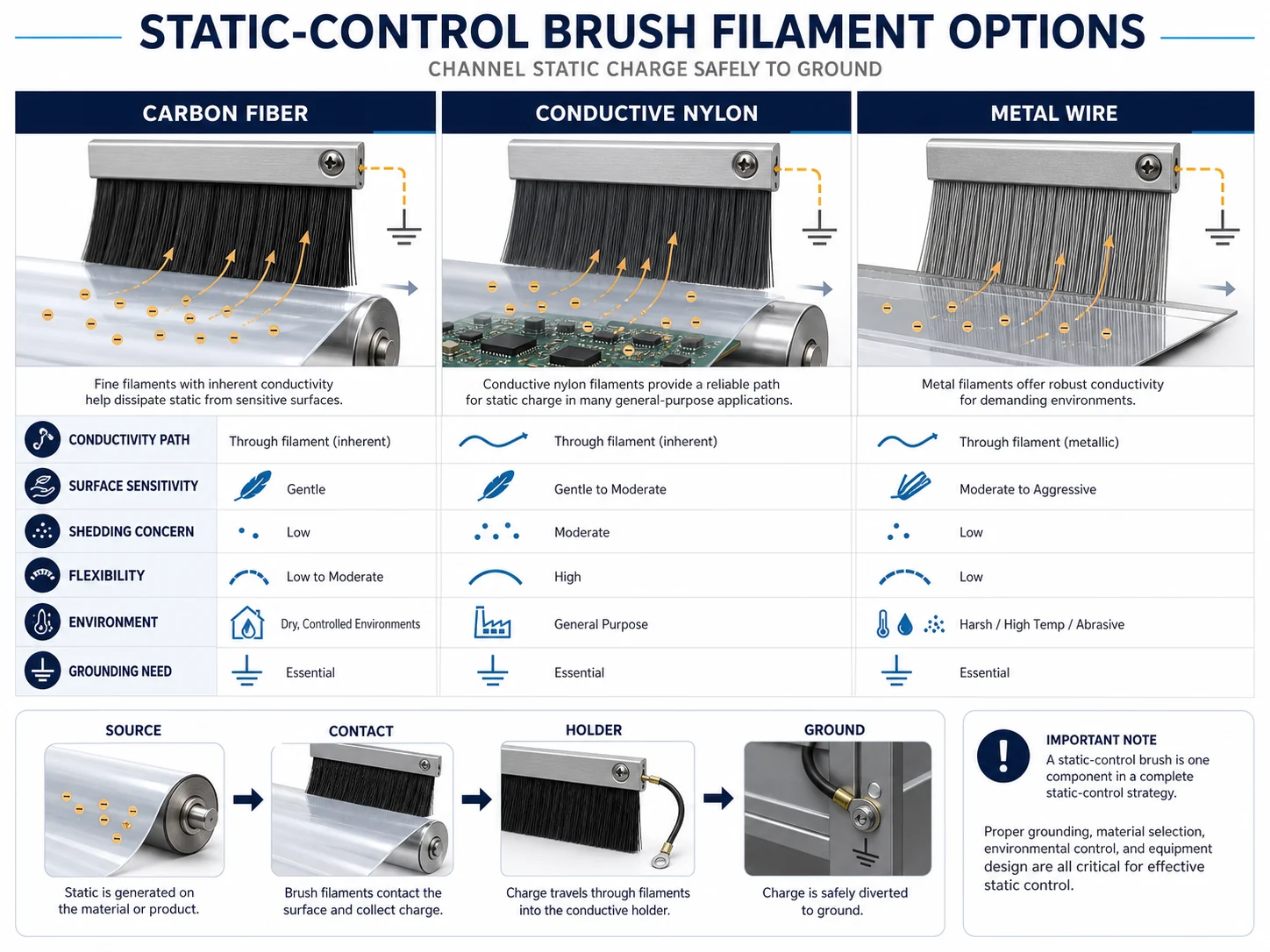
While many variations exist, most static-control brushes fall into three material categories: carbon fiber, conductive nylon, and metal wire. Each offers a different balance of conductivity, abrasiveness, particle generation, and cost.
Carbon Fiber vs Conductive Nylon vs Metal Wire: A Comparison
The table below compares the three brush types across key selection factors. Use this as a starting point when evaluating options for your line or process.
| Feature | Carbon Fiber | Conductive Nylon | Metal Wire |
|---|---|---|---|
| Conductivity approach | High intrinsic conductivity; bristles often self-ground when in contact with a grounded surface | Moderate resistivity; relies on conductive fillers or coatings; requires a dedicated grounding path | Very high conductivity; metal bristles can directly ground through a handle or mounting |
| Surface sensitivity | Gentle, non-scratching; safe for most delicate electronic assemblies | Soft and flexible; low risk of scratching; suitable for sensitive surfaces | Abrasive; can scratch coatings, soft metals, and plastic housings; not for precision surfaces |
| Shedding / particle risk | Low shedding if brush is well-constructed; fibers can snap with heavy pressure; inspect for loose fibers | Low shedding; high-quality grades produce minimal particles; verify fiber integrity for cleanroom use | No bristle shedding, but metal wear debris and corrosion particles can contaminate; not for cleanrooms |
| Cleaning method | Dry wiping or with static-dissipative solvents; avoid soaking | Washable with mild cleaners; can be used with dissipative liquids | Requires thorough drying to prevent rust; use with contact cleaners that leave no residue |
| Typical integration positions | Static elimination bars, bench-top brushes, inline web cleaners, manual ESD-safe brushes | Anti-static cleaning brushes for PCBs, computer components, electronic enclosures | Heavy-duty cleaning of machine parts, battery terminals, grounding brushes for rotating shafts |
| Cost factor | Higher cost due to material and manufacturing | Moderate cost; wide availability | Lowest cost in many industrial forms |
How to Choose a Static-Control Brush
Your selection should be based on measurable criteria and real process constraints, not on appearance or cost alone. Work through these five factors before you order or specify a brush.
- Required resistance range: Define the acceptable resistance-to-ground for your application. For ESD-sensitive devices, a brush with a resistance between 10⁶ and 10⁹ ohms is often specified. Carbon fiber typically falls at the lower end, while conductive nylon may need verification. Request material data sheets.
- Grounding path design: A brush must reliably connect to a common ground point. Check how the bristles are attached to the handle or mounting block. Carbon fiber brushes can sometimes rely on bristle contact, but most installations need a dedicated ground wire or metal body connection.
- Contamination limits: If you work in a cleanroom or near optical surfaces, total particle shedding and ionic contamination matter. Ask for outgassing data, particle test reports, or suitability certifications. Metal brushes are almost never appropriate in such environments.
- Operating conditions: Consider line speed, stroke frequency, presence of solvents, and temperature. Carbon fiber may fray under constant high-speed rubbing. Conductive nylon can absorb moisture and temporarily change resistivity. Metal wire may corrode in humid or chemical atmospheres.
- Maintenance and replacement: Determine how often the brush needs cleaning or replacement. Built-up contaminants can mask the conductive properties. Factor in brush life when comparing total cost of ownership.
Common Mistakes in Static-Control Brush Selection
Even experienced buyers choose incorrectly when they skip verification steps. Avoid these five pitfalls.
- Choosing by bristle softness alone. A soft brush may feel safe but still generate static if it lacks a dissipation path. Always confirm the material’s resistivity.
- Assuming all carbon fiber brushes are ESD-safe. Not all carbon fiber is equal. Some low-quality brushes use mixed fibers that can charge up. Demand a surface resistance measurement.
- Using metal brushes near sensitive electronics. The high conductivity of metal can cause rapid discharge surges, and the abrasive action can create conductive debris that causes shorts.
- Ignoring contamination transfer. A brush that cleans one part may deposit conductive particles onto the next. In battery or PCB assembly lines, this cross-contamination can cause latent failures.
- Forgetting the full grounding circuit. A brush connected to an ungrounded handle or a floating bracket does nothing. Test the entire grounding chain from bristle tip to facility ground.
When a Static-Control Brush Alone Is the Wrong Choice
Static-control brushes are one part of a larger ESD mitigation strategy. In high-speed web handling, you may need active ionizing bars. In cleanrooms, you may need ULPA-filtered vacuum systems alongside a brush. For explosive atmospheres, the brush must be documented for the hazard class and paired with special grounding interlocks. When an application carries high voltage, high current, or involves battery terminals with residual charge, a simple dissipative brush cannot protect against arc flash or short circuit. In these cases, involve a qualified ESD engineer and request third-party test data from the brush supplier.
Final Takeaway
Select a static-control brush by matching its material properties to your required resistance range, your surface’s sensitivity, and your contamination budget. Carbon fiber offers excellent conductivity with low particle risk for electronic assemblies. Conductive nylon provides a soft, cost-effective option for general electronics cleaning when properly grounded. Metal wire brushes are powerful tools for heavy-duty cleaning but rarely belong near ESD-sensitive components or in clean environments. Always verify the full grounding path and ask for supporting material data before making a final decision.
Frequently Asked Questions
What resistance range is acceptable for an ESD-safe brush?
Industry guidelines such as ANSI/ESD S20.20 typically call for a resistance to ground between 1×10⁶ and 1×10⁹ ohms for dissipative materials. Specific applications may narrow this window, so check your internal ESD control plan.
Can I use a regular nylon brush and treat it with anti-static spray?
Temporary anti-static sprays can reduce charging, but they are not a reliable permanent solution. The film can wear off unevenly, attract dust, and may not provide a defined resistance to ground. For consistent static control, choose a brush with inherent dissipative properties.
How do I test whether my static-control brush is still working?
Use a surface resistance meter or a static field meter. Place the brush bristles on a grounded surface and measure resistance from the bristle tips to the handle’s ground point. If readings drift above the acceptable range, clean the brush according to the manufacturer’s instructions and retest. Replace if cleaning restores conductivity but performance degrades rapidly.
Is a metal wire brush safe for cleaning battery terminals?
Metal wire brushes can effectively remove corrosion from battery terminals, but they introduce risks. They can create sparks if the battery is not disconnected, and loose metal bristles can cause short circuits. For static-control applications near battery cells during manufacturing, use a dissipative brush approved for the specific energy level and environment.
What should I look for in a static-control brush for a cleanroom?
Cleanroom-compatible static-control brushes should have low particle generation, non-sloughing bristles, and a resistance that meets your cleanroom’s ESD requirements. Look for brushes that are tested to the applicable cleanroom standards and offered with certificates of compliance for outgassing and ionic cleanliness.
Do carbon fiber brushes shed particles over time?
High-quality carbon fiber brushes exhibit low shedding, but brittle fibers can break under high pressure or with age. Periodic inspection under magnification and regular replacement after a defined number of cycles can prevent contamination surprises.
Can one static-control brush work for both cleaning and static dissipation?
Yes, many dissipative brushes are designed to clean dust and debris while simultaneously draining charge. However, if the brush becomes saturated with insulating contaminants, its conductivity may drop. Implement a cleaning and testing schedule to keep it in spec.
Technical References
- EOS/ESD Association — ESD Fundamentals
- EOS/ESD Association — Principles of ESD Control
- World Stainless — Corrosion Resistance of Stainless Steels
- British Plastics Federation — Thermoplastics
Which bristle material fits this job — Conductive Nylon, Carbon Fiber or Nylon PA?
| Material | Continuous temperature (°C) | Peak temperature (°C) | Water absorption | Hardness |
|---|---|---|---|---|
| Conductive Nylon | 80–110 | 130–160 | 0.5–2.5% | Shore D 75–88 |
| Carbon Fiber | 200–350 | 400–500 | ≤0.10% | — |
| Nylon PA | 93 | 121 | 0.3–9% by PA grade and conditioning | Medium to firm; filament diameter and trim length control bending force. |
Figures as published by Brushtec / DuPont. Confirm the exact grade against the supplier datasheet before ordering.
What should replace Handheld Detail Brushes for static-control brush?
- Handheld Detail Brushes — Handheld detail brushes cover general precision cleaning; auto-detailing brushes impose tighter controls for painted, polished, leather, display, and trim surfaces.
- Conductive Nylon — Compare Conductive Nylon with Anti-static filament, carbon fiber, stainless conductive filament, standard PA6. Change material when wet stiffness, temperature, chemical resistance, conductivity, particle shedding, or surface marking becomes the limiting factor.
- Carbon Fiber — Compare Carbon Fiber with Conductive nylon, anti-static filament, stainless micro-wire, standard nylon. Change material when wet stiffness, temperature, chemical resistance, conductivity, particle shedding, or surface marking becomes the limiting factor.
- Nylon PA — Compare Nylon PA with PP, PBT, PET. Change material when wet stiffness, temperature, chemical resistance, conductivity, particle shedding, or surface marking becomes the limiting factor.