
Custom Cleaning Brush
ESD Static Control Brush
Grounded static control brush with conductive nylon or carbon fiber filaments for ESD-safe connector, PCB, and contact cleaning. Custom widths and mounts.
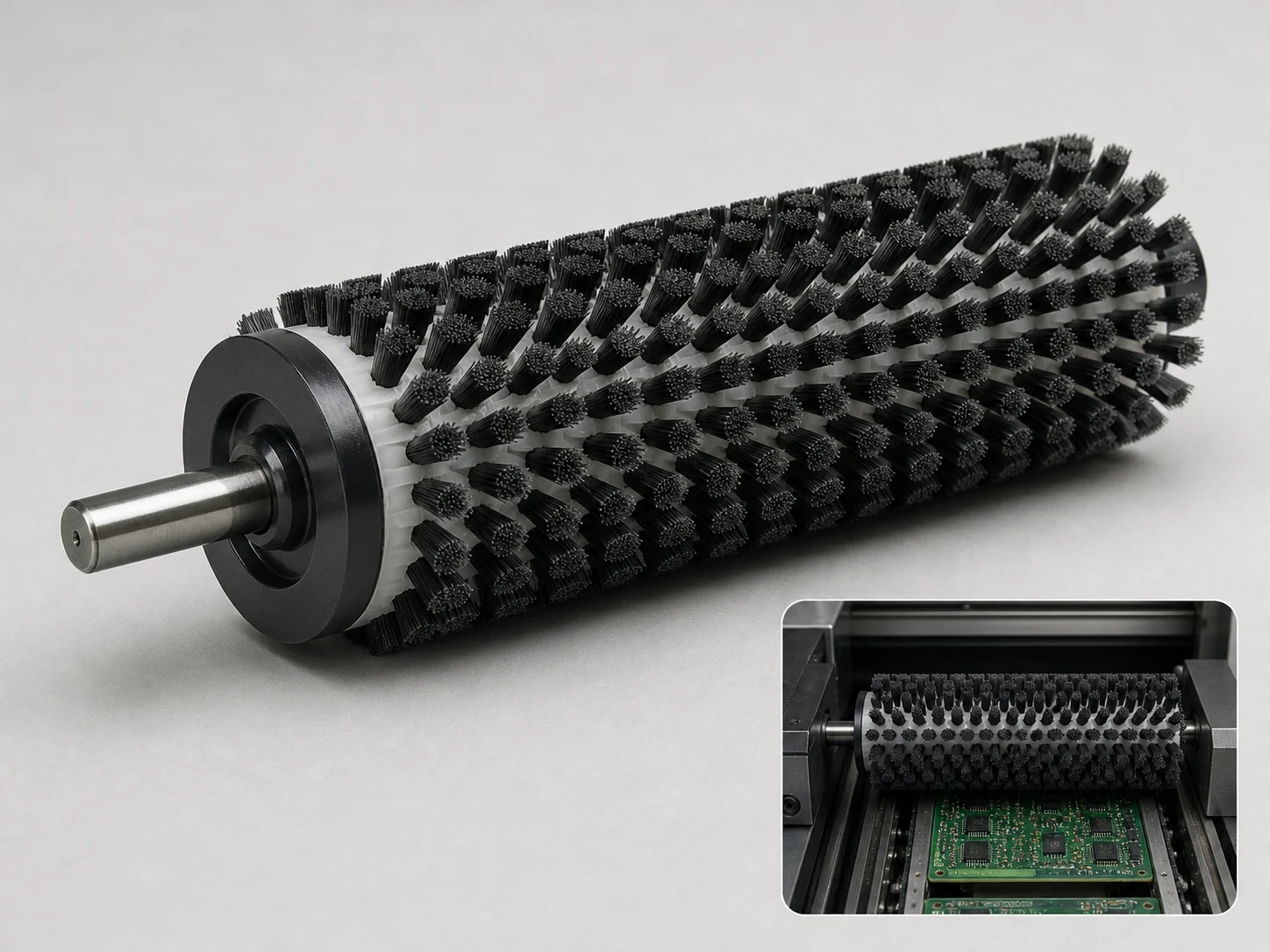
Medium brush
100 pcs
Minimum order
Worked with two hands or on a pole: chimney, gutter and pond-filter brushes, discs, cups and tank brushes.
Production lead time, once the specification is confirmed
- Up to 100 pcsWithin 7 days
- 101–5,000 pcsWithin 14 days
- 5,001–50,000 pcsWithin 21 days
- Over 50,000 pcsConfirmed with your quotation
Peak season can extend these times; the shipping date is confirmed in writing with your quotation. Sampling and shipping are quoted separately.
A grounded cleaning brush that removes static-attracted dust, fine particles, oxide film, and loose contamination from connectors, contacts, PCBs, terminals, and sensitive equipment — without leaving a charge behind. Conductive filaments carry the charge to a grounded handle or mounting strip, so the brush stays neutral while it sweeps.
What can this brush do for you?
Discharges static at the point of contact
Conductive nylon and carbon fiber filaments are connected to a grounded handle, strip, or machine mount. The brushing motion that would normally build a triboelectric charge on an insulative brush instead drains through the filament path to ground. That makes the brush itself an ESD-safe tool, not a new charge source in the work area.
Lifts particles instead of redistributing them
Static-attracted dust clings to connector bodies, contact rows, and panel surfaces because of a charge imbalance. As the filaments drain surface charge, the particles release and the mechanical sweep actually removes them. This is the difference between a static control brush and a standard brush that simply pushes charged dust to another location.
Reaches recessed contacts without bending pins
Fine conductive nylon and carbon fiber microfilaments slip between connector pins, into card edge slots, around soldered leads, and under component bodies. The fibers are compliant enough to clean the contact area without applying side load to fragile terminals.
Protects thin platings and sensitive finishes
Conductive nylon filaments are softer than abrasive or metal brushes, so they remove loose particles and light oxide without scratching gold, tin, or other thin contact platings. A conductive acrylic option is available for surfaces that need even softer contact, such as coated optics or delicate coatings.
Works as a handheld tool or a fixed line position
The same conductive path is available in a hand brush with a grounding cord, or as a strip, plate, or machine-mounted brush for a fixed cleaning station. Manual formats suit bench repair and inspection; mounted formats provide continuous static control and particle sweeping on board-handling, web, or panel lines.
What is a ESD Static Control Brush?
A ESD Static Control Brush is a cleaning tool in which the filament fill, ferrule or block, and handle are all part of a continuous path to ground. During use, any static charge present on the target surface or generated by brushing friction is carried away through the conductive filaments to the grounded handle or mount. The result is a controlled discharge while the brush sweeps away loose contamination.
Typical use is dry, mechanical cleaning in ESD-protected work areas. The brush is selected for connector cleaning, removing dust and oxide from PCB assemblies, contacts, terminals, and panel surfaces where an insulative brush could leave a residual charge and re-attract the same particles. It is used by hand at bench repair and inspection stations, or bolted into a fixed position on production equipment where parts pass under the brush face.
Two conditions make the brush work correctly: the filaments must remain conductive from root to tip, and the handle or mount must be bonded to a verified equipment ground. If either side of that path fails, the brush becomes an ordinary brush — and in an ESD-sensitive area, that means it becomes a potential source of static damage.
It is not an aggressive scrubber for burned-on deposits or corrosion scale, and it does not replace chemical cleaning. Its job is controlled static drainage plus removal of loose particles, fine dust, and light oxide films.
Technical Specifications
Dimensions, filament type, and ground interface are matched to the connector pitch, surface width, or machine mounting position. Typical build ranges:
| Parameter | Value / Options |
|---|---|
| Brush face width | 5–200 mm, matched to contact row or passage width |
| Trim length | 10–40 mm, selected for recess depth and stiffness |
| Filament materials | Conductive nylon, carbon fiber, or conductive acrylic alternative |
| Conductive nylon filament diameter | 0.045 mm |
| Carbon fiber filament diameter | 0.008–0.012 mm |
| Surface-to-ground resistance | 10³–10⁹ Ω, depending on filament and handle selection |
| Ground interface | Conductive handle with snap, banana jack, ring terminal, ground cord; or direct-bonded strip/plate/machine mount |
| Mounting | Handheld, mounting strip with holes or adhesive, plate, bracket, or machine holder |
| Filament density | Standard, dense, or extra-sparse, set by particle size and contact requirement |
| Operating position | Manual bench use or fixed in-line position; de-energized surfaces for manual work |
| Brush type | Custom Handheld Detail Brushes |
| How it is driven | Hand-guided |
| Cleaning target | connector body and contact row, pcb assembly and rework station, and terminal block and esd-protected production cell cleaning |
| Surface or part | connectors, terminals, panels, boards, recesses, edges, webs, sensitive equipment, and pins |
| Residue or debris | particles, dust, oxide, oxide film, fine particles, loose contamination, fine dust, static-attracted dust, and lint |
| Mounting / connection | Conductive handle with snap, banana jack, ring terminal, ground cord; or direct-bonded strip/plate/machine mount; Handheld, mounting strip with holes or adhesive, plate, bracket, or machine holder |
The resistance band is the parameter to confirm with your ESD coordinator: lower values drain charge faster, while higher values provide a more dissipative, controlled path. All values can be adjusted for the project.
Where does this brush work best?
- Connector bodies and contact rows. RJ45, USB, board-to-board, card edge, backplane, D-sub, and pin header cleaning where the brush face matches the connector span and the trim reaches into the recess.
- PCB assemblies before coating, soldering, inspection, or test. Remove lint, handling debris, and fine dust that can cause soldering defects or false AOI/test rejects.
- Electrical contacts and terminal blocks. Relay contacts, switch contacts, battery terminals, and control panel terminals that collect oxide film and fine particles.
- ESD-sensitive equipment service and inspection. Repair benches, field service kits, test fixtures, and pass-through stations where a standard brush would introduce charge.
- Fixed machine positions on board or web handling lines. Mounted strip or machine-holder configurations that neutralize and sweep surface dust as parts move past a set position.
How do I choose the right one?
Selection is driven by the contact surface, particle type, access geometry, and whether the brush will be used by hand or in a fixed position.
Match the filament to the residue and surface
Conductive nylon is the first choice for general static removal, light dust, and fine-pitch connectors because it is compliant and will not scratch thin contact plating. Carbon fiber is stiffer and more effective on oxide film, stubborn fine particles, and surfaces where more contact pressure is needed. Conductive acrylic is the alternative when the finish is ultra-soft or coated and even nylon contact is too aggressive.
Set the face width and trim length
Measure the widest connector, terminal row, or board edge the brush must cover in one pass. The brush face should span that contact area; trim length should let the filaments bottom out in recesses without bending at the sides. Longer trim reaches deep slots; shorter trim gives more controlled pressure on flat pads and low-profile contacts.
Confirm the ground path resistance
Select a filament, handle, and ground interface combination that lands inside your target ESD resistance band. Standard builds cover 10³–10⁹ Ω. If you do not have an internal target, use 10⁶–10⁹ Ω for general ESD-sensitive assembly work and discuss lower-resistance options when faster charge drain is required.
Choose the mounting style
Handheld brushes with a conductive handle and ground cord fit bench, repair, and inspection tasks. A strip with mounting holes or adhesive backing suits fixed cleaning positions on conveyors, printers, laminators, or board handlers. A plate or machine holder integrates the brush into automated equipment where a standard hand brush would not fit.
When this brush is not the right choice
Use a metal wire or abrasive brush if you need to remove heavy corrosion scale, burned-on deposits, or deep oxides. Use an ionizing bar or air ionizer if the requirement is non-contact static neutralization across a web or cavity. Use a solvent or ultrasonic process if the residue is flux, oil, conformal coating, or chemical film. The static control brush handles dry particle removal, light oxide, and controlled static drainage — not aggressive mechanical or chemical cleaning.
Can I customize this brush?
Most projects start from a target connector, board, or machine position. Provide the contact width, recess depth, platings, particle type, required resistance range, and whether the brush will be hand-held or mounted. A sample part or drawing helps us set the face, trim, and density correctly.
- Face geometry — width, length, angled or stepped profile, custom end shape for multi-level connectors or mixed contact heights
- Trim and density — trim length, filament density, curved or tapered trim patterns, and fill mix if the application needs two contact zones
- Filament material and diameter — conductive nylon, carbon fiber, conductive acrylic, or a project-specific conductive fiber with the diameter needed for the pitch
- Handle and ground interface — conductive or static-dissipative handle, ergonomic grip, snap/banana/ring-terminal/cord connection, or direct-bonded mount
- Mounting hardware — strip with holes, slots, or adhesive backing; plate, bracket, rail clamp, or machine holder matched to equipment
- Marking and packaging — part number marking on handle or block, ESD-shielding bags, bulk packing, line-side dispenser, or kit packaging
For projects that require ESD performance verification, material declarations, inspection documentation, or third-party testing support, we can assist during the customization process.
When is an ESD static control brush worn out rather than just dirty?
How do I verify that the brush is properly grounded before use?
Check continuity between the filament tips and the ground connection on the handle or mount with an ohmmeter or resistance meter. The reading should fall within the specified surface-to-ground band for the build, typically 10³–10⁹ Ω. Also confirm the ground cord, wrist strap point, or machine frame is actually bonded to a verified equipment ground. If the brush side or the equipment side is open, do not use the brush around ESD-sensitive components.
Can this brush be used on energized electrical equipment?
No. The conductive filaments and conductive body can carry current. For manual cleaning, de-energize the circuit, follow lockout/tagout, and confirm stored energy is discharged first. Cleaning energized equipment requires a qualified procedure and insulated tooling; a static control brush is not an insulated tool.
How do I clean the brush after it is loaded with dust?
Remove loose particles with dry, filtered, ionized air first. If a wet clean is necessary, use a solvent that is compatible with the filaments, ferrule, and handle, then dry completely before use. Any residue left on the fibers can act as an insulating film and break the ground path, so re-check resistance after cleaning.
Will this brush remove solder flux, conformal coating residue, or heavy corrosion?
No. The brush removes loose dust, lint, fine particles, and light oxide film, and it drains static charge. Flux and coating residues require solvent cleaning; heavy oxides and corrosion require a wire or abrasive brush or chemical treatment. Use the static control brush for dry particle control, not chemical removal.
What signs indicate the brush should be replaced?
Look for bent or permanently clumped filaments, uneven trim, cracks in the ferrule or handle, intermittent ground continuity, or a resistance reading outside the specified band. Any of these can reduce cleaning performance or turn the brush into a static hazard in an ESD-protected area.
Can one brush be used on both gold-plated and tin-plated contacts?
Yes, but test first on a scrap sample. Conductive nylon is soft enough for gold plating and most tin finishes. Carbon fiber is stiffer and can leave fine marks on very thin or soft platings, so conductive nylon or conductive acrylic may be the safer choice for delicate finishes. The brush face and trim should also match both connector geometries if the same brush is intended for multiple products.
Guides that go deeper on this
Custom Manufacturing RFQ
Describe Your Application
Please include the main sizes, application, residue, preferred material, interface, quantity, and any drawing or sample available.
Drawing or photo optional — it speeds things up, it does not gate the enquiry.
Custom Brush RFQ
Send Your Brush Project
Upload a drawing, product photo, or sample photo and provide the core dimensions and cleaning conditions.
“We need a brush to remove wet residue from a stainless steel conveyor, about 800mm wide. The current brush wears quickly. We can send photos.”
“We sell drinkware and need a cleaning brush to include with the product. Quantity around 5,000 pieces.”