
Custom Cleaning Brush
Silo Dust Control Brush
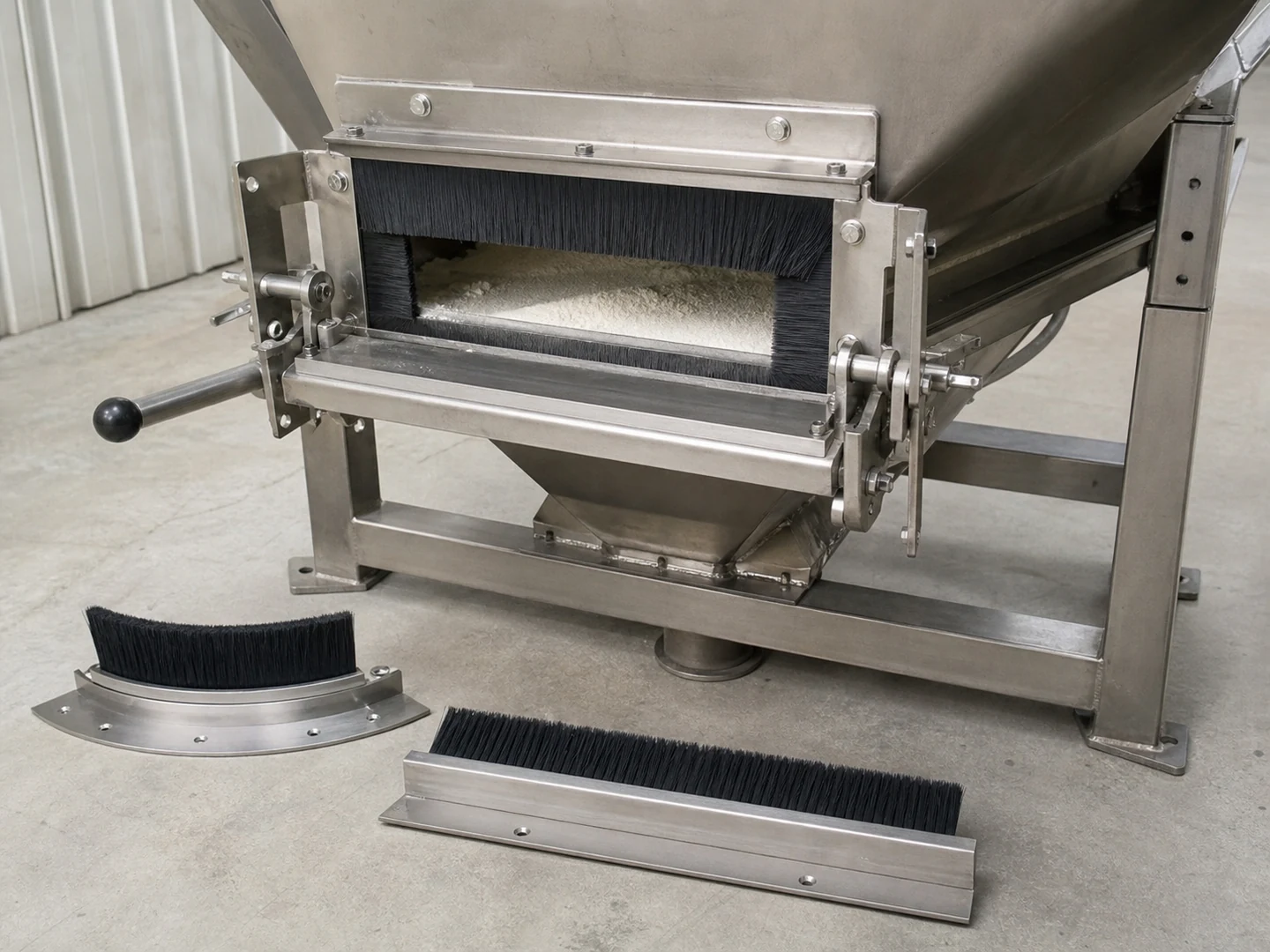
Custom silo dust control brushes for chutes, hoppers, dosing wheels, screens and enclosure gaps. PP, nylon and antistatic filaments, 30–400 mm wide.
Medium brush
100 pcs
Minimum order
Worked with two hands or on a pole: chimney, gutter and pond-filter brushes, discs, cups and tank brushes.
Production lead time, once the specification is confirmed
- Up to 100 pcsWithin 7 days
- 101–5,000 pcsWithin 14 days
- 5,001–50,000 pcsWithin 21 days
- Over 50,000 pcsConfirmed with your quotation
Peak season can extend these times; the shipping date is confirmed in writing with your quotation. Sampling and shipping are quoted separately.
A configurable filament brush for controlling fine dust, dust cake, and product carryover around silo discharge chutes, hoppers, dosing wheels, screens, filter faces, rails, and enclosure gaps. It uses dense PP or nylon filaments in widths of 30 to 400 mm to wipe, seal, and release powder without scratching the contact surface.
What can this brush do for you?
Catches fine powder at the point where it escapes
The filament face is built from fine fibers as thin as 0.05 mm and configurable tuft density, which creates many wiping edges per square centimeter. As the brush passes over a chute seam, dosing wheel pocket, or screen edge, it lifts the dust film and light cake away from the surface instead of pushing it into the surrounding air. Less dust becomes airborne, so less redeposits on nearby equipment.
Dissipates static cling on powder-contact surfaces
Polypropylene or nylon fill can be produced with conductive or antistatic additives that give the brush a surface resistivity in the 103 to 109 ohm range. On grounded equipment, this helps charge bleed away instead of holding powder on the brush face and chute wall. The result is cleaner release of fine material and fewer operator shocks in static-prone handling areas.
Reaches the gaps where dust collects and hangs
Brush widths from 30 to 400 mm and trim lengths from 25 to 100 mm let the brush follow narrow clearances around feed chutes, hopper seams, screen edges, rails, and enclosure openings. The same brush can work as a wiper, a scraper, and a partial dust seal where a rigid blade would bind or scratch.
Wipes clean without gouging liner, rail, or filter surfaces
The flexible PP and nylon filaments conform to slight surface irregularities and curved equipment shapes. They remove powder buildup but do not leave the deep score marks that a metal scraper can cause on aluminum, coated steel, plastic liners, or filter media. Contact force is distributed across the filament tips instead of concentrated on a hard edge.
Handles the temperature range of typical silo and powder areas
PP and nylon filament grades remain effective from about -20 to 100°C, while aluminum or stainless steel backings resist corrosion on washdown and outdoor installations. The brush does not become brittle in a cold morning feed out and does not soften or lose shape in a warm process room.
What is a Silo Dust Control Brush?
A Silo Dust Control Brush is a custom brush assembly that contacts the surfaces where fine powder, granules, and fibers accumulate in silo discharge and powder-handling systems. It consists of a dense filament face set into a backing, holder, or mounting profile, with the filament material, trim length, density, and mounting interface configured to a specific contact gap or moving surface.
In use, the brush sweeps against a chute wall, hopper side, screen frame, dosing wheel, rail, or filter face. As the surface moves past the filament tips, the brush loosens dust film and dust cake, frees product trapped in pockets and joints, and blocks some of the escape path. Depending on the configuration, it can act as a fixed wiper, a dust seal across an opening, or a hand-guided detail-cleaning tool.
This is not a general maintenance broom or a heavy wire brush. It is specified for fine airborne dust, soft to moderately bonded dust cake, loose granules, fibers, and product carryover. It is not meant for hard scale, melted plastic, weld spatter, or thick pastes, and it does not replace a dust collection system or dust extraction line. It reduces dust at the source and helps keep surrounding equipment clean.
Technical Specifications
The table below shows the working ranges we build into silo dust control brushes. Final dimensions, filament grade, and backing are matched to the contact surface and the powder being handled.
| Parameter | Specification / Options |
|---|---|
| Fill material | Polypropylene (PP); Nylon (PA 6, PA 6.6); conductive or antistatic PP/PA on request |
| Filament diameter | 0.05–0.40 mm, selected for residue type and surface sensitivity |
| Trim length | 25–100 mm working bristle length |
| Brush width / head width | 30–400 mm, custom coverage per project |
| Overall length | 150–600 mm across strip, backing, or handle configuration |
| Filament density / tuft pattern | Dense fill for fine dust and sealing; open rows for coarse granules and self-cleaning action |
| Backing / mounting material | Wood for dry manual use; PP for chemical/moisture resistance; aluminum for lightweight structural use; stainless steel for washdown and corrosion resistance |
| Surface resistivity (static-safe fill option) | 103–109 ohm, for applications where static charge must be controlled |
| Operating temperature | -20 to 100°C, depending on selected filament and backing |
| Mounting interface | Pre-drilled holes, bolt slots, continuous channel, clamp profile, custom bracket, or handle as required |
| Brush type | Custom Handheld Detail Brushes |
| How it is driven | Hand-guided |
| Cleaning target | silo discharge chute and transfer flange, dosing wheel, and hopper and hopper cone section cleaning |
| Surface or part | gaps, filters, rails, chutes, screens, hoppers, dosing wheels, and filter faces |
| Residue or debris | dust, powder, dust cake, fine dust, fine powder, product carryover, fiber, and granules |
| Mounting / connection | Pre-drilled holes, bolt slots, continuous channel, clamp profile, custom bracket, or handle as required |
For applications involving solvents, strong acids, or temperatures outside this range, contact us before specifying the fill and backing.
Where does this brush work best?
- Silo discharge chutes and transfer flanges: wipes fine powder from chute side walls and flange gaps, reducing dust release where material changes direction or drops into a receiving hopper.
- Dosing wheels, rotary valves, and feed screws: cleans pockets, blade edges, and seal zones so product does not pack, bridge, or carry over between doses.
- Hoppers and hopper cone sections: removes light powder coating and static-held fines from liner surfaces without cutting or marring the liner.
- Vibratory screens, sifters, and sieves: cleans screen edges, frame rails, and side walls to reduce blinding and fine dust buildup around the deck.
- Filter faces, filter cages, and filter housings: fine soft filament contact releases dust cake and surface dust from filter media without tearing the media when filament and trim are selected for that purpose.
- Rails, slide gates, and enclosure gaps: wipes guide rails, gate edges, and narrow openings clean while providing a partial inline dust barrier.
How do I choose the right one?
A workable brush comes down to three fittings: filament to residue, trim and density to gap geometry, and backing and mounting to the operating environment. Work through these checks and we can finalize a configuration.
Match the filament to the particle size and surface
For fine, static-prone, or sticky dust, use dense fill with 0.05–0.15 mm PP or anti-static nylon filaments. For coarser granules, fibers, and heavier dust cake, use 0.25–0.40 mm nylon filaments with wider tuft spacing so material does not pack into the brush. On filter media or soft coated rails, choose soft fine PP; on a stainless screen or hardened rail, nylon PA 6.6 gives more abrasion life.
Set trim length and density for the physical gap
Choose longer trim (75–100 mm) when the brush needs to follow a contour, cross a deep gap, or stay flexible on irregular surfaces. Choose shorter trim (25–50 mm) when the job needs firmer scraping pressure on a flat rail or chute wall. Dense fill seals fine dust better; open row spacing sheds larger particles and keeps the face from loading up.
Pick the backing and mounting for the environment
Dry indoor manual use can work with wood or PP. Washdown, humid, or outdoor silo areas call for stainless steel or PP. Aluminum gives a stiff, lightweight structural carrier where corrosion is not severe. If solvents, strong acids, or temperatures beyond -20 to 100°C are present, specify these before choosing the grade.
Check contact force and running clearance
For a mounted or stationary brush, the tips should make light, even contact across the full width of the surface, with only the deflection needed to wipe the residue. Heavy interference increases filament wear and drive load; too little leaves a dust line. Verify total brush length, mounting centers, and rotating-member runout before production so the brush cannot pinch or catch.
When another tool is the better answer
Hard scale, weld spatter, heavy grease, or deeply bonded deposits usually need a wire brush, scraper, or chemical pre-treatment first. If the gap must be air-tight, add a gasket or air purge because a brush face alone is not a hermetic seal. If the powder area is combustible-dust classified, static-safe filaments help but grounding, ventilation, housekeeping, and site hazard controls still have to be in place. For cleaning deep inside an empty silo from top access, a long-handled or remote cleaning system is more appropriate than a short strip brush.
Can I customize this brush?
Silo dust control brushes are ordered to fit a specific gap, contact path, and powder, so most dimensions and materials are adjustable. Share the contact surface, residue type and particle size, gap width, available mounting, operating temperature, chemical or washdown exposure, and any static requirements. A drawing or photos of the equipment speed up the configuration.
- Dimensions: head width, trim length, overall length, backing thickness, and mounting hole pattern built to your gap and machine space.
- Filament material and diameter: PP, PA 6, PA 6.6, or conductive/antistatic blends; 0.05–0.40 mm filament; color coding available.
- Filament layout: tuft rows, spacing, density, bevel angle, straight or contoured face, multi-row strips, or end-facing brush sections.
- Backing and interface: wood, PP, aluminum, or stainless steel; pre-drilled, slotted, clamp channel, bracket-mounted, or hand-guided handle configuration.
- Shape: straight strips, curved segments, corner sections, and custom profiles for the actual chute or housing contour.
- Marking and packaging: custom color, lot marking, ID labels, individual wrap, or bulk carton packing.
If your project requires project-specific certification support, material declarations, incoming inspection, or third-party testing, we can assist with those requirements during the customization stage.
Which filament survives the cleaning chemicals a silo dust control brush meets?
Does this brush alone control dust at a silo transfer point?
No. The brush removes powder from contact surfaces and reduces the open gap where dust escapes, but it is not a substitute for source dust collection, ventilation, or housekeeping. Use the brush to keep surfaces clean and the gap controlled, and keep the extraction system doing the main dust capture.
What is the difference between conductive and antistatic fill?
Both reduce charge retention, but they work over different resistance ranges. Conductive fill dissipates charge more quickly and is usually used where the brush is grounded and charge generation is continuous. Antistatic fill works over a higher resistance range and slows charge buildup enough for many powder-handling situations. The right choice depends on the powder, the grounding path, and the process speed.
How much contact pressure should I set between the brush and the surface?
Start with light, even contact across the full width, then run actual material and inspect the surface after a shift. If a continuous dust line remains, increase contact or reduce the gap slightly. If the tufts stay bent over, wear quickly, or the drive load rises, back off the interference. Record the original trim length at installation so wear can be measured later.
Can the same brush clean both the screen section and the chute above it?
Usually not, because the two surfaces have different contours, residue, and required filament behavior. A fine, dense brush selected for a filter or screen can pack with coarse product on a chute, and a coarse chute brush can damage filter media. Use separate configurations for separately behaving contact areas.
What should I inspect when the brush leaves powder streaks?
Check the brush face for flattened or matted tufts, missing filament, backing distortion, or mounting bolts that have shifted. Verify the contact gap along the full length and look for hardened or brittle filament tips. A worn brush often loses contact at the ends or along a curved section first, so compare those areas with the center before replacing the strip.
Is the static-safe filament option enough for combustible dust areas?
No single brush material makes an area safe. The brush reduces charge buildup at the contact point, but the entire equipment train must be properly bonded and grounded, and site dust control, ventilation, and hazard procedures must be followed. Specify the static-safe fill only after reviewing the complete installation.
Guides that go deeper on this
Custom Manufacturing RFQ
Describe Your Application
To quote this brush accurately, send the size, material, cleaning target, residue, quantity, and any available drawing or sample photo.
Drawing or photo optional — it speeds things up, it does not gate the enquiry.
Custom Brush RFQ
Send Your Brush Project
Upload a drawing, product photo, or sample photo and provide the core dimensions and cleaning conditions.
“We need a brush to remove wet residue from a stainless steel conveyor, about 800mm wide. The current brush wears quickly. We can send photos.”
“We sell drinkware and need a cleaning brush to include with the product. Quantity around 5,000 pieces.”