
Custom Cleaning Brush
Nylon Dust Removal Brush
Custom Nylon PA dust removal brushes for panels, profiles, slots, and equipment surfaces. Fine to coarse filaments, antistatic options, width 30–400 mm.
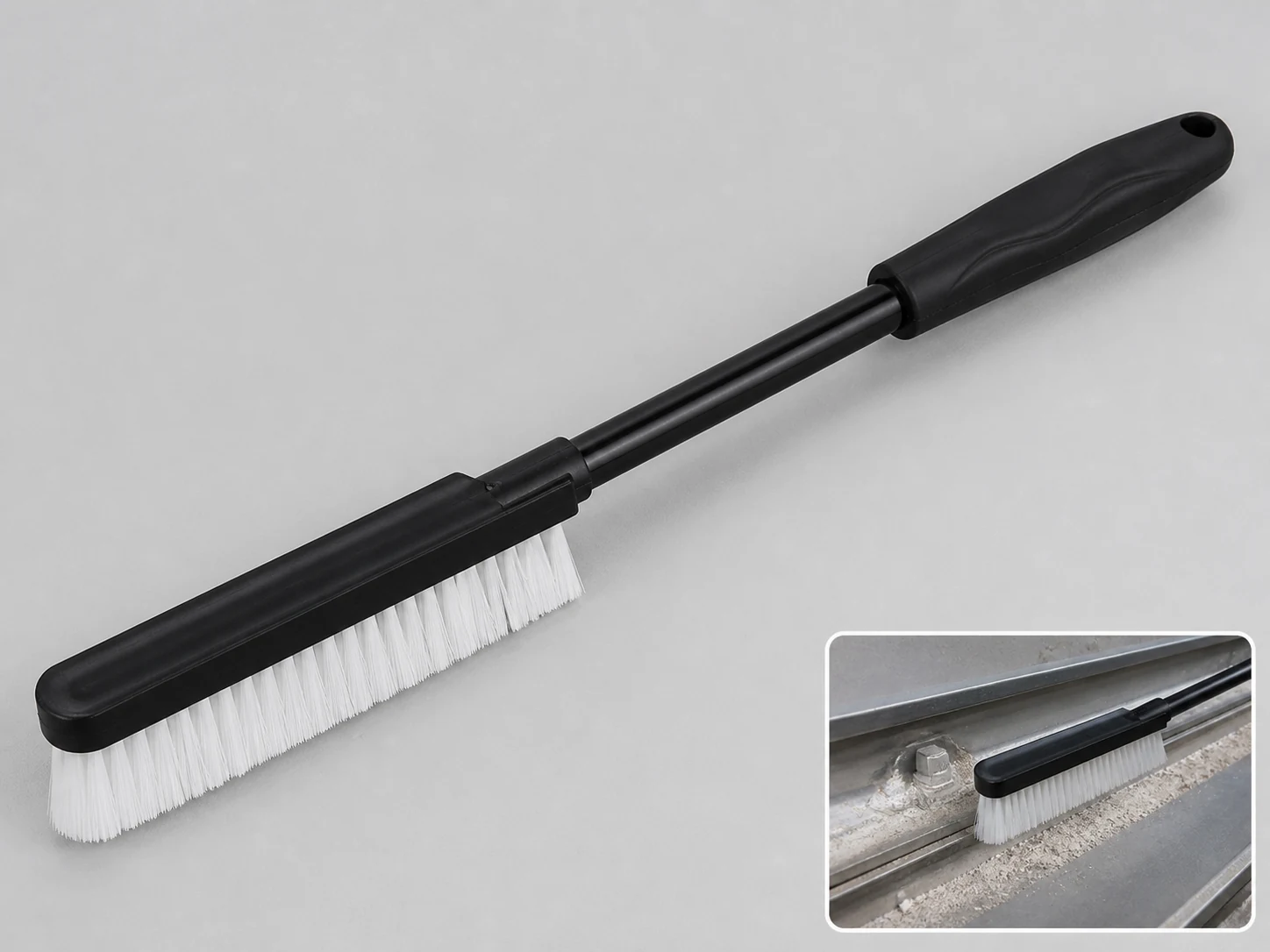
Small brush
500 pcs
Minimum order
Held in one hand: tube, bottle, detail and swab brushes — including long-handled ones with a small head.
Production lead time, once the specification is confirmed
- Up to 500 pcsWithin 7 days
- 501–50,000 pcsWithin 14 days
- Over 50,000 pcsWithin 21 days
Peak season can extend these times; the shipping date is confirmed in writing with your quotation. Sampling and shipping are quoted separately.
A flexible, dry-cleaning nylon brush family designed to lift and carry loose dust, lint, fibers, and fine particles away from panels, profiles, slots, and equipment surfaces — without scratching finished, coated, or polished surfaces.
What can this brush do for you?
Fine, Soft Nylon Filaments Remove Dust Without Marking the Surface
Nylon PA filaments in the 0.05–0.40 mm range flex at the tip instead of digging in. The brush sweeps powder, sanding dust, lint, and fiber debris off painted metal, coated plastic, glass, and polished components while leaving the original finish intact. If your process rejects parts for hairline scratches, this is the contact you need instead of a stiff scrubbing brush.
Flagged and Fine-Tipped Filaments Pick Up Particles Instead of Redistributing Them
Filament ends can be flagged (split) or selected in finer diameters to increase tip surface area. Dust is captured between and along the fibers during the stroke, then released when the brush is tapped or cleaned, rather than being pushed into a corner or swept into the next panel. This makes a visible difference on large flat surfaces where re-deposition is the main complaint.
Face Widths and Trim Profiles Serve Both Wide Panels and Narrow Slots
The brush face is available from 30 mm up to 100 mm for hand use, and strip-brush variants can reach 400 mm for machine-mounted wiping. Straight trim clears large panels with fewer strokes; angled, chisel, or stepped trim reaches into grooves, louvers, heat-sink fins, and connector gaps where a square-ended brush only skims the top.
Static-Dissipative Options Keep Dust From Jumping Back
Standard nylon insulates and can build a static charge on plastics. When the work surface is an electronic assembly, optical part, or plastic housing that attracts particles, the brush can be filled with antistatic or conductive nylon (surface resistivity between 10³ and 10⁹ Ω) so the brush itself does not become a re-contamination source.
Handle and Backing Materials Match the Operator or the Line
Wood, polypropylene, aluminum, and stainless steel backings are available. Lightweight wood or PP handles reduce fatigue in manual wiping; aluminum and stainless steel suit paint lines, cleanrooms, or equipment where the brush must survive frequent handling and occasional solvent wipe-down.
What is a Nylon Dust Removal Brush?
A Nylon Dust Removal Brush is a hand-guided or fixture-mounted cleaning tool built around Nylon PA filaments set into a handle, block, or channel backing. Its job is dry particulate removal: sweeping, lifting, and carrying away loose dust, powder, lint, fibers, and fine dry particles from accessible surfaces.
In use, the operator works the brush face across the panel, profile, or slot with light pressure. The filaments flex as they contact the surface; the tips and inter-filament spaces collect loose debris, and the residue is then tapped out, blown off, or washed from the brush between uses. The brush is intended for dry, unfixed particles that are not bonded, greasy, wet, or baked onto the surface.
This is a dust tool, not a scrub tool. It will not remove dried adhesive, oily film, rust, paint, or hard deposits. For those applications, a stiffer Nylon, abrasive nylon, or wire brush is the appropriate choice.
Technical Specifications
The table below reflects the standard configuration range. Face width, trim length, filament diameter, and backing material are adjusted to the job; please confirm the operating environment when specifying.
| Parameter | Value / Options |
|---|---|
| Brush face width | 30–100 mm for hand brushes; up to 400 mm for strip brush variants |
| Trim length (filament exposure) | 25–100 mm, selected for reach and dust load |
| Overall length | 100–250 mm for hand-held configurations |
| Filament diameter | 0.05–0.40 mm; fine for sensitive finishes, heavier for larger debris and stronger wiping |
| Filament material | Nylon PA (PA6, PA66, or PA612 selected for stiffness, moisture, and abrasion balance) |
| Tip treatment | Unflagged or flagged (split) ends for improved dust pickup |
| Trim profile | Straight flat, angled, chisel, stepped, or multi-row face |
| Surface resistivity | Insulative standard; 10³–10⁹ Ω options for antistatic or conductive fill |
| Handle / backing | Wood, PP, aluminum, or stainless steel; channel or block mounting for strip builds |
| Operating temperature | -20 to 100°C (-4 to 212°F) for Nylon PA fill |
| Color and marking | Natural, black, white, or custom filament and handle colors; pad print or laser marking available |
| Brush type | Custom Handheld Detail Brushes |
| How it is driven | Hand-guided |
| Cleaning target | electronics assembly and repair bench, instrument surface, and paint and coating preparation cleaning |
| Surface or part | panels, profiles, slots, metal, plastic, grooves, housings, and channel |
| Residue or debris | dust, particles, fiber, paint, lint, loose dust, fine particles, and powder |
| Mounting / connection | Fixed |
If the brush will contact solvent, moisture, or high-humidity environments, specify the exposure so the Nylon grade and backing are chosen accordingly.
Where does this brush work best?
- Electronics assembly and repair benches — clearing dust from PCB edges, enclosures, keyboards, and vent slots before inspection or packaging.
- Optics, camera, and instrument surfaces — removing loose particles from lens barrels, housing bodies, and displays without bristle-tip scratching.
- Paint and coating preparation — dry dusting metal panels, plastic moldings, and automotive body panels before primer, paint, or clear coat.
- Woodworking and furniture production — cleaning sanding dust from profiles, routed grooves, cabinet panels, and edge banding lines.
- Printing, copying, and converting equipment — wiping loose paper dust, toner dust, and fiber from rollers, guides, and machine frames during maintenance.
- Injection molding and light assembly — removing static-attracted dust and small plastic flash from finished parts, housings, and control panels.
- Facility and equipment care — daily dusting of control cabinets, display screens, motor vents, and operator workstations where wet cleaning is not allowed.
How do I choose the right one?
Start with the surface finish
Soft painted, coated, polished, or optical surfaces call for fine filaments (0.05–0.15 mm) and flagged tips. Textured metal, wood grain, or powder-coated panels can accept coarser filament (0.20–0.40 mm) and stronger wiping without risk. Run a test on a reject or sample part before locking the filament diameter.
Measure the access geometry
Width, trim length, and trim profile are determined by what the brush must cover. Wide flat panels favor a broad straight face; fins, louvers, grooves, or connector gaps need angled or stepped trim long enough to reach the bottom of the recess. Give the actual slot width and depth at RFQ stage so the face does not bridge over the area.
Decide whether static is part of the problem
If dust is attracted back to the part after brushing, or if the surface is electrostatic-sensitive, choose antistatic or conductive fill and pair it with a metal or grounded backing when possible. Otherwise, standard Nylon is usually sufficient and more economical for general dry dusting.
Match the handle or mounting to the motion
Manual cleaning benefits from a comfortable angled or pistol handle with a width the operator can control. Machine or line wiping requires a strip brush with a channel or aluminum backing that fits the existing holder. Confirm mounting dimensions before specifying a strip variant.
Confirm the environment before finalizing
Nylon PA is suitable for dry indoor use and temperatures from -20 to 100°C. If the brush sees moisture, humidity, or occasional solvent, choose PA612 or another low-moisture grade and a sealed metal or PP backing. Continuous hot or solvent-soaked operation moves the selection toward other materials.
When a different brush is the better tool
Use a stiffer chemical-resistant brush for oily, greasy, or sticky residues; an abrasive nylon or wire brush for rust, scale, or baked-on deposits; a vacuum brush or tack roller when dust must not transfer at all; and an ionized air or lint-free wipe system when even fine filament contact is not acceptable. A nylon dust removal brush removes loose dry particles — it does not replace chemical cleaning or mechanical surface preparation.
Can I customize this brush?
Yes. Each configuration is built around the surface, geometry, and dust it will meet. We typically ask for the following to define a custom brush:
- Surface material and finish sensitivity (clear coat, polished, painted, textured, bare metal)
- Dust or particle composition (plastic dust, metal fines, paper fiber, lint, paint powder)
- Maximum access width, slot depth, and profile to be cleaned
- Required face width and stroke direction
- Static sensitivity of the part (ESD-protected, optical, electronic)
- Handle style, hand or machine mounting, and preferred grip angle
- Operating temperature, humidity, and any chemical contact
Within those parameters, we can adjust:
- Face width, trim length, and overall dimensions
- Trim profile — flat, angled, chisel, stepped, notched, or custom contour
- Filament material — PA6, PA66, PA612, plus antistatic or conductive Nylon fill
- Filament diameter and density — tuft spacing and fill pattern for the required dust load
- Tip treatment — flagged, unflagged, or a combination across the face
- Handle / backing — wood, PP, aluminum, stainless steel, or a specified channel profile
- Color, marking, and identification — custom filament color, pad print, laser mark, or label pocket
- Packaging — bulk cartons, individual poly bags, retail-ready sleeve, or kit packing
A drawing, photo of the part, or sample of the current brush shortens the configuration process. If the project also requires material declarations, batch inspection reports, or third-party test support, include those requirements in the RFQ so they are planned from the first sample.
When is a nylon dust removal brush worn out rather than just dirty?
How do I verify that the brush will not scratch my surface?
Test the selected filament diameter and tip treatment on a reject or scrap panel with the same finish as production. Use the same stroke direction, speed, and pressure the operator will use, then inspect under bright light at a low angle. A pre-production sample lets you confirm the face before a full order is produced.
Does an antistatic or conductive brush eliminate static dust attraction completely?
No. Antistatic and conductive fill reduce charge buildup and can route charge to ground through the backing or handle, but they do not remove static already present on the part. If the part itself holds charge, ionizing air, grounded work surfaces, or environmental humidity control may still be required. Verify surface charge with a field meter during trials.
Can the brush be used for light wet wiping?
This brush is intended for dry dust removal. Nylon PA tolerates brief damp contact and mild detergent cleaning, but the handle and backing must be selected to match. Soaking, steam, or continuous solvent exposure can degrade the assembly and is outside the intended use. Specify the cleaning chemical before production if any liquid contact is expected.
How do I clean and store the brush between uses?
Tap the face against a clean surface or use low-pressure compressed air to release loose dust. Wash with warm water and a mild detergent only when necessary, rinse thoroughly, and dry with the filaments pointing downward so moisture does not sit in the backing or handle. Store in a sealed bag or closed drawer in dusty production areas.
How can I tell when the brush should be replaced?
Replace the brush when filaments become bent, matted, or flattened and no longer recover their position after use; when the brush leaves visible dust after a normal pass; or when an antistatic or conductive brush no longer shows consistent surface resistance. Routine replacement is cheaper than accepting surface contamination in finished product.
Will one brush handle both a large panel and a narrow slot?
Usually not well. A broad flat face covers panels efficiently but cannot enter a narrow groove; a stepped or chisel face reaches the slot but moves less air and dust on the open panel. If both areas are part of the same operation, consider a two-sided face, a multi-row configuration, or a matched brush set rather than forcing one geometry to do both.
Guides that go deeper on this
Custom Manufacturing RFQ
Describe Your Application
For an accurate quotation, please provide the main dimensions, material preference, working surface, residue, quantity, and a drawing or photo.
Drawing or photo optional — it speeds things up, it does not gate the enquiry.
Custom Brush RFQ
Send Your Brush Project
Upload a drawing, product photo, or sample photo and provide the core dimensions and cleaning conditions.
“We need a brush to remove wet residue from a stainless steel conveyor, about 800mm wide. The current brush wears quickly. We can send photos.”
“We sell drinkware and need a cleaning brush to include with the product. Quantity around 5,000 pieces.”