
Custom Cleaning Brush
Nylon Dust Removal Tobacco Brush
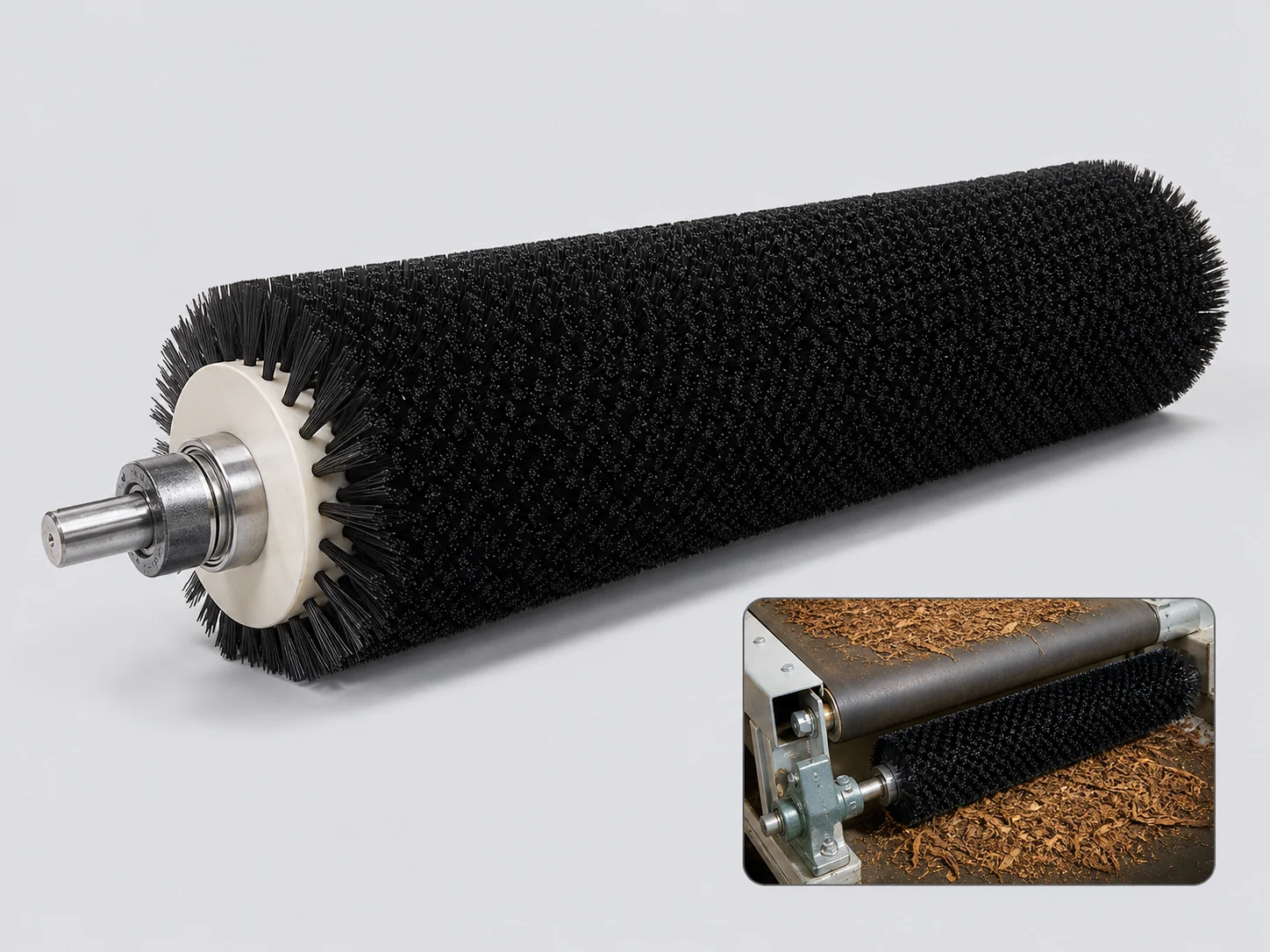
Dry-use nylon fill from 0.05 mm reaches tobacco dust in guides, gaps and panel edges, supplied as a hand brush, bolted strip or mounted roller.
Small brush
500 pcs
Minimum order
Held in one hand: tube, bottle, detail and swab brushes — including long-handled ones with a small head.
Production lead time, once the specification is confirmed
- Up to 500 pcsWithin 7 days
- 501–50,000 pcsWithin 14 days
- Over 50,000 pcsWithin 21 days
Peak season can extend these times; the shipping date is confirmed in writing with your quotation. Sampling and shipping are quoted separately.
A dry-use nylon brush for lifting tobacco dust, loose leaf fibers, lint, and fine particles from processing equipment, guide rails, machine panels, and sensor surfaces without adding moisture to the line. The same Nylon PA filament specification can be supplied as a hand brush, a bolted strip brush, or a shaft-mounted roller for fixed positions on conveying and packing equipment.
What can this brush do for you?
Fine filaments reach the dust that settles in guides, gaps, and panel edges
Filament diameters from 0.05 mm to 0.40 mm let the brush work into shallow channels, panel seams, rail corners, and the area around photocell housings where tobacco dust and short leaf fibers settle and pack. Fine fill dislodges the dust film from the bottom of these recesses, while coarser, denser fill clears lint and heavier accumulation on flat machine panels. The practical result is fewer fouled sensors and less dust carried back into the product flow.
Stays dry so tobacco dust never turns into gum
Tobacco dust carries natural oils and sugars. Mixed with water, it becomes a sticky film that bonds to machine surfaces and gets harder to remove with every pass. This brush is specified for dry wiping and dry line positions; it loosens residue in its original dry state so the dust can be tapped out of the fill and drawn off by the extraction system instead of being smeared.
Antistatic fill releases dust instead of building charge
Fine dried tobacco dust clings electrostatically. A standard insulating nylon fill can charge the very surfaces it is cleaning, so dust re-attaches within minutes. When specified, the brush carries antistatic or conductive Nylon PA fill with a surface resistivity of 10³–10⁹ Ω, which bleeds the charge away and lets loosened dust fall or be collected by vacuum rather than re-depositing on the panel.
Nylon PA holds its trim shape shift after shift
Nylon PA6 and PA6.6 filaments have high flexural recovery; after repeated flexing along rails and panel edges, the fill springs back to its set length and keeps the contact band working. Anchored tuft construction keeps filaments locked in the head, so the brush itself does not become a source of loose nylon in cut tobacco.
One filament spec, three mounting forms
A hand brush covers operator spot cleaning on machine panels and accessible areas, while bolted strip brushes and 100–200 mm diameter rollers apply the same filament selection at fixed points on conveyor frames, belt edges, and guide rails. Specifying one fill grade across all three forms simplifies purchasing and gives uniform cleaning results from the line position to the changeover station.
What is a Nylon Dust Removal Tobacco Brush?
A Nylon Dust Removal Tobacco Brush is a dry-cleaning tool bedded with nylon PA filament, built for removing tobacco dust, leaf fragments, lint, and other fine dry particles from equipment surfaces in tobacco processing and packing operations. It is not a wet scrubbing brush: the fill is selected for pushing and sweeping dry residue, not for lifting sticky gum.
In daily use, operators pass the brush head over machine panels, rails, and sensor housings with a combination of push, pull, and short rotating strokes. Filament tips reach into recesses and sweep the dust out where vacuum or extraction airflow can take it away. In mounted form, the strip or roller keeps high-traffic surfaces such as belt edges, guide rails, and frame ledges from accumulating dust between manual cleaning rounds.
The brush matters most where accumulation creates operating problems: sensors that start reading through a dust film, belts that drag dust back into the cut product, panels that hide leaks and wear behind a layer of tobacco powder. Dry, fine-dust removal on process equipment is the core task.
Operating conditions are part of the design picture. Nylon PA covers a working window of roughly -20°C to 100°C, which fits normal processing and drying areas. Wet washes, solvent baths, or steam exposure require confirming the backing, anchoring method, and specific PA grade against the actual process before ordering. The brush is intended for light to moderate dust loading; it is not built to grind off buildup that has bonded into a hard layer.
Technical Specifications
The starting engineering values below cover the hand form and the line-mounted versions. Most dimensions are adjustable; the binding parameters are the machine’s clearance dimensions, the operator’s reach, and the dust loading at each position.
| Parameter | Hand brush | Strip / roller forms |
|---|---|---|
| Fill material | Nylon PA6 / PA6.6, standard or antistatic / conductive grade | Same fill grades |
| Filament diameter | 0.05–0.40 mm | 0.10–0.40 mm |
| Head width | 50–100 mm | Working width 500–2000 mm for strip builds |
| Trim length | 20–50 mm | 20–50 mm, set to clearance at each mount |
| Overall length | 200–300 mm | Set by frame position and access |
| Handle / backing | Wood, PP, aluminum, or stainless steel | Aluminum or stainless channel; shaft-mounted roller |
| Roller diameter (roller form) | — | 100–200 mm |
| Surface resistivity (antistatic grades) | 10³–10⁹ Ω | 10³–10⁹ Ω |
| Operating temperature | -20 to 100 °C | -20 to 100 °C |
| Brush type | Custom Handheld Detail Brushes | |
| How it is driven | Hand-guided | |
| Cleaning target | cigarette making and packing machine, cut-tobacco conveying line, and optical inspection station cleaning | |
| Surface or part | panels, tobacco, rails, guide rails, roller, belts, edges, and frames | |
| Residue or debris | dust, tobacco dust, particles, fiber, lint, fine particles, mold, and powder | |
| Mounting / connection | Fixed |
Filament diameter, density, trim length, and resistivity grade are the first variables to confirm. Widths and lengths follow from the machine drawing: fixing hole pattern, panel depth, roller shaft diameter, and clearance at each position determine the final geometry.
Where does this brush work best?
- Cigarette making and packing machines — hopper decks, guide rails, drum housings, and panel seams where fine cut-tobacco dust settles as the machines run.
- Cut-tobacco conveying lines — conveyor side frames, belt edge guides, skirt gaps, and idler brackets that collect tobacco dust and short fibers during product transfer.
- Sensors, photocells, and optical inspection stations — camera windows, reflectors, and detector lenses that lose response through dust films; fine filaments clean without scratching acrylic covers.
- Leaf processing and redrying equipment — grader pans, thresher surrounds, sifter screens, and control enclosures where dry leaf particles build up quickly.
- Cigar manufacturing — press molds, cutting boards, wrapper and binder tables, and handwork stations.
- Cabinets, air grilles, and electrical panels — accessible interior trays and ventilation openings; use the antistatic fill in electronics areas.
How do I choose the right one?
Start with the dust and the surface, not the brush size. The filament diameter controls both how fine a dust particle the fill can lift and how much contact pressure is applied to the surface.
Select the filament diameter by dust load and surface
Fine filaments in the 0.05–0.15 mm range suit sensor lenses, acrylic covers, painted panels, and light dust films. The 0.15–0.25 mm range covers standard machine bodies and guide rails. Coarse fills from 0.25 mm to 0.40 mm handle heavier lint and dense dust accumulation on frame ledges and structural areas.
| Working condition | Recommended configuration |
|---|---|
| Fine dust film on lenses, acrylic, or painted panels | 0.05–0.15 mm filament, medium density |
| General machine dust and short fibers on steel surfaces | 0.15–0.25 mm filament |
| Larger lint clumps or heavy dust accumulation | 0.25–0.40 mm filament, higher density |
| Dust re-attaches, static discharge, electronics nearby | Antistatic fill, 10³–10⁹ Ω |
| Dry indoor processing | Any backing or handle material |
| Washdown or hygiene-prepared areas | PP, aluminum, or stainless backing; no wood |
| Constant dust load at one machine position | Mounted strip or roller |
| Operator spot cleaning around the line | Hand brush |
Match the handle and backing to the environment
Wood is economical and light for dry process areas; PP and stainless steel suit wet-wipe or hygiene-focused areas; aluminum balances weight and corrosion resistance for mounted strip forms. If the plant runs metal detection or X-ray inspection on product that could contact the brush, confirm that the fastener and backing materials are compatible with the plant’s detection and foreign-matter rules before release.
Hand brush, strip, or roller?
If the cleaning need is an operator walking the line once a shift, the hand brush covers it. If the same spot repacks dust between rounds, mount a strip or roller. Roller forms suit belt edges and moving surfaces with a contact width under 2000 mm; bolt-mounted strips suit stationary ledges and frame channels with limited clearance.
When a different tool fits the job better
If the residue is sticky, resinous, or solvent-softened such as tobacco gum or tar-like films, a stiff natural or PBT brush with solvent assist, or a brass and wire brush for hard scale, may be the right choice. If dust is already airborne, no brush will capture it; add source extraction or a vacuum-assisted cleaning station. For deep enclosed channels narrower than the head width, a narrow tube or crevice brush reaches where the panel brush cannot.
Can I customize this brush?
Yes. Tobacco line layouts, surface clearances, and plant hygiene rules are rarely identical from one facility to the next. We start from your machine drawing or sample panels and set the fill, backing, and mounting to the actual positions.
Typical changeable variables:
- Fill — filament diameter, trim length, tuft density, trim profile (flat or angled ends), and standard, antistatic, or conductive grade
- Head geometry — width, thickness, angled head, and curved blocking for rail shapes
- Handle / backing — material, length, ergonomic grip, hanging feature, or bolt-slot channel
- Mounted forms — strip length and fixing pattern; roller diameter, face length, shaft dimensions, and end treatment
- Color — zone coding, safety colors, or a specific customer tint
- Marking — pad print, laser marking, or molded identification
- Packaging — bulk, individual bag, branded label, or kit packing
If your project needs material declarations, inspection records, or third-party testing against a plant specification, we can support that as part of the customization process. Include these requirements in the initial inquiry so they are built into the sample and batch documentation.
Which filament survives the cleaning and still lasts on a nylon dust removal tobacco brush?
How can I check that the brush will not shed nylon filaments into the tobacco?
Before release, inspect the fill rows: grip each row between thumb and forefinger and pull with moderate force. Individual filaments should flex, not slide out of the backing. Check the back of the head for exposed anchor ends or gaps. On in-service brushes, retire the head when loose filaments appear in the fill area or when individual fibers release during normal use.
How should I clean and store the brush between uses?
Tap the head against a firm surface to drop loose dust, then blow through the fill with dry compressed air pointed into the floor extraction zone. Do not soak the brush; moisture mixes tobacco dust into a paste that loads the trim and hardens. Store the brush head-up in a dry rack, away from direct heat sources.
Does brushing alone control tobacco dust in an area?
No. Brushing moves dust off surfaces so the building’s dust extraction can capture it. If the area has no effective capture, brushed-off dust simply becomes airborne dust again. Use the brush as the first step and pair it with vacuum or extraction airflow after the surfaces are swept.
How do I know whether I need the antistatic grade?
Three signals: dust re-settles on the cleaned panel within minutes, operators feel static when handling the brush, or the brush holds a dust coat that will not tap out. If these occur with the standard fill, specify the antistatic grade and verify the head’s surface resistivity with a meter to confirm it falls inside the 10³–10⁹ Ω window for your application.
Can I use this brush on wet or gummed tobacco residue?
No. Wet residue smears tobacco oils and sugars into the nylon fill as a sticky film, and the brush cannot then return to dry dust work. Solvent-assisted scrapers, stiff PBT fill, or brass and wire brushes handle gum and scale; this brush is specified for dry dust and loose fiber only.
When should the brush head be replaced?
Replace when the trim is visibly flattened or matted, when the contact band has narrowed from the original width, when dust no longer taps out of the fill, or when filaments begin releasing. A quick pickup check, brushing a marked dusty panel and then wiping it with a clean white cloth, will show whether the head is still removing dust rather than moving it around.
Guides that go deeper on this
Custom Manufacturing RFQ
Describe Your Application
To prepare the correct quotation, provide the dimensions, cleaning task, residue, material, mounting details, quantity, and a drawing or photo.
Drawing or photo optional — it speeds things up, it does not gate the enquiry.
Custom Brush RFQ
Send Your Brush Project
Upload a drawing, product photo, or sample photo and provide the core dimensions and cleaning conditions.
“We need a brush to remove wet residue from a stainless steel conveyor, about 800mm wide. The current brush wears quickly. We can send photos.”
“We sell drinkware and need a cleaning brush to include with the product. Quantity around 5,000 pieces.”