
Custom Cleaning Brush
Tobacco Brush
Custom nylon tobacco brush for dry dust and chaff removal from tobacco lines. Strip, roller, coil and hand-held forms. FDA-compliant material options.
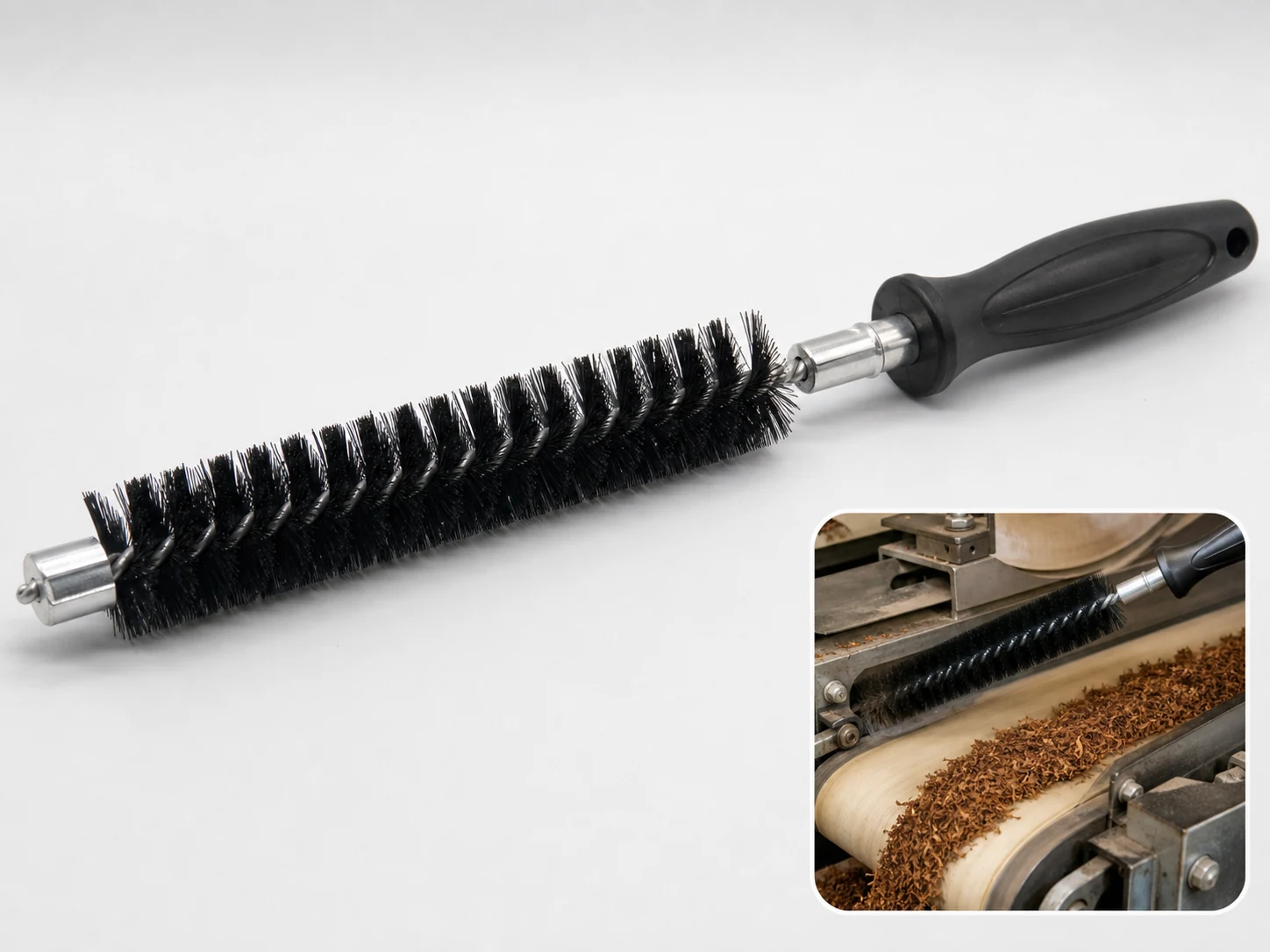
Medium brush
100 pcs
Minimum order
Worked with two hands or on a pole: chimney, gutter and pond-filter brushes, discs, cups and tank brushes.
Production lead time, once the specification is confirmed
- Up to 100 pcsWithin 7 days
- 101–5,000 pcsWithin 14 days
- 5,001–50,000 pcsWithin 21 days
- Over 50,000 pcsConfirmed with your quotation
Peak season can extend these times; the shipping date is confirmed in writing with your quotation. Sampling and shipping are quoted separately.
A customizable nylon PA tobacco brush for dry dust, fiber, and chaff removal from tobacco processing equipment, product paths, conveyors, and narrow machine zones. Available in strip, roller, coil, and hand-held configurations with mounting options to fit your line.
What can this brush do for you?
Removes fine dust and chaff without loading or clogging
Nylon PA filaments are smooth and resist particle embedding. Paired with the right filament diameter and fill density, the brush dislodges fine particles without the filament tips packing with dust. This keeps cleaning action consistent over long runs and reduces brush changeouts.
Reaches tight gaps and narrow machine zones
Strip brushes as narrow as 10 mm and roller brushes with short trim lengths fit between rollers, under belts, and inside dust hoods. This cleans accumulation points that other tools can’t reach, reducing jams and contamination risks.
Gentle on equipment and product contact surfaces
Nylon is softer than wire or abrasive media, so the brush sweeps away particles without scratching conveyor belts, rollers, guide rails, or polished surfaces. For applications where the brush contacts tobacco directly, FDA-compliant nylon PA material grades can be supplied.
Handles static-attracted particles
Dry tobacco dust tends to cling to surfaces due to static charge. The mechanical sweeping action of the filaments physically overcomes this attraction. For environments where static re-adhesion is a recurring problem, antistatic nylon filaments are available that dissipate charge, helping particles release instead of re-attaching.
Easy to mount and replace
Depending on configuration, brushes can be mounted on quick-change brackets, threaded ferrules, or keyed shafts, so worn strips or rollers can be swapped in minutes without disassembling the line.
What is a Tobacco Brush?
A Tobacco Brush is an industrial cleaning brush built with nylon PA filaments, configured for dry-particle removal in tobacco primary processing, cigarette manufacturing, and related handling lines. It works by direct filament contact: as the brush moves across a surface, or as a product or conveyor passes under it, the filament tips sweep away dust, fiber, chaff, and powder. The removed particles either fall away, are captured by a collection system, or are carried out by air flow.
The brush can be configured several ways: a strip brush mounted to a bracket or machine bar for continuous wiping of a moving surface; a roller brush mounted on a shaft for rotating contact with product or equipment; a coil brush for cleaning inside bores or tubes; or a hand-held brush for operator use. The common thread is a controlled, non-scratching mechanical sweep in a dry, ambient-temperature environment.
This is not a wet scrubbing brush or a heavy-abrasive tool. It is designed for regular removal of loose, dry particulate residues from tobacco processing machinery, not for removing baked-on deposits, grease, or heavy buildup.
Technical Specifications
The values below represent the standard range we can configure. Your application drawing, surface dimensions, and residue characteristics determine the final build.
| Parameter | Range / Options |
|---|---|
| Brush configuration | Strip, roller, coil, hand-held (project-specific) |
| Head width / roller length | 10–400 mm (wider custom on request) |
| Trim length | 10–100 mm (shorter = stiffer, longer = more conformable) |
| Filament diameter | 0.08–1.00 mm (finer for dust, thicker for chaff) |
| Filament material | Nylon PA 6, PA 6.6, or PA 6.12; optional antistatic grade |
| Mounting | Aluminum or steel channel, bracket, machine bar, threaded ferrule, shaft with keyway or set screw, handle (manual) |
| Fill density | Standard, dense, or extra dense (rows per cm specified per project) |
| Operating temperature | Up to 80°C continuous for standard nylon PA (verify for antistatic grades) |
| Color | Natural, white, black, or custom (color coding for line identification) |
| Brush type | Custom Strip Seal Brushes |
| How it is driven | Supplied hand-guided or machine-mounted |
| Cleaning target | tobacco primary processing line, cigarette making and packing machine, and conveyor system cleaning |
| Surface or part | tobacco, roller, conveyors, narrow machine zones, coils, belts, bars, and guide rails |
| Residue or debris | dust, chaff, particles, fiber, fine particles, tobacco dust, grease, and powder |
| Mounting / connection | Aluminum or steel channel, bracket, machine bar, threaded ferrule, shaft with keyway or set screw, handle (manual) |
All dimensions are configurable per project. Specify your surface width, required contact clearance, and residue particle size to finalize filament diameter and density.
Where does this brush work best?
- Tobacco primary processing lines: stem cleaning, cut tobacco transportation, drying drums, and classification sieves where dust and chaff accumulate.
- Cigarette making and packing machines: removal of tobacco dust from hoppers, guide rails, folding surfaces, and detector windows.
- Conveyor systems: edge cleaning, belt cleaning, and under-belt cleaning to reduce buildup and belt slippage.
- Dust collection and air-handling zones: cleaning of hoods, baffles, and filter surrounds where fine particles settle.
- Narrow machine zones: gaps between rollers, under guards, and inside sensor housings where hand access is limited.
How do I choose the right one?
Choosing the right tobacco brush comes down to four decisions: configuration, filament stiffness, trim length, and mounting. Answer these questions and the specification falls into place.
Step 1: Decide the brush configuration
- Moving surface (conveyor belt, roller, panel) needing constant cleaning: strip brush mounted to a bracket.
- Rotating contact or cylindrical parts: roller brush on a shaft.
- Internal bores or tubes: coil brush.
- Operator spot cleaning: hand-held brush with handle.
Step 2: Match filament diameter to the particle and surface
- Fine dust and powder (smaller than 0.1 mm): 0.08–0.30 mm filaments with high density.
- Fibers and chaff (up to several mm): 0.30–0.60 mm filaments for more stiffness.
- Larger debris or stronger adherence: 0.60–1.00 mm filaments, but verify surface tolerance.
Step 3: Set trim length based on contact and clearance
- Short trim (10–30 mm): stiffer contact, more force, best for flat surfaces and tight spaces.
- Long trim (50–100 mm): more conformability, best for uneven or curved surfaces and when you need extra reach.
Step 4: Choose mounting and retention
- Fixed bracket or machine bar for permanent installations.
- Quick-release bracket or threaded ferrule for brushes that will be replaced regularly.
- Shaft with keyway or set screw for roller brushes.
- Ergonomic handle for manual brushes.
Step 5: Consider static and environment
Dry tobacco lines generate static; if dust re-adheres after brushing, specify antistatic nylon. Standard nylon PA is rated for ambient temperatures up to 80°C; if your process exceeds that, reconsider the material. No liquids: this brush is for dry use; occasional damp wiping may be acceptable, but continuous wet cleaning requires a different filament (e.g., polyester or PBT).
When this brush is not the right choice: for heavy grease, sticky resins, or baked-on deposits, use a wire brush or chemical cleaning; for wet or high-temperature zones, select polyester, PBT, or metal filaments; for aggressive abrasion on rough surfaces, use a wire or abrasive brush. This nylon PA tobacco brush is for dry, loose-particle removal.
Can I customize this brush?
Every tobacco processing line has different dimensions, mounts, and particle profiles, so we build each brush to order. To start, send us your equipment drawings or photos, the contact surface material, residue type and particle size, operating speed and temperature, and any tobacco-contact compliance needs.
We can adjust:
- Brush form – strip, roller, coil, hand-held, or custom shape.
- Dimensions – head width, trim length, overall length, roller diameter, core diameter.
- Filament – nylon PA 6, 6.6, or 6.12, antistatic grade, diameter, crimped or straight, color.
- Fill pattern – standard, dense, staggered rows, single or double spiral.
- Mounting – channel (aluminum, galvanized steel, stainless), bracket with holes/slots, machine bar, threaded ferrule, shaft with keyway or set screw, handle (wood, plastic, metal).
- Color and marking – custom filament color, ink marking on core, laser marking on metal parts, identification tags.
- Packaging – bulk, individual polybag, labeled boxes, or custom industrial packaging.
If your project requires material documentation, third-party testing, or compliance verification for tobacco contact (for example, FDA-compliant material grades), we can coordinate those as part of the customization process.
Which filament survives the cleaning and still lasts on a tobacco brush?
How do I know if the filament diameter is right for my dust?
If the particles are smaller than 0.1 mm (like flour), use filaments 0.1–0.2 mm with dense spacing. If you find chaff pieces of 1–5 mm, use 0.4–0.8 mm filaments. If the brush slips over the residue without moving it, go thicker; if it scratches or wears the surface, go thinner.
Can I use this brush to remove sticky or oily tobacco residue?
No. Nylon PA is designed for dry, loose particulates. Sticky or oily residues will clog the filaments and require solvents or different brush materials. For those cases, use a stiffer brush such as PBT or change the cleaning method.
How do I prevent filament shedding into the product stream?
Crimped filaments, secure channel retention, and proper density reduce shedding. We can also use fused or flagged filament ends for extra retention if product contamination is critical. Inspect brushes regularly and replace when filament loss exceeds 5% of the original fill.
Does the brush wear out the equipment surfaces?
Nylon is much softer than steel, so it generally does not wear metal or most plastic surfaces during normal dry sweeping. However, excessive contact pressure or high speed can polish softer materials over time. Monitor contact pressure and trim length.
Can this brush be used in an explosive dust environment?
In tobacco facilities, dust can be combustible. While nylon PA itself is not conductive and can generate static, we can supply antistatic or conductive filaments and grounding options to help dissipate charge. However, brush material alone is not a substitute for proper dust control and ATEX-rated equipment requirements. Check with your safety engineer.
Guides that go deeper on this
Custom Manufacturing RFQ
Describe Your Application
Please include the main sizes, application, residue, preferred material, interface, quantity, and any drawing or sample available.
Drawing or photo optional — it speeds things up, it does not gate the enquiry.
Custom Brush RFQ
Send Your Brush Project
Upload a drawing, product photo, or sample photo and provide the core dimensions and cleaning conditions.
“We need a brush to remove wet residue from a stainless steel conveyor, about 800mm wide. The current brush wears quickly. We can send photos.”
“We sell drinkware and need a cleaning brush to include with the product. Quantity around 5,000 pieces.”