
Custom Cleaning Brush
PBT Brush
Stiff, chemical-resistant PBT brush for wet and dry industrial machine cleaning. Custom filament diameter, trim length, fill density, and mounting.
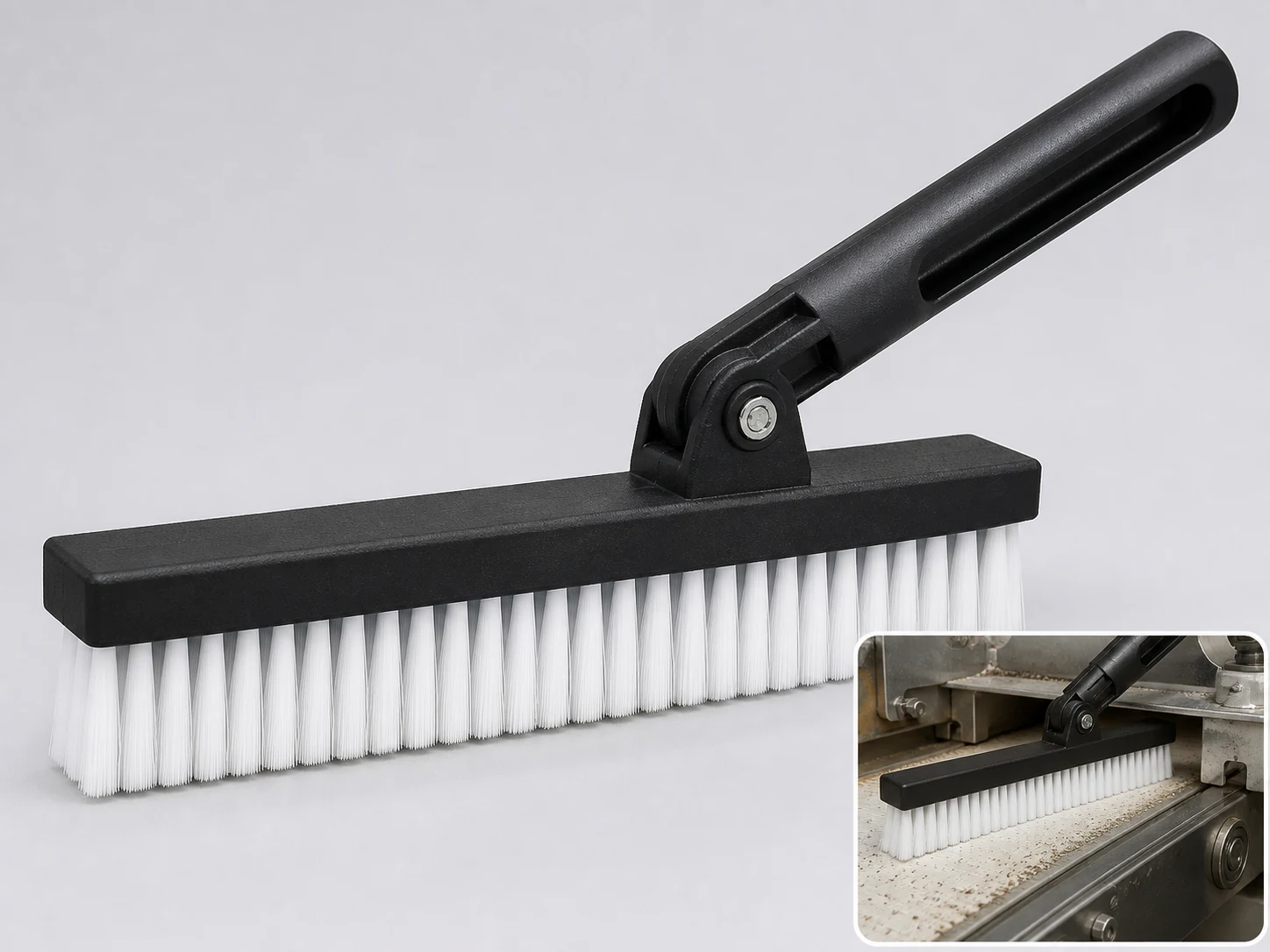
Medium brush
100 pcs
Minimum order
Worked with two hands or on a pole: chimney, gutter and pond-filter brushes, discs, cups and tank brushes.
Production lead time, once the specification is confirmed
- Up to 100 pcsWithin 7 days
- 101–5,000 pcsWithin 14 days
- 5,001–50,000 pcsWithin 21 days
- Over 50,000 pcsConfirmed with your quotation
Peak season can extend these times; the shipping date is confirmed in writing with your quotation. Sampling and shipping are quoted separately.
A stiff, chemical-resistant PBT brush for wet and dry machine cleaning on accessible equipment surfaces, panels, slots, and hand-cleaning areas. It removes dust, oil, particles, and light process residue without marring painted, coated, or machined finishes.
What can this brush do for you?
Keeps Working Pressure When Wet
PBT filament absorbs very little water, so the bristles do not soften, wilt, or lose their recovery after being soaked in coolant, detergent, or rinse water. A brush that gets wet during machine cleaning still pushes with the same stiffness on the next stroke — unlike many natural fibers that go limp when saturated.
Breaks Up Oil-and-Dust Paste Without Damaging Paint or Machined Surfaces
The stiff, springy PBT tips cut into compacted oil, dust, and light process film, but they flex before they score painted panels, anodized covers, or precision-ground surfaces. This gives the brush enough bite for maintenance cleaning while staying below the damage threshold that would rule out wire or abrasive options.
Reaches into Slots, Seams, and Panel Recesses
Trim length and head width can be matched to narrow gaps, louver openings, and areas around fasteners. Longer trims follow the contour of a recess; shorter trims apply more scrubbing pressure on flat panes. The tuft pattern can be arranged to enter gaps that a cloth or sponge cannot reach.
Moves Between Hand Cleaning and Machine-Mounted Use
The same PBT filament system can be built into a handled brush for operator use, a strip for frame and guard edges, a plate for automated arms, or a wheel, roller, or shaft brush for moving surfaces and line cleaning. One materials decision can cover both the hand station and the mounted application.
Holds Up Across Common Machine-Room Chemicals
PBT tolerates many mineral oils, mild aqueous detergents, common degreasers, and weak acid or alkaline solutions. A single brush can move between coolant splash zones, detergent washdown, and dry dusting without the bristles dissolving or turning brittle the way some lower-cost plastics do.
What is a PBT Brush?
A PBT brush is a cleaning tool built from polybutylene terephthalate filament set into a base, handle, channel, plate, or roller. The bristles are tufted, stapled, or molded in rows, then trimmed to the working length required for the surface. PBT is a polyester-family engineering plastic with high stiffness, low moisture uptake, good flex recovery, and resistance to many oils and process chemicals — the combination that makes it a workhorse for industrial machine cleaning.
In practice, the brush removes dust, oil film, loose particles, and light process residue from accessible equipment surfaces: machine frames, housings, covers, panels, workholding, tooling storage, and operator-maintained areas. It is not a replacement for a wire wheel or abrasive pad when rust, scale, weld spatter, or baked carbon are present.
The brush can be used dry or wet. Dry use lifts dust and powder without generating the static effect common to some plastics; wet use lets detergent or degreaser carry the loosened residue away. PBT’s low water absorption means the filament keeps its shape and working stiffness through repeated wetting cycles.
Operating considerations: keep the brush moving across the surface rather than pressing straight down; heavy downward force bends long trims over and reduces contact. Allow wet brushes to drain or air-dry between shifts. Do not run PBT against sharp edges, burrs, or extremely hot surfaces unless the trim, base, and handle material are all rated for that condition.
Technical Specifications
The ranges below represent the standard production envelope for PBT cleaning brushes. Final dimensions and density are project-specific. Provide your cleaning surface, access, and operating conditions, and we will fix the values that match the job.
| Parameter | Value / Options | Notes |
|---|---|---|
| Head width | 10–400 mm | Hand brushes commonly 20–100 mm; larger widths for strip, plate, or roller builds. |
| Trim length | 5–100 mm | Shorter trim = stiffer contact; longer trim = deeper reach and more conformability. |
| Overall length | 100–800 mm | Handheld reference 200–350 mm; mounted configurations can run longer or shorter. |
| Filament diameter | 0.05–1.20 mm | Thinner for fine dust and sensitive surfaces; thicker for heavy oil paste and tough metals. |
| Fill density | 20–200 tufts per 100 cm² | Higher density holds more filament for scrubbing; lower density sheds debris more easily. |
| Filament material | PBT | Low moisture absorption, high stiffness, good chemical resistance, flex recovery. |
| Mounting | Handle, ferrule, strip, wheel, plate, stem, or shaft | Select based on manual use or machine integration. |
| Backing / base material | PP, ABS, nylon, aluminum, galvanized steel, stainless steel | Chosen for rigidity, chemical exposure, and attachment method. |
| Operating temperature (PBT filament) | Up to approx. 120°C continuous | Total brush rating depends on backing and adhesive or handle material. |
| Brush type | Custom Handheld Detail Brushes | |
| How it is driven | Hand-guided | |
| Cleaning target | machine frame and housing, panel and control enclosure, and workholding and tooling storage cleaning | |
| Surface or part | panels, roller, edges, accessible equipment surfaces, slots, frames, seams, and housings | |
| Residue or debris | dust, oil, powder, light process residue, particles, chips, oil film, and coolant | |
| Mounting / connection | Handle, ferrule, strip, wheel, plate, stem, or shaft |
For tube brushes, small-diameter internal bores, or very large machine variants, specify the bore diameter and total insertion depth so we can confirm the appropriate core and trim construction.
Where does this brush work best?
PBT brushes appear most often where an operator or automated system needs to remove a light-to-moderate film of oil, dust, chips, or process powder from an accessible machine surface without risking the finish. Typical installations include:
- Machine frames and housings — between-shift wiping of painted or powder-coated covers, guards, and base castings where oil mist and shop dust settle.
- Panels and control enclosures — cleaning of recessed seams, louver openings, and door edges without scratching the finish.
- Workholding and tooling storage — removing cutting fluid residue, fine chips, and wiping compound from vise jaws, clamping surfaces, and fixture plates.
- Chip trays and coolant splash zones — lifting accumulated oil-and-dust paste from areas that are wet one shift and dry the next.
- Pre-inspection and assembly stations — a final non-marring pass over machined surfaces before measurement or fit-up.
- Strip, roller, or wheel-mounted cleaning lines — continuous dry or lightly lubricated contact on belts, sheets, panels, or extruded profiles where the brush is held in a fixed position.
How do I choose the right one?
Start with the surface and the residue, because those two factors set the filament diameter and trim length. Then confirm the mounting form and environment.
1. Match filament diameter to the cleanup load.
- 0.05–0.20 mm: light dust, fine powder, polished or painted surfaces, electronic enclosures.
- 0.20–0.50 mm: general machine cleaning — oil film, dust, loose chips on steel, coated panels, and machined castings.
- 0.50–1.20 mm: heavier pastes, thick oil-and-dust buildup, open steel structures, and areas where more mechanical action is needed.
2. Set trim length for access and stiffness. If you need to reach into a slot, seam, or recess, add trim length until the gaps are fully contacted without bending the row over. For flat surfaces, keep trim short — 15–30 mm usually balances contact stiffness and hand control. A long trim on a wide head can fold and skip; a short trim on a deep slot leaves residue behind.
3. Choose the mounting form. A handle gives operator control for irregular machines and small areas. A strip or plate supports fixed or automated cleaning where the brush stays in one position. A wheel, roller, or shaft works when the surface moves past the brush, such as a conveyor, sheet line, or rotating drum.
4. Check the environment. For wet stations, PBT’s low water absorption is an advantage, but the base or handle material must also survive the detergent and temperature. If chlorinated solvents, strong acids, strong alkalis, or continuous operation above 120°C are involved, confirm compatibility before specifying PBT; PA, PP, or metal-filament options may be better.
5. Use density to manage clogging versus service life. Denser tuft patterns give more filament ends per pass and longer wear, but they can hold oily debris. If the brush will be used mostly dry with fine dust, choose a lower density with good row spacing so debris drops out. If you need maximum scrubbing life in wet oil films, use higher density and plan for periodic rinse-out.
When PBT is the wrong choice: If the job includes rust, scale, weld spatter, or sharp burrs, move to a wire or abrasive brush. If the surface is highly polished, mirror-finished, or has a very thin clear coat, test the PBT filament on a scrap panel first; a natural fiber or extra-fine nylon may be safer. For food-contact or pharmaceutical areas, specify a filament grade and documentation package that meets the required hygiene standard.
Can I customize this brush?
PBT brushes are configured around the cleaning surface and the way the operator or machine reaches it. To define a custom build, provide the following:
- Surface material and finish (raw steel, painted, powder-coated, anodized, plated, composite).
- Residue type and thickness (dust, oil film, paste, chip mixture, process powder).
- Cleaning method: manual, mounted on an arm, strip along an edge, or roller over a moving surface.
- Wet, dry, or alternating conditions, plus the cleaning chemical, wash temperature, and any continuous heat exposure.
- Required head width, trim length, overall length, and the exact mounting interface or handle shape.
- Desired filament diameter, stiffness feel, and fill density, if already known.
We can adjust the following for your project:
- Geometry: head width, trim length, trim profile (flat, tapered, angled, contour), and overall length.
- Filament: diameter, color, crimp or straight fiber, tuft pattern, row spacing, and density.
- Mounting: wooden or plastic handle, metal ferrule, aluminum or steel strip channel, plate, wheel, roller, stem, or shaft. Threaded, clamped, or welded attachment can be added.
- Base and back: PP, ABS, nylon, aluminum, galvanized steel, or stainless steel, selected for the environment and mounting load.
- Marking and packaging: engraved or printed logo, custom color coding, bulk pack, individual bag, or project-specific packing.
If your project requires material declarations, inspection documentation, or third-party testing support, we can assist with those requirements during the customization process.
Which filament survives the cleaning and still lasts on a PBT brush?
How do I check whether PBT is compatible with my cleaning chemical?
Soak a tuft or a sample brush in the actual chemical at process temperature for 24 hours. After drying, compare the stiffness and recovery against an unsoaked sample. If the filament softens, curls permanently, or becomes brittle, select a different filament material or contact our engineering team with the chemical name and concentration.
Will the bristles shed in service?
A properly set PBT brush uses staple-set or anchored tufts that resist pull-out under normal hand and machine pressure. Inspect the tuft roots weekly during break-in. If loose filaments appear near precision bearings, seals, or paint booths, reduce pressure, increase tuft anchoring, or move to a lower-density pattern.
What should I do when oily debris packs between the tufts?
Rinse with warm water or a mild detergent and let the brush drain. For dense patterns, brush the tufts with a stiff comb or blow out with low-pressure air. Do not reverse the bristles or crush them against a hard edge. If packing returns quickly, lower the fill density or increase filament diameter for a more open row pattern.
Can I cut the trim shorter after receiving the brush?
We do not recommend cutting PBT bristles in the field. Cutting changes the tip profile, can leave sharp or uneven ends, and often flares the tuft. If the installed trim is too long, order the correct trim length from the start or discuss a pre-trimmed sample before production.
When should I use a wire brush instead of a PBT brush?
Switch to wire when the surface has rust, scale, weld spatter, or heavy metal-to-metal residue that PBT cannot break through with normal hand pressure. PBT is for oil, dust, light films, and process residue removal — not for material removal or heavy abrasion.
How can I maximize the service life of a PBT brush?
Rinse wet brushes after use, allow them to dry in a hanging position, and store away from direct heat or strong solvent vapors. Use the right filament diameter and pressure for the job; the longest wear comes from a filament that is stiff enough to clean without being overloaded into permanent bend.
Guides that go deeper on this
How to Choose PBT Brush for Wet Cleaning
Read this guideGuideHow to Choose the Right PBT Brush for Chemical Exposure
Read this guideGuideNylon vs PBT Brush: Which Material Fits Your Application?
Read this guideGuidePBT Brush Maintenance in Solvent Environments
Read this guideGuidePBT Brush: Specs for Scratch-Sensitive Parts
Read this guideGuideNylon 612 vs PBT vs Polypropylene Brush Filament
Read this guideCustom Manufacturing RFQ
Describe Your Application
Send the key measurements, cleaning requirement, residue, material direction, mounting method, quantity, and drawing or photo.
Drawing or photo optional — it speeds things up, it does not gate the enquiry.
Custom Brush RFQ
Send Your Brush Project
Upload a drawing, product photo, or sample photo and provide the core dimensions and cleaning conditions.
“We need a brush to remove wet residue from a stainless steel conveyor, about 800mm wide. The current brush wears quickly. We can send photos.”
“We sell drinkware and need a cleaning brush to include with the product. Quantity around 5,000 pieces.”