
Custom Cleaning Brush
PBT Deck Scrub Brush
Stiff PBT deck scrub brush for embedded mud, oil, tire marks, and coatings on concrete, tile, epoxy, and asphalt.
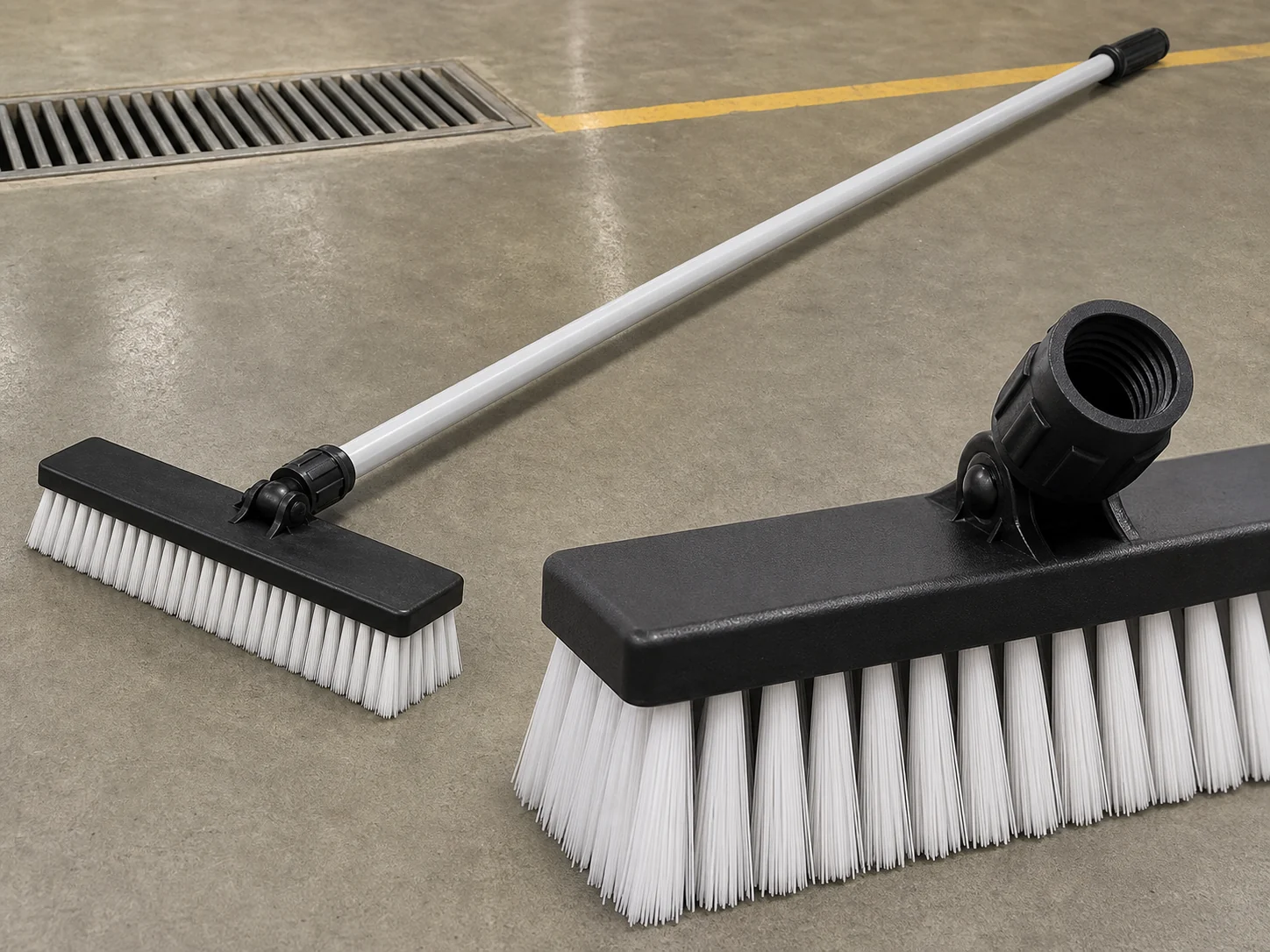
Small brush
500 pcs
Minimum order
Held in one hand: tube, bottle, detail and swab brushes — including long-handled ones with a small head.
Production lead time, once the specification is confirmed
- Up to 500 pcsWithin 7 days
- 501–50,000 pcsWithin 14 days
- Over 50,000 pcsWithin 21 days
Peak season can extend these times; the shipping date is confirmed in writing with your quotation. Sampling and shipping are quoted separately.
The PBT Deck Scrub Brush is a stiff, chemical-resistant scrubbing tool for breaking up embedded mud, sand, oil, tire marks, and surface coatings on concrete, tile, epoxy, asphalt, and textured commercial floors. Available as a brush block for machine mounting or with a matching handle, it uses durable PBT bristles to keep scrubbing force stable through wet and chemical cleaning cycles.
What can this brush do for you?
Stiff bristles that keep working when wet
PBT filaments absorb very little water, so the bristle tips stay upright and rigid even after the brush sits in a cleaning solution. On concrete, textured tile, or asphalt, this means consistent cutting action throughout the shift instead of a brush that softens and flattens as it gets wet.
Chemical-tolerant filament for degreasers and alkaline cleaners
PBT resists common deck cleaners, degreasers, and alkaline detergents better than many standard polypropylene bristles. You can pair the brush with the same chemical program you already use on truck decks, loading docks, and outdoor walkways without the filaments turning limp or breaking down.
Dense tufting reaches grout lines, joints, and non-slip texture
The staple-set PBT tufts can be arranged in straight rows or staggered patterns so the tips enter expansion joints, grout lines, curb edges, and the valleys of textured safety flooring. Embedded sand, mud, and tire deposits release from the low points instead of being skipped by a surface-only brush.
A block that accepts real downward force
The rigid base transfers hand or pole pressure directly to the bristle tips, which is what breaks up packed-in debris. With a threaded broom handle socket or molded grip, the operator can lean into the stroke without flexing the brush, so scrubbing force reaches the deck surface rather than bending the handle.
Long wear on abrasive concrete and aggregate
PBT monofilament has good abrasion resistance compared with soft PP or natural fiber, so the trim wears down slowly on rough surfaces such as exposed aggregate, broom-finished concrete, and asphalt. Fewer filament breaks mean fewer replacement heads and a more predictable consumable budget.
What is a PBT Deck Scrub Brush?
A PBT Deck Scrub Brush is a heavy-duty scrubbing brush built around PBT (polybutylene terephthalate) monofilament tufts set into a rigid block. The block can be used as a standalone hand brush, fitted with a molded grip, connected to a threaded broom handle, or bolted to a scrubbing machine or floor tool.
In use, the operator spreads a cleaning solution over the deck surface, applies moderate downward pressure, and works the brush in short back-and-forth strokes. The stiff PBT tips dislodge dried mud, oil residue, tire marks, and loose coatings; the solution encapsulates the loosened soil; and the brush then moves the slurry toward a drain or squeegee path. The action is mechanical, not merely wiping.
This is not a sweeping brush for loose dust or a soft finishing brush for polished surfaces. It is intended for aggressive scrubbing where surface texture and embedded soil need more force than a deck mop or soft-floor brush can provide.
Technical Specifications
| Parameter | Values / Options |
|---|---|
| Head width | 50–150 mm, selected for coverage and access to edges or joints |
| Head length | 100–300 mm, matched to scrubbing stroke and mounting footprint |
| Overall length (block or block + short handle) | 150–300 mm, configurable for hand scrub or threaded pole use |
| Trim length | 20–50 mm; longer for uneven/textured surface, shorter for high pressure on flat floors |
| Filament material | PBT (polybutylene terephthalate) extruded monofilament |
| Filament diameter | 0.30–0.80 mm; thicker for embedded debris, finer for lighter scrubbing |
| Tuft pattern | Straight rows, staggered, or perimeter/corner zones; density set by loading |
| Set method | Staple-set with stainless or galvanized wire staples; resin-set available for heavier washdown |
| Block / base material | PP, ABS, nylon, or chemical-resistant filled polymer; drainage holes optional |
| Handle / interface | No handle (machine mount), molded grip, threaded broom handle socket, or bolt pattern |
| Operating temperature | -10°C to 60°C continuous for block; PBT filament remains stiff beyond this range |
| Chemical exposure | Resists common deck cleaners, degreasers, alkaline detergents; confirm with full chemistry |
| Brush type | Custom Handheld Detail Brushes |
| How it is driven | Hand-guided |
| Cleaning target | concrete loading dock, tile and epoxy floor, and asphalt walkway cleaning |
| Surface or part | floors, concrete, tile, asphalt, epoxy, edges, joints, and recesses |
| Residue or debris | mud, tire marks, oil, sand, grease film, surface contamination, dried mud, and loose dust |
| Mounting / connection | No handle (machine mount), molded grip, threaded broom handle socket, or bolt pattern |
All dimensions and materials are project-set. Provide the surface type, cleaner chemistry, and expected contact pressure to lock the best configuration for your deck or floor program.
Where does this brush work best?
- Concrete loading docks, sidewalks, ramps, and dumpster pads where mud, sand, and compacted soil pack into surface pores.
- Tile and epoxy floors in commercial kitchens, maintenance bays, and food or beverage facilities where oil and grease films build up.
- Asphalt walkways, parking decks, and roadway edges with tire marks, gum residue, or dried spill lines.
- Stairs, curb edges, expansion joints, and threshold transitions where a narrow or angled head can track the recess.
- Textured safety flooring and anti-slip coatings where debris hides in the profile valleys.
- Pre-cleaning before pressure washing, repainting, or re-coating when loose coatings and surface contamination must be broken up first.
How do I choose the right one?
Start with surface hardness and finish
PBT filaments are firm, so they are the right choice for hard mineral surfaces such as concrete, quarry tile, porcelain, cured epoxy, and asphalt. On soft wood decks, painted surfaces with thin film, or glossy polished tile, PBT can leave fine scratches or dull the finish. For those cases, switch to a softer nylon, PP, or tampico filament.
Size the head to the area and the access points
Wide heads cover open floors faster; narrow heads get into stairs, curbs, and short edge runs. If the deck includes expansion joints, measure the joint width and choose a head and trim length that allow the bristle tips to enter the recess without bottoming the block against the surface.
Use trim length and filament diameter to set aggression
A shorter trim length (20–30 mm) creates a stiffer brush and more concentrated tip pressure for flat floors and heavy deposits. A longer trim length (35–50 mm) follows uneven surfaces and enters low spots more easily. For thin, flexible filaments, use for lighter soil; for thick monofilament (0.50 mm and up), use for embedded mud, dried coatings, and tire marks.
Choose the interface for how the brush will be driven
If the brush will be used by hand on hands-and-knees or close-up work, a molded grip or short handle is enough. For standing operation on large decks, select a threaded broom handle socket. If the head is mounted on a scrubbing machine or floor tool, specify the bolt pattern and head footprint. The interface determines operator fatigue and how much downward force the user can sustain.
Confirm the chemical and temperature environment
PBT filament handles many degreasers and alkaline solutions, but the block material and staple metal must also be compatible. For bleach or strong alkaline programs, use stainless staples and a chemical-resistant block. For acid-based cleaners, request a compatibility check; galvanized staples are not suitable for mineral acids. High-temperature washdown above 60°C requires a block material and set method rated for that condition.
When to pick a different brush
Use a softer filament brush for painted or coated surfaces where scratch marks are not acceptable. Use a wire brush or abrasive pad for hard scale, rust, or heavy coating removal that goes beyond deck scrubbing. Use a rotary floor machine brush disk for large open areas where machine speed replaces hand labor. The PBT deck scrub brush is the right tool when you need aggressive manual scrubbing with chemical compatibility and long filament life.
Can I customize this brush?
PBT deck scrub brushes are built around the specific deck surface, cleaning chemistry, and operator setup. To define the configuration, provide the surfaces to be scrubbed, the residue or coating to be removed, the cleaner composition, the width of any joints or recesses, and whether the head will be used by hand, on a broom handle, or mounted to a machine. A dimensioned drawing or sample photo speeds up the specification.
Typical customization variables include:
- Head geometry — rectangular, curved, narrow edge, multi-row, or custom-shaped block; width, length, and corner radius.
- PBT filament — diameter, cut length, trim profile (flat, wavy, perimeter longer), crimp level, color, and tuft density.
- Set method — staple-set with stainless or galvanized wire, resin-set for peel resistance, or a combination.
- Block material — PP, ABS, nylon, or filled polymer; drainage holes, reinforcement ribs, and anti-slip top texture.
- Handle / interface — no handle, molded grip, threaded broom socket, extension pole connector, or machine mounting bolt pattern.
- Marking and packaging — custom color, molded or pad-printed logo, batch coding, bulk packing, or individual retail wrap.
If the project requires material documentation, inspection reports, or third-party testing for your cleaning program, we can support those requirements as part of the custom specification.
Which filament survives the cleaning and still lasts on a PBT deck scrub brush?
Is PBT safe for sealed or painted deck surfaces?
PBT filaments are firm enough to leave fine scratch marks on soft paint or thin topcoats. On fully cured two-part epoxy or hard industrial coatings, spot-test on a low-visibility area before full use. For softer paint, acrylic sealers, or wood finishes, choose a softer nylon, PP, or tampico filament instead.
Can this brush be used with bleach or acid-based cleaning solutions?
PBT filament has good resistance to many chemicals, but the block material, staple metal, and set method must match the full cleaning chemistry. For bleach or strong alkaline solutions, specify stainless staples and a chemical-resistant block. For acid-based cleaners, request a material compatibility check; galvanized staples are not suitable for mineral acids.
How do I check whether the brush is wearing out?
Compare the current trim length with the original specification. If the bristles have shortened more than 25–30%, become ragged or flagged, or if tufts are starting to shed, scrubbing force drops below the target. Also check the block corners for cracks, the handle thread for wear, and the staple line for rust. Replace the head when it no longer produces a uniform scrub pattern.
Does this brush replace a pressure washer or floor scrubber?
No. The PBT deck scrub brush loosens and detaches embedded soil, oil film, and tire marks when combined with cleaning chemistry and agitation. A pressure washer provides water force on a different scale, and a floor scrubber provides machine speed. Many programs use the brush before pressure washing or machine scrubbing, but these are separate steps in the cleaning sequence.
What is the best way to store the brush between shifts?
Rinse the head with clean water, shake out loose debris, and store the brush bristle-side up or hanging by the handle. Do not leave it submerged in degreaser or solvent, and allow the block to dry to prevent bacteria buildup and filament set deformation. Consistent storage extends trim life and keeps the tuft pattern straight.
Can I use one brush for both concrete and tile without damaging the tile?
It depends on the tile glaze and grout. PBT is generally safe for porcelain and unglazed quarry tile, but glossy or polished tile may show micro-scratching. For mixed floors, specify a medium filament diameter (0.35–0.50 mm) and test on the most sensitive tile first, or keep a separate brush for the sensitive surface.
Guides that go deeper on this
Custom Manufacturing RFQ
Describe Your Application
An accurate custom quote starts with the dimensions, working surface, residue, material choice, connection, quantity, and reference files.
Drawing or photo optional — it speeds things up, it does not gate the enquiry.
Custom Brush RFQ
Send Your Brush Project
Upload a drawing, product photo, or sample photo and provide the core dimensions and cleaning conditions.
“We need a brush to remove wet residue from a stainless steel conveyor, about 800mm wide. The current brush wears quickly. We can send photos.”
“We sell drinkware and need a cleaning brush to include with the product. Quantity around 5,000 pieces.”