
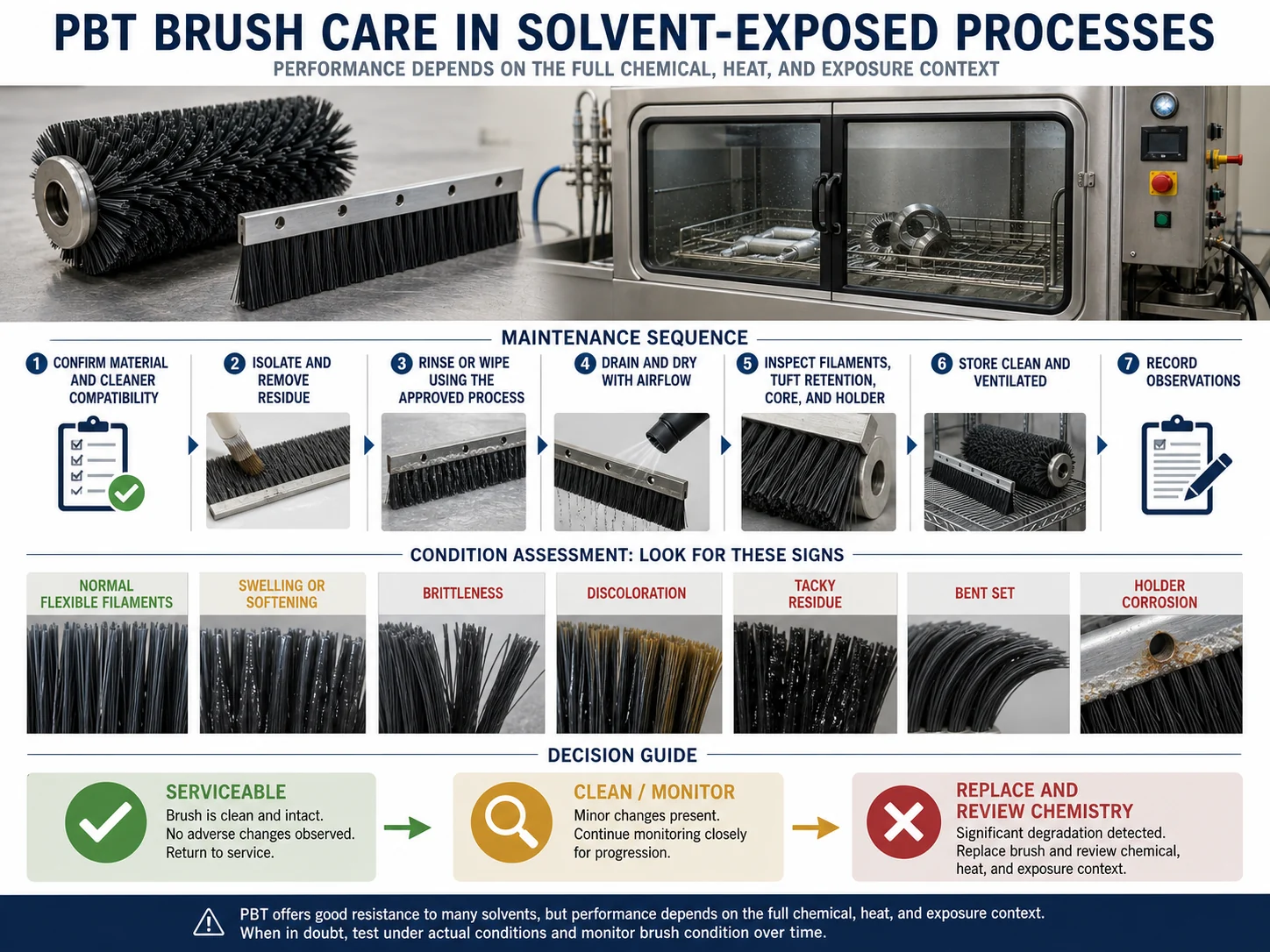
What Is a PBT Brush and Why Does Solvent Compatibility Matter?
A PBT brush uses bristles made from polybutylene terephthalate, a thermoplastic polyester known for its stiffness, abrasion resistance, and good chemical resistance. In solvent environments, the brush material can swell, soften, or degrade if exposed to incompatible chemicals. Understanding compatibility prevents mechanical failure and cross-contamination in sensitive processes.
Solvent Compatibility Chart for PBT Brushes
The table below provides general guidance on PBT resistance to common solvent families at room temperature. Actual performance depends on concentration, temperature, and exposure time. Always test under your specific operating conditions.
| Chemical Family | Compatibility Rating | Notes |
|---|---|---|
| Aliphatic Hydrocarbons (e.g., hexane, heptane) | Good | Minimal swelling; suitable for continuous exposure. |
| Aromatic Hydrocarbons (e.g., toluene, xylene) | Fair to Good | May cause slight swelling at elevated temperatures. |
| Alcohols (e.g., ethanol, isopropanol) | Good | Generally resistant up to 60°C. |
| Ketones (e.g., acetone, MEK) | Poor | Significant swelling and degradation; avoid prolonged contact. |
| Esters (e.g., ethyl acetate, butyl acetate) | Poor | Rapid attack and softening; not recommended. |
| Chlorinated Solvents (e.g., dichloromethane, trichloroethylene) | Poor | Severe swelling; often causes bristle breakage. |
| Glycols (e.g., ethylene glycol, propylene glycol) | Good | Resistant at typical process temperatures. |
| Dilute Acids (pH > 3) | Fair | Suitable for short-term contact; rinse thoroughly after use. |
| Dilute Alkalis (pH < 12) | Fair | Can cause stress cracking over time; monitor bristle condition. |
| Strong Acids and Bases | Poor | Rapid hydrolysis; do not use PBT brushes. |
How to Clean PBT Brushes After Solvent Exposure
Proper cleaning prevents chemical carryover and extends brush life. Follow these steps after each solvent contact cycle:
- Identify a compatible rinsing solvent. Use a solvent from the “Good” compatibility category in the chart above. Isopropanol or a mild hydrocarbon blend often works well.
- Rinse thoroughly. Submerge or flush the brush with the cleaning solvent to remove residual process chemicals. Agitate gently to dislodge contaminants trapped between bristles.
- Air dry completely. Place the brush in a well-ventilated area. Avoid heat guns or ovens unless the temperature is well below the softening point of PBT (approx. 200°C).
- Inspect before reuse. Check for bristle damage, softening, or discoloration. Do not return a suspect brush to service.
Inspection Procedures for PBT Brushes in Solvent Environments
Regular inspection catches early signs of chemical attack and prevents unexpected failures. Use this checklist at each maintenance interval:
- Visual check: Look for bent, broken, or missing bristles. Note any surface crazing or color changes.
- Tactile check: Run a gloved finger across the bristle tips. Softening, gumminess, or brittleness indicates chemical damage.
- Dimensional check: Compare brush block or holder dimensions to an unused reference. Swelling > 3% suggests excessive solvent absorption.
- Performance test: Apply the brush to a test surface under normal pressure. Inconsistent scrubbing or bristle shedding means the brush should be replaced.
Common Mistakes in PBT Brush Maintenance
- Using aggressive cleaning solvents. A quick wipe with acetone or MEK can destroy PBT bristles in minutes. Stick to compatible cleaners from the chart.
- Soaking brushes overnight. Even compatible solvents can cause swelling over extended periods. Rinse and dry brushes promptly after use.
- Ignoring temperature limits. PBT softens and loses chemical resistance at elevated temperatures. Never exceed 80°C in solvent service unless field testing confirms suitability.
- Skipping the rinse step. Residual process chemicals left on the brush can concentrate as the solvent evaporates, leading to localized attack.
- Mixing brush types. Store PBT brushes separately from nylon or polypropylene brushes to avoid accidental chemical incompatibility from cross-use.
When PBT Brushes Are Not Suitable for Solvent Exposure
PBT is not a universal chemical barrier. Choose an alternative brush material or engineered solution when:
- Continuous exposure to ketones, esters, or chlorinated solvents is required.
- The process involves strong acids or alkalis at any concentration.
- Operating temperatures exceed 80°C while in contact with fair-rated solvents.
- Brush stiffness must remain constant; even minor swelling from aromatic hydrocarbons can alter scrubbing performance.
In these cases, consider brushes with stainless steel, PTFE, or specialty elastomer bristles, and always consult material compatibility data sheets for your specific chemical mix.
Final Takeaway: Extending PBT Brush Life in Solvent Applications
Match the solvent to the material, clean brushes immediately after use with a compatible rinsing agent, and inspect regularly for early signs of damage. When in doubt, test a single brush under worst-case conditions before deploying a full batch. Small adjustments in maintenance routine often yield significant cost savings and process reliability.
Frequently Asked Questions
What solvents can damage PBT brushes?
Ketones like acetone, esters, and chlorinated solvents such as dichloromethane are most aggressive. Strong acids and bases also quickly degrade PBT. Refer to the compatibility chart above for a quick check.
How often should I inspect PBT brushes used with solvents?
Inspect after every production shift or at least daily for continuous processes. Increase frequency when using a solvent rated as “Fair” or when process temperatures fluctuate.
Can I soak PBT brushes in strong cleaning solvents?
No. Even solvents with a “Good” compatibility rating can cause swelling with prolonged immersion. Soaking should be limited to a few minutes, followed by thorough rinsing and drying.
Are all PBT brushes the same chemical resistance?
While the base resin is similar, fillers, plasticizers, and manufacturing processes can affect chemical resistance. Always use brushes from a consistent supplier and test a sample when changing chemicals.
What is the maximum temperature for PBT brush use with solvents?
PBT’s heat deflection temperature is around 200°C under no load, but in solvent service, stay below 80°C. Higher temperatures accelerate swelling and attack, especially with “Fair” rated chemicals.
What are signs that a PBT brush is degrading from solvent exposure?
Look for bristle softening, permanent bending, surface cracking, discoloration, or a gummy feel. Any change from the original stiffness means the brush should be taken out of service.
Can I repair a PBT brush that has swelled from solvent exposure?
Once the bristle structure has been compromised by solvent absorption and swelling, the damage is irreversible. Drying may restore some stiffness, but the brush will likely underperform and shed bristles. Replacement is recommended.
Is PBT better than nylon for solvent resistance?
PBT generally outperforms standard nylon in many hydrocarbon and alcohol environments, but nylon has better resistance to strong alkalis. The choice depends on the exact chemical exposure and temperature profile.
Technical References
- OSHA — Hazard Communication
- OSHA — Chemical Hazards and Toxic Substances
- British Plastics Federation — Thermoplastics
Which bristle material fits this job — PBT, Nylon PA or AISI 304 Stainless Steel Wire?
| Material | Continuous temperature (°C) | Peak temperature (°C) | Water absorption | Hardness |
|---|---|---|---|---|
| PBT | 120–140 | 160–180 | 0.05–0.20% | Shore D 80–90 |
| Nylon PA | 93 | 121 | 0.3–9% by PA grade and conditioning | Medium to firm; filament diameter and trim length control bending force. |
| AISI 304 Stainless Steel Wire | 400 | 500 | 0% | Rockwell B 70–95 depending on temper and cold work |
| Flagged Polyester Filament | 100 | 130 | 0.1–1.0% | Soft to medium; high tip density |
Figures as published by Perlon; Brushtec / DuPont; Alleima. Confirm the exact grade against the supplier datasheet before ordering.
When are Handheld Detail Brushes the wrong choice for pbt brush?
- Handheld Detail Brushes — Use a tube brush, powered brush, scraper, wipe, sponge, or vacuum when the target is internal, heavily bonded, or highly delicate.
- Tube & Pipe Bore Brushes — Use pigs, flushing, ultrasonic, chemical descaling, blasting, or a flexible cable system for long, sharply curved, or heavily scaled passages.
- PBT — Not for heavy rust removal or high-cutting deburring.
- Nylon PA — The nylon family spans several grades, so heat, moisture and chemical limits should follow the selected PA resin rather than a generic nylon value.
What should replace Handheld Detail Brushes for pbt brush?
- Handheld Detail Brushes — Handheld detail brushes cover general precision cleaning; auto-detailing brushes impose tighter controls for painted, polished, leather, display, and trim surfaces.
- Tube & Pipe Bore Brushes — Tube and bore brushes work by radial contact inside a confined diameter; wire wheels and cups work mainly on external edges, profiles, welds, and broad surfaces.
- PBT — Compare PBT with Nylon, PP, PET. Change material when wet stiffness, temperature, chemical resistance, conductivity, particle shedding, or surface marking becomes the limiting factor.
- Nylon PA — Compare Nylon PA with PP, PBT, PET. Change material when wet stiffness, temperature, chemical resistance, conductivity, particle shedding, or surface marking becomes the limiting factor.